
Quick Answer:
Yes, certified compostable bags can be composted—but only under the right conditions. “Compostable” means the bag is designed to break down into water, carbon dioxide, and biomass under specific composting conditions. Most certified bags require industrial composting (90–180 days at 55°C+), while some are also certified for home composting (6–12+ months in backyard systems). The key is matching the bag to the right disposal system—and that depends on your local infrastructure.
Key Takeaways:
- Industrial vs Home: Most compostable bags require industrial composting facilities; only those specifically certified as “home compostable” will break down in backyard systems
- Certification Matters: Look for ASTM D6400 (US) or EN 13432 (Europe) certification—these ensure the bag meets strict compostability standards
- Not Recyclable: Compostable bags cannot go in traditional recycling—they contaminate recycling streams
- Timeline: Industrial facilities: 3–6 months; Home composting: 6–12+ months
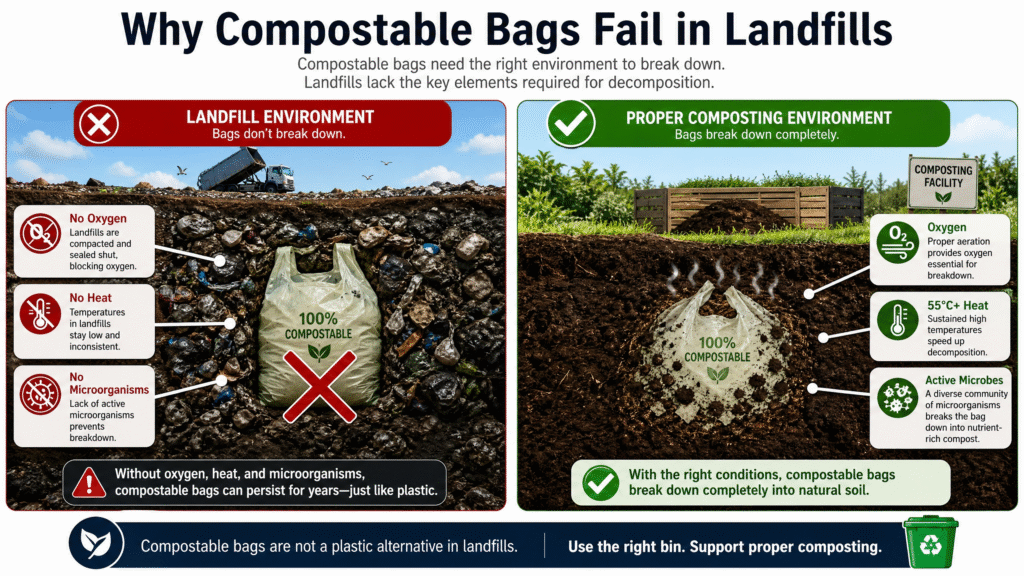
- Landfill = NO: Compostable bags do not break down in landfills—they require oxygen, heat, and moisture
Common Questions About Compostable Bags at a Glance
| Question | Answer |
|---|---|
| Can compostable bags go in recycling? | No—they contaminate recycling streams |
| Can compostable bags go in food waste bins? | Yes—if your local composter accepts them (check first) |
| Do compostable bags break down in landfills? | No—landfills lack oxygen and proper conditions |
| How long do compostable bags take to break down? | Industrial: 3–6 months; Home: 6–12+ months |
| Are compostable bags the same as biodegradable? | No—compostable requires specific conditions; biodegradable is vague and unregulated |
| Can I put compostable bags in my home compost? | Only if certified “home compostable”—most are industrial only |
What Does “Compostable” Actually Mean?
Understanding compostable meaning starts with one key distinction: compostable is not the same as biodegradable. While all compostable products are biodegradable, the reverse is not true. A product labeled “compostable” must meet strict certification standards—it must break down completely within a specific timeframe and leave no toxic residue.
A compostable bag is designed to break down into water, carbon dioxide, and organic matter under specific composting conditions. For a bag to be legally labeled compostable, it must meet recognized certification standards such as ASTM D6400 (United States) or EN 13432 (Europe). These standards define how fast and how completely the material must break down.
The key difference:
- Biodegradable: The product will degrade over time—but no conditions are specified. The term is effectively meaningless without context.
- Compostable: The product will biodegrade under controlled conditions (temperature, oxygen, moisture) within a specific timeframe.
As the Biodegradable Products Institute (BPI) explains, “While everything that is compostable is technically biodegradable, the reverse isn’t true. Products labeled ‘biodegradable’ are often lookalikes that contaminate compost systems because they aren’t designed for composting.” According to C-Label’s certification guidelines, “a biodegradable material decomposes under the influence of microorganisms, but can leave residue after a composting cycle and has no guarantee for toxic residues. Therefore, a biodegradable material cannot be considered compostable before its compostability has been proven according to standard EN 13432.”
Compostable Bag Materials Explained
Compostable bags are made from different plant-based polymers. Understanding the material helps explain why some break down faster than others.
| Material | Source | Key Properties | Decomposition Speed (Industrial) |
|---|---|---|---|
| PLA (Polylactic Acid) | Fermented corn starch or sugarcane | Rigid, brittle; often blended with PBAT for flexibility | Slower; may fail to reach 90% within 6 weeks |
| PBAT | Fossil-based but biodegradable | Flexible, strong; often blended with PLA or starch | Moderate |
| PBS (Polybutylene Succinate) | Bio-based or fossil-based | Flexible, heat-resistant | Moderate |
| PHA (Polyhydroxyalkanoate) | Bacterial fermentation of sugars | Naturally occurring; marine biodegradable | Fastest; but more expensive |
| TPS (Thermoplastic Starch) | Corn, potato, or other plant starches | Flexible, low cost | Fastest; >95% within 6 weeks in some conditions |
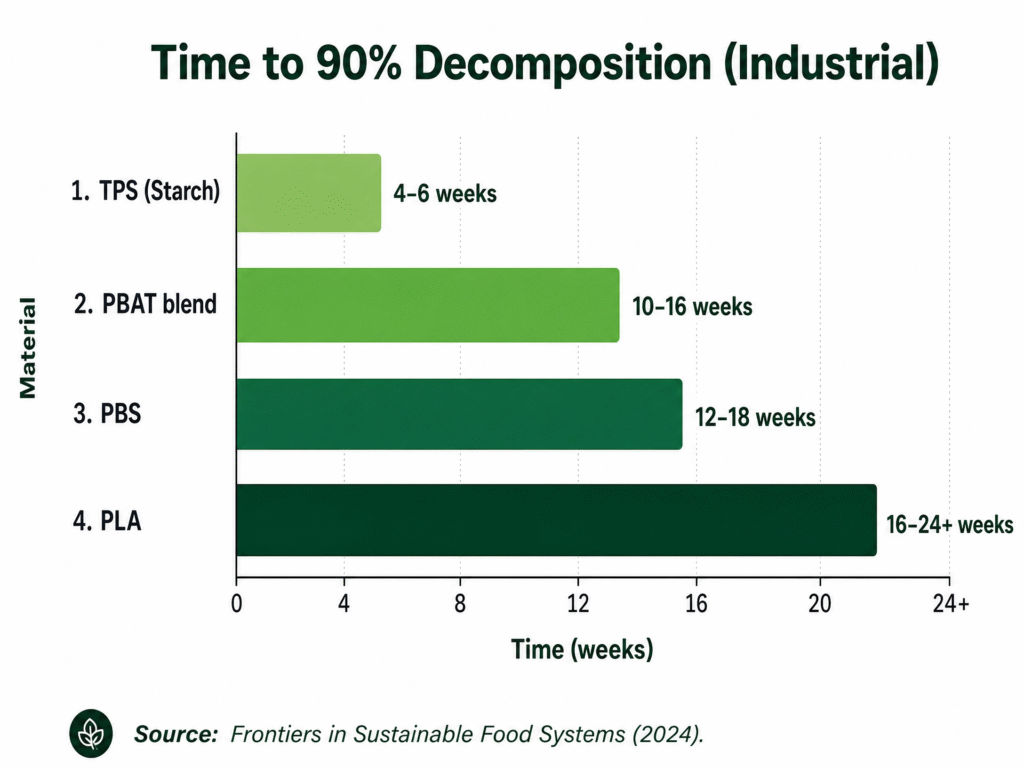
Key insight: According to peer-reviewed research from the Hamburg University of Technology, TPS blend bags achieved over 95% decomposition within six weeks in industrial composting conditions, while PLA blend bags failed to reach the 90% decomposition threshold in the same timeframe. This is why some bags break down faster than others—the material composition matters as much as the conditions.
Our recommendation: If you’re choosing between bags and decomposition speed is important, TPS-based or TPS-blend bags typically break down faster than PLA-dominated bags in real-world industrial composting conditions.
How Do Compostable Bags Actually Break Down?
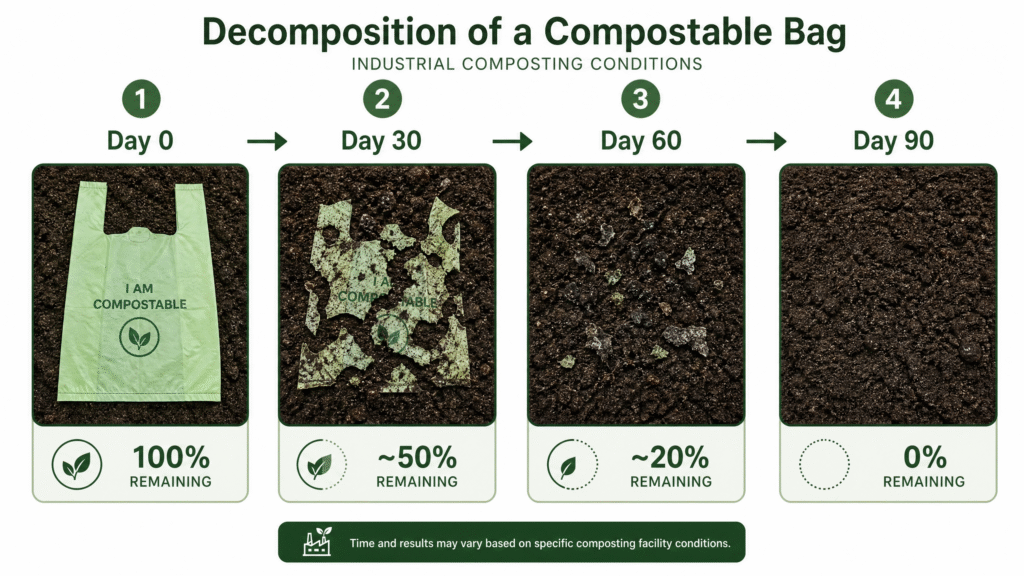
Visual Timeline: Compostable Bag Decomposition
Material Decomposition Speed Comparison
The Breakdown Mechanism
When exposed to the right conditions, microorganisms digest these materials. The EN 13432 standard requires that a packaging sample “biodegrades to generate at least 90% as much carbon dioxide as the control/reference material within a maximum of 6 months,” and must disintegrate such that “no more than 10% of material fragments are larger than 2mm after 12 weeks.”
According to BPI, certified compostable products are “rigorously tested to confirm complete disintegration within a specific timeframe, full biodegradation into CO₂, water, and biomass, and no toxic residues or persistent fragments in finished compost.”
The conditions required for proper breakdown are:
- Temperature: Industrial composting requires 55°C+; home systems are usually much cooler
- Oxygen: Aerobic conditions are essential—landfills don’t provide this
- Moisture: Proper moisture levels accelerate microbial activity
- Microorganisms: The right microbial community must be present
Which Composting Method Is Right for You?
Decision Flow
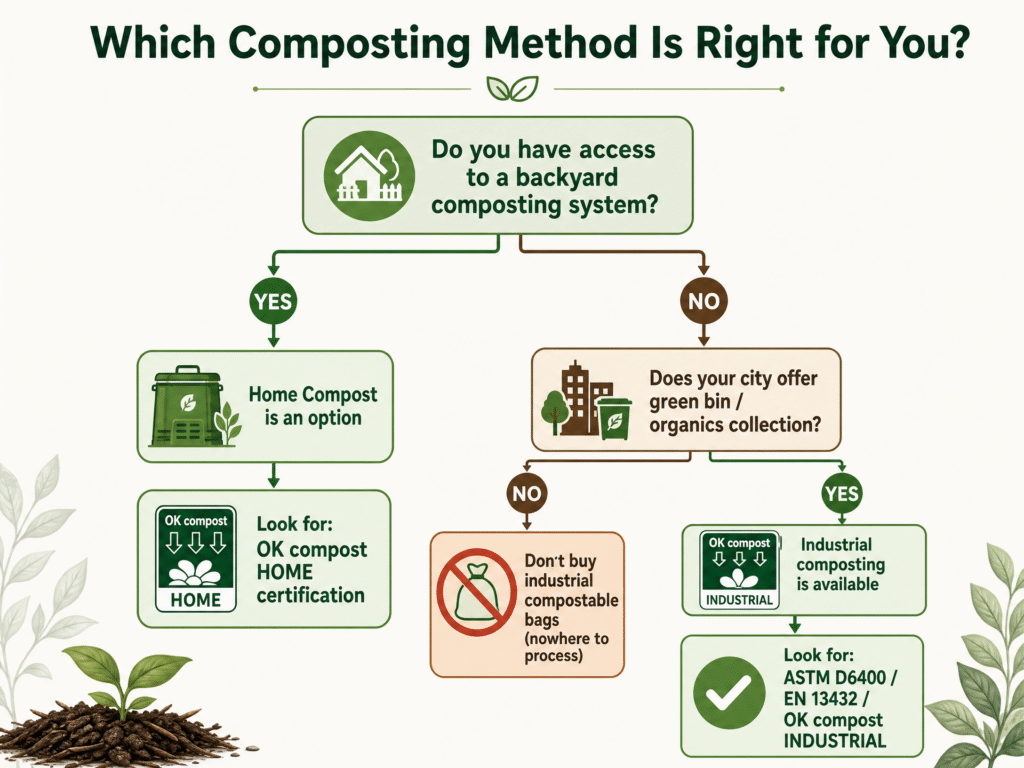
This flowchart helps you determine which type of compostable bag—if any—is appropriate for your situation. The right bag for you depends entirely on your local disposal infrastructure.
Industrial vs Home Composting
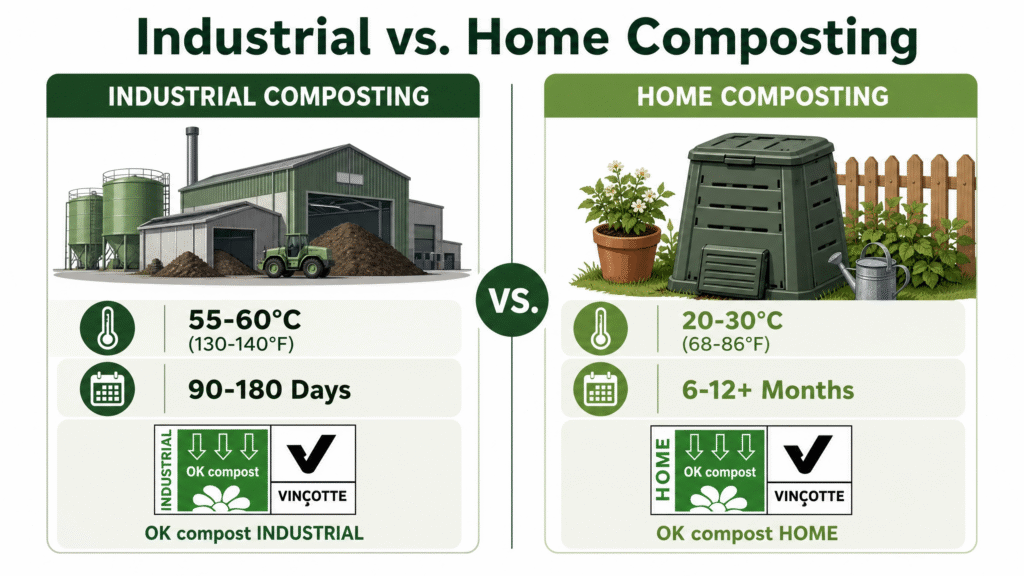
Detailed Comparison Table
| Requirement | Industrial (EN 13432) | Home (OK compost HOME) |
|---|---|---|
| Biodegradation temperature | 58°C ± 2°C | Ambient (20-30°C) |
| Biodegradation timeframe | 6 months (max) | 365 days (max) |
| Disintegration timeframe | 12 weeks (84 days) | 26 weeks (182 days) |
| Certification logos | OK compost INDUSTRIAL | OK compost HOME |
According to TÜV Austria’s OK compost certification, products that are solely OK compost INDUSTRIAL-certified “compost only in industrial composting facilities (at temperatures between 55 to 60°C), so products that are solely OK compost INDUSTRIAL-certified should not go into the garden compost.” Conversely, OK compost HOME “refers to products that also compost at lower temperatures, so they can go into the compost heap in your garden at home.”
Important research finding: A 2024 peer-reviewed study published in Frontiers in Sustainable Food Systems tested four bag types in a real industrial composting plant over six weeks. The study found that “after six weeks, the mass-based decomposition rate of TPS blend bags exceeded 95%. In contrast, PLA blend bags failed to reach a decomposition rate of 90%.”
Can Compostable Bags Go in Green Bins? (By Region)
| Country / State | Green Bin Acceptance | Notes |
|---|---|---|
| USA — California | ✅ Accepted | CalRecycle requires certified compostable bags; accepted in most municipal programs |
| USA — New York | ⚠️ Variable | NYC accepts BPI-certified bags; upstate varies by hauler |
| USA — Other states | ⚠️ Check local | Most states vary by city; check with your waste hauler |
| Canada | ✅ Generally accepted | Accepted in provinces with organics programs (BC, ON, QC, AB) |
| United Kingdom | ✅ Accepted | Widely accepted in food waste collections |
| Australia | ✅ Accepted (AS 4736 certified) | Requires AS 4736 (Australian standard) certification |
What to do: Always check with your local waste hauler first. The rules can change, and not every composter accepts compostable bags—some require loose food scraps only.
Can Compostable Bags Break Down in Ocean Water?
No—compostable bags are NOT designed to break down in ocean water.
This is one of the most common misconceptions. Here’s why:
Why home compost works:
- Active microbial community present in soil and compost
- Controlled oxygen and moisture
- Moderate temperatures (20-30°C)
- Home compostable products are tested in these conditions
Why ocean water doesn’t work:
- Low temperature (4-15°C)
- Low oxygen levels (hypoxic conditions)
- Different microbial community (marine vs terrestrial)
- Lack of physical breakdown (no turning/agitation)
- High salinity inhibits some microorganisms
What the research shows: A 2024 study found that PLA and PBAT did not degrade in marine water environments within 12 months. Only PHA (Polyhydroxyalkanoate) has demonstrated marine biodegradability—but PHA is rarely used in consumer bags due to cost and availability.
Bottom line: Compostable bags should never be disposed of in oceans or waterways. They do not break down in marine environments and can harm marine life. Proper composting systems are the only effective disposal method.
Certification Standards
To ensure a bag is genuinely compostable, look for these recognized certifications. According to the British Plastics Federation, “packaging products that conform to the ‘compostable’ criteria of the relevant standard are suitable for composting (the tests simulate industrial scale composting conditions).”

Recognized Certification Logos
| Logo | Certification | Region | Meaning |
|---|---|---|---|
| BPI | BPI Commercial | USA | Meets ASTM D6400 for industrial composting |
| Seedling | DIN Certco | Europe | EN 13432 compliance |
| OK compost INDUSTRIAL | TÜV Austria | International | EN 13432 compliance; industrial only |
| OK compost HOME | TÜV Austria | International | Certified for home composting |
Certification Standards Comparison
| Standard | Region | Application | Key Requirements |
|---|---|---|---|
| ASTM D6400 | United States | Industrial composting | Biodegradation ≥90% in 180 days |
| EN 13432 | Europe | Industrial composting | Biodegradation ≥90% in 6 months; disintegration ≤10% >2mm after 12 weeks |
| OK compost HOME | Europe | Home composting | Biodegradation at 20-30°C within 365 days |
According to EN 13432:2000, the standard specifies requirements and procedures to determine compostability by addressing four characteristics:
- Biodegradability — 90% CO₂ conversion compared to control within 6 months
- Disintegration — ≤10% of fragments >2mm after 12 weeks
- Effect on the composting process — no negative impact
- Effect on compost quality — compost must support plant growth; heavy metals must be below strict limits
Heavy metal limits under EN 13432 (mg/kg of dry sample): zinc 150, copper 50, nickel 25, cadmium 0.5, lead 50, mercury 0.5, chromium 50, molybdenum 1, selenium 0.75, arsenic 5, fluoride 100.
BPI’s new Home Compostability Certification: In December 2025, BPI launched a combined Commercial & Home Compostable Certification program. To earn the new certification, “products must break down completely in the lower temperatures of backyard composting environments in addition to meeting existing certification criteria,” with home composting thresholds “validated through extensive field testing across North American climates and composting practices.”
How Long Do Compostable Bags Take to Break Down?
| Environment | Time | Conditions Required |
|---|---|---|
| Industrial composting | 3–6 months | 55°C+ temperature, oxygen, moisture |
| Home composting | 6–12+ months | Variable temperature, proper moisture, aeration |
| Landfill | Years / Never | Insufficient oxygen and moisture |
| Open environment | Unknown | Not designed for this; may persist |
| Ocean water | Years / Never | Low temperature, low oxygen, different microbes |
Why Certification Matters
Certification is what separates genuine compostable products from greenwashing. According to BPI, “certification ensures that compostable products actually perform as promised” and “prevents contamination in compost streams, builds trust among composters, brands, and consumers, and supports policy alignment with state and local laws.”
Key certifications to look for:
| Certification | Region | What It Means |
|---|---|---|
| BPI | United States | Meets ASTM D6400 |
| OK compost INDUSTRIAL | Europe | EN 13432 compliance |
| OK compost HOME | Europe | Certified for home composting |
| Seedling logo (DIN Certco) | Europe | EN 13432 compliance |
According to the British Plastics Federation, “a product certificate is only valid for three years after which it must be renewed. In addition, at frequent intervals throughout the three year period, the certification body will seek samples from the market which will then be sent for further testing.” This ensures ongoing compliance.
Common Mistakes When Using Compostable Bags
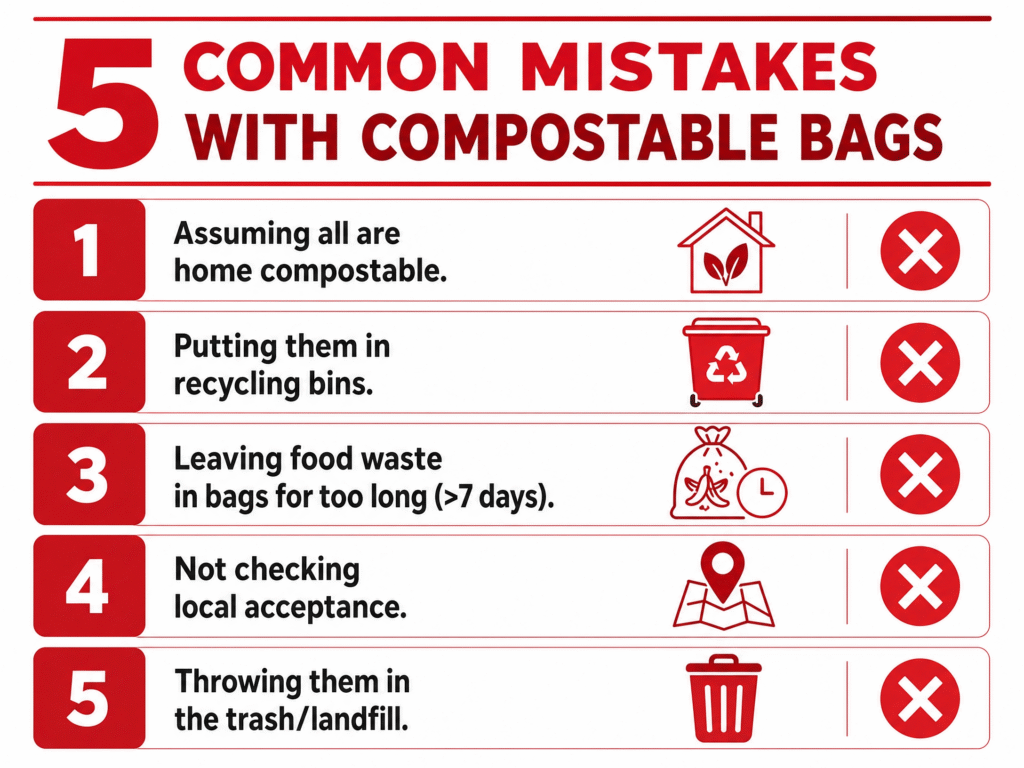
Mistake 1: Assuming all compostable bags are home compostable
Most certified bags are designed for industrial composting only. Look for “home compostable” certification before adding to backyard piles.
Mistake 2: Putting compostable bags in recycling bins
This contaminates recycling streams and can cause entire batches to be rejected.
Mistake 3: Leaving food waste in bags for too long
Extended storage (5–7+ days) can cause premature liner degradation, especially with wet waste.
Mistake 4: Composting bags without checking local acceptance
Not all composting facilities accept compostable bags—check with your local hauler.
Mistake 5: Throwing them in the trash
In landfills, they won’t break down properly—defeating the purpose.
Expert Tips for Using Compostable Bags
Tip #1: Check local acceptance first
To learn what your hauler is willing to take, check with them specifically and often. The rules can change.
Tip #2: Match bag type to your disposal method
- Industrial composting → Look for ASTM D6400 or EN 13432
- Home composting → Look for “home compostable” certification (OK compost HOME)
- Food waste collection → Use 40-60 GSM liners for optimal performance
Tip #3: Look beyond the word “compostable”
The term “compostable” alone doesn’t have a legal definition—only certified products have been validated. Always look for certification labels.
Tip #4: Store bags properly
Store compostable bags away from light, heat, and moisture, as these can trigger premature degradation.
Tip #5: Understand material differences
If you’re concerned about speed of decomposition, TPS (starch-based) bags decompose faster than PLA in industrial conditions.
FAQs
Can compostable bags go in recycling?
No. Compostable plastics contaminate PET recycling streams because they melt differently from traditional plastics. They can ruin entire batches of recycled material.
Can compostable bags go in food waste bins?
Yes—if your local composter accepts them. Check with your hauler first. Not every composting facility accepts compostable bags; some require loose food scraps only.
Do compostable bags break down in landfills?
No. Landfills are compacted and sealed to reduce oxygen and moisture—the exact opposite of what compostable materials need. They will not break down in landfill conditions.
How long does it take for a compostable bag to decompose in industrial compost?
3–6 months (90–180 days). Research shows TPS bags can exceed 95% decomposition within six weeks, while PLA bags may not reach the 90% threshold in that timeframe.
How long does it take for a compostable bag to decompose in home compost?
6–12+ months, depending on conditions. Not all bags are certified for home composting.
Are compostable bags better than biodegradable bags?
Yes—when properly disposed.
“Compostable” has a specific legal meaning with certification standards. “Biodegradable” doesn’t define how or where breakdown happens—or how long it takes.
What’s the difference between industrial and home compostable?
Temperature and timeframe.
Industrial compostable requires high temperatures (55–60°C) found in commercial facilities; home compostable breaks down in backyard conditions at lower temperatures (20–30°C).
What certifications should I look for?
ASTM D6400 (US) or EN 13432 (Europe), plus recognizable logos like BPI, Seedling, OK compost INDUSTRIAL, or OK compost HOME.
Can I put compostable bags in my food waste bin?
Yes—if your local composting facility accepts them. Check with your hauler before using.
Are compostable bags safe for the environment?
Yes—when properly composted. They break down into water, CO₂, and biomass without toxic residue. However, proper disposal is essential—if they end up in landfills, they won’t provide environmental benefit.
Continue Learning About Composting
Getting Started
Composting Standards
- Home Compost Certification: What You Need to Know
- Industrial vs Home Compostable Bags: What’s the Difference?
Compostable Bags
- Compostable Bags vs Biodegradable Bags
- Compostable Bags FAQ
- Shelf Life of Compostable Bags: How Long Do They Last?
Buying Guides
About the Author / Technical Review
Reviewed by:
Chris Xiang
Founder
HEMCBags
10+ years in compostable packaging manufacturing
ASTM D6400 / EN 13432 certified product lines
Supplying compostable liners to commercial and household customers
This guide was developed based on:
- ASTM D6400 and EN 13432 certification standards
- TÜV Austria OK compost certification guidelines
- BPI (Biodegradable Products Institute) consumer guidance
- Peer-reviewed research from Frontiers in Sustainable Food Systems
- British Plastics Federation industry standards
Final Thoughts
Before throwing away a compostable bag, ask yourself three questions:
- Is it certified? Look for ASTM D6400, EN 13432, or a certification logo.
- Is my local facility willing to accept it? Check with your hauler before using.
- Am I using the right composting system? Industrial vs home—match the bag to the system.
Compostable bags are a powerful tool for reducing plastic waste—but only when used correctly. The key is understanding the difference between industrial and home composting, looking for proper certification, and knowing your local disposal options.
As BPI notes, “certified compostables are tools for circularity—helping consumers and composters divert food waste from landfills, reduce methane emissions, and return valuable nutrients to the soil.”