
Author: HEMCbags Technical Team | BPI and OK Compost Certified Manufacturer | 10+ Years Experience | 50+ Million Bags Supplied
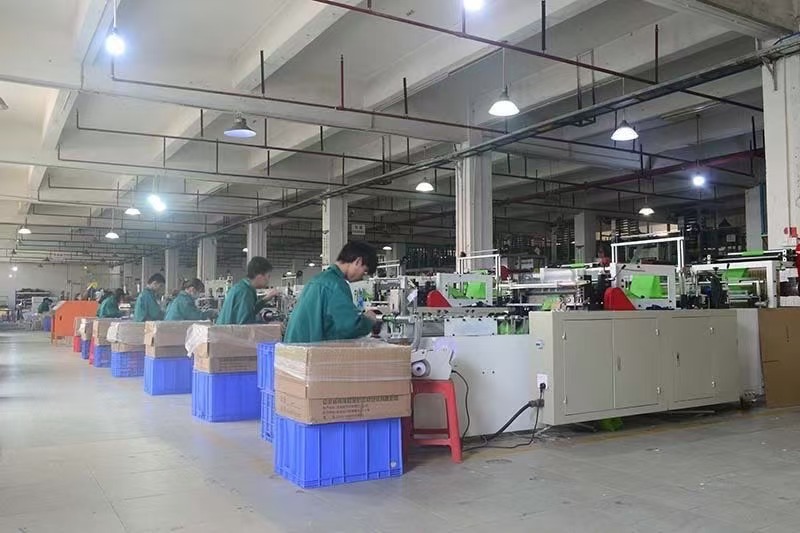
As a BPI and OK Compost certified compost bags manufacturer that has supplied more than 50 million compostable bags to distributors, municipalities, and waste management companies across North America and Europe, we hear the same questions again and again.
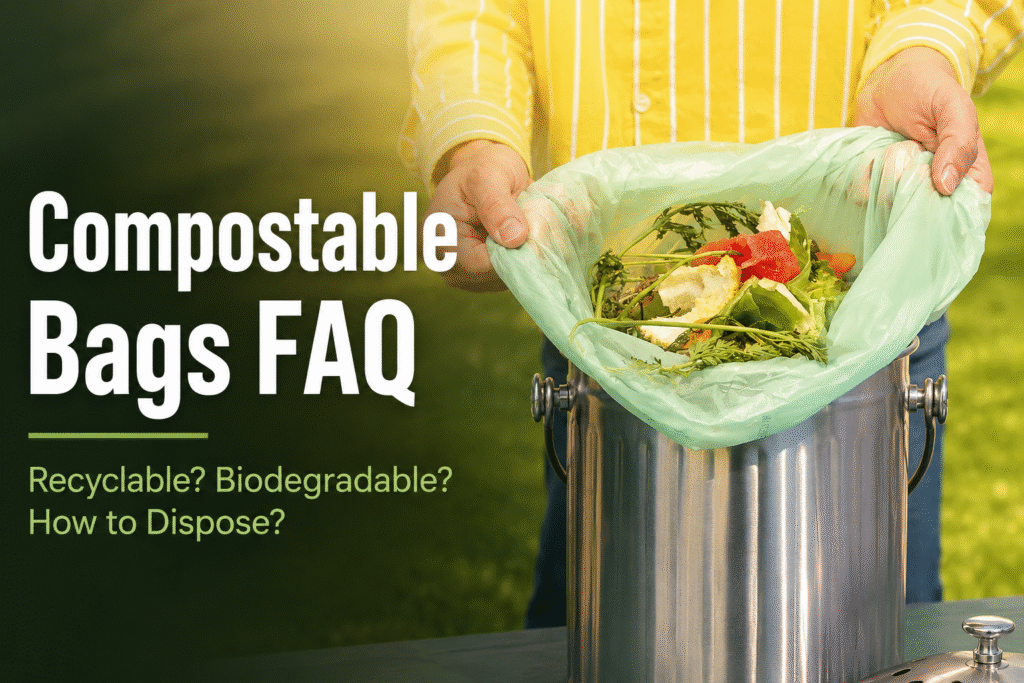
This compostable bags FAQ guide answers the most common questions about compostable bags — including whether they are recyclable, how they differ from biodegradable bags, and how to dispose of them correctly.
➡️ Looking for product recommendations? See our top-rated compostable trash bags.
Are Compostable Bags Recyclable?
No. Compostable bags are not recyclable. They belong in the compost bin, not the recycling bin.
Compostable bags contaminate the recycling stream. According to recycling guidelines from multiple US states, compostable plastics look similar to conventional plastics but cannot be processed together. If a compostable bag enters a recycling facility, it can jam equipment and ruin otherwise recyclable materials.
The rule is simple:
- Compostable bag → compost bin
- Regular plastic bag → recycling bin (if clean and dry)
- Do not mix them
Not sure what size bag you need? Check our trash bag size guide before ordering.
Are Compostable Bags Biodegradable?
Yes, but with an important distinction. All compostable bags are biodegradable, but very few biodegradable bags are compostable.
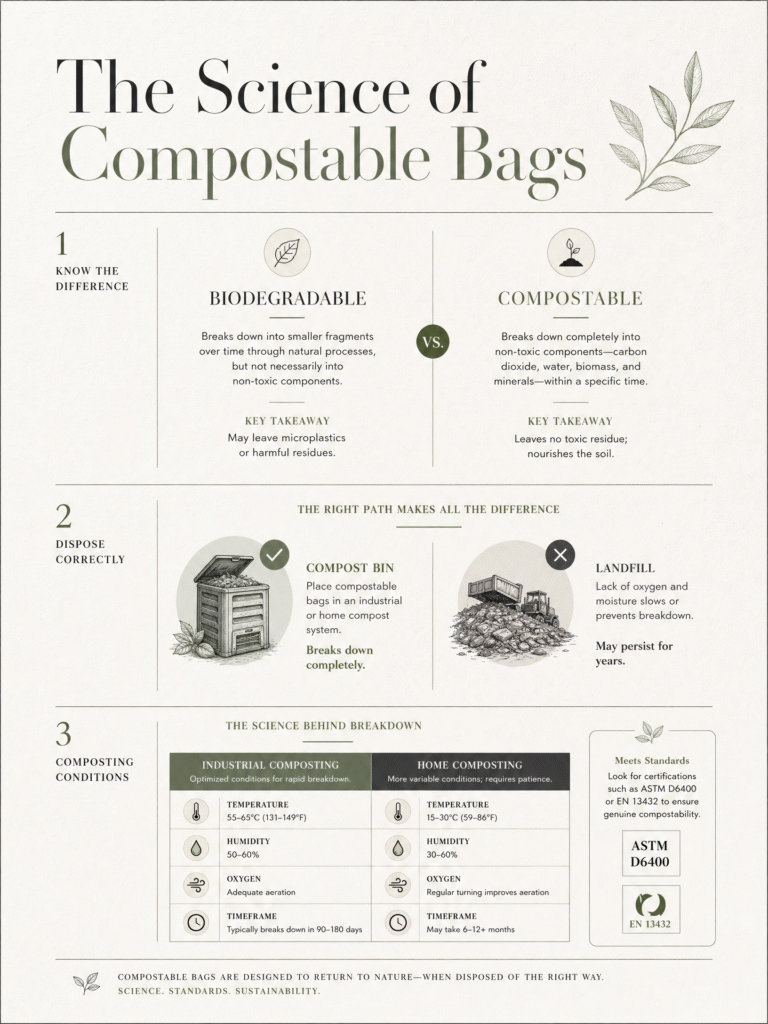
According to the Biodegradable Products Institute (BPI), “compostable” is a stricter standard. Compostable bags must meet ASTM D6400 or EN 13432 standards, breaking down within 90-180 days into CO₂, water, and biomass without toxic residue.
“Biodegradable” has no legal standard, no required timeframe, and no third-party verification. A product can be called biodegradable whether it breaks down in 6 months or 600 years.
| Feature | Biodegradable | Compostable |
|---|---|---|
| Legal standard | None | ASTM D6400 / EN 13432 |
| Timeframe | Unspecified | 90-180 days |
| Certification | Not required | Required (BPI, OK Compost) |
| End result | May fragment into microplastics | CO₂, water, biomass |
A real-world example: One of our distributor partners in Texas purchased 50,000 “biodegradable” bags thinking they could sell them to municipal compost programs. The bags were rejected because they lacked BPI certification. The distributor lost the customer and had to recall the entire shipment.
Want to understand the difference in more detail? Read our biodegradable vs compostable bags guide.
How to Dispose of Compostable Bags?
Compostable bags should go to composting facilities — not landfills. Industrial compostable bags go to municipal facilities. Home compostable bags go in backyard piles.
According to the U.S. Environmental Protection Agency (EPA), landfills are designed as “dry tombs” — compacted, sealed, and lacking the oxygen, heat, and moisture required for composting.
| Bag Type | Correct Disposal | Notes |
|---|---|---|
| Industrial compostable (BPI, ASTM D6400) | Municipal composting facility | Requires high heat (50-60°C) |
| Home compostable (OK Compost HOME) | Backyard compost pile | Breaks down at ambient temperature |
| Uncertified “compostable” | Trash | May not break down even in facilities |
Important: Do not put compostable bags in your recycling bin. Do not litter them. Do not flush them.
What Are Compostable Bags Made Of?
Compostable bags are made from plant-based polymers, not fossil fuels. The three most common materials are PLA, PBAT, and cornstarch blends.
- PLA (Polylactic Acid): Derived from fermented plant starch — usually corn, sugarcane, or cassava.
- PBAT (Polybutylene Adipate Terephthalate): A biodegradable polymer that adds flexibility and tear resistance.
- Cornstarch blends: Cost-effective combinations of cornstarch with PLA or PBAT.
According to the Biodegradable Products Institute (BPI), the material alone does not guarantee compostability — certification matters more than composition.
Why this matters for your business: A bag made from PLA is not automatically compostable. It must also meet ASTM D6400 or EN 13432 standards.
Want to dive deeper into the materials? Read our detailed comparison of PLA vs PBAT vs Cornstarch to understand how each material performs.
How Long Do Compostable Bags Take to Decompose?
In industrial composting facilities: 10-45 days. In home composting: 90-180 days. In landfills: unknown — many never fully decompose.
According to the U.S. Composting Council, commercial facilities maintain optimal conditions (temperature, moisture, aeration) that speed up decomposition.
| Environment | Temperature | Timeframe |
|---|---|---|
| Industrial composting | 50-60°C (122-140°F) | 10-45 days |
| Home composting | Ambient (~25°C / 77°F) | 90-180 days |
| Landfill | Variable (cool) | Unknown |
Our test results: In a USCC-certified industrial facility, our 0.85 mil bags fully decomposed in an average of 47 days. In a backyard pile, shredded bags took 4-5 months.
Are Compostable Bags Food Safe?
Yes, certified compostable bags made from PLA and cornstarch are food safe. The FDA has approved PLA for food contact applications.
PLA is derived from plants, and lactic acid is a monomer naturally present in the human body. The FDA has approved PLA for use in medical surgical sutures, injection capsules, and implants.
Important notes for food storage:
- Avoid high temperatures (may accelerate degradation)
- Keep away from moisture (ensure proper sealing)
- Avoid direct contact with oils (may speed up breakdown)
What Is the Shelf Life of Compostable Bags?
Compostable bags typically have a shelf life of 6-12 months when stored properly.
According to a U.S. Army Corps of Engineers report, biodegradable and compostable plastics begin to degrade once exposed to moisture and heat.
Storage guidelines:
- Store in a cool, dry place (below 30°C / 86°F)
- Keep away from humidity and direct sunlight
- Use within 6 months for best performance
- Do not store in hot garages or cars
Our experience: A restaurant chain stored our bags in their outdoor storage shed during summer. The bags began breaking down on the shelf. Now we always advise customers to store their compostable bags in a climate-controlled environment.
How to Tell If a Bag Is Genuinely Compostable?
Look for certification logos — not the word “compostable” alone. BPI, OK Compost, ASTM D6400, or EN 13432 logos indicate third-party verification.
Many products that say “compostable” on the box do not actually meet certification standards. Unverified “compostable” claims are common.
How to verify:
- Look for the BPI logo (North America)
- Look for the OK Compost logo (Europe and global)
- Check the ASTM D6400 or EN 13432 designation
- Visit the BPI website to search for certified products
Red flags to avoid:
- No certification logo anywhere on the packaging
- Vague terms like “eco-friendly” or “green”
- “Biodegradable” without a timeframe or standard
Learn more about what BPI certification means from our detailed guide.
Home Compostable vs Industrially Compostable: What’s the Difference?
Home compostable bags are designed to break down in backyard compost piles at ambient temperatures. Industrially compostable bags require high heat (50-60°C) from municipal composting facilities.
| Type | Temperature | Timeframe | Certification |
|---|---|---|---|
| Industrial compostable | 50-60°C | 90-180 days | BPI, OK Compost INDUSTRIAL |
| Home compostable | Ambient (~25°C) | 6-12 months | OK Compost HOME, TÜV HOME |
Most certified compostable bags are industrial compostable only. If you compost at home, look specifically for OK Compost HOME certification.
Why Do Some Cities Ban Compostable Bags?
Some cities ban compostable bags because residents put non-compostable lookalikes in their bins, causing contamination.
Several cities have strict guidelines about which bags they accept. Only certified compostable bags (BPI, OK Compost) are accepted. Bags labeled “biodegradable” or “oxo-degradable” are not accepted.
What you should do: Check your local waste authority’s website before buying compostable bags. Some accept them, some do not.
Do Compostable Bags Break Down in the Ocean or Soil?
No. Compostable certifications apply only to controlled composting environments. In the ocean or soil, they behave like persistent waste.
According to the University of Plymouth study, even certified compostable bags showed minimal breakdown after three years in marine environments. They are not designed to be littered.
How to Choose Certified Compostable Bags: A Buyer’s Checklist
When purchasing compostable bags, use this checklist:
1. Check for certification logos. BPI, OK Compost, ASTM D6400, or EN 13432.
2. Verify the material. PLA, PBAT, or cornstarch blends.
3. Know your disposal method. Industrial or home composting?
4. Check thickness (mil). 0.65-0.75 for light waste, 0.80-0.90 for general use, 1.00+ for heavy loads.
5. For commercial buyers: Request current BPI or TÜV certificates before ordering.
For Business Buyers: Sourcing Compostable Bags Wholesale
If you are a business looking to source compostable bags, here is what you need to know.
What is the MOQ for custom compostable bags?
Typical MOQ is 10,000 pieces per size. Custom printing, private label packaging, and custom sizes are available.
| Order Type | Typical MOQ | Lead Time |
|---|---|---|
| Standard retail sizes | 10,000 pieces | 15-20 days |
| Custom sizes | 10,000 pieces | 15-20 days |
| Custom printing | 10,000 pieces | 15-20 days |
| Private label packaging | 10,000 pieces | 15-20 days |
Do you provide samples for testing?
Yes. We provide sample rolls at no cost for qualified commercial buyers. You pay only for shipping.
How to verify a supplier’s certification?
Ask for current BPI or TÜV certificates for the finished product. Do not accept “our materials are certified” — the finished product must be certified.
Looking for a trusted supplier? See our list of the top 10 compostable bags manufacturers and suppliers worldwide for vetted, certified options.
Conclusion
This Compostable Bags FAQ has covered recycling, biodegradability, proper disposal, shelf life, and certifications.
Key takeaways:
- Compostable bags are not recyclable — put them in the compost bin
- All compostable bags are biodegradable, but not all biodegradable bags are compostable
- Look for certification logos (BPI, OK Compost, ASTM D6400)
- Industrial compostable bags go to municipal facilities
- Home compostable bags (OK Compost HOME) go in backyard piles
- Store bags in a cool, dry place and use within 6-12 months
Still have questions about compostable bags? Our team of BPI certified experts is here to help.
➡️ Contact us for a free consultation, samples, or wholesale pricing