
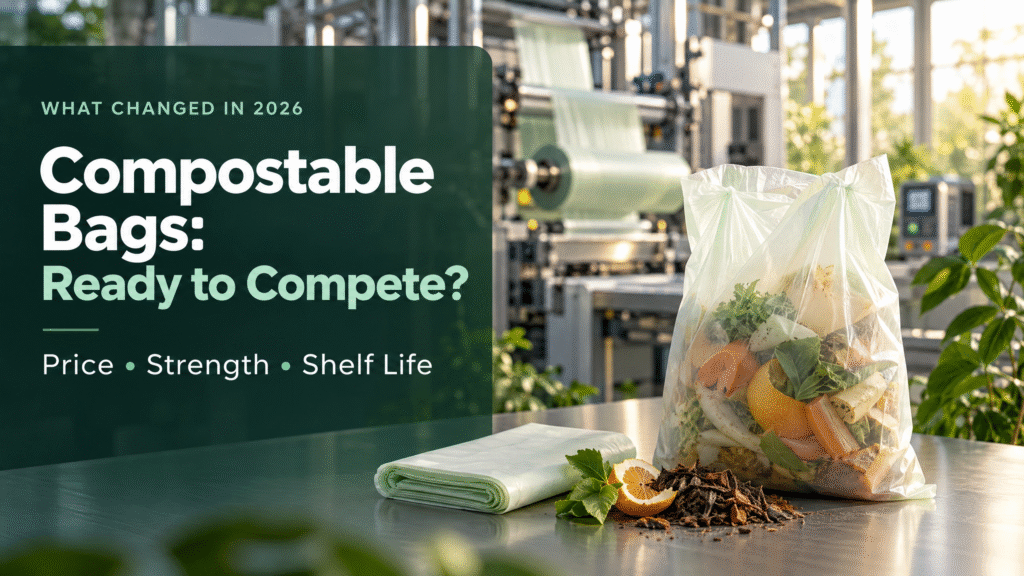
What 20 years of experience in bag materials, manufacturing, and product development taught us about price, strength, and shelf life.
Quick Answer
The three most common reasons buyers avoided compostable bags were price, strength, and shelf life. Those concerns were real. For many products on the market today, they are no longer accurate.
Material formulations, film manufacturing, bag design, and supply chains have changed. For some specifications and applications, compostable bags now come close to traditional plastic bags in cost, mechanical performance, and storage life.
The three reasons that once made buyers hesitate are no longer universal. For many specifications and applications, they are no longer barriers at all.
This does not mean every compostable bag equals every plastic bag. Real-world performance still depends on formulation, thickness, bag structure, certification, storage conditions, and the application itself.
What follows is what changed — and what still hasn’t.
The Three Reasons Buyers Used to Avoid Compostable Bags
We know why you stopped. Let’s name them clearly.
They Were Too Expensive
Compostable bags used to cost significantly more than plastic. That wasn’t arbitrary. It came from real cost drivers:
- Raw materials. PLA, PBAT, and starch-based resins cost more than PE.
- Production scale. Volumes were small, so unit costs stayed high.
- Formulation. Early blends were difficult to process, which increased waste.
- Bag thickness. To compensate for weaker film, manufacturers used more material.
- Certification and testing. BPI, OK compost, EN 13432-related testing, and other certification requirements can add cost.
- Production efficiency. Compostable films are sensitive to temperature and humidity, which lowers yield rates.
The result: a bag that worked, but at a price most buyers couldn’t justify at scale.
But is the price gap still as large as it used to be?
They Were Not Strong Enough
Many early compostable bags earned this reputation for a reason. Some tore easily, punctured under load, or failed at the seams. They couldn’t hold wet food waste without leaking.
The problems were specific:
- Low tear resistance in thin films
- Poor puncture resistance against bones, stems, and packaging edges
- Weak tensile strength under load
- Seam failure when the bag was full and heavy
- Moisture sensitivity that caused the film to soften or break down prematurely
For kitchen waste, trash bags, and shopping bags, these were real failures in real use.
Modern compostable films can be engineered very differently from early-generation products. But that depends on who is making them and how.
They Did Not Last Long Enough
This was the reason many buyers gave up entirely. They bought a box, stored it, and came back months later to find the bags brittle, weak, or already degrading.
The causes were predictable:
- Hydrolysis — moisture can contribute to polymer degradation in some compostable formulations, particularly under unfavorable storage conditions
- Heat exposure during warehouse storage
- Humidity above recommended levels
- Sunlight accelerating degradation
- Poor packaging that didn’t protect the product
Buyers learned to treat compostable bags as something to use immediately, not stock. That made them impractical for businesses that order in bulk.
How long can today’s compostable bags actually be stored?
What Changed in Compostable Bag Manufacturing
Three things changed. All three matter.
Better Material Formulations
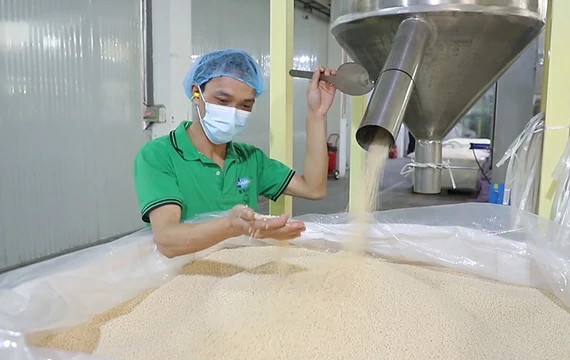
The first generation of compostable bags was made from whatever worked. The current generation is made from formulations designed for specific performance targets.
PLA can contribute rigidity and clarity, while PBAT is commonly used to improve flexibility and toughness. Starch-based components can also be used to modify cost, flexibility, and compostability characteristics. The blend ratio determines how the final film behaves.
What matters is not which materials are used, but how they are balanced. Formulation optimization is where strength, flexibility, processability, and cost meet. Getting that balance right is not something you can copy from a data sheet. It comes from years of trial, testing, and production experience.
We don’t publish our formulation ratios. That’s the work.
Better Film and Bag Manufacturing
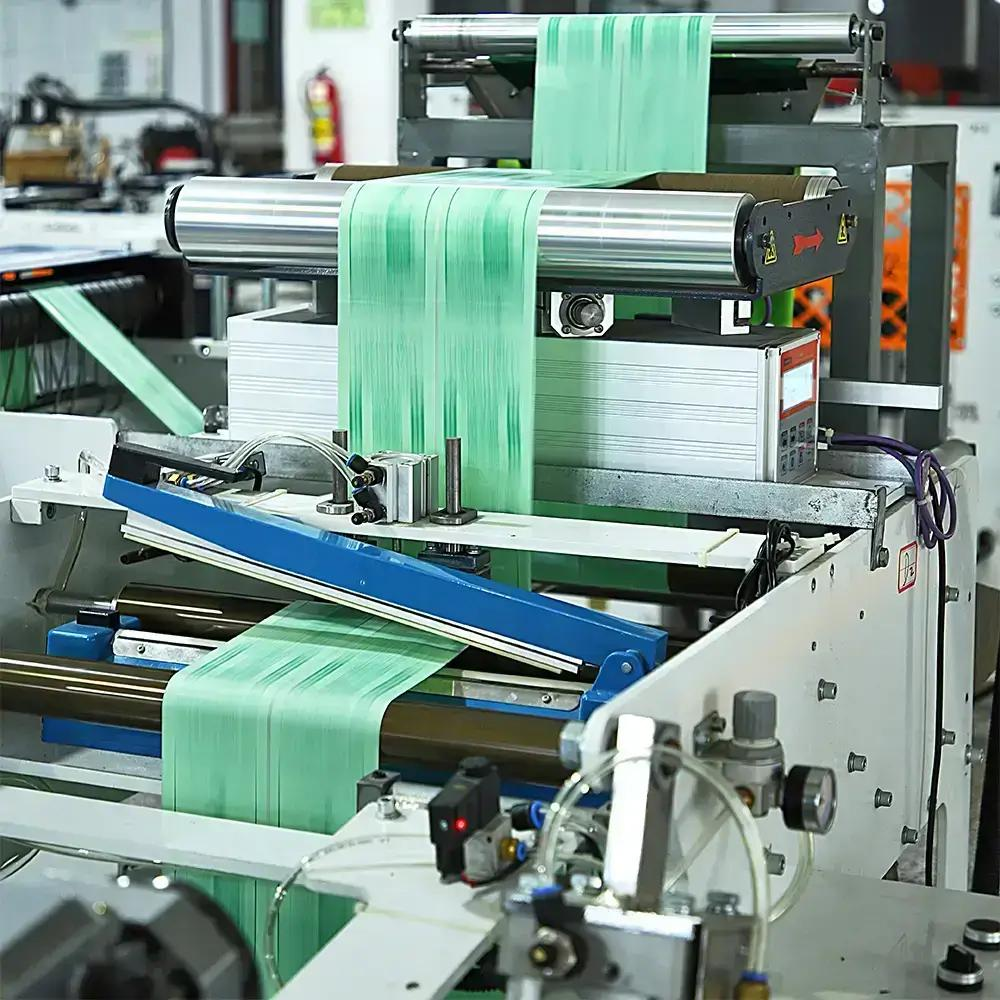
Material alone doesn’t determine performance. How the film is made and how the bag is built matter just as much.
Key variables:
- Extrusion control — temperature, speed, and cooling affect film consistency
- Film thickness — measured in microns, and it has to be uniform across the roll
- Sealing — a weak seal fails before the film does
- Gusset design — determines how the bag opens, stands, and carries load
- Bag structure — bottom, side, and handle construction all affect strength
- Printing and processing — heat and tension during printing can weaken the film
- Quality control — batch-to-batch consistency is a manufacturing discipline, not a promise
Sourcing a compostable bag and engineering a compostable bag are two different things. The difference becomes important when buyers need consistent strength, thickness, sealing, and batch-to-batch performance.
Larger and More Predictable Supply Chains
Compostable bags used to be a niche product made at small scale. That is no longer true.
What changed:
- Raw material availability — more resin suppliers, more consistent quality
- Multiple sourcing options — reduced dependence on a single supplier
- Manufacturing capacity — larger production lines, higher output
- Production planning — better forecasting, shorter disruptions
- Standardized production — specs that hold across batches
- Lead times — more predictable, easier to plan around
Compostable bags are no longer a specialty item. They are a manufactured product with a real supply chain behind them.
So, Where Do the Three Reasons Stand Today?
This is the section that gets the most attention. It deserves a direct answer — with data, not slogans.
Cost
Several factors have pushed compostable bag costs down: material efficiency, higher production volumes, thinner films, formulation improvements, manufacturing efficiency, MOQ flexibility, and supply chain maturity. The gap between compostable and plastic is narrower than it has ever been.
But not every compostable bag is cheap.
| Factor | Effect on Cost |
|---|---|
| Material formulation | High |
| Thickness | High |
| Bag size | High |
| Certification | Medium–High |
| Printing | Medium |
| Packaging | Medium |
| Order quantity | High |
| Production efficiency | High |
Conclusion: “Compostable” does not automatically mean “expensive.” But it also doesn’t automatically mean “as cheap as LDPE.” A thin, unprinted, uncertified compostable bag for dry goods will cost far less than a thick, printed, certified kitchen waste bag. Compare like for like.
Strength
A bag’s strength is not determined by its material alone. It is determined by material, thickness, bag design, and manufacturing quality together. Change any one of these, and the performance changes. Film performance depends on formulation, thickness, and processing together — not on any single variable alone.
| Performance Factor | What Matters |
|---|---|
| Tear resistance | Film formulation, thickness uniformity, processing |
| Puncture resistance | Film structure, thickness, bag geometry |
| Seal strength | Sealing method, seal design, bag construction |
| Wet-load performance | Hydrolysis resistance, seal integrity, gusset design |
| Batch consistency | Production controls, QC process |
For wet and heavy waste, what matters most: seal strength, hydrolysis resistance, tensile strength, and gusset design. Our kitchen waste bags use reinforced sealing and a leak-resistant structure designed for wet and heavy loads.
Shelf Life
For some products, yes. Under recommended storage conditions.
| Storage Condition | Recommended Range |
|---|---|
| Temperature | ~15–25°C |
| Humidity | Below 50% RH |
| Sunlight | Away from direct exposure |
| Packaging | Sealed |
For the products we have tested, our current compostable bag formulations can maintain their intended performance for approximately 12 to 16 months under these recommended storage conditions. This is our internal product experience and testing data, not a universal shelf-life claim for all compostable bags.
For buyers, the important point is not simply a number of months. It is the storage conditions behind that number.
Shelf life is not the same as compostability. Shelf stability and compostability are separate performance requirements. A product’s shelf life describes how well it maintains its intended properties during storage. Its compostability certification addresses how the finished product performs under defined composting conditions. A longer shelf life does not change the product’s certified composting performance.
Are Compostable Bags Reliable Enough for Business?
For B2B buyers, the question is no longer simply whether compostable bags exist. It is whether a supplier can produce the required specification consistently at the required volume.
Compostable resin supply has matured. There are more suppliers, more consistent quality, and more options for sourcing. Compostable bags are made on production equipment designed for the material, at volumes that can support commercial orders.
Our combined annual production capacity across our manufacturing operations is approximately 30,000 tons. That translates to consistent output at commercial volume, with the ability to scale with your order requirements.
Lead Times: Because we produce custom orders only, our typical production lead time is approximately 15 days. If you need samples first, sampling takes 4–7 days. A reliable supplier will give you a realistic timeline, not an optimistic one.
MOQ: Our standard MOQ starts from 5,000 pieces, although lower quantities may be possible for selected specifications. What matters is whether the supplier can scale with you as your volume grows. With 30,000 tons of combined annual capacity, we can.
Why Supplier Experience Matters: Compostable materials behave differently from conventional plastics. They are more sensitive to temperature, humidity, and processing conditions. A supplier who understands these differences will produce more consistent bags. A supplier who treats compostable film like plastic will produce problems.
That is a manufacturing question. It requires a manufacturer’s answer.
Real-World Manufacturer Data from Hemcbags
As a manufacturer with 20 years of experience in bag materials, manufacturing, and product development, and approximately 30,000 tons of combined annual production capacity, we have data from actual production, not from marketing brochures.
| Specification | Details |
|---|---|
| Thickness range | Light-duty: ~15 microns · Standard-duty: ~20–25 microns · Heavy-duty: ~30 microns and above |
| Self-adhesive bags | 0.015 mm to 0.071 mm (15 to 71 microns), fully customizable |
| Load-bearing | Built on a modified resin system developed in-house with an advanced blown-film process, allowing compostable bags for a wide range of load-bearing applications |
| Price | Custom-quoted. Depends on formulation, thickness, size, structure, certification, printing, packaging, and order quantity |
| MOQ | From 5,000 pieces, though lower quantities may be possible for selected specifications |
| Production lead time | ~15 days for bulk production; 4–7 days for sampling |
| Annual capacity | ~30,000 tons combined across our manufacturing operations |
| Batch consistency | Thickness, seal strength, and film performance tracked across production runs |
| Shelf life | ~12–16 months under recommended storage conditions (15–25°C, below 50% RH, away from direct sunlight). Internal testing data, not a universal claim |
We don’t publish formulation ratios or proprietary process parameters. That’s our work. But we’re happy to share performance data that helps buyers make informed decisions.
What Still Matters
If we only told you what improved, this would be an advertisement. Here is what still matters.
Compostable Bags Still Need the Right Disposal System
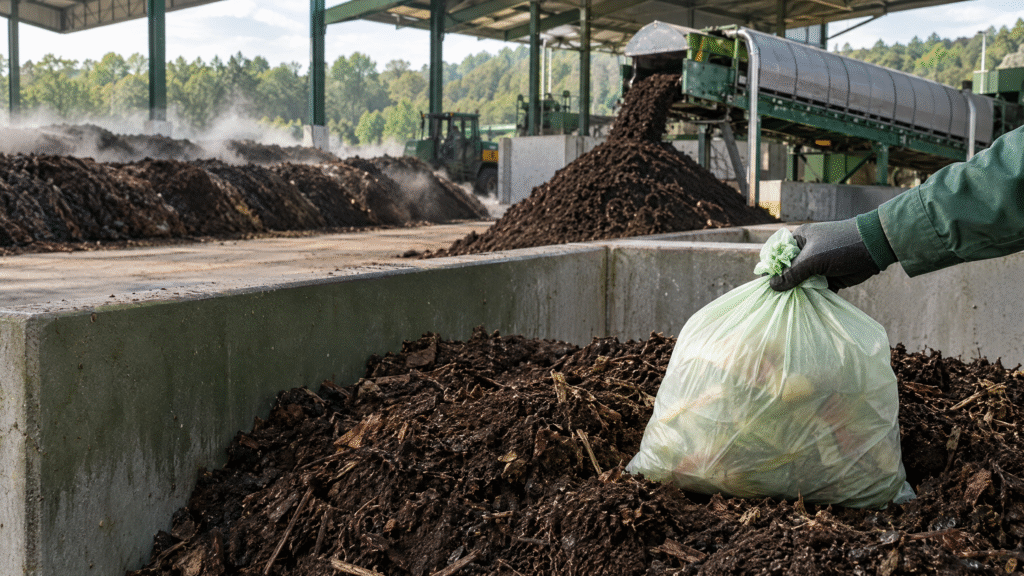
A compostable bag is designed to break down under the composting conditions for which it has been tested and certified. Commercially compostable and home-compostable products are not interchangeable.
The bag is only part of the system. The disposal environment matters.
A three-year study published in Environmental Science & Technology examined how biodegradable, oxo-biodegradable, compostable, and conventional plastic carrier bags deteriorated in the sea, soil, and open air. The study observed differences in physical deterioration across environments — but physical disappearance is not the same as complete biodegradation, and marine environments are not the certified disposal environment for compostable bags. The study concluded that none of the bags could be relied upon to show substantial deterioration across all environments over three years. (Napper & Thompson, 2019)
A compostable bag is designed for specific composting conditions — not for every environment it might end up in.
Certification Still Matters
“Compostable” is a product claim that should be supported by appropriate testing and, where applicable, third-party certification.
BPI, OK Compost, and EN 13432 are not interchangeable labels. They relate to defined standards, certification schemes, and composting environments. BPI’s certification program is built on ASTM D6400 as the foundational standard, and also evaluates eligibility, labeling, and third-party verification. The ASTM D6400 standard defines the requirements for plastics designed to be aerobically composted in municipal or industrial facilities.
Certification should be checked against the actual finished product and its certified specifications — not assumed from the certification of a resin or raw material.
For a full breakdown of BPI, OK Compost, and EN 13432, see our Compostable Certifications Guide.
2026 Certification Update: ASTM D6400 has recently been strengthened, including revisions that expand the range of constituents required to independently demonstrate biodegradability. These changes are relevant to certification bodies, manufacturers, brands, and retailers. (BPI, 2026)
Storage Conditions Still Matter
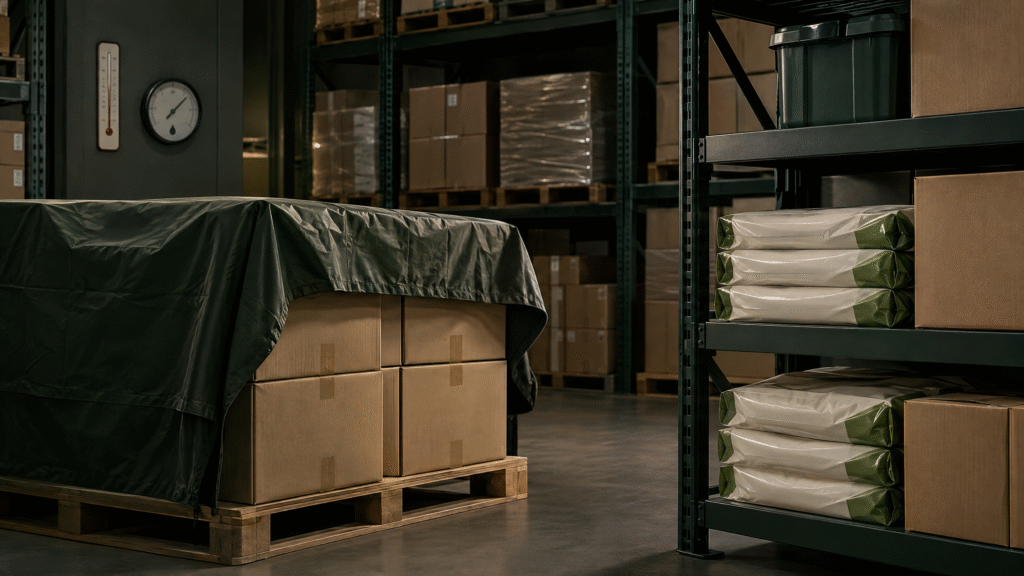
A compostable bag with a 12–16 month shelf life still needs to be stored properly. High heat, high humidity, and direct sunlight will shorten its life.
Conventional plastic bags are designed for much greater storage stability. Compostable bags are designed to break down under specific composting conditions. That’s the point.
Store them cool, dry, and dark. Use them within the recommended timeframe.
Not Every Compostable Bag Is the Same
The compostable bag market has matured, but it is not uniform. Quality, specifications, and certifications vary. Some compostable bags are excellent. Some are not.
Compare specific products for specific applications.
For a detailed comparison of biodegradable vs compostable bags, read our full guide.
Can Compostable Bags Compete with Plastic Now?
| Question | Then | Now |
|---|---|---|
| Cost | Often significantly higher | More competitive for many applications |
| Strength | A common concern | Improved formulations and structures |
| Shelf life | Often a concern | 12–16 months possible for some products |
| Supply | Less mature | More established |
| Applications | More limited | Much broader |
| Certification | Still important | Still important |
Compostable bags have not become identical to plastic. They have become a much more practical alternative to it.
The three reasons you stopped buying — price, strength, shelf life — are no longer universal limitations. For many specifications, they are no longer limitations at all.
How to Source Compostable Bags in 2026
If you are sourcing compostable bags for a business, here is what to do.
Stop comparing bags by material alone. “Compostable vs plastic” is not a useful comparison. Compare specific bags for specific applications.
Get samples and test them. Tear resistance, puncture resistance, load-bearing capacity, seal strength. Fill the bag with what you actually put in it. Carry it the way you actually carry it.
Ask for shelf-life information. Ask how long the bags last under recommended storage conditions. Ask what those conditions are. Ask what happens if storage conditions are not ideal.
Verify certification. Ask which certification the product holds. For BPI-certified products, the BPI Certified Products Database allows buyers to search by company, product name, or SKU.
Request samples before bulk production. Test the bags in your actual application. Fill them with what you actually put in them. Carry them the way you actually carry them. Store them the way you actually store them.
Ask for a custom specification, not a catalog. Every application is different. If a supplier only offers standard products, you may be compromising on performance.
Compare total cost, not just unit price. Unit price matters. But so does failure rate, shelf life, storage requirements, and disposal cost.
Frequently Asked Questions
Can compostable bags be as strong as plastic bags?
Some can, depending on the formulation, thickness, bag structure, and application. Compare specific products, not categories.
How long do compostable bags last?
Under recommended storage conditions, our tested compostable bag formulations can maintain their intended performance for approximately 12 to 16 months. This is our internal testing data, not a universal shelf-life claim.
Why do some compostable bags become brittle?
Hydrolysis — moisture contributing to polymer degradation in some formulations — is a main cause, particularly under unfavorable storage conditions. Heat and sunlight can accelerate it. Proper storage helps prevent it.
Are compostable bags suitable for heavy kitchen waste?
Yes, if the bag is designed for it. Look for high seal strength, good hydrolysis resistance, and appropriate thickness.
Are compostable bags reliable for wholesale orders?
They can be, provided the supplier has appropriate material sourcing, production controls, testing, and capacity.
How should compostable bags be stored?
Cool, dry, dark. Approximately 15–25°C. Below 50% relative humidity. Away from direct sunlight.
Continue Reading
- Compostable Certifications Guide: What BPI, OK Compost, and EN 13432 Actually Mean
- Biodegradable Garbage Bags vs Compostable Garbage Bags: What’s the Real Difference?
- Biodegradable Waste Bags: Types, Sizes, Materials & Disposal Guide
- Compost Bags: Types, Materials, Sizes & Buying Guide
Conclusion
For years, cost, durability, and shelf life gave buyers legitimate reasons to hesitate about compostable bags.
Those concerns have not disappeared from every product or every market. But they are no longer universal limitations.
Better formulations, improved manufacturing, and more mature supply chains have made modern compostable bags considerably more practical for many applications.
The question is no longer simply whether compostable bags can replace plastic. It is where, how, and under what conditions they make sense.
We’ve been working in bag materials, manufacturing, and product development for 20 years.
If you are sourcing compostable bags for a specific application, send us the size, thickness, application, and certification requirements. We’ll tell you what specification makes sense.