
EN 13432 at a Glance
EN 13432 is a European standard for assessing whether packaging can be recovered through industrial composting and biodegradation. It evaluates biodegradation, disintegration, effects on the treatment process and compost quality. It is not a home-compostability standard, and EN 13432 certification alone does not prove full compliance with every PPWR obligation.
The Packaging and Packaging Waste Regulation (PPWR) (EU) 2025/40 applies from 12 August 2026. It introduces mandatory compostability requirements for a narrow set of packaging formats from 12 February 2028, while the European Commission has confirmed that existing EN 13432 may be used as guidance until new harmonised standards are developed. Understanding what EN 13432 actually covers — and what it does not — is essential for any business placing compostable packaging on the EU market. For the full implementation schedule from 2026 to 2040, see our EU PPWR timeline.
What Is EN 13432?
EN 13432:2000 is a European standard that specifies requirements for packaging recoverable through industrial composting and biodegradation. During the transition to new PPWR harmonised standards, the European Commission states that EN 13432 may be used as guidance. It should not be presented as an automatic presumption of conformity with the PPWR. The standard is published by CEN and available through national standards bodies such as BSI in the UK.
The standard applies to packaging made from any material, including plastics, paper, and composite structures. It covers the entire packaging unit — not just the raw material used to make it. A material that passes EN 13432 testing does not automatically mean the finished package, with its inks, adhesives, labels and coatings, will also comply.
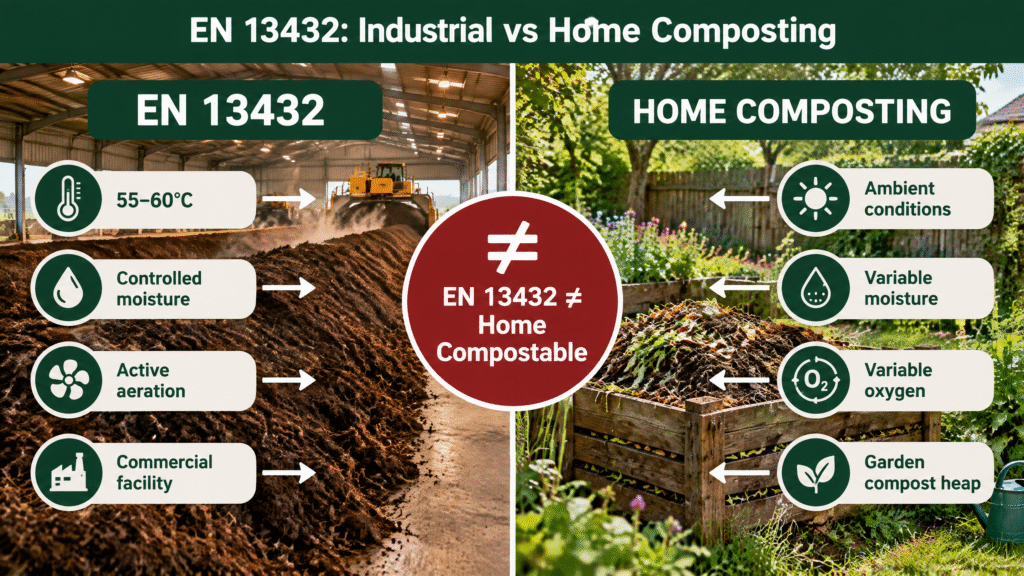
EN 13432 is an industrial composting standard. It was designed to simulate the conditions found in commercial composting facilities, where temperatures typically reach 55–60°C and the process is actively managed. It is not a home composting standard, and products certified to EN 13432 should not be marketed as “home compostable” without separate certification. For a comparison of how PLA, PBAT and cornstarch behave under these conditions, see our guide to compostable packaging materials.
The Four Core Requirements of EN 13432
EN 13432 requires packaging to meet four core criteria, all of which must be satisfied for certification. These are evaluated through laboratory testing under controlled conditions.
| Requirement | What it evaluates |
|---|---|
| Biodegradation | At least 90% of the organic carbon is converted to carbon dioxide within the specified test period under the applicable test conditions. |
| Disintegration | After 12 weeks of composting, no more than 10% of the original mass may remain as fragments larger than 2 mm. |
| Compost quality | The packaging must not have any negative effects on the composting process itself. |
| Ecotoxicity / heavy metals | Heavy metal content must remain within defined limits, and the resulting compost must support plant growth — typically assessed through plant germination and biomass tests showing at least 90% of the blank compost performance. |
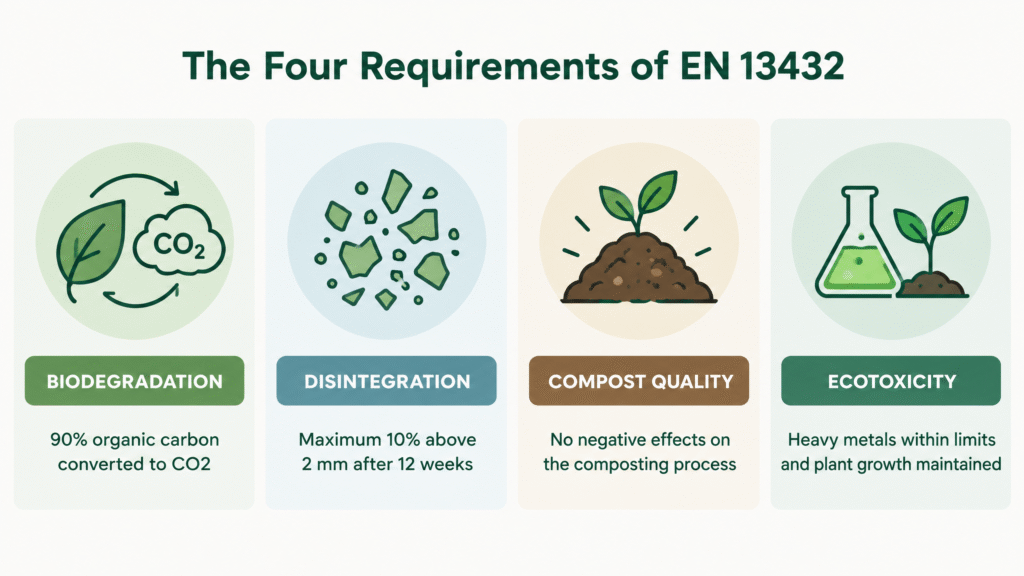
These four criteria work together. A material might biodegrade quickly but leave toxic residues, or disintegrate physically but not biodegrade at the molecular level. EN 13432 certification confirms that all four requirements are met simultaneously.
It is important to note that EN 13432 is an industrial compostability framework. The temperature, moisture and microbial conditions tested are those of a commercial composting facility, not a garden compost heap.
EN 13432 and the EU PPWR: What Changes in 2026
The PPWR entered into force in February 2025 and applies generally from 12 August 2026. It replaces the previous Packaging and Packaging Waste Directive and introduces a more prescriptive approach to compostable packaging — but only for a narrow set of formats. The full legal text is available on EUR-Lex, and the European Commission’s packaging waste page provides an overview of the regulation’s scope.
Article 9: The Mandatory Compostability List
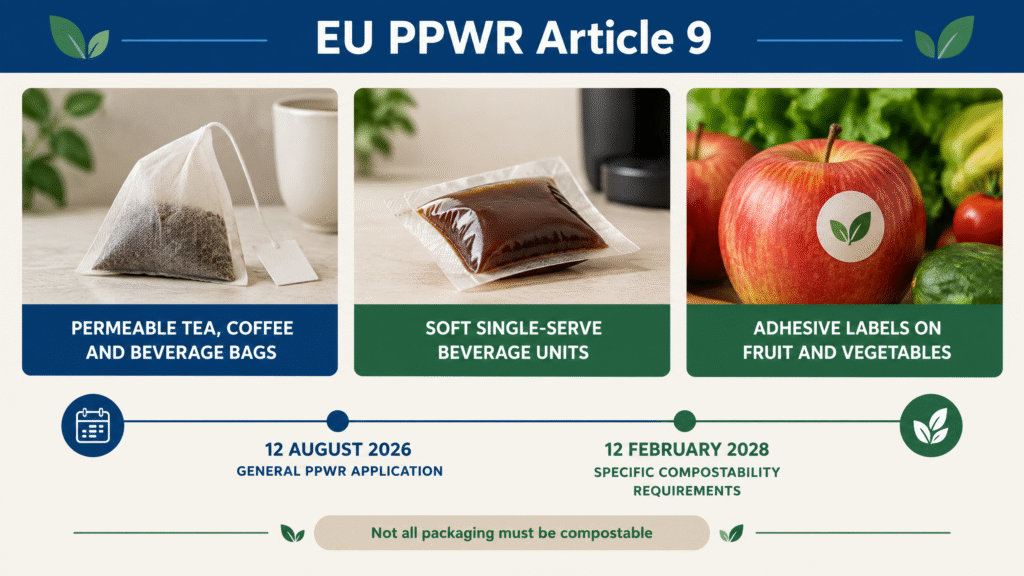
Article 9 of the PPWR establishes that certain packaging formats must be industrially compostable from 12 February 2028. Article 9(1) specifically covers the following packaging formats:
- Permeable tea, coffee and other beverage bags — the soft, permeable variants used for single-serve beverages
- Soft after-use system single-serve units containing tea, coffee or another beverage
- Adhesive labels applied to fruits and vegetables
These formats were selected because they are typically contaminated with food waste or disposed of together with organic material, making recycling impractical. They are the only compostable packaging types that do not also need to be recyclable under the PPWR. For the broader regulatory timeline, see our EU PPWR implementation schedule.
Member States May Go Further
Article 9(2) allows Member States to require compostability for additional packaging types where appropriate waste collection infrastructure exists. Member States may impose additional compostability requirements only under the conditions set out in Article 9(2), including appropriate bio-waste collection and treatment infrastructure. Home compostability should not be presented as a general requirement for all additional packaging formats.
Not Every Package Needs to Be Compostable
This is perhaps the most important practical point for businesses: the PPWR does not require all packaging to be compostable. The Regulation’s overall framework prioritises recyclability, and compostability is treated as an exception for specific formats where it delivers demonstrable environmental benefit.
For biodegradable packaging not covered by Article 9(1), Article 9(3) requires that such packaging be designed for material recycling by 12 February 2028, in a way that does not impair the recycling of other waste streams.
The Transitional Role of EN 13432
Under Article 9(6) of the PPWR, the Commission was required to request European standardisation organisations to prepare or update harmonised standards for compostable packaging by 12 February 2026. The Commission has also indicated that it will request harmonised standards for home compostability.
Until those new standards are adopted and listed in the Official Journal, the Commission’s PPWR guidance (C/2026/3084) confirms that the existing EN 13432 may be used as a reference for industrial compostability. What this does not mean is that EN 13432 certification equals PPWR compliance. EN 13432 is a technical standard; the PPWR is legislation. A product may meet EN 13432 but still need to satisfy other PPWR requirements related to labelling, documentation, or recyclability.
When Does Compostability Actually Matter Under PPWR?
The question is not simply “Is my packaging compostable?” but “Does my packaging need to meet a compostability requirement, and which pathway applies?” The PPWR creates different obligations depending on the packaging format and market.
| If your packaging is… | Start by checking… |
|---|---|
| Tea/coffee/beverage bag covered by Article 9(1) | Applicable industrial-compostability requirements; EN 13432 may be used as technical guidance during the transition |
| Fruit/vegetable adhesive label | Article 9 compostability requirements |
| Lightweight plastic carrier bag | Relevant Member State rules under Article 9(2) |
| Other compostable packaging | Recyclability requirements under Article 6 |
| Home-compostable claim | Applicable home-compostability requirements |
For most packaging types, the PPWR’s primary demand is recyclability, not compostability. Under the PPWR recyclability framework, packaging placed on the EU market is subject to phased recyclability requirements from 2030 onwards. The applicable performance grade and timing depend on the packaging category, the relevant delegated acts and transitional provisions. Compostability is a targeted exception for formats where recycling is not feasible or environmentally beneficial.
Multi-Component Compostable Packaging: Adhesives, Inks and Coatings
A compostable film does not automatically make the entire packaging unit compostable. This is one of the most common and costly misconceptions in compostable packaging procurement.
Under the PPWR, packaging is assessed as a unit that includes all integrated and separate components. The Regulation distinguishes between:
- Integrated component: a packaging component that may be distinct from the main body but is not designed to be separated by the end consumer. It is typically discarded together with the main packaging body.
- Separate component: a packaging component that can be manually disassembled completely by the end consumer and is recommended to be disposed of separately.
For compostable packaging, a certification issued for a compostable film does not automatically cover:
- Adhesives used to bond layers or attach labels
- Printing inks applied to the surface
- Coatings that provide barrier properties
- Labels that are integrated into the packaging unit
- Closures or dispensing systems
- Multilayer structures where different materials are combined
DIN CERTCO’s certification scheme sets additional requirements for inks and additives. These limits are scheme-specific and should not be treated as universal EN 13432 or PPWR thresholds. For example, certified printing inks may not exceed 1% of the dry weight of the product per certified ink and less than 5% in total. For additives whose biodegradability has not been separately determined, similar limits apply: less than 1% per organic additive and less than 5% in total, provided they are harmless for the composting process.
These thresholds are certification-scheme requirements and should not be presented as universal PPWR thresholds. Do not confuse certification-scheme limits with the legal requirements of the PPWR itself.
The practical implication for buyers is straightforward: always verify that the certification covers the finished packaging, not just the raw material. A certificate for a compostable resin or film is a starting point, not an endpoint.
EN 13432 vs OK Compost INDUSTRIAL vs OK Compost HOME vs BPI
The landscape of compostability certification can be confusing because standards and certification schemes serve different purposes.
| EN 13432 | OK compost INDUSTRIAL | OK compost HOME | BPI | |
|---|---|---|---|---|
| Nature | Standard | Certification scheme | Certification scheme | Certification scheme |
| Main context | Industrial composting | Industrial composting | Home composting | North America |
| EU relevance | High (technical reference) | High | Relevant for home compost claims | Mainly US/Canada |
| Home compostable? | No | No | Yes | Depends on scope |
EN 13432 is the European standard. It defines the technical requirements but is not itself a certification. Compliance is verified through certification bodies.
OK compost INDUSTRIAL is a certification scheme operated by TÜV AUSTRIA. It is based on the requirements of EN 13432 for industrial compostability. The Seedling logo, owned by European Bioplastics, also indicates compliance with EN 13432 for industrial composting.
OK compost HOME is a separate certification scheme for home composting. It is based on different standards and tests conditions that simulate a garden compost heap — lower temperatures, longer timeframes, and variable conditions. A product certified to EN 13432 is not automatically home compostable, and the two claims should never be used interchangeably.
BPI (Biodegradable Products Institute) is the primary certification scheme for the North American market. Its relevance depends on the target market of the packaging. For a full breakdown of how these schemes compare, see our compostable certifications guide and our explainer on ASTM D6400.
How to Verify an EN 13432 Claim From a Supplier
When a supplier claims that their packaging is “EN 13432 certified” or “compostable,” the claim needs to be verified against the actual certificate.
What buyers should verify:
- Certificate holder — Is the certificate in the supplier’s name, or in the name of a material manufacturer?
- Certificate number — Can it be verified directly with the certification body?
- Certification body — Is it a recognised body such as DIN CERTCO or TÜV Austria?
- Exact product covered — Does the certificate specify the product, material, formulation, thickness, and format?
- Printing and inks — Does the certification cover the printed product, or only the unprinted material?
- Additives and coatings — Are all components of the finished packaging included in the scope?
- Certificate validity — Is the certificate currently valid, and when was it last reviewed?
- Finished packaging vs. raw material — Does the certificate cover the finished package, or only the raw material?
The most important distinction is this: “Made with EN 13432-compliant material” is not necessarily the same as “the finished packaging is certified.”
A simple visual logic helps:
Raw material certificate
↓
Film certificate
↓
Finished bag / packaging
↓
Actual printed / converted product
↓
Certificate scope
The closer the certificate scope is to the actual product being purchased, the more useful the certificate is for procurement due diligence.
EN 13432 vs Home Compostability
No. EN 13432 is not a home-compostability standard.
EN 13432 tests conditions that simulate an industrial composting facility: temperatures of 55–60°C, controlled moisture, active aeration, and a six-month biodegradation window. Home composting takes place at ambient temperatures, with variable oxygen levels, and typically over a longer period.
Home compostability is assessed to different standards, such as the TÜV Austria OK Compost HOME certification. A product carrying the Seedling logo (indicating EN 13432 industrial compostability) is not making the same claim as one carrying OK Compost HOME. Our compostable certifications guide explains the difference in full.
For packaging covered by Article 9(1) and, where applicable, Article 9(2), the PPWR requires a label indicating that the material is compostable, not suitable for home composting and not to be discarded in nature. The obligation applies from 12 August 2028 or 24 months after the relevant implementing acts, whichever is later, subject to the Regulation’s transitional rules.
Does a PBAT or PLA Bag Automatically Meet EN 13432?
No.
PBAT and PLA can be used in EN 13432-compliant packaging, but neither polymer automatically makes a finished product EN 13432 compliant. The finished product’s compliance depends on the complete formulation, including:
- Additives — plasticisers, stabilisers, processing aids
- Pigments and masterbatch — colourants can affect biodegradation and ecotoxicity
- Inks — printing inks become part of the finished package
- Adhesives — used in multilayer structures or for attaching components
- Thickness — thicker products may take longer to disintegrate
- Structure — multilayer films, laminates, and composite structures may behave differently from single-layer films
A compostable film made from PBAT and PLA may meet EN 13432 in its unprinted, unmodified form. But the bag that reaches the consumer — printed, converted, with handles and seams — is a different product that needs its own assessment. Our guide to PLA, PBAT and cornstarch materials covers how each performs in practice.
What Buyers Should Check Before Purchasing Compostable Packaging
Before placing an order, these questions will help establish whether the packaging actually meets the required standard for the intended market and application:
Certification scope:
- Which compostability standard does the finished product meet — EN 13432, OK compost HOME, or another scheme?
- Is the certification for the finished bag or only the raw material?
- Which certification body issued the certificate?
- What product specifications are covered — material, thickness, format?
- Does the certificate cover printing and inks?
- Does it cover adhesives and other components?
Application and market:
- Is it industrial compostable or home compostable?
- What market is the certification intended for — EU, UK, North America?
- Is the certificate currently valid, and when does it expire?
- Does the packaging need to meet other PPWR requirements (recyclability, labelling, documentation)?
Documentation:
- Can you provide the certificate and scope documents?
- Is there an EU Declaration of Conformity where applicable?
- What traceability records are available for the material and components?
These questions are not just for due diligence. Under the PPWR and related enforcement frameworks, the responsibility for a misleading compostability claim can extend through the supply chain. Having the right documentation in place is both a compliance requirement and a risk management measure. If you are sourcing certified products, our compostable packaging range covers BPI and OK Compost certified options.
FAQs
Is EN 13432 still valid in 2026?
Yes. The European Commission’s PPWR guidance (C/2026/3084) confirms that existing EN 13432 may be used as guidance during the transition to new harmonised standards under the PPWR.
Is EN 13432 required by the EU PPWR?
No. EN 13432 is not a blanket requirement for all packaging. Article 9 of the PPWR applies industrial compostability requirements to specific packaging formats from 12 February 2028.
Is EN 13432 the same as OK compost INDUSTRIAL?
No. EN 13432 is the standard; OK compost INDUSTRIAL is a certification scheme based on that standard.
Does EN 13432 mean home compostable?
No. EN 13432 addresses industrial composting conditions. It does not establish that a product is suitable for home composting.
Does a PBAT bag automatically meet EN 13432?
No. Compliance depends on the complete formulation, including additives, inks, adhesives, thickness and structure.
What does EN 13432 certification cover?
Certification scope varies. It may cover raw material, film, or finished packaging. Always verify what the certificate specifically covers.
Can I claim “compostable” if my packaging only meets EN 13432?
You can claim “industrially compostable” where accurate. Claiming simply “compostable” without qualification may be misleading, as consumers may interpret this as home compostable.
How do I verify an EN 13432 certificate?
Check the certificate holder, number, certification body, exact product covered, and validity directly with the issuing body. Our compostable certifications guide and ASTM D6400 explainer walk through the verification process for each scheme.
Conclusion:
The right question is not simply “Can my packaging pass EN 13432?” It is “Does my packaging need to meet a compostability requirement, and which requirement applies to the market, format and end-of-life route?”
For permeable tea and coffee bags, soft single-serve beverage units, and fruit and vegetable stickers, the answer under the PPWR is clear: from 12 February 2028, these formats must meet the applicable industrial-compostability requirements under Article 9. During the transition, EN 13432 may be used as technical guidance until the relevant harmonised standards are adopted and listed in the Official Journal. For other packaging types, the primary regulatory demand is recyclability, and compostability is a targeted exception rather than a default.
If your packaging does need to be compostable, the work does not stop at choosing a material with an EN 13432 certificate. The finished packaging unit — including its inks, adhesives, labels and closures — must be covered by the certification. And the claim must be accurate: industrial compostability is not home compostability, and the distinction matters to regulators, consumers and waste management systems alike.
If you are sourcing compostable bags or packaging, we can help identify the relevant product specifications and certification requirements based on the intended application and market. Explore our certified compostable packaging range.
About the Author and Reviewer
- Author: HemcBags Technical Team — specialising in compostable packaging materials, certification and regulatory compliance, with over 10 years of industry experience
- Regulatory review: HemcBags Compliance — responsible for tracking updates to the EU PPWR, EN 13432 and related standards
- Last updated: September 2026
- Next review: February 2027, or sooner if new harmonised standards are published
- Editorial note: This article is based on publicly available EU legislation and official Commission guidance. Where commercial products are referenced, they are clearly identified as HemcBags products. All regulatory statements are sourced from the official references listed below.
- About HemcBags: HemcBags is a BPI and OK Compost certified manufacturer with over 10 years of experience supplying compostable packaging to distributors, municipalities and waste management partners across North America and Europe. We have supplied more than 50 million certified compostable bags.
Official Sources
- Regulation (EU) 2025/40 — Packaging and Packaging Waste Regulation (EUR-Lex)
- European Commission — PPWR Guidance C/2026/3084
- European Commission — Packaging and Packaging Waste
- BSI BS EN 13432
- DIN CERTCO — Compostability Certification
- TÜV AUSTRIA — OK compost
- European Bioplastics — Seedling Certification Scheme
- BPI World