
Last reviewed: 15 September 2026
Sources checked: Regulation (EU) 2025/40, Commission Guidance C/2026/3084 (5 June 2026), and the Commission PPWR FAQs, second edition (August 2026).
Next review: After the next Commission FAQ update or once the Article 12 implementing act is published.
Quick Answer:
This EU PPWR timeline and implementation schedule covers the key dates for businesses from 2026 to 2040. The EU Packaging and Packaging Waste Regulation (PPWR), Regulation (EU) 2025/40, entered into force on 11 February 2025 and generally applies from 12 August 2026. Its requirements are phased through 2028, 2030, 2035, 2038 and 2040, covering packaging minimisation, recyclability, recycled content, labelling, reuse and other requirements. Businesses should treat the timeline as a compliance roadmap rather than a list of isolated deadlines.
Priority actions for 2026: Clarify your economic operator role, build a packaging inventory, verify PFAS and heavy-metal compliance, prepare DoC and technical documentation, and assess EPR registration obligations.
Who Is Responsible? Role Decision Tree
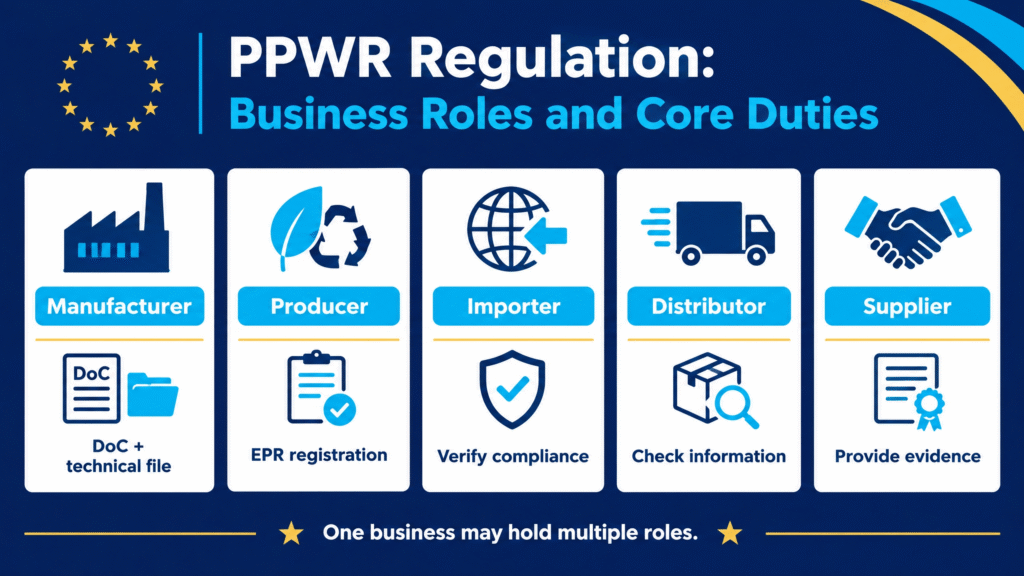
Use the following “If… then…” structure to identify your role(s) under PPWR.
Note: A company can hold multiple roles at the same time (e.g., Manufacturer + Producer) .
| If your business… | Then you are… | Primary obligations |
|---|---|---|
| Designs or commissions packaging under your own brand | Manufacturer | Conformity assessment, DoC, technical documentation, labelling |
| First places packaged goods on a Member State market | Producer | EPR registration, fees, reporting in that Member State |
| Brings packaging or packaged goods from outside the EU | Importer | Verify DoC exists before placing on market |
| Supplies packaging or materials to a manufacturer | Supplier | Provide the information and documentation required for the manufacturer or importer to demonstrate compliance; additional duties may apply depending on the supplier’s role |
| Is a non-EU business selling directly into the EU | Producer in the relevant Member States | May have producer obligations in the relevant Member States, subject to its role, sales structure and national EPR requirements |
EU PPWR Timeline and Implementation Schedule at a Glance
Key milestones (simplified):
| Date | Key milestone |
|---|---|
| 12 Aug 2026 | PPWR generally applies |
| 12 Aug 2028 | Harmonised labelling (or later) |
| 1 Jan 2030 | Major compliance deadline |
| 1 Jan 2035 | Recyclability at scale |
| 1 Jan 2038 | Grade C phased out |
| 1 Jan 2040 | Higher targets |
Full timeline:
| Date | PPWR Milestone | What Businesses Must Prepare | Legal application date | Delegated/implementing act date | Business preparation deadline | Priority |
|---|---|---|---|---|---|---|
| 12 Aug 2026 | PPWR generally applies. PFAS limits, heavy metals restrictions, DoC obligations, and EPR-related requirements take effect | Verify substance compliance; prepare DoC per packaging type; assess EPR obligations | Fixed | — | Immediate | Critical |
| 12 Feb 2027 | HORECA “bring your own container” obligation begins | Staff training; hygiene processes for customer-supplied containers | Fixed | — | Q1 2027 | Medium |
| 12 Feb 2028 | Compostability rules apply to specific formats. Commission must adopt Article 24(2) implementing acts on empty-space methodology | Source certified industrially compostable materials; prepare for empty-space calculation methodology | Fixed | 12 Feb 2028 (deadline) | Q4 2027 | High |
| 12 Aug 2028 / later | Harmonised labelling for material composition applies EU-wide | Update packaging artwork to meet the harmonised material-composition labelling requirements | 12 Aug 2028 or 24 months after the relevant implementing act enters into force, whichever is later | Implementing act not yet adopted | Q1 2028 | High |
| 1 Jan 2029 | 90% separate collection target for single-use plastic bottles and metal beverage containers up to 3 litres; deposit-return systems required | Prepare for DRS compliance if placing beverage containers on market | Fixed | — | 2028 | Medium |
| 12 Feb 2029 | Reusable packaging labelling and digital information (QR codes) apply | Implement QR codes for reusable packaging | Fixed | — | Q4 2028 | Medium |
| 1 Jan 2030 | Major milestone. Recyclability Grade C minimum (≥70%); recycled content targets; maximum 50% empty-space ratio (1 Jan 2030, or 3 years after Art. 24(2) implementing act, whichever is later) | Redesign non-compliant packaging; verify recyclability grades; document recycled content | Fixed (or later if act-dependent for empty-space) | Design-for-recycling delegated act expected Jan 2028 | 2028–2029 | Critical |
| 1 Jan 2035 | Packaging must be recyclable at scale | Prepare evidence of recycling infrastructure and performance | Fixed | — | 2032–2034 | Medium |
| 1 Jan 2038 | Grade C packaging expected to be phased out | Long-term redesign toward Grade A/B | Act-dependent | — | 2035–2037 | Low |
| 1 Jan 2040 | Higher recycled content and reuse targets apply | Strategic portfolio planning | Fixed | — | 2038–2039 | Low |
Footnote: As of the latest available Commission materials, the Article 12 implementing act had not yet entered into force . The 24-month period runs from the date that implementing act enters into force. The final application date should be confirmed once the act is published.
Immediate 2026 Priority Checklist
Five highest-priority actions for August–December 2026:
- Build a comprehensive packaging materials inventory — list every SKU, component, and material across your product range.
- Initiate PFAS and heavy metals testing — food-contact packaging requires total fluorine screening; no stock-exhaustion period applies .
- Establish Technical Documentation (TD) and Declaration of Conformity (DoC) frameworks — manufacturers must complete conformity assessment before placing packaging on market .
- Assess supplier capabilities and request compliance documentation — suppliers must provide material composition, recycled content, and substance data.
- Clarify liability boundaries according to export structures (B2B vs. B2C) — identify your role(s) under PPWR.
EU PPWR Compliance Steps for Businesses
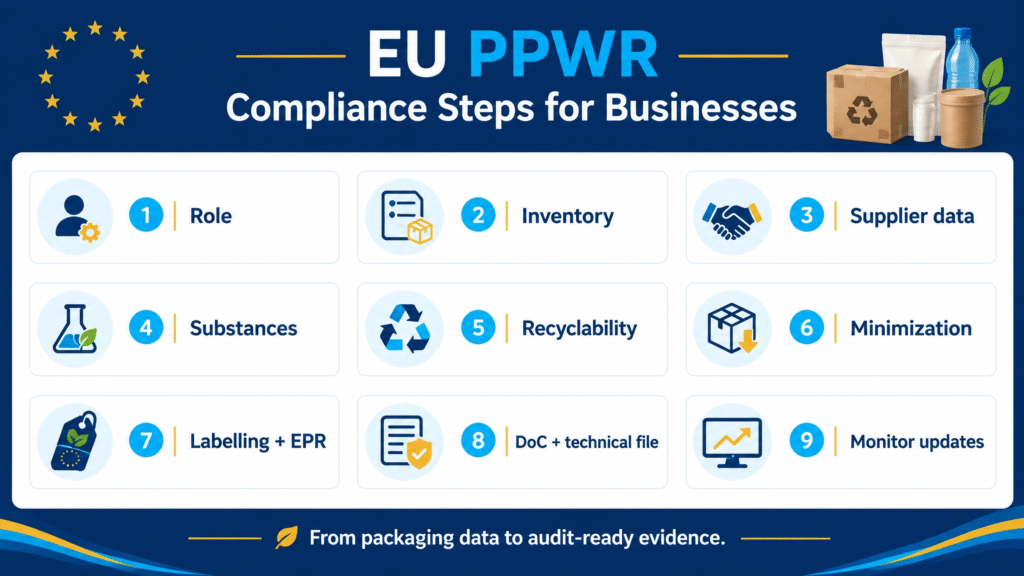
Numbered checklist:
- Identify the company’s PPWR role.
- Build a component-level packaging inventory.
- Collect supplier composition and test data.
- Check PFAS and heavy-metal restrictions.
- Assess recyclability and recycled content.
- Review minimisation and empty-space requirements.
- Check labelling and EPR obligations.
- Prepare the EU Declaration of Conformity and technical documentation.
- Monitor delegated acts and Commission guidance.
Detailed steps:
| Step | Action | Output | Legal Reference |
|---|---|---|---|
| 1 | Identify your role | Manufacturer / Producer / Importer / Distributor | Art. 3(1)(13)–(21), Arts. 15–21 |
| 2 | Create packaging inventory | Packaging register (all SKUs, components, materials) | Annex VII No. 4 |
| 3 | Collect supplier data | Material composition, weight, dimensions, food-contact status | Art. 16 |
| 4 | Check restricted substances | PFAS and heavy-metal assessment | Art. 5(4)–(5) |
| 5 | Assess recyclability & recycled content | Article 6/7 assessment | Art. 6, Art. 7 |
| 6 | Review minimisation | Weight, volume, empty-space data | Art. 10, Art. 24 |
| 7 | Check labelling & EPR | Member State registration records | Art. 12, Arts. 44–45 |
| 8 | Prepare DoC & technical documentation | EU Declaration of Conformity (Articles 38–39) | Art. 38, Art. 39, Annex VII |
| 9 | Monitor delegated acts | Commission guidance and FAQ updates | — |
Retention periods: DoC and technical documentation must be retained for 5 years (single-use packaging) or 10 years (reusable packaging) .
Practical note from Commission FAQs (August 2026): Packaging already produced or held in stock before 12 August 2026, but not yet placed on the market, does not need to be destroyed, remanufactured or physically relabelled. The required identification and manufacturer information may be provided through accompanying documentation .
PPWR Packaging Minimisation and Empty-Space Rules
The 50% Empty-Space Rule (Article 24)
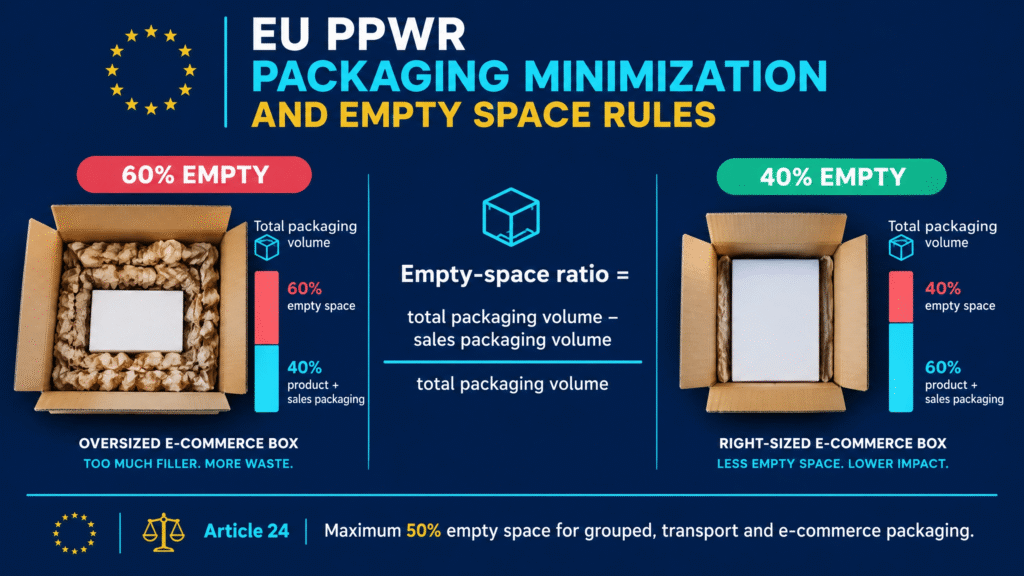
PPWR 50% empty-space rule: From the applicable date under Article 24, grouped, transport and e-commerce packaging must have an empty-space ratio of no more than 50%, subject to the Commission’s implementing methodology and applicable exemptions .
The applicable date is 1 January 2030, or 3 years after the Article 24(2) implementing acts enter into force, whichever is later . The final calculation methodology will be established by a Commission implementing act under Article 24(2), due by 12 February 2028.
Simplified example: If the total internal volume of grouped packaging is 10 litres and the sales packaging inside occupies 4 litres, the simplified empty-space ratio is (10 − 4) ÷ 10 = 60%. This would exceed the 50% limit, subject to the final Commission methodology and applicable exceptions.
Counts as empty space: air cushions, bubble wrap, foam, paper fillers, polystyrene chips. Filling materials do NOT reduce the empty-space ratio — the space they occupy remains counted as empty space .
Double walls and false bottoms designed to create a misleading impression of volume are explicitly prohibited unless protected by design rights or trademarks.
For Sales Packaging
Article 24 does not impose the same fixed 50% empty-space ratio on sales packaging. However, sales packaging must still comply with the separate minimisation requirements under Article 10, including the requirement to reduce weight and volume to the minimum necessary for functionality. Until the relevant harmonised standards and implementing measures apply, businesses should document sales-packaging minimisation using applicable transitional requirements, recognised standards such as EN 13428 where relevant, and the latest Commission guidance.
PFAS Limits in Food-Contact Packaging (Article 5)
From 12 August 2026, food-contact packaging placed on the EU market must not contain PFAS at or above these thresholds :
| Limit Type | Threshold |
|---|---|
| Any individual non-polymeric PFAS | 25 ppb |
| Sum of non-polymeric PFAS | 250 ppb |
| Total fluorine content | 50 mg/kg |
The Commission’s 2026 guidance describes a three-step testing approach: (1) total fluorine screening, (2) confirmatory analysis (e.g., pyrolysis-GC/MS), and (3) total oxidizable precursor (TOP) analysis if needed .
No stock-exhaustion period applies for packaging not yet placed on the market. Packaging manufactured before 12 August 2026 but first placed on the EU market after that date must comply with the PFAS limits .
Recyclability Requirements (Article 6)
From 1 January 2030, packaging will need to meet the applicable recyclability performance requirements under Article 6. The detailed design-for-recycling criteria will be established through delegated acts by 1 January 2028.
| Grade | Recyclability Performance |
|---|---|
| Grade A | ≥95% |
| Grade B | ≥80% |
| Grade C | ≥70% |
| Below Grade C | Generally below the applicable minimum threshold |
From 1 January 2035, packaging must be recyclable at scale . Under the PPWR framework, the minimum recyclability performance threshold is expected to tighten from 2038 so that Grade C packaging will generally no longer qualify, subject to the final delegated acts, applicable exemptions and transitional provisions .
Recycled Content Requirements for Plastic Packaging (Article 7)
From 1 January 2030, plastic packaging must contain minimum post-consumer recycled content, calculated as an average per manufacturing plant and year:
| Packaging Type | 2030 Target | 2040 Target |
|---|---|---|
| Contact-sensitive PET | 30% | 50% |
| Contact-sensitive non-PET plastics | 10% | 25% |
| Single-use plastic beverage bottles | 30% | 65% |
| Other plastic packaging | 35% | 65% |
Exemption: Plastic parts accounting for less than 5% of total packaging weight are excluded. Adhesives, paints, and inks are not considered plastic.
Compostability and Labelling Requirements
Compostable Packaging (Article 9)
From 12 February 2028, the following must be compatible with industrial composting :
- Sticky labels on fruit and vegetables
- Permeable tea, coffee, and beverage bags
- Soft after-use system single-serve units that contain tea, coffee or another beverage and are intended to be used and disposed of together with the product
Important distinction: Compostability does not mean PPWR compliance. Compostable packaging must still meet applicable recyclability, minimisation, substance restriction, labelling, and documentation requirements. Only specific formats are covered by Article 9. For an overview of compostability certifications referenced in PPWR assessments, see our compostable certifications guide.
Harmonised Labelling (Article 12)
From 12 August 2028 or 24 months after the implementing act enters into force, whichever is later, packaging must bear harmonised labels denoting material composition for consumer sorting . As of the latest available Commission materials, the Article 12 implementing act had not yet entered into force . Packaging produced before the deadline benefits from a three-year sell-through period . Businesses should review existing national sorting instructions and update packaging artwork before the harmonised labelling requirements become applicable.
PPWR Compliance Checklist
| Check | What to Review | Legal Reference |
|---|---|---|
| Packaging role | Manufacturer / Producer / Importer / Distributor | Arts. 3, 15–21 |
| Materials | Composition and restricted substances (PFAS, heavy metals) | Art. 5 |
| Minimisation | Weight, volume, empty space | Art. 10, Art. 24 |
| Recyclability | Article 6 requirements; Grade C minimum from 2030 | Art. 6 |
| Recycled content | Article 7 targets | Art. 7 |
| Compostability | Article 9 where applicable | Art. 9 |
| Labelling | 2028 harmonised labelling requirements | Art. 12 |
| Documentation | Technical file and Declaration of Conformity | Arts. 38–39, Annex VII |
| EPR | Member State registration and reporting obligations | Arts. 44–45 |
FAQ
When does PPWR apply?
PPWR generally applies from 12 August 2026, following entry into force on 11 February 2025 .
What is the PPWR empty-space rule?
A maximum 50% empty-space ratio applies from 1 January 2030, or 3 years after the Article 24(2) implementing acts enter into force (whichever is later), to e-commerce, grouped, and transport packaging .
How is empty space calculated?
(Total packaging volume − sales packaging volume) ÷ total packaging volume. Filling materials (air cushions, paper, foam) count as empty space .
What happens in 2030?
From 1 January 2030: Grade C minimum (≥70%) recyclability, recycled content targets for plastic packaging, and the 50% empty-space rule for grouped/transport/e-commerce packaging.
Does PPWR apply to compostable packaging?
Yes. Compostability under Article 9 covers only specific formats (tea bags, sticky labels, single-serve units). Other compostable packaging must still meet recyclability, minimisation, and documentation requirements.
What are the PFAS limits?
25 ppb (any individual non-polymeric PFAS), 250 ppb (sum of non-polymeric PFAS), 50 mg/kg (total fluorine content) from 12 August 2026. No stock-exhaustion period applies .
What documents do businesses need?
Technical documentation, EU Declaration of Conformity (Articles 38–39), supplier test reports, and EPR registration records. Retain for 5 years (single-use) or 10 years (reusable) .
Does PPWR apply to non-EU companies?
Yes. PPWR applies to all packaging placed on the EU market, regardless of origin. Non-EU economic operators may need to appoint an authorised representative or producer responsibility representative depending on their role and Member State requirements.
What happens to stock manufactured before 12 August 2026?
Packaging already placed on the market before 12 August 2026 may continue to be sold. Packaging produced but not yet placed on the market does not need to be destroyed or relabelled; required information may be provided via accompanying documentation . This is a clear distinction: placed on market vs. produced but not placed on market.
Does filling material help meet the 50% empty-space rule?
No. Paper, air cushions, foam, and other filling materials count as empty space and do not reduce the empty-space ratio .
What if my supplier cannot provide compliance documentation?
Manufacturers or importers remain legally responsible for packaging compliance. Under Commission FAQ, suppliers must provide the necessary information, but the legal burden stays with the manufacturer/importer. Supply chain exclusion is a real risk for non-compliant suppliers.
How do I appoint an authorised representative?
Non-EU producers may need an authorised representative in each Member State where they place packaging on the market. Requirements vary by Member State. Registration timelines and tax-identification requirements should be confirmed with the relevant national authority before market entry.
Will the Commission enforce penalties immediately from August 2026?
The Commission’s August 2026 FAQs describe an implementation-support approach for certain initial administrative or labelling issues. However, enforcement practice and penalties may vary by Member State, and businesses should not assume that a warning or remediation period will always be available. Businesses should assume full legal responsibility from day one.
Official PPWR Sources
- Regulation (EU) 2025/40 on EUR-Lex — full legal text
- European Commission PPWR Guidance Document C/2026/3084 — interpretative guidance published 5 June 2026
- European Commission PPWR FAQs — updated August 2026 (2nd edition)
Related Resources for Packaging Suppliers
HEMCBags supplies certified compostable bags and flexible packaging. Product specifications, material information, and certification documents are available for customers conducting PPWR compliance reviews. For compostability certifications referenced in PPWR assessments, see our compostable certifications guide. For supplier data needed for your PPWR technical file, businesses should request material composition, weight, dimensions, recycled content, and substance test reports from packaging suppliers.
Disclaimer: This article is provided for general information and does not constitute legal advice. Businesses should assess their obligations based on their role, packaging type, Member State and the latest official EU and national guidance.