
Last reviewed: September 2026
Scope: General guidance. Local council and waste-facility rules take priority.
Quick Answer: If you are shopping for compostable bags for compost bins, the bag that works depends on two things, in this order: (1) whether your local waste program accepts compostable bags at all, and (2) which treatment system the bag will actually enter. For a home compost pile, look for a recognized home-compostable certification. For a municipal green bin, look for an industrially compostable certification — but only if your municipality permits them. If the bag is destined for general rubbish or landfill, its compostability is generally not used as intended, and a conventional bag may be more practical.
The single most important rule: A bag can be certified compostable and still be rejected by your local program. Certification and local acceptance are two separate questions. Certification verifies that the certified product has met defined compostability requirements under specified test conditions. Local acceptance determines whether it will actually be processed in your area.
Compostable Bags for Compost Bins: The Decision Table
Before reading anything else, find your situation in this table. It will tell you what to do in under 30 seconds.
| Your disposal situation | What to do | What to verify |
|---|---|---|
| Backyard compost pile or tumbler | Use home compostable bags | A recognized home-compost certification covering the specific product |
| Worm farm (vermicomposting) | Usually add food scraps directly; don’t assume a compostable plastic bag is suitable | Check product instructions and your vermicomposting system |
| Municipal green bin (food waste) | Check your council’s rules first | Does your program accept compostable bags? Which certification? |
| Yard waste collection | Check rules — often paper bags only | Plastic bags may not be accepted, even when certified compostable |
| Kitchen caddy → backyard pile | Home compostable liners | Home-compost certification |
| Kitchen caddy → municipal green bin | Only if council accepts them | Industrially compostable certification, per local rules |
| General rubbish / landfill | Compostability generally not used as intended | Strength + leak resistance may matter more |
Compostable vs. Biodegradable vs. Oxo-Degradable
Supermarket shelves are full of environmental claims, but the terminology is not always specific enough to tell you how a bag should be disposed of.
Compostable: A Verifiable Claim
A certified compostable bag has been assessed against a defined compostability scheme for biodegradation, disintegration and environmental safety under specified conditions. The exact requirements depend on the standard and certification program. A certification claim has layers: the standard, the certification program, the certificate holder, the product scope, and the certificate validity. A logo alone does not confirm any of these. Look for a recognized certification and verify that it applies to the specific product, not just the material or manufacturer.
Biodegradable: Too Vague to Trust
“Biodegradable” simply means the material can be broken down by microbes, without specifying how long it takes, what remains behind, or whether the result is safe for soil. The term itself does not identify the required composting conditions, timeframe, or end result. Certification requirements depend on the applicable claim and market.
Oxo-Degradable: Not the Same as Compostable
Oxo-degradable plastics are designed to fragment through oxidation. Fragmentation is not the same as biological composting and does not produce compost in the way certified compostable products are designed to. EU Directive 2019/904 bans products made from oxo-degradable plastic from being placed on the market in the EU. If a bag claims to be degradable without a recognized certification, treat that claim with caution until verified.
Which Certification Matches Your Composting System?
Home-compostability standards are designed for lower-temperature, less-controlled composting conditions than industrial composting. The exact test conditions and time limits depend on the applicable standard, so the following should be read as a general framework rather than a single universal specification.
Home Compostable (Backyard Pile, Tumbler)
Certifications to look for:
- OK Compost HOME (TÜV Austria)
- AS 5810 (Australia)
- NF T 51-800 (France)
OK Compost HOME certifies products that compost at the lower, less constant temperatures typical of a garden compost heap. The NF T 51-800 standard specifies procedures and requirements for plastics suitable for home composting, covering biodegradation, disintegration, and environmental safety. AS 5810 specifies requirements and procedures to determine whether a plastic material is biodegradable in home composting conditions. Because home composting systems vary considerably in design and operation, these standards use lower temperatures and longer test durations than industrial standards to account for these variations.
Reality check: In a UK citizen-science study, 60% of the tested plastic items marketed or certified for home composting did not fully disintegrate within the study period. This does not mean that every certified product will fail, but it shows why certification should not be treated as a guarantee of rapid disappearance in every backyard pile.
Industrially Compostable (Municipal Green Bin)
Certifications to look for:
- EN 13432 (European standard)
- ASTM D6400 (US technical standard; BPI is a certification program based on it)
- AS 4736 (Australia)
EN 13432 defines the requirements for packaging that can be recovered through composting and biodegradation. ASTM D6400 specifies requirements for plastics designed to be aerobically composted in municipal and industrial facilities where thermophilic conditions are achieved. BPI uses ASTM D6400 as the base standard for its commercial compostability certification process, requiring third-party verification of formulation and performance.
These standards are designed for the higher temperatures and controlled conditions of industrial composting facilities. TÜV Austria notes that OK compost INDUSTRIAL-certified products compost at temperatures between 55 and 60°C and should not be placed in a garden compost heap. A backyard pile typically cannot reach and sustain these temperatures.
Critical warning: If your municipality collects food waste in a separate green bin, they may accept only certified industrially compostable bags — or may ban all compostable plastics entirely. In the Netherlands, Milieu Centraal states that compostable plastic packaging generally belongs in residual waste rather than GFT or PMD. Special GFT collection bags carrying the Kiemplant or OK compost logo are an exception because they are intended to encourage food-waste separation. Local rules always take priority over certification.
Compostable Bags for Food Waste: What Works in the Kitchen Caddy
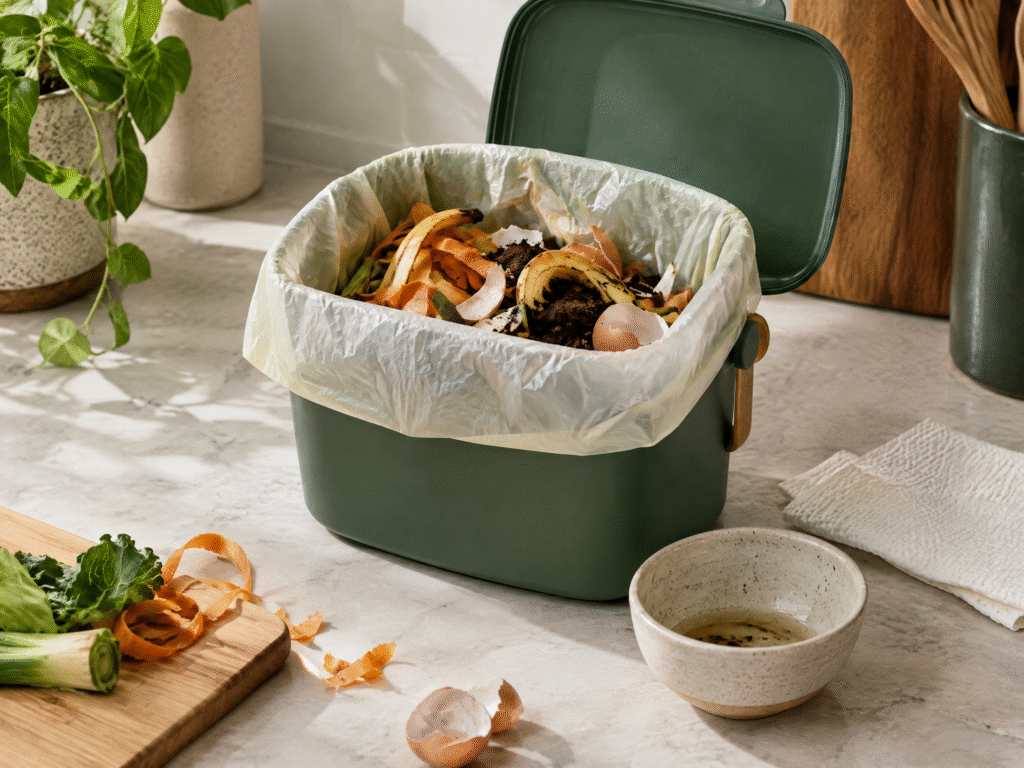
When shoppers search for compostable bags for food waste, they usually mean a liner for a small kitchen caddy — the countertop bin that collects vegetable peels, coffee grounds, and plate scrapings before they go out to the main compost pile or green bin.
What to Expect
Compostable bags can be more sensitive to moisture, heat and prolonged storage than conventional plastic bags. Research on biodegradable polymer films confirms that these materials are susceptible to hydrolysis from atmospheric moisture, which can reduce durability and shelf life.
Practical Tips That Reduce Leaks and Odours
- Store bags in a cool, dark, dry place — not under the sink
- Use within the manufacturer’s recommended shelf life
- For especially wet or heavy scraps, consider using a paper liner, draining excess liquid, freezing scraps, or emptying the caddy more frequently. Do not double-bag unless your local program permits it and the product instructions support it.
- Wrap wet items in newspaper or paper towel before bagging
- Empty the caddy frequently for wet waste
- Do not tie a knot in the bag — this makes composting the bag and its contents more difficult
Certification for Food Waste Bags
For curbside organics, choose industrially compostable liners that are accepted by your local program. For a kitchen caddy that goes into a backyard pile, choose home-compostable bags labeled for home use. Verification should include checking that the specific product is covered by the certification, not just the material or manufacturer.
Compostable Bags for Yard Waste: Do You Actually Need Them?
This is the question most guides ignore. When people search for compostable bags for yard waste, they often assume they need the same type of bag as for kitchen scraps. They usually don’t.
Why Yard Waste Is Different
Yard waste — leaves, grass clippings, branches, hedge trimmings — usually doesn’t need a bag at all. Most municipal yard waste collection programs require paper bags or open containers, not compostable plastic bags. Yard waste is processed differently from food waste in commercial facilities, and plastic — even compostable plastic — may be screened out.
When Bags Help (and When They Hurt)
If you home compost: Leaves and grass clippings go directly into the pile. No bag needed. Using a bag may restrict airflow and slow decomposition. The one exception: if you’re storing yard waste temporarily before adding it to the pile, a compostable bag can keep things tidy.
If your municipality requires bags: Check their specific rules. Some accept certified compostable yard waste bags. Others accept only paper bags. Never assume.
The Key Difference from Food Waste Bags
Food waste bags need to be leak-resistant for wet, heavy scraps. Yard waste bags need to be breathable and sturdy for dry, bulky loads. The specifications are different — don’t buy one type expecting it to perform well for the other.
How to Check Your Local Rules
Search your council or waste hauler’s website for:
- “compostable bags accepted”
- “green bin liners”
- “food scraps bags”
- “organics collection”
- “yard waste bags”
Check specifically for:
- Which certifications are accepted
- Whether only council-issued bags are permitted
- Whether paper bags are required
- Whether bags must be left open or untied
- Whether food waste and yard waste have different rules
The Uncomfortable Truth About Rubbish and Landfill
If your compostable rubbish bags is going into general rubbish (not a compost collection), its compostability is generally not used as intended, so the environmental advantage associated with composting is lost. Landfills are engineered to manage waste in a way that does not provide the controlled composting conditions for which compostable bags are designed. Under these conditions, a compostable bag may not break down as expected.
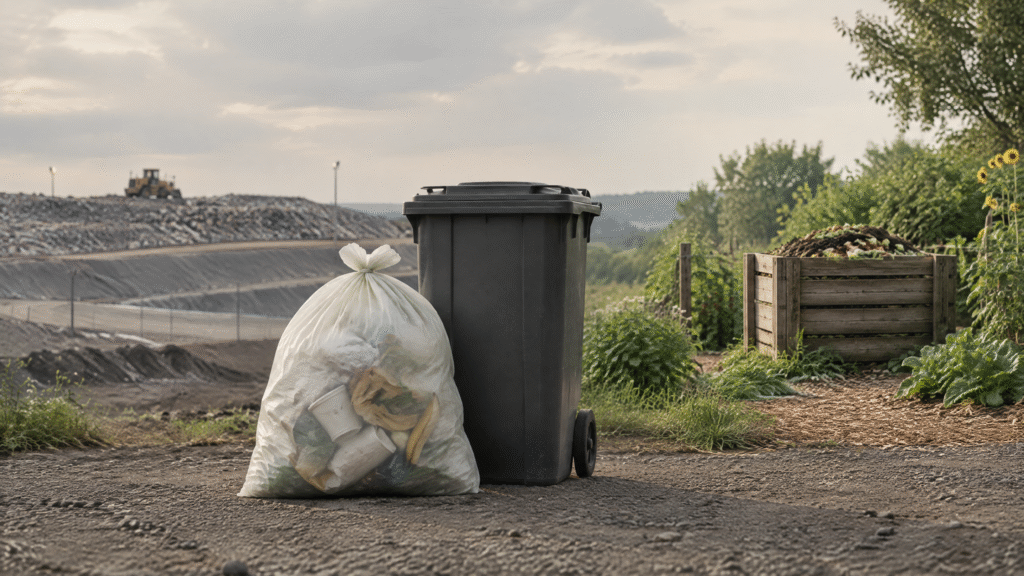
This means: If you don’t have access to a compost collection or a home compost system, buying compostable bags for general rubbish offers limited practical benefit compared with a conventional bag that may be stronger and more leak-resistant.
How to Choose a Compostable Bag by End Use
| End use | Bag type | What matters most |
|---|---|---|
| Backyard compost | Home compostable | Home-compost certification covering the product |
| Municipal food waste | Industrially compostable | Local acceptance + applicable certification |
| Kitchen caddy | Depends on destination | Moisture resistance + storage life |
| Yard waste | Often no plastic bag | Local collection rules |
| General rubbish | Conventional bag may be more practical | Strength + leak resistance |
Bottom Line
- Check local acceptance first. Certification does not guarantee your local program accepts the bag. Verify before you buy.
- Match the certification to the actual treatment system. Home compostable for backyard piles; industrially compostable for municipal collection.
- Look beyond the logo. Verify that the certification applies to the specific product, not just the material or manufacturer.
- Accept the durability trade-off. Compostable bags are generally weaker than conventional plastic. Handle carefully, empty frequently, store properly.
- Yard waste is not food waste. Don’t assume the same bag works for both. Check your collection program’s rules.
- If the bag is destined for landfill, compostability is generally not used as intended. Choose a bag based on strength and leak resistance for that context.
Sources and Further Reading
Standards and certification bodies
- TÜV Austria — OK Compost HOME
- TÜV Austria — OK Compost INDUSTRIAL
- ASTM D6400
- BPI — Certified Compostable
- AFNOR — NF T 51-800
Government and regulatory sources
Peer-reviewed research
- The Big Compost Experiment — UK Centre for Ecology & Hydrology dataset
- Purkiss et al., Frontiers in Sustainability, 2022
Industry and technical references