
Quick Answer
Compost bags are bags used to collect food scraps, yard waste, and other organic materials for composting. The most common types include certified compostable bags made from PBAT, PLA, and starch blends, as well as paper yard waste bags. The right bag depends on your composting system—home compostable bags require OK Compost HOME certification, while industrial-compostable bags need certification to ASTM D6400 or EN 13432 requirements and a municipal facility that accepts them.
What Are Compost Bags?
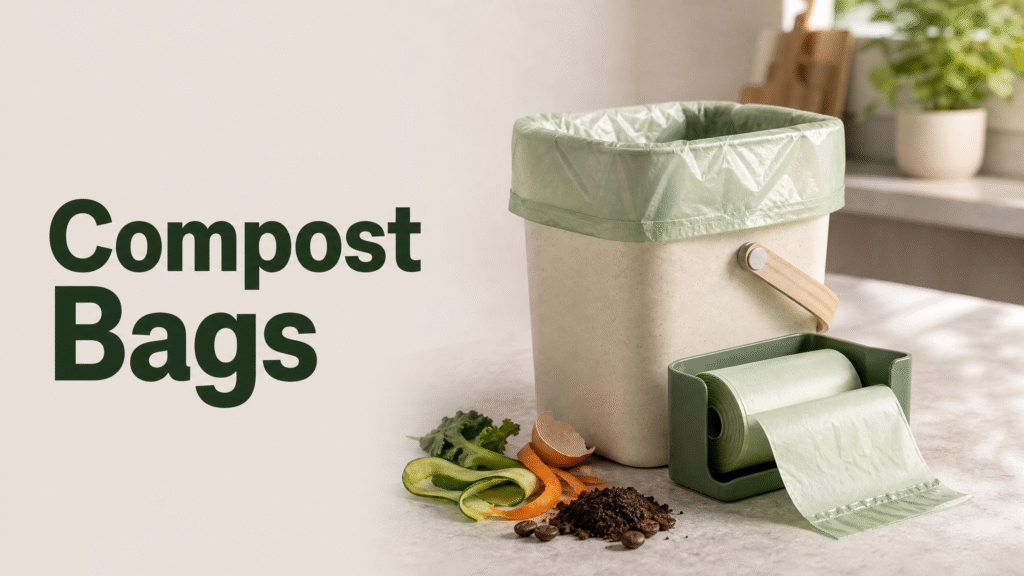
Compost bags are containers designed to collect organic waste—food scraps, yard trimmings, coffee grounds, and other compostable materials—before they enter a composting system. They serve two purposes: keeping your kitchen or collection bin clean and making it easier to transport waste to a compost pile or curbside collection program.
The term “compost bags” is often used interchangeably with “compostable bags,” but they are not technically identical. A compost bag is any bag used for collecting organic waste—it could be paper, conventional plastic, or certified compostable material. A compostable bag is a specific product category that meets recognized certification standards.
Many buyers search for compostable bags, compost bags, and related terms when comparing materials, certifications, sizes, and disposal options.
Are Compost Bags the Same as Compostable Bags?
Not exactly. “Compost bag” is a broader term that includes any bag used to collect organic waste—paper yard bags, kitchen caddy liners, even conventional plastic bags used for yard waste. “Compostable bag” is a more specific category: bags that are certified to break down under defined composting conditions according to recognized standards.
Key distinction: All compostable bags can be used as compost bags (if designed for that purpose), but not all compost bags are certified compostable.
What “Compostable” Actually Means
For a bag to be labeled compostable, it must meet specific certification requirements. Below is a breakdown of key standards and certifications.
| Standard or Certification | Market | What It Means |
|---|---|---|
| ASTM D6400 | United States | A standard for compostable plastic products under defined conditions |
| EN 13432 | Europe | A standard for compostable packaging under defined conditions |
| BPI Certified | North America | Third-party certification for eligible compostable products |
| OK Compost HOME | International | Certification for specified home-composting conditions |
| OK Compost INDUSTRIAL | International | Certification for specified industrial-composting conditions |
Important: Products that are solely OK Compost INDUSTRIAL-certified should not go into home compost piles. Only OK Compost HOME-certified products are designed for backyard conditions.
Compostable vs Biodegradable vs Oxo-Degradable
| Type | Meaning | Certification | Breakdown Conditions | Residue |
|---|---|---|---|---|
| Compostable | Breaks down under defined composting conditions | Certification to ASTM D6400, EN 13432, BPI, or OK Compost requirements | Defined by applicable certification | Minimal under proper conditions |
| Biodegradable | Can break down biologically | Not necessarily certified | May vary | May leave microplastics |
| Oxo-degradable | Fragments through oxidation | No universal certification | Requires oxygen/heat | May fragment rather than fully biodegrade |
Key insight: The term “biodegradable” may not provide a standardized timeframe, test method, or disposal condition by itself. Requirements for environmental claims vary by market and applicable regulations.
To understand why certified compostable bags offer a different end-of-life outcome, it helps to first understand how conventional plastic bags are made, used, and disposed of. See our complete Plastic Bags: Types, Materials, Recycling & Environmental Impact Guide for a full comparison.
What Are Compost Bags Made Of?

| Material | Source | Properties | Compostability |
|---|---|---|---|
| PBAT | Fossil-fuel-based biodegradable polyester | Flexible, durable, tear-resistant | Depends on complete formulation and certification |
| PLA | Corn, sugarcane, or other plant starches | Stiff, bio-based | Industrial compostable under specific formulations |
| Corn Starch Blends | Corn starch + PBAT/PLA | Renewable content, cost-effective | Varies by formulation and certification |
| Paper | Recycled paper or wood pulp | Breathable, strong when dry | May be suitable for home composting when uncoated and free from unsuitable inks, adhesives, laminates, and other non-compostable components. Check local guidance before composting. |
Commercial Formulations
PBAT, PLA, and starch are often combined in commercial formulations to balance flexibility, stiffness, renewable content, processing, and cost. The exact formulation varies by product and certification requirements.
Types of Compost Bags by Use Case
Kitchen and Food Scrap Liners
Best for: Countertop caddies and kitchen compost bins.
Typical size: 1–5 gallons.
Recommended material: Certified compostable liners that are suitable for the intended composting or collection program, with reinforced seams and practical moisture management.
For home composting: choose a liner with a valid home-compostability certification such as OK Compost HOME.
Key features: Fit the caddy snugly to prevent slipping; leak resistance for food scraps; easy tie-off or drawstring closure for daily disposal.
Yard Waste Bags
To understand why certified compostable bags offer a different end-of-life outcome, it helps to first understand how conventional plastic bags are made, used, and disposed of. See our complete Plastic Bags: Types, Materials, Recycling & Environmental Impact Guide for a full comparison.Best for: Leaves, grass clippings, and garden waste.
Typical size: 30–60 gallons.
Recommended material: Heavy-duty kraft paper bags are commonly specified by GSM, while compostable film bags are usually specified by microns. Choose reinforced bottoms and verify the finished product’s load and leak performance.
Considerations: Paper bags generally outperform film bags for yard waste due to cost, lower fragment risk, and easier home composting. For wet yard waste, choose heavy-duty film bags only if your facility accepts them.
Pet Waste Bags
Best for: Dog waste collection.
Typical size: 7″ × 9″ to 9″ × 13″.
Recommended material: Certified compostable bags (if accepted by your composting program).
Important: Many municipal programs do not accept pet waste, even when the bag itself is certified compostable. Always check local rules before placing pet waste in a compost collection stream.
Commercial / Large Volume Bags
Best for: Restaurants, catering, municipal programs.
Typical size: 20–55+ gallons.
Recommended material: Heavy-duty certified compostable bags with reinforced seals and high puncture resistance.
Compost Bag Sizes and Dimensions

Important: There is no single universal dimension for each gallon capacity. The following sizes are common starting points—not standardized sizes. These ranges are based on common supplier specifications and should be validated against the finished product, bin dimensions, waste type, and quality-control testing.
| Size | Common Use | Typical Dimensions |
|---|---|---|
| 1–3 gallon | Kitchen scraps, countertop bins | 16″ × 18″ |
| 5–8 gallon | Small kitchen bins, office compost | 18″ × 22″ |
| 13 gallon | Standard kitchen trash cans | 24″ × 28–33″ |
| 30 gallon | Large household compost, yard waste | 30″ × 36″ |
| 55+ gallon | Commercial compost, municipal programs | 38″ × 58″ |
How to Choose Compost Bag Size
Selecting the correct size requires measuring your bin:
- Opening width: Measure straight across the top of the bin
- Bin height: Measure from the inside bottom to the top rim
- Overhang: Add 4–6 inches for securing the bag over the rim
How Thick Should a Compost Bag Be?
Thickness is measured in microns (or mils). The appropriate thickness depends on material, waste type, and application. The ranges below are based on common supplier specifications and should be validated against the finished product, bin dimensions, waste type, and quality-control testing.
| Thickness | Best For |
|---|---|
| 15–25 microns | Lightweight use, dry kitchen scraps |
| 25–40 microns | Standard use, moderate food waste |
| 40–60+ microns | Heavy-duty use, wet waste, yard waste |
Note: Strength comes from material formulation and seal design as much as thickness. A 25-micron PBAT blend may outperform a 30-micron PLA bag.
Performance Features to Compare

Strength and Tear Resistance
GSM and tensile strength can provide useful specification information, but puncture resistance also depends on film formulation, elongation, seal design, bag geometry, and actual testing.
Indicative ranges only; verify the finished product through supplier specifications and testing:
- Kitchen liners: 10–30 GSM
- Yard sacks: 60–120 GSM or thicker
Leak Control
Gusseted bottoms, reinforced seams, and liquid-barrier coatings (where certified compostable) keep bins dry. Untreated paper bags fail with liquids. For wet food scraps, choose star-seal bottoms and thicker film.
Moisture and Odor Management
Paper and some breathable liner designs may help manage moisture and odors, but the composting outcome depends primarily on the certified product, waste mix, airflow, moisture, temperature, and receiving system.
Can Compost Bags Go in Compost?

Only if the finished bag is certified for the specific composting system.
Industrial Compostable
Requires commercial composting facility with controlled conditions. Industrial composting uses elevated temperatures, moisture, oxygen, and microbial activity. The exact conditions depend on the applicable standard and facility.
Look for: Certification to ASTM D6400 or EN 13432 requirements; BPI Certified; OK Compost INDUSTRIAL.
Home Compostable
Requires specific certification such as OK Compost HOME or AS 5810. Not all compostable bags are home compostable.
Check: Home-certified products are evaluated under specified home-composting conditions. Actual breakdown time varies by product, climate, compost management, and certification requirements.
Disposal Guidelines
| Environment | What Works |
|---|---|
| Industrial composting | Certification to ASTM D6400 or EN 13432; BPI Certified |
| Home composting | OK Compost HOME, AS 5810 |
| General waste | Benefit is limited; bags may not break down in landfill |
| Worm farms | Not recommended for most films; use paper or thin home-compostable liners |
Important: Even certified compostible bags may not be accepted by all facilities. Check your municipal composting program’s accepted materials list before purchasing.
How Long Do Compost Bags Take to Break Down?
Reported breakdown times vary by product, certification method, composting conditions, and facility operation. The ranges below are indicative only and are not a performance guarantee.
| Environment | Indicative Breakdown Time |
|---|---|
| Industrial composting | Weeks to a few months, depending on the certified product and facility conditions |
| Home composting (OK Compost HOME) | Several months or longer under suitable home-composting conditions |
| Landfill | Limited; composting conditions not present |
What to Look for When Buying Compost Bags
- Verify certification for the finished bag – Confirm the certificate number, check the certifying organization, and make sure the certification applies to the exact product formulation and intended disposal system. See ASTM D6400, BPI certification, OK compost, and EN 13432 information.
- Match bag to your disposal system – Industrial-compostable bags need a municipal facility. Home-compostable bags need OK Compost HOME certification.
- Check size and fit – Match the bag to your bin’s opening and height.
- Consider thickness for your waste type – Thin bags for dry scraps; thicker for wet waste.
- Look for practical features – Drawstrings or tie tabs improve handling. Reinforced seams reduce leaks.
- Read performance reviews – Look for feedback on strength, leak resistance, and actual breakdown performance.
Which Type of Compost Bag Is Right for Your Use Case?
| If you need… | Consider… | Why |
|---|---|---|
| Kitchen food scraps | 1–3 gal certified compostable liner | Easy handling, suitable for countertop bins |
| Wet restaurant waste | Heavy-duty 13–30 gal bag | Higher load and moisture resistance |
| Yard waste | Paper or approved compostable yard bag | Depends on local program |
| Municipal organic collection | Certified compostable bag | Certification to ASTM D6400 or EN 13432 and facility acceptance matter |
| Home composting | Home-compostable bag | Must have appropriate home-compost certification |
Wholesale and Private-Label Specifications
For commercial buyers, specify:
| Specification | What to Provide |
|---|---|
| Material | PBAT / PLA / starch blend |
| Size | Width × length |
| Thickness | Microns |
| Bag style | Flat / gusseted |
| Seal | Bottom / side |
| Roll | Bags per roll |
| Printing | Colors / artwork |
| Packaging | Retail / bulk |
| Certification | Required market |
| Quantity | MOQ / annual volume |
Common Mistakes to Avoid
Assuming “Biodegradable” = “Compostable”
The term “biodegradable” may not specify a standardized timeframe, test method, or disposal condition by itself. Requirements for environmental claims vary by market and applicable regulations.
Using Industrial-Only Bags in Home Compost
Industrial-compostable bags are tested for controlled industrial conditions and should not be assumed to break down properly in backyard compost piles or worm bins.
Buying Uncertified Bags
Without certification, there’s no guarantee of breakdown or that a municipal facility will accept them.
Storing Bags Incorrectly
Heat and humidity can weaken starch-based films over time. Store in a cool, dry place away from direct sunlight.
FAQs
Are compostable bags really compostable?
Yes, but only if the finished product is certified and processed in the appropriate composting system. Industrial certification does not guarantee home compostability.
What is the difference between compostable and biodegradable?
Compostable requires certification and defined breakdown conditions. The term “biodegradable” may not specify a standardized timeframe, test method, or disposal condition by itself. Requirements for environmental claims vary by market and applicable regulations.
Can compost bags go in home compost?
Only if specifically certified OK Compost HOME. Most certified compost bags require industrial facilities.
How long do compost bags take to break down?
Industrial composting: weeks to months. Home composting: several months or longer. Landfill: limited or none.
What certification should compost bags have?
For industrial composting, look for a finished-product certification demonstrating compliance with applicable requirements such as ASTM D6400 or EN 13432. BPI certification is one North American verification option. For home composting, look for a valid home-compostability certification such as OK Compost HOME.
Are compost bags stronger than plastic bags?
High-quality PBAT/PLA compostable bags can achieve good tensile strength, but conventional PE bags usually have better durability.
Can compost bags hold wet food waste?
Yes, when properly designed. Choose thicker bags with star-seal bottoms for wet waste. Untreated paper bags fail with liquids.
Are compost bags waterproof?
Water resistance varies by material, thickness, seal design, and construction. For wet food waste, compare the finished bag’s leak-resistance data rather than relying on the compostable label alone.
Need Help Specifying Compost Bags?
Our team can assist with material recommendations, certification verification, size, thickness, packaging, MOQ, and printing requirements.
Contact HEMCbags for a Custom Quote
Written by: Chris, HEMCbags Packaging Team
Reviewed by: HEMCbags Product & Compliance Team with experience in compostable bag manufacturing, certification requirements, and international B2B supply.