
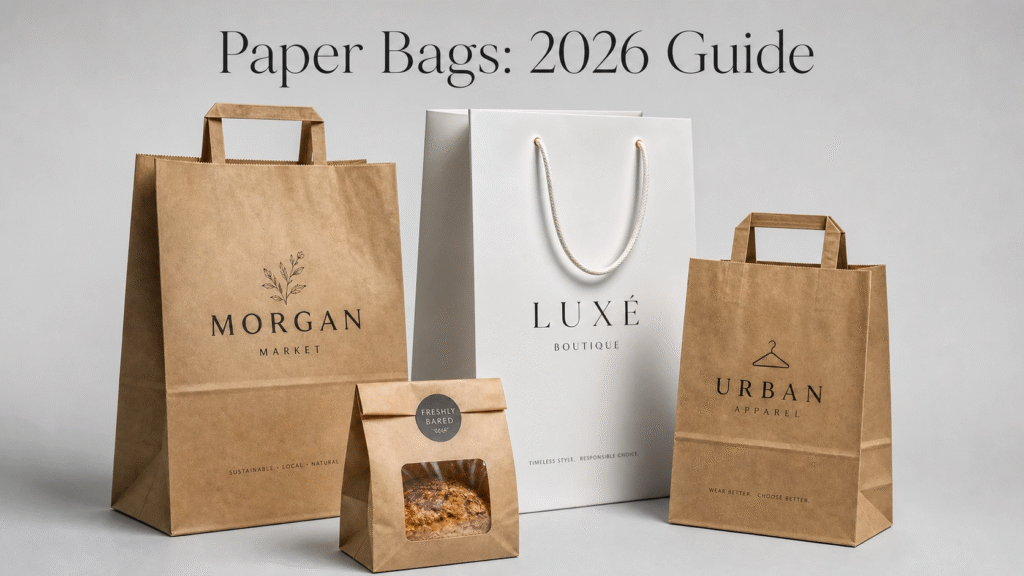
Quick Answer: Paper bags are recyclable, biodegradable carriers made from kraft or recycled paper. They are widely used for grocery, retail, food service, and luxury packaging, offering an eco-friendly alternative to plastic bags when sourced and recycled responsibly.
Key Takeaways
- Made from kraft paper, recycled paper, or FSC-certified virgin fibers
- Eco-credentials: recyclable, compostable, and reusable
- Handle options: twist, flat, die-cut, or rope handles for different load requirements
- Strength indicator: measured in GSM; higher GSM means heavier-duty carrying capacity
What Are Paper Bags?
A paper bag is a packaging container made from paperboard or kraft paper, designed to carry goods. According to the Handbook of Paper and Paperboard Packaging Technology (Wiley, the industry’s definitive reference), paper bags are manufactured through a series of converting processes that transform paper rolls into finished bags with specific strength and dimensional characteristics. While simple in concept, modern paper bags are engineered for specific strengths, finishes, and branding capabilities.
How Paper Bags Are Made
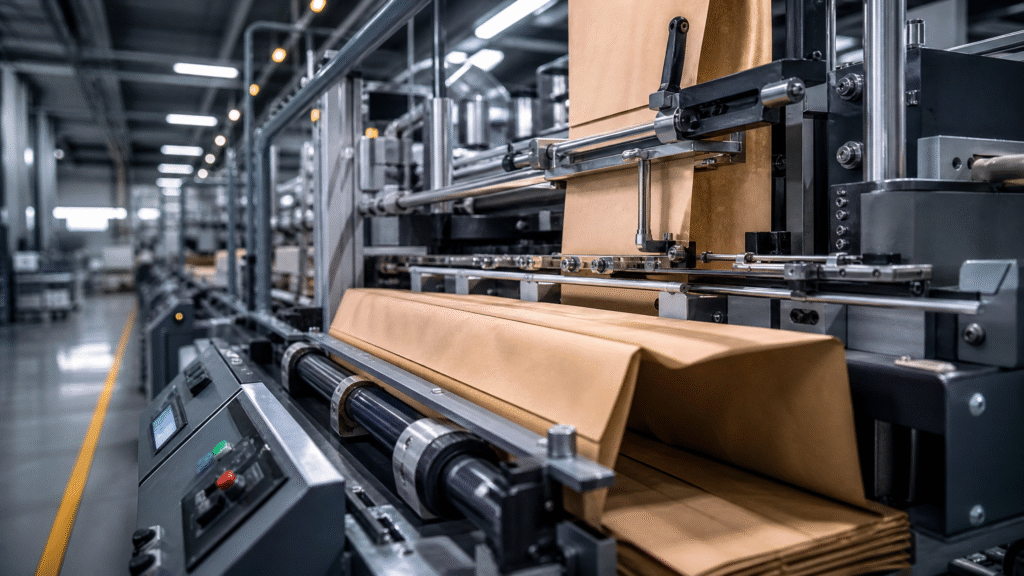
Understanding the manufacturing process helps buyers appreciate why material quality and construction matter.
Step 1: Pulping
Wood chips are cooked in a chemical solution to break down lignin (the natural glue that holds wood fibers together). This creates a pulp slurry of cellulose fibers. The kraft process, which uses sodium hydroxide and sodium sulfide, produces exceptionally strong fibers because it preserves fiber length.
Step 2: Sheet Formation
The pulp is washed, refined, and pumped onto a moving wire mesh screen. Water drains away, and the fibers bond together to form a continuous paper web. This web passes through heated rollers to remove remaining moisture and create a smooth, uniform sheet.
Step 3: Converting
The finished paper roll—often weighing several tons—is fed into a bag-making machine. The machine performs multiple operations in sequence:
- Tube formation: The flat paper is folded into a cylindrical tube, with overlapping edges glued to form a seam
- Bottom folding: The tube is cut to length, and one end is folded into a flat or gusseted bottom
- Bottom sealing: A cold or hot adhesive is applied to seal the bottom securely
- Handle attachment (optional): For bags with handles, twisted paper ropes or flat paper handles are glued or heat-sealed to the bag body
Step 4: Quality Control
Finished bags are tested for tensile strength, burst resistance, seam integrity, and handle attachment strength. GSM is measured to ensure weight consistency. Many manufacturers also test bottom-load capacity to certify weight-bearing specifications.
Step 5: Printing (Optional)
If the bag requires custom branding, printing is applied either before converting (on the flat paper roll) or after bag formation, depending on the printing method and design complexity.
Types of Paper Bags (By Style and Handle)
Choosing the right style determines functionality and brand perception.
| Bag Type | Handle Type | Best Use Case |
|---|---|---|
| SOS Bags (Self-Opening) | None or twisted | Groceries, takeaways, produce; expands to hold bulky items |
| Flat Handle Bags | Flat paper handle | Retail, apparel; handle glued to exterior for a neat look |
| Twisted Handle Bags | Twisted paper rope | Most popular for retail; strong, comfortable, cost-effective |
| Die-Cut Handle Bags | Cut-out hole | Lightweight items like gifts and pastries; no added material |
| Euro Tote (Luxury) | Reinforced flat or rope | Boutiques, high-end retail; gusseted bottom for stability |
| Bakery and Food Bags | None | Pastries, bread, deli; often includes transparent window and grease-resistant lining |
| Merchandise Mailing Bags | None | E-commerce shipping; durable, moisture-resistant, tear-resistant seal |
Paper Bag Sizes (Dimensions and Capacity)
Standard sizes vary, but here is the industry benchmark for shopping and grocery bags, measured as Width × Gusset × Height:
| Size Category | Dimensions (Inches) | Typical Load Capacity | Common Uses |
|---|---|---|---|
| Small | 5 × 3 × 8 | Up to 5 lbs | Jewelry, cosmetics, small gifts |
| Medium (Standard) | 10 × 5 × 13 | 8–10 lbs | Apparel, books, general retail |
| Large (Grocery) | 12 × 7 × 16 | 15–20 lbs | Heavy groceries, multiple items |
| Extra Large | 16 × 10 × 20 | 25+ lbs | Bulk purchases, oversized apparel |
| Wine Bag | 4 × 4 × 15 | 2–3 bottles | Wine and spirits; often with reinforced bottom |
Paper Bag Materials (Kraft, White, Recycled)
The material dictates strength, texture, and printability.
- Natural Kraft Paper: Unbleached brown paper. The strongest option due to the natural length of cellulose fibers. Ideal for heavy groceries and industrial use.
- White Kraft Paper: Bleached for a clean, premium look. Best for vibrant printed paper bags with logos.
- Recycled Paper: Contains post-consumer or post-industrial waste. Slightly weaker but excellent for eco-branding. According to industry data, each paper bag contains an average of 40 percent recycled content.
- FSC-Certified Virgin Paper: Sourced from responsibly managed forests. Crucial for brands with strict sustainability policies.
Printed Paper Bags vs Plain Paper Bags
A plain kraft bag is functional; a printed paper bag is a mobile marketing asset.
| Feature | Plain Paper Bags | Printed Paper Bags |
|---|---|---|
| Branding | None | Logo, slogan, full-color artwork |
| Printing Methods | N/A | Flexography (bulk), Offset (high detail), Digital (small runs) |
| Color Options | Brown or White | CMYK and Pantone matching |
| Cost | Low | Medium to high due to setup and plate costs |
| Perceived Value | Basic, commodity | Premium, professional |
For buyers searching “paper bags with logo”: Custom printing is the primary driver. Most B2B buyers use this term when they need branding-specific solutions. The key decision points are print area, ink type (water-based vs solvent-based), and minimum order quantities.
Paper Bags with Logo (Customization Deep-Dive)
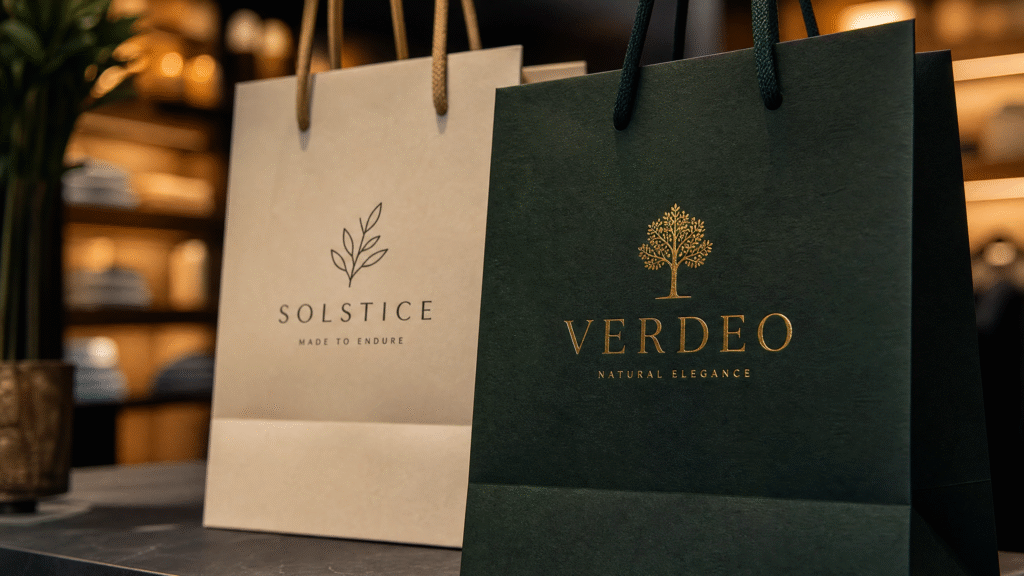
For retailers and restaurants, logo bags are non-negotiable.
Key Considerations:
- Printing Area: Front panel, both sides, or full-wrap
- Ink Type: Water-based for eco-friendliness vs solvent-based for vibrancy
- MOQ (Minimum Order Quantity): Typically 500–1,000 pieces for custom flexo printing
- Die-Cut vs Sticker: For small orders, applying a logo sticker can be more cost-effective than direct printing
Are Paper Bags Eco-Friendly?
Yes, but with caveats. They are superior to plastic in end-of-life impact, but have a higher production carbon footprint.
According to the U.S. Environmental Protection Agency (EPA), paper and paperboard products achieved a recycling rate of over 65 percent—the highest among materials in municipal solid waste. In comparison, plastic bags are recovered at only a 10 percent rate.
The Eco Checklist:
- Recyclable: Yes. They can be pulped and remade into new paper up to 5–7 times.
- Compostable: Yes. Brown kraft bags are safe for home composting when using chemical-free inks.
- Reusable: Yes. High-GSM bags can be reused for months. Research indicates that reusable bags with multiple reuses significantly reduce environmental footprint.
- Carbon Impact: Producing one paper bag emits more CO2 than one plastic bag. However, paper’s biogenic carbon and recyclability offset this over time.
Paper vs Plastic: Recycling Rate Comparison
| Material | Recycling Rate | Notes |
|---|---|---|
| Paper Bags | Over 65% | Widely accepted in curbside programs; fiber degrades after 5–7 recycling cycles |
| Plastic Bags | ~10% | Rarely recycled; most end up in landfill or oceans; requires specialized facilities |
Source: U.S. Environmental Protection Agency (linked above)
Paper Bag Decision Flowchart
Choose the right paper bag in 4 simple steps:
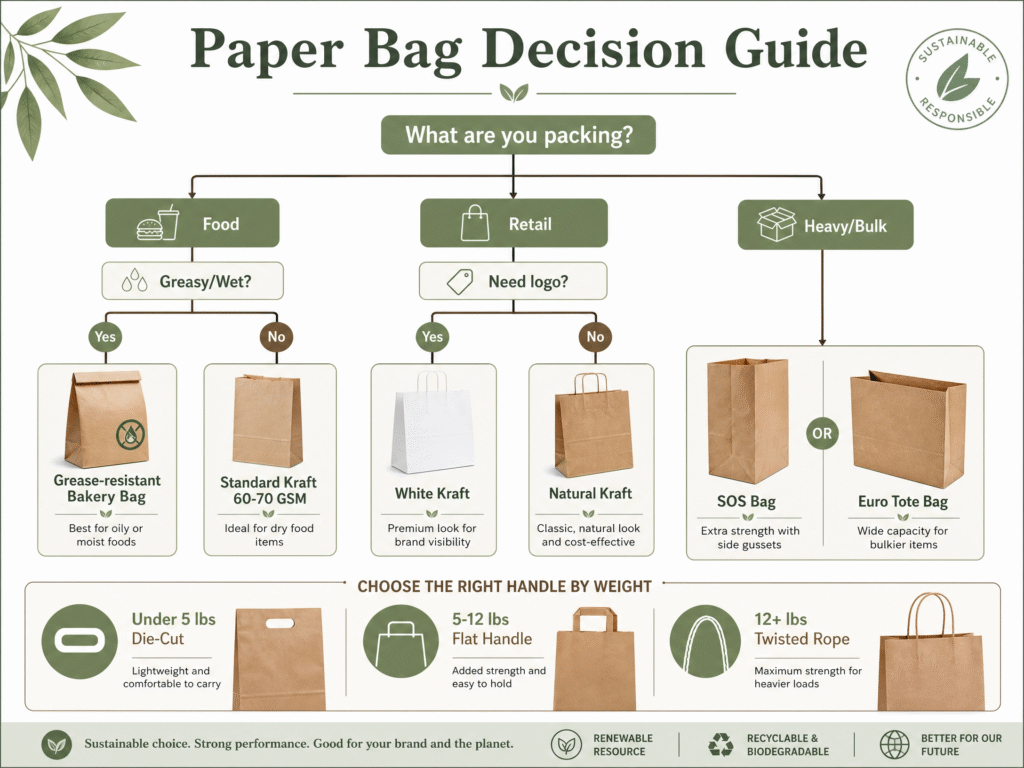
Decision Summary:
| Your Product | Bag Type | Paper Color | Handle Type | GSM Range |
|---|---|---|---|---|
| Greasy food (pastries, deli) | Bakery with grease-proof lining | Natural Kraft | None | 40–60 |
| Dry food (produce, bread) | SOS | Natural Kraft | None or twisted | 60–70 |
| Apparel, gifts (lightweight) | Flat or die-cut | White or Natural | Flat or die-cut | 40–50 |
| Apparel, gifts (medium weight) | Twisted handle | White or Natural | Twisted | 50–60 |
| Books, luxury goods | Euro Tote | White (premium) | Reinforced flat | 70–80 |
| Groceries, bulk items | SOS or Twisted handle | Natural Kraft | Twisted | 70–80+ |
| Wine, heavy bottles | Wine bag | Natural or White | Twisted | 80+ |
| E-commerce shipping | Mailing bag | Natural Kraft | None | 60–70 |
HEMCBags Technical Insight: One Mistake Almost Every Buyer Makes
After producing millions of paper bags for supermarkets, retailers, restaurants, and packaging distributors worldwide, we have observed a consistent pattern: most buyers prioritize the wrong specifications.
The Thickness Trap
One of the biggest mistakes buyers make is choosing paper weight by thickness instead of GSM (Grams per Square Meter). Thickness is a measure of caliper—the physical height of the paper. It can be artificially increased by adding fillers or using looser fiber structures without actually improving strength.
GSM, by contrast, measures the density of the paper. A 70 GSM bag with high-quality kraft fibers and proper fiber alignment often outperforms an 80 GSM bag made from inferior pulp or weaker fiber bonding.
The Handle Blind Spot
Another common oversight: buyers focus on the bag body while ignoring the handle attachment method. We have seen countless retail failures where the bag body held perfectly, but the handle detached mid-carry—spilling contents and damaging brand reputation.
Heat-sealed handles consistently outperform glued handles for heavy loads. Glue can fail under humidity, temperature fluctuations, or prolonged storage. Heat-sealing fuses the handle fibers directly into the bag body, creating a bond that withstands real-world carrying conditions.
The Premium Paper Assumption
Many buyers automatically choose white kraft paper assuming it is “premium.” White paper is undeniably elegant and provides superior print contrast. However, for grocery and food service applications, natural kraft paper typically delivers higher tear resistance and better sustainability perception among consumers.
The bleaching process for white paper weakens fiber structure slightly. For applications where strength matters more than aesthetics—heavy groceries, takeaway packaging, bulk items—natural kraft is often the better choice.
The Bottom Line
Before ordering paper bags, evaluate these factors in order of importance:
- Load weight — tested with actual product samples, not estimates
- Moisture exposure — humidity, cold chain, outdoor conditions
- Handle attachment — heat-sealed vs glued, double-ply vs single-ply
- Bottom reinforcement — single-ply vs double-ply with patch
- Printing requirements — colors, position, ink type
- Recycling regulations — verify local compliance requirements
A 70 GSM twisted-handle kraft bag with reinforced bottom patches and heat-sealed handles will consistently outperform an 80 GSM bag with poor handle bonding and weak bottom construction. The difference is not in the paper weight—it is in the engineering.
Paper Bag vs Plastic Bag: Quick Summary
| If you need… | Choose |
|---|---|
| Lowest cost | Plastic |
| Best branding surface | Paper |
| Best recyclability | Paper |
| Wet or humid environment | Plastic (or coated paper) |
| Heavy grocery carrying | Paper (80+ GSM with reinforced handles) |
| Luxury retail presentation | Paper (Euro Tote, white kraft) |
| Fast checkout packing | Paper (stands upright, easy to open) |
| Long-term storage | Plastic |
| Compostable end-of-life | Paper (uncoated kraft) |
| Lightweight shipping | Plastic |
Detailed Comparison
| Criteria | Paper Bags | Plastic Bags |
|---|---|---|
| Raw Material | Renewable (Trees) | Non-renewable (Fossil Fuels) |
| Production Energy | High | Low |
| Recyclability | 100% recyclable | Limited; often downcycled |
| Biodegradability | 2–6 months | 500+ years |
| Water Resistance | Low | High |
| Branding Space | Excellent | Poor |
| Consumer Perception | Eco-friendly, premium | Environmentally harmful |
A life cycle assessment published in Cleaner Environmental Systems (Elsevier, 2024) examined the comparative environmental impact of plastic and paper carrying bags. Research indicates that kraft paper bags demonstrate higher negative impacts in certain categories during manufacturing, but the study emphasizes that recycling infrastructure and reuse behavior are decisive factors—a higher percentage of reuse and effective recycling systems significantly reduce the eco-impact of paper bags.
Why Are Paper Bags Becoming Popular Again?
After decades of plastic dominance, paper bags are experiencing a global resurgence. Several converging forces are driving this comeback:
- Plastic Bans and Regulations: The EU Packaging and Packaging Waste Regulation (PPWR) places significant emphasis on sustainable packaging solutions. In the US, states including California, New York, and Colorado have enacted plastic bag bans, while major cities like Boston and Chicago have followed suit. These regulations force retailers to seek compliant alternatives.
- Corporate ESG Commitments: Fortune 500 companies are racing to meet 2025 and 2030 sustainability targets. Paper bags, particularly those with FSC certification and high recycled content, provide a tangible way to demonstrate environmental responsibility.
- Consumer Preference Shift: Modern consumers increasingly view paper packaging as more natural, trustworthy, and aligned with their values. A bag that rustles, carries a natural texture, and visibly degrades creates a sensory experience that plastic cannot replicate.
- Retail Branding Opportunity: Paper bags offer superior print surfaces for logos, slogans, and custom designs. They transform a functional carrier into a mobile billboard that walks out of the store with every customer.
Common Applications Across Industries
- Retail: Apparel, shoes, luxury goods (Euro Totes)
- Food Service: Takeaways, bakeries (Window Bags)
- Grocery: Heavy-duty SOS Bags
- E-commerce: Mailing Bags for shipping
- Promotional: Custom printed bags for tradeshows and events
Market Data: Paper Bags Industry Growth
The global paper bags market continues to expand, driven by regulatory pressure and shifting consumer preferences. According to industry research, the market is projected to grow at a compound annual growth rate of approximately 5.5% through 2030.
Key Growth Drivers:
- EU PPWR implementation
- US state-level plastic bans
- Asia-Pacific retail expansion
- Food service packaging demand
This growth trajectory underscores the long-term viability of paper bags as a primary packaging solution.
FAQ
Are paper bags recyclable?
Yes. According to the U.S. Environmental Protection Agency (linked above), paper products achieve a recycling rate of over 65 percent, the highest among materials in municipal solid waste. Most curbside recycling programs accept paper bags as long as they are clean and dry.
Are paper bags compostable?
Unbleached, non-coated kraft paper bags are home compostable. Bags with plastic linings, wax coatings, or foil are not compostable.
Are paper bags waterproof?
Standard paper bags are not waterproof. They absorb moisture and lose strength when wet. For applications requiring moisture resistance, choose bags with grease-proof coatings, PE laminations, or wax linings—though these may affect recyclability.
Are paper bags stronger than plastic?
For equal weight, plastic bags are generally stronger and more tear-resistant. However, high-GSM paper bags (80+ GSM) with reinforced handles can carry 20–25 lbs, matching the capacity of standard plastic grocery bags. Paper bags also hold their shape better, making them easier to pack and stack.
Are brown paper bags better than white ones?
It depends on the application. Brown kraft bags are stronger (unbleached fibers retain length and integrity), more sustainable (no bleaching chemicals), and convey a natural, rustic brand image. White kraft bags offer superior print contrast for vibrant logos and colors, and present a cleaner, more premium aesthetic. Choose brown for strength and sustainability; choose white for branding and visual impact.
Are paper bags made from recycled paper?
Not always. Paper bags contain an average of 40 percent recycled content. Paper bags can be made from virgin kraft pulp, recycled paper, or a blend of both. FSC-certified virgin paper ensures responsible forestry; recycled content reduces landfill waste. Many manufacturers offer custom blends to balance strength and sustainability.
How many times can paper bags be recycled?
Paper fibers shorten with each recycling cycle. High-quality kraft fibers can be recycled 5–7 times before becoming too short to bond effectively. After that, the fibers are used for lower-grade paper products like newsprint or cardboard.
How much weight can paper bags hold?
Standard retail bags (50–60 GSM) hold 8–12 lbs. Heavy-duty grocery bags (70–80 GSM) hold 15–20 lbs. Extra-heavy bags with reinforced bottoms and twisted handles (80+ GSM) can hold 25 lbs or more.
Why do grocery stores use paper bags?
Grocery stores are adopting paper bags due to plastic bag bans, consumer preference for sustainable packaging, and the structural benefits of paper—they stand upright, pack easily, and communicate eco-responsibility.
Can paper bags be reused?
Yes. High-GSM paper bags with strong handles can be reused 10+ times, functioning effectively as reusable totes. Research indicates that reusable bags significantly reduce environmental footprint when reused multiple times. Many consumers intentionally reuse sturdy paper bags for storage, gift wrapping, and secondary shopping trips.
Conclusion
Paper bags are no longer just a commodity; they are a strategic branding and sustainability tool. Whether you need a budget-friendly SOS bag for groceries or a custom-printed, high-GSM Euro tote for luxury retail, the key lies in understanding the material, GSM, and handle construction.
By choosing responsibly sourced and fully recyclable paper bags, businesses not only meet regulatory standards but also build stronger connections with environmentally conscious consumers.