
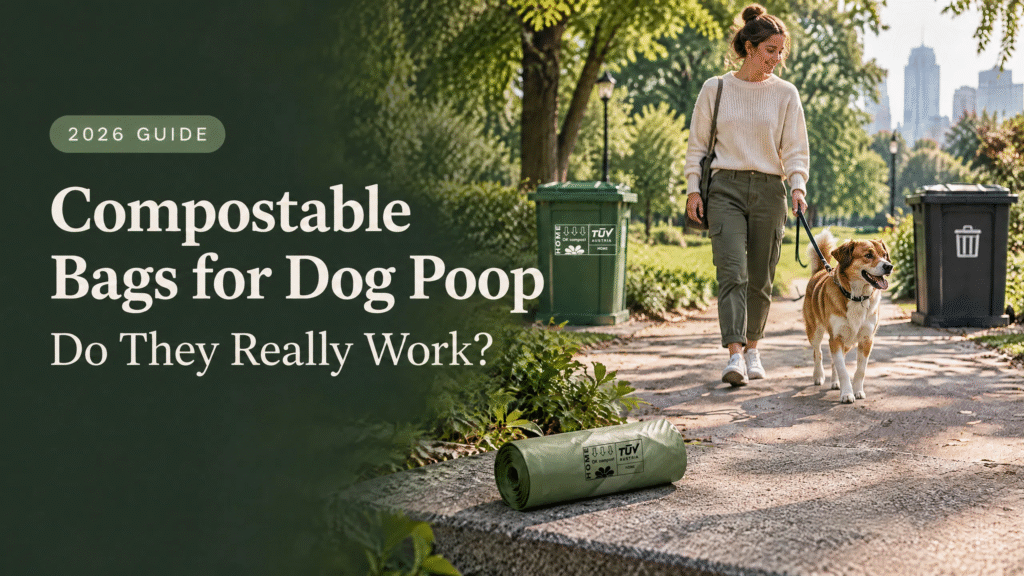
Quick Answer: A compostable dog poop bag can be compostable without making the dog poop itself safe or acceptable for composting. Many ordinary backyard compost piles and municipal green-bin programs reject pet waste because of pathogen concerns, but rules vary by location. Always check the local program before choosing a bag.
The single most important rule: Dog poop is not automatically accepted as food waste or yard waste. Local programs may classify it differently, so check your council or waste hauler’s rules. The bag and the waste inside it are two separate questions.
Compostable Bags for Dog Poop: The Decision Table
Use this table to identify the correct disposal route for your situation.
| Your disposal situation | What to do | What to verify |
|---|---|---|
| Standard home compost pile | Do not add dog waste | Pathogen risk; typical backyard piles do not reliably reach required temperatures |
| Municipal green bin | Check local rules — programs vary widely | Some explicitly ban pet waste; others accept it |
| Dedicated dog waste composter | Use bags the system specifies | Product instructions + system requirements |
| General rubbish / landfill | Certification does not make it compost | Leak resistance + durability matter more |
| Dog waste collection service | Use whatever bag the service specifies | Service rules take priority |
A compostable dog poop bag should only go in a green bin if the local waste program explicitly accepts both pet waste and compostable bags. Many programs accept neither, because dog waste may contain pathogens and compostable plastics may not break down during the facility’s processing cycle.
Can You Compost Dog Poop at Home?
Do not put dog poop in an ordinary backyard compost pile. It can contain roundworms, hookworms, and whipworms—parasites that shed eggs in dog faeces. Typical backyard piles do not reliably reach and maintain the temperatures needed to destroy all pathogens and parasite eggs. Specialized dog-waste composting is possible, but it requires a controlled system.
Expanded content:
Home composting of dog waste is not recommended for standard backyard systems. The core problem is pathogen survival. The University of Florida IFAS Extension advises that dog manure should not be added to regular compost bins or piles without following a specific recipe and reaching the required temperature.
If you are composting other household waste at home, see our guide to compostable bags for compost bins for the general framework on home vs. industrial compostability.
What about specialized dog-waste composting?
Research and extension guidance describe controlled dog-waste composting methods. The University of Florida IFAS Extension provides a recipe requiring:
- 2 parts dog manure
- 1 part sawdust (carbon source)
- Reaching at least 140°F (60°C)
- Turning at least once a week
- 4–8 weeks to reach a crumbly, dirt-like mixture
The Fairbanks Soil and Water Conservation District, with technical assistance from USDA NRCS, developed similar methods for northern climates. Their guidance emphasizes temperature monitoring, repeated turning, and a long curing period.
Critical limitation: The University of Florida notes that researchers were not able to confirm whether Toxocara canis (roundworm) is killed during the process. For that reason, they advise using the resulting compost only on non-food plantings such as flower beds and shrubs.
Key distinction: Certification of the bag does not address the pathogens inside it. A bag can be certified home compostable and still fail to disintegrate in real-world home compost conditions. For a deeper look at how home compostable certification works, see our guide to home compostable vs. industrially compostable bags.
Can Compostable Poop Bags for Dogs Go in the Green Bin?
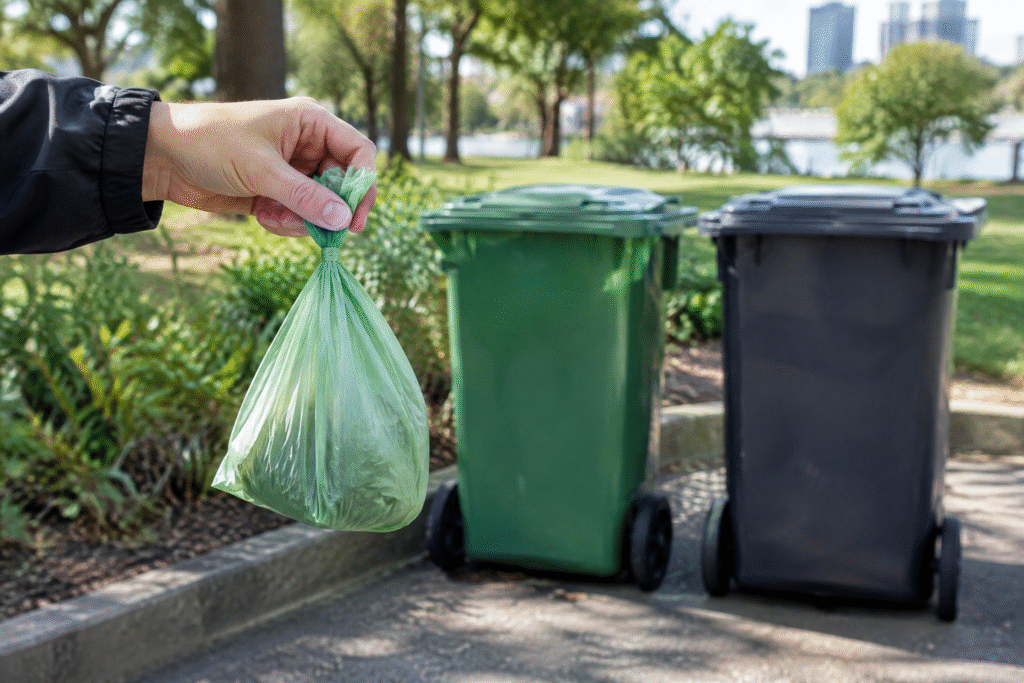
Usually, no. A compostable dog poop bag should only go in a green bin if the local waste program explicitly accepts both pet waste and compostable bags. Many programs accept neither, because dog waste may contain pathogens and compostable plastics may not break down during the facility’s processing cycle.
Why most green bins reject dog waste:
Many municipal organics programs explicitly reject pet waste, even when the bag is labeled compostable. A common explanation from waste authorities is that the local composting facility does not accept dog or cat poop, and that certification of the bag does not override the facility’s acceptance rules.
A second barrier is the waste itself. Dog waste can spread pathogens and diseases including roundworms, hookworms, and whipworms.
Where green bins DO accept dog waste:
Regional exceptions exist. The City of Oshawa, Ontario updated its Green Bin program in July 2024 to explicitly accept pet waste and pet litter for weekly collection. The City of Onkaparinga in South Australia provides compostable dog waste bags at dispensers across the city and states that “the used bags are okay to go in your green organics bin.”
Key distinction: The bag and the waste are two separate acceptance questions. Even if a facility accepts certified compostable bags for food waste, that does not mean it accepts dog waste inside them.
Are Compostable Dog Poop Bags Actually Compostable?
Sometimes, but only under the conditions covered by the certification. A compostable dog poop bag may break down in an approved industrial or home-composting environment, but certification does not mean it will decompose in a landfill, an ordinary backyard pile, or every municipal green-bin system.
Expanded content:
“Compostable” can be a defined technical claim when it is supported by a recognized certification and a named standard. A certified compostable bag has been assessed against a specific standard (ASTM D6400, EN 13432, AS 5810, etc.) for biodegradation, disintegration, and environmental safety under specified conditions.
If you want to understand how the main certifications differ, see our comparison of EN 13432 vs. ASTM D6400 vs. OK Compost HOME.
Biodegradable has no unified standard. A manufacturer can use this term without certification.
Oxo-degradable plastics are designed to fragment through oxidation rather than undergo biological composting. Fragmentation can result in persistent plastic fragments rather than compost. EU Directive 2019/904 bans products made from oxo-degradable plastic from being placed on the market in the EU.
Real-world disintegration research:
A 2024 study published in Waste Management investigated certified home compostable plastic bags in outdoor household composting conditions containing dog faeces. The study reported the following results: “None of the tested bags met the Australian Standard AS5810 minimum disintegration requirements of 90% mass loss of plastic fragments >2 mm, with average mass change of certified home compostable bags ranging from +1.51 to -81.28%.” The study concluded that “dog owners should avoid including compostable plastic bags in their home composts” due to potential risks of microplastic contamination.
How We Evaluate the Best Compostable Poop Bags for Dogs
Evaluation methodology: Based on publicly available product specifications, certification claims, and published usability information. This is not independent laboratory testing.
We compared products using the following decision criteria:
- Leak resistance: Seam strength, bottom design, gusset construction
- Tear resistance: Opening strength, tensile durability during pickup
- Certification clarity: Clear certification mark vs. vague “biodegradable”
- Opening and tying: Ease of separation from roll, handle design
- Size and storage: Fit for dog size, roll format, shelf-life stability
How Different Compostable Dog Poop Bags Compare
Note: Because we did not independently test these bags, this table does not establish a definitive overall ranking. It summarizes publicly available claims and specifications to help readers narrow their options. Prices and availability change frequently. Verify current certifications and prices before purchase.
| Product | Example use case | Certification claim shown in listings | Verification status | Thickness | Size | Key feature | Main drawback |
|---|---|---|---|---|---|---|---|
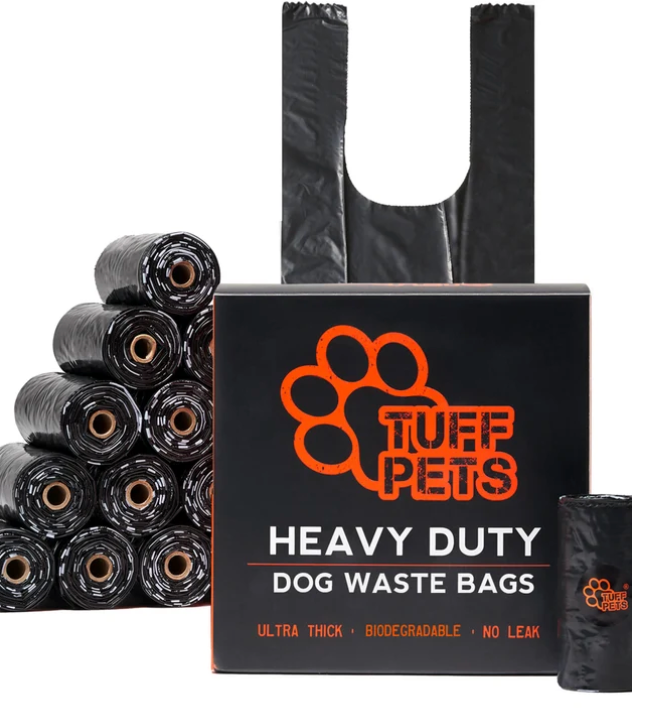
| Tuff Pets | Positioned for larger dogs | OK Compost HOME, EN 13432 | Retailer/product-page claim | 20 microns | 34×14 cm | Tie handles; strengthened gusset; tabbed sticker | Higher price per bag |
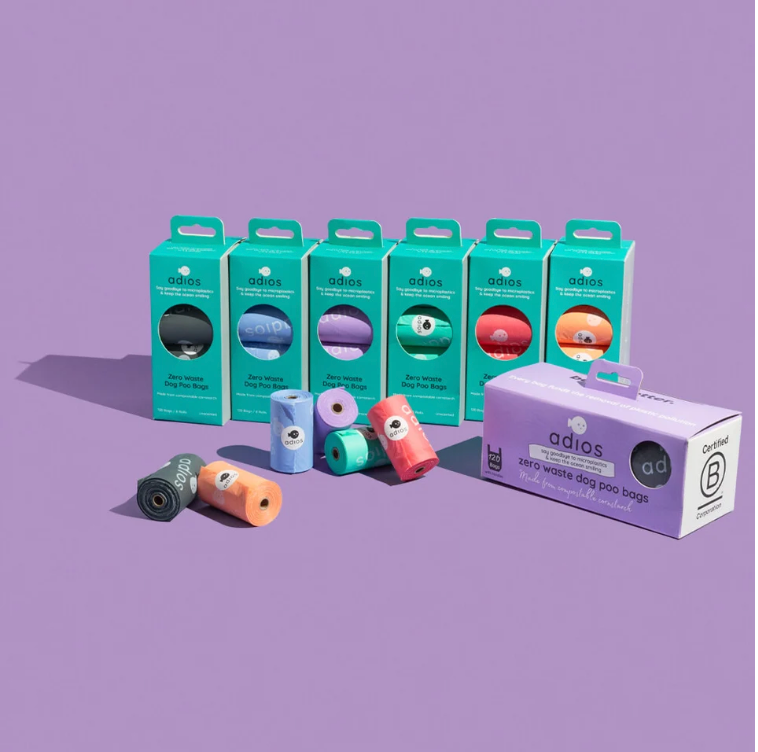
| Adios Plastic | Everyday walks | EN 13432, TÜV Austria HOME | Product-page claim; verify current certificate | 20 microns | 13×9 in | One-hand opening; leakproof; multiple colours | Premium price |
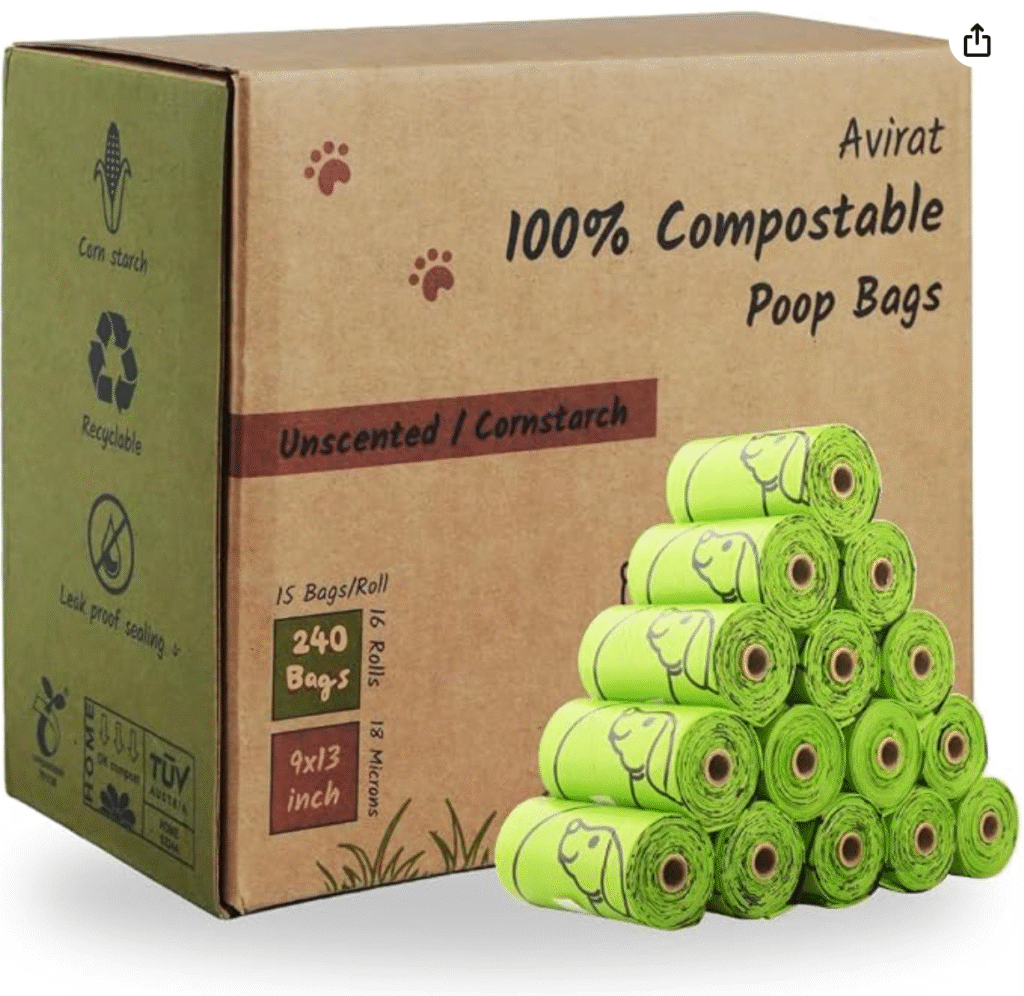
| Avirat | Budget shoppers | TÜV Austria OK Compost HOME | Retailer claim; verify product SKU | 18 microns | 13×9 in | 240 count bulk; easy peel stickers | Mixed reviews on durability |
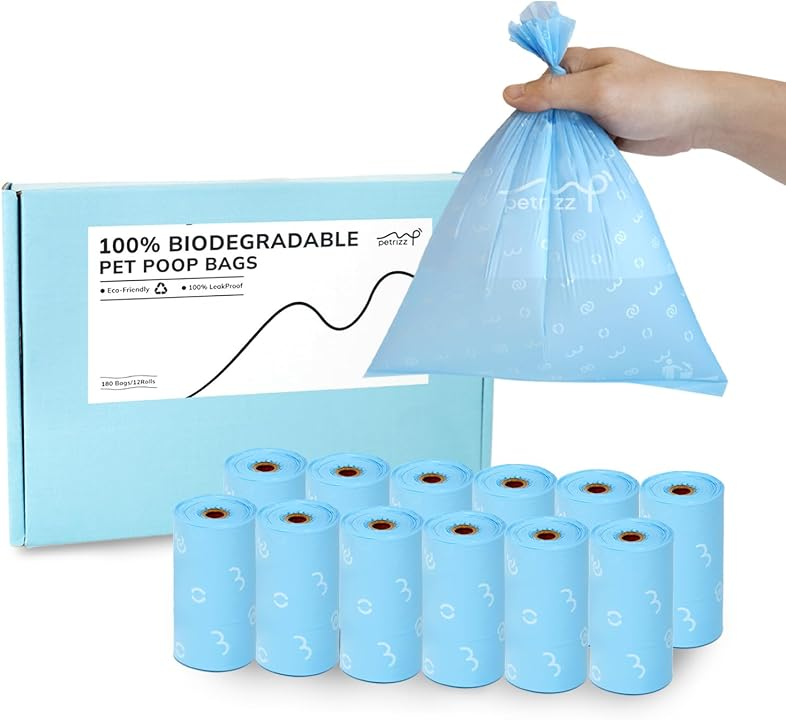
| Petrizz | Bulk buying | BPI, ASTM D6400, OK Compost HOME | Unverified; do not rely without official confirmation | Not specified | 9×12.4 in | 180 count; unscented | Currently unavailable on some platforms |
Important caution: For Petrizz, the BPI certification claim appears in the product listing, but a buyer review for a similar BIOOK product noted that the BPI logo was missing from the actual packaging despite being shown on the Amazon page. Verify BPI certification directly in the official BPI directory before relying on this claim.
Key considerations by use case:
| Category | Recommended direction | Why |
|---|---|---|
| Overall | Certification clarity + leak resistance + ease of opening | Balanced performance |
| Large dogs | Wider, longer bags with longer handles (Tuff Pets) | Effective opening size matters more than total dimensions |
| Leak resistance | Reinforced seams, gusseted bottoms | Seams are the primary failure point |
| Unscented | No added fragrance | Some dogs and owners prefer unscented |
| Home-composting-system compatibility | Only for dedicated dog-waste composters | Not for standard home compost piles |
| Budget | Roll packs, larger quantities | Store cool and dry; use within shelf life |
Important nuance: OK Compost HOME certifies the bag’s behavior under specified home-composting test conditions. It does not certify that dog feces inside the bag can be safely composted in an ordinary backyard pile.
For a closer look at how compostable bag materials affect strength and degradation, see our guide to PBAT vs. PLA vs. starch-based compostable bags.
What Certifications Mean for Compostable Dog Poop Bags
| Standard / Certification | Typically represents | Relevance to dog poop bags |
|---|---|---|
| ASTM D6400 | US commercial/industrial compostable plastics standard | Only meaningful if bag and contents reach industrial composting. Does not certify dog waste pathogen safety. |
| BPI | North American certification program based on ASTM D6400 | Certification of the bag does not establish acceptance of pet waste. Verify current product scope. |
| EN 13432 | European industrial composting/packaging requirements | Industrial composting only |
| OK Compost HOME | Home composting conditions | Bag can home compost ≠ dog waste can home compost |
| “Biodegradable” | No unified standard | May be oxo-degradable; fragments into persistent plastic pieces |
Certification does not make a bag compost in a landfill. If the used bag will go into general rubbish, leak resistance and durability may matter more in practical terms, although certification can still verify that the product meets a defined compostability standard.
What to Look For in Compostable Poop Bags for Dogs
Certification (if applicable):
- If the bag is only going to general rubbish: certification does not change landfill outcome
- If local program accepts dog waste: look for EN 13432 or ASTM D6400
- If using a dedicated home dog-waste composter: check whether the product is specifically suitable for that system
Thickness and durability:
Thickness can be useful for comparison, but it should not be treated as a universal quality threshold. Material formulation, seam design, and gusset construction matter as much as micron count. Look for independently tested leak resistance and strong seams.
Leak resistance:
Dog waste is heavier and wetter than kitchen scraps. The most common failure point is the seam. Look for reinforced gussets or seamless bottom designs.
Ease of opening:
Compostable bags are often harder to open than conventional plastic bags, especially in cold or wet weather. The City of Onkaparinga notes that their compostable bags “will take a little more time and care to open to avoid ripping.”
Size and handle:
- Small dogs: standard sizes usually work
- Large dogs: choose wider, longer bags with longer handles
- Don’t rely on total dimensions alone — look at effective opening size and bottom capacity
Storage and shelf life:
Compostable bags are sensitive to heat, moisture, and light. Store in a cool, dry, dark place. Use within the manufacturer’s recommended shelf life.
How to Check Your Local Rules for Dog Waste
Search your council or waste hauler’s website for:
- “dog waste disposal”
- “pet waste green bin”
- “dog waste composting”
- “pet waste collection”
Check specifically for:
- Whether dog waste is accepted in green bin programs
- Whether specific bags are required
- Whether there are dedicated dog waste collection points
- Whether general rubbish disposal is permitted
- Whether there are dedicated dog waste composting services
Regional examples showing how much rules vary:
| Location | Local rule | What it demonstrates |
|---|---|---|
| Davis, California | Dog waste must go in trash; not accepted in organics | Certification does not override facility rules |
| Onkaparinga, Australia | Compostable dog waste bags accepted in green organics bin | Some systems explicitly allow them |
| Oshawa, Ontario | Pet waste accepted in Green Bin since July 2024 | Regional exceptions exist |
These examples are illustrative, not interchangeable. A bag accepted in Onkaparinga may not be accepted in Davis or another council.
What Should You Choose?
For those who can only use general rubbish:
- Prioritize leak resistance and tear resistance
- Certification does not change landfill outcome
- Choose reinforced seams and adequate thickness
For those with a dedicated dog waste composting service:
- Buy the product specified by the service
- Confirm which certification the service accepts
- Do not substitute other “compostable” bags
For those with a dedicated home dog-waste composter:
- Follow system certification and instructions
- Confirm that the system follows a documented temperature protocol—for example, reaching approximately 140–145°F (60–63°C), with repeated turning and an appropriate curing period
- Use finished compost only on non-food plants
Bottom Line
- Do not put dog poop in an ordinary backyard compost pile. Specialized dog-waste composting is possible, but it requires controlled conditions.
- Most green bins do not accept dog waste — but rules vary by location. Check your local program.
- Certification does not make a bag compost in a landfill. If it’s going to general rubbish, leak resistance and durability matter more.
- If you have a dedicated dog waste composter, use bags the system specifies.
- For most users, a suitable compostable dog poop bag should have strong seams, adequate capacity, easy opening, and clear certification claims that match the intended disposal system.
- Check local rules first. Dog waste is not automatically food waste or yard waste.
Sources and Further Reading
Standards and certification bodies
- ASTM D6400 — Standard Specification for Labeling of Plastics Designed to be Aerobically Composted in Municipal or Industrial Facilities
- BPI — Certified Compostable program
- TÜV Austria — OK Compost HOME
Government and regulatory sources
- EUR-Lex — Directive (EU) 2019/904 on oxo-degradable plastics
- City of Onkaparinga — Compostable dog waste bags
- City of Oshawa — Green Bin
Peer-reviewed research
Extension and technical guidance