
Short answer: As of September 18, 2026, Massachusetts does not have an enacted statewide plastic checkout bag ban in effect. However, statewide legislation has advanced: S.2541 remains a current plastics-reduction bill referred to Senate Ways and Means, while the 2026 Mass Ready Act moved from S.3050 to the amended and reprinted Senate text S.3064. S.3064 is still in conference after the House and Senate disagreed on amendments. Many Massachusetts communities already regulate single-use checkout bags. Boston allows certain compostable checkout bags, which must be labeled “compostable” and satisfy the city’s certification guidance.
This guide explains the current status of the Massachusetts plastic bag ban bill, how it differs from local ordinances, and what retailers need to know before buying replacement bags.
If you are comparing state requirements, see our separate guide to the 2026 California plastic bag ban and compliant bag requirements. California and Massachusetts do not use the same rules, so retailers should not assume that a bag accepted in one state is automatically accepted in the other.
Important: This article provides general information, not legal advice. Retailers should confirm the current requirements with the applicable Massachusetts state, city or town authority before purchasing or distributing checkout bags.
Massachusetts Plastic Bag Ban: Quick Answers
| Question | Answer |
| Is there one statewide Massachusetts plastic bag ban currently applying identically everywhere? | No. Massachusetts has considered statewide legislation, while many cities and towns already have local bag ordinances. |
| Are local plastic bag restrictions already active? | Yes. Many Massachusetts communities regulate or restrict single-use checkout bags. |
| Are compostable checkout bags allowed in Boston? | Yes, if they meet Boston’s requirements. |
| What certification does Boston identify for compostable checkout bags? | ASTM D6400. |
| Must a Boston compostable checkout bag be labeled? | Yes. Boston’s guidance says the bag must say “compostable” on the outside and display the required certification information. |
| Is Senate Bill S.590 already a Massachusetts law? | No. The official bill history does not show that S.590 was enacted as a statewide plastic bag ban. |
| Are the rules identical in every Massachusetts city and town? | No. Local requirements can differ. |
Is the Massachusetts Plastic Bag Ban Bill Law in 2026?
No enacted statewide plastic checkout bag ban is currently in effect as of September 2026. Massachusetts has, however, developed multiple statewide proposals that have moved through the Legislature. The most useful way to understand the current position is to separate the original S.590 proposal, the consolidated S.2541 plastics bill, and the later 2026 Mass Ready Act proposal.
Current Massachusetts plastic bag legislation status
| Bill or legislative development | What happened | Status as of September 2026 |
| S.590 — An Act relative to plastic bag reduction | Filed in 2025; referred to Environment and Natural Resources; later accompanied by a new draft. | Not enacted as written. The official history points to S.2541 as the new draft. |
| S.2541 — An Act to reduce plastics | Reported on June 23, 2025 as a new draft combining S.543, S.554, S.589, S.590, S.609, S.629, S.630, S.643 and S.654. | Current. Referred to the Senate Committee on Ways and Means. It is a live legislative proposal, not an enacted law. |
| S.2542 — An Act to build resilience for Massachusetts communities | Governor Healey’s environmental resilience bill; the Senate Ways and Means Committee recommended a new draft. | Replaced by the new draft S.3050 in April 2026. |
| S.3050 — Mass Ready Act / An Act to build resilience for Massachusetts communities | The Senate passed the bill on April 15, 2026 by a 36–3 vote. Its plastic policy would prohibit single-use plastic bags at retail stores and allow recyclable paper bags with a fee and reusable plastic bags without charge. | Reprinted as amended as S.3064 after Senate action. Not an enacted statewide law. |
| S.3064 — Amended Mass Ready Act text | Officially described as “the text of Senate No. 3050, printed as amended.” The House later amended and substituted text, and the Senate non-concurred. | Pending conference committee action after House and Senate disagreement; not enacted. |
S.590 to S.2541: what changed?
S.590 should not be treated as the only current Massachusetts plastic bag bill. The official S.590 history records that on June 23, 2025 it was accompanied by a new draft, S.2541.
The official S.2541 page identifies S.2541 as a new draft of several bills, including S.590. The combined proposal is titled An Act to reduce plastics and is also described as the Massachusetts Plastics Reduction Act in the bill text.
The official status of S.2541 is:
Current — Referred to the Senate Committee on Ways and Means.
This means S.2541 remains relevant to searches about the Massachusetts plastic bag ban bill, but it has not become a statewide law merely because it is listed as “Current.”
The S.2541 text proposes that a retailer or charging entity would not provide a carryout bag unless it is a recycled paper bag or reusable bag. It also proposes a minimum 10-cent charge for recycled paper bags, with five cents directed to a state plastics environmental protection fund. The bill text contains exceptions and separate definitions, and its proposed effective dates are not the same as the date on which the bill was filed. These are proposed provisions, not current statewide requirements.
2026 statewide development: S.3050 and amended text S.3064
In April 2026, the Massachusetts Senate advanced a separate statewide plastics proposal within the Mass Ready Act, formally identified as S.3050, An Act to build resilience for Massachusetts communities. After the Senate amended and engrossed the bill, the Legislature created S.3064 as the reprinted amended Senate text.
The official Senate press release states that:
•The Senate passed S.3050 on April 15, 2026;
•The vote was 36–3;
•The proposal would prohibit single-use plastic bags at retail stores;
•It would allow recyclable paper bags with a 10-cent fee;
•Five cents of that fee would go to a state Plastics Environmental Protection Fund;
•It would allow reusable plastic bags without charge; and
•The Senate text was reprinted as amended as S.3064 and sent to the House of Representatives.
•The House later amended the measure and substituted new text.
•The Senate non-concurred in the House amendment, and a conference committee was appointed.
The official S.3064 bill history confirms the April 2026 Senate action, the reprinting of S.3050 as amended, the House amendments and the subsequent conference process. As of the current official record, S.3064 is a live legislative measure in conference, not an enacted statewide plastic bag ban. Retailers should therefore distinguish between “the Senate passed and amended a proposal” and “Massachusetts law currently prohibits these bags.”
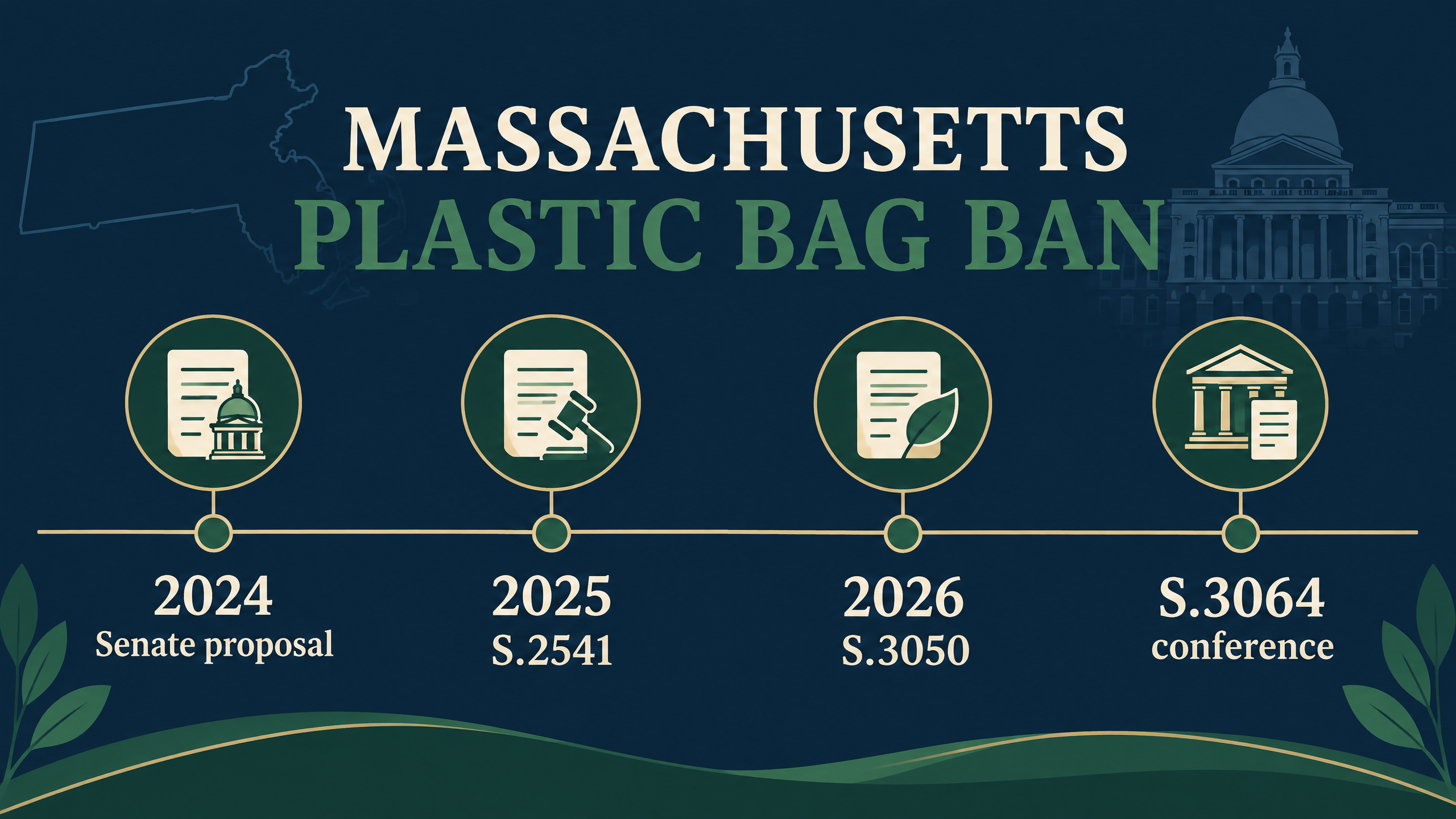
Legislative timeline
| Date | Development | What it means |
| June 2024 | The Senate passed S.2830, an earlier Plastics Reduction Act proposal, by a 38–2 vote. | The proposal included a statewide carryout plastic bag prohibition, but Senate passage did not by itself enact the bill. |
| February 2025 | S.590 was referred to the Committee on Environment and Natural Resources. | S.590 entered the 2025–2026 legislative process. |
| June 23, 2025 | The Legislature reported S.2541 as a new draft combining S.590 and several other plastics bills. | S.2541 became the more relevant consolidated plastics proposal. |
| January–April 2026 | S.2542, the Governor’s resilience bill, moved through committee and was replaced by S.3050. | The Mass Ready Act became a separate legislative vehicle containing a statewide plastic bag proposal. |
| April 15, 2026 | The Senate passed S.3050 by 36–3 and sent it to the House. | The proposal advanced, but it was not automatically law. |
| September 18, 2026 | S.2541 remains Current and is referred to Senate Ways and Means. S.3064 remains Current after the House and Senate disagreed and appointed conference committees. | No enacted statewide plastic checkout bag ban is established by these records. Local ordinances remain important. |
The Massachusetts plastic bag ban bill has moved through multiple legislative vehicles since 2024.
The current practical situation is:
•Massachusetts has repeatedly advanced statewide plastic bag proposals.
•S.2541 is the current consolidated plastics bill associated with S.590.
•S.3050 is the original Senate Mass Ready Act draft; S.3064 is the amended and reprinted Senate text now carrying the later legislative history.
•S.3064 remains pending after the House and Senate disagreed on amendments and a conference committee was appointed.
•Neither S.2541 nor S.3064 should be described as an enacted statewide ban unless the official record later shows enactment.
•Many cities and towns already have local plastic bag ordinances.
•Retailers must follow the rule that applies to their location and the specific type of bag they distribute.
Massachusetts State Rules vs. Local Plastic Bag Ordinances
The Massachusetts plastic bag ban bill is often confused with local ordinances. They are two different things.
| Location or rule level | Current practical situation | What retailers should do |
| Massachusetts statewide | Statewide plastic bag reduction bills have been proposed, but retailers should verify whether a specific proposal has become law. | Check the Massachusetts Legislature and Mass.gov for the current official status. |
| Boston | The city has an active plastic bag ordinance. | Follow Boston’s requirements for bag type, certification, labeling, handles, charges and receipts. |
| Other Massachusetts cities and towns | Many communities have local restrictions, but requirements may vary. | Check the current ordinance for the exact city or town where the store operates. |
A retailer in Boston should not assume that a rule in Cambridge, Worcester, Quincy or another community is identical. The same caution applies to suppliers: a product that is accepted under one local ordinance should not automatically be marketed as compliant throughout Massachusetts.
Are Compostable Bags Allowed in Massachusetts?
Compostable bags may be allowed under some Massachusetts local ordinances, but they are not automatically accepted everywhere. The answer depends on the specific city or town, the product type, the certification, the label and the way the bag is used.
Retailers should not rely only on a product description that says “biodegradable” or “eco-friendly.” Those terms do not, by themselves, prove that a bag meets a local checkout bag requirement.
Before using a compostable bag, a retailer should confirm:
1.Whether compostable checkout bags are an allowed alternative under the local ordinance.
2.Whether the bag must have handles.
3.Which certification standard is required.
4.What wording or certification mark must appear on the outside of the bag.
5.Whether the store must charge customers for the bag.
6.Whether the charge must appear on the receipt.
7.Whether the rule applies to the intended use, such as retail checkout, food service, shipping or waste collection.
Are Compostable Bags Allowed in Boston?
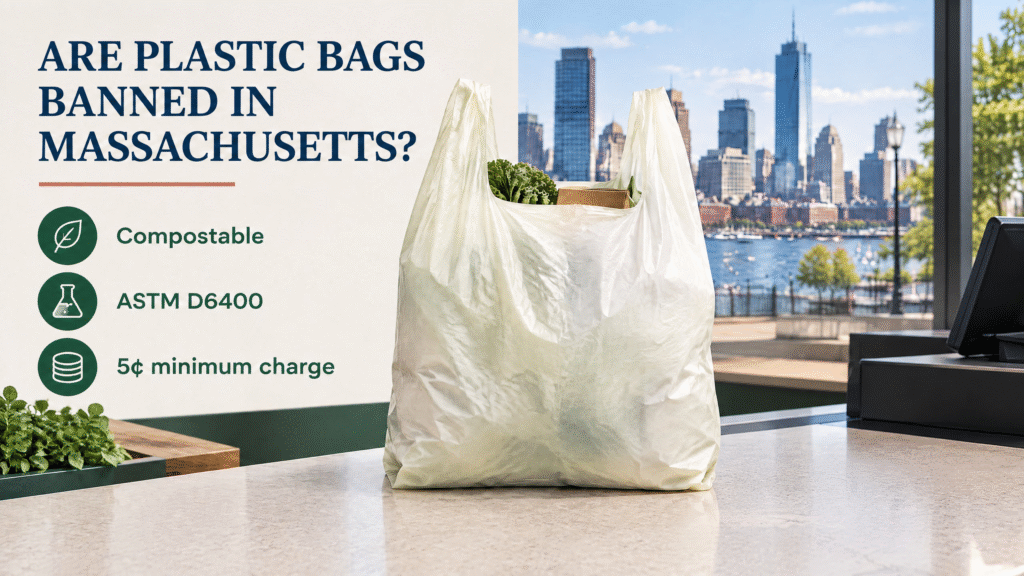
Yes. Boston allows compostable checkout bags when they meet the city’s requirements.
Boston’s official guidance states that stores may provide customers with:
•Reusable bags;
•Recyclable paper bags; or
•Compostable checkout bags.
Boston retailers can no longer stock single-use plastic bags with handles. If a retailer provides a handled bag, it must be one of the alternatives allowed by the city ordinance.
For a compostable checkout bag, Boston’s current retailer guidance says that the bag must:
1.Say “compostable” on the outside of the bag.
2.Meet the city’s compostability certification guidance. The current retailer page identifies ASTM D6400, while Boston’s official compliant-bag checklist also lists BPI certification and the BioBag brand as accepted certification or brand options.
3.Display the required certification information on the outside of the bag.
4.Have handles when used as a handled checkout bag.
5.Be sold in accordance with Boston’s checkout bag charge requirements.
Boston also requires retailers to communicate the bag charge near the register and record the charge on the customer’s receipt. The city’s current guidance states that bags with handles must be sold for at least five cents per bag.
Boston Compostable Bag Requirements at a Glance
| Requirement | Boston guidance |
| Bag type | Compostable checkout bag |
| Handles | Required when used as a handled checkout bag |
| Exterior wording | The bag must say “compostable” |
| Certification | Current retailer guidance identifies ASTM D6400; Boston’s official checklist also lists BPI certification and BioBag brand options |
| Bag charge | At least five cents for a handled bag under the city guidance |
| Register notice | Retailers must display information about the bag charge near the register |
| Receipt | The checkout bag charge must be recorded on the receipt |
| Plastic handled bags | Retailers can no longer stock single-use plastic bags with handles |
Retailers should confirm the current ordinance and city guidance before placing an order because local requirements may be amended.
What Certification Does a Boston Compostable Bag Need?
For compostable checkout bags used under Boston’s ordinance, the current city retailer page identifies ASTM D6400. Boston’s official compliant checkout-bag checklist also lists BPI certification and the BioBag brand as accepted options. This distinction matters because the simplified current webpage and the more detailed checklist present the certification information at different levels of specificity.
ASTM D6400 is a standard for plastics designed to be aerobically composted in municipal or industrial composting facilities. It addresses characteristics such as biodegradation, disintegration and the effect of the material on compost quality.
For a broader explanation of compostable packaging standards, see our compostable certifications guide. The guide should be used as background information; the local authority’s current rule remains the controlling requirement for a retailer’s intended use.
A supplier should provide documentation for the exact product model being sold. Retailers should not assume that a certificate for one bag model covers every bag manufactured by the same supplier.
Before purchasing, request:
•The certification program name;
•The exact product model or SKU covered by the certificate;
•The certification or verification number;
•The issuing or verifying organization;
•The applicable standard, such as ASTM D6400;
•The certificate issue date and expiration date, if applicable;
•The approved material and product scope;
•A physical sample showing the required exterior labeling.
BPI certification is therefore more than a generic marketing reference in the Boston context, but retailers should still confirm that it applies to the exact bag and that the final product labeling satisfies the applicable local ordinance.
Is EN 13432 Enough for Boston?
Retailers should not assume that EN 13432 automatically replaces the ASTM D6400 requirement identified by Boston.
EN 13432 is an important European standard for compostable packaging. However, a local ordinance may identify a specific standard or certification requirement. If a supplier offers a bag certified to EN 13432, the retailer should ask the relevant local authority whether that certification is accepted for the intended use.
The same principle applies to OK Compost Industrial, OK Compost Home and other certification programs. A certification can be valuable, but the retailer must verify that it matches the requirement in the relevant market.
Biodegradable Bags vs. Compostable Bags
The terms “biodegradable” and “compostable” should not be treated as interchangeable.
| Term | What it generally communicates | Automatically sufficient for Boston checkout use? |
| Biodegradable | The material may break down under certain conditions, but the claim may not specify the environment, timeframe or certification. | No |
| Compostable | The product is designed to break down under defined composting conditions. | No, not without the required certification and labeling |
| ASTM D6400 certified | The product has been evaluated against a recognized standard for compostable plastics. | It matches the standard identified by Boston’s guidance, subject to the complete local requirements |
| BPI certified | The product has been certified through the Biodegradable Products Institute program. | Confirm the exact product scope and labeling |
| EN 13432 certified | The product meets a European compostable packaging standard. | Do not assume it substitutes for ASTM D6400 in Boston |
| OK Compost Industrial | The product is certified for industrial composting under the applicable program. | Verify local acceptance |
| OK Compost Home | The product is certified for home composting under the applicable program. | Verify local acceptance and intended use |
A product page should explain the intended disposal environment. A bag certified for industrial composting should not be marketed as suitable for backyard composting unless it also carries the relevant home-composting certification.
Does a Compostable Bag Replace Every Plastic Bag?
No. Plastic bag ordinances usually apply to specific bag types and uses.
A handled checkout bag, produce bag, food-service bag, shipping mailer and garbage bag may be treated differently. A retail checkout ordinance may regulate a handled bag given to a customer at the point of sale, while a shipping mailer may be governed by different commercial, packaging or customer requirements.
A local rule may not apply in exactly the same way to:
•A bag used to contain an unwrapped food item;
•A bag used to protect clothing on a hanger;
•A bag used to separate or protect small products;
•A shipping mailer used for e-commerce fulfillment;
•A garbage bag used inside a waste container;
•A specialty bag used for medical, pet or industrial waste.
Businesses should match the bag to its actual application rather than assuming that one certification or product format covers every use.
What Should Massachusetts Retailers Ask a Bag Supplier?
Retailers should request more than a general statement such as “eco-friendly” or “biodegradable.” Before placing an order, ask the supplier the following questions.
Is the exact product certified?
Ask whether the exact product model is certified to ASTM D6400 or another applicable standard. Request a current certificate or verification document.
Is the bag labeled correctly?
For Boston checkout bags, confirm that the outside of the bag clearly says “compostable” and displays the required certification information.
Does the bag have handles?
If the product will be used as a handled checkout bag, confirm the handle design and whether the local ordinance applies to that bag type.
What material is used?
Ask for the material composition, such as PBAT, PLA, starch-based materials or other biopolymers. The material description should match the certification documents.
What sizes and thicknesses are available?
Confirm the finished bag dimensions, thickness, acceptable tolerance and load capacity. Environmental claims do not replace the need for performance testing.
What is the minimum order quantity?
Ask for separate quantities for samples, trial orders and full production. Wholesale suppliers may have different MOQs for plain bags and custom-printed bags.
Can the bag be custom printed?
Confirm the available printing colors, ink type, artwork requirements, print area and whether the required compostable labeling can be included in the final design.
What is the production lead time?
Request separate lead times for sampling, artwork approval, production, packaging and shipment.
Can the supplier provide test reports?
Ask for relevant testing documentation, including tensile strength, puncture resistance, sealing performance and leak resistance where applicable.
What disposal instructions should appear on the packaging?
The product should tell users whether it is intended for industrial composting, home composting or another disposal route. Vague disposal instructions can create customer confusion and compliance risk.
How to Choose Compostable Checkout Bags for Massachusetts Stores
A Massachusetts retailer should follow this process:
1.Identify the city or town where the store operates.
2.Read the current local bag ordinance.
3.Confirm whether compostable checkout bags are an allowed alternative.
4.Check whether the ordinance requires ASTM D6400 or another certification.
5.Confirm whether the bag must have handles.
6.Check the required exterior wording and certification mark.
7.Confirm the required bag charge and receipt language.
8.Request documentation from the supplier for the exact product model.
9.Order samples and verify the final printing before mass production.
10.Recheck the rule before placing repeat orders because local requirements may change.
Wholesale Compostable Shopping Bags for Massachusetts Retailers
HEMCBags supplies compostable and biodegradable bags for wholesale and custom packaging projects, including shopping bags, mailer bags, pet waste bags and trash bags.
For retailers and distributors evaluating compostable checkout bags, a supplier should be able to discuss:
•Custom dimensions;
•Film thickness;
•Bag style and handle design;
•Material composition;
•Printing and branding;
•Certification documentation;
•Sample approval;
•Minimum order quantity;
•Packaging configuration;
•Production lead time; and
•Shipping and delivery requirements.
HEMCBags can discuss custom manufacturing options for buyers who provide their required bag type, dimensions, thickness, quantity, printing requirements and target market.
Retailers should confirm the current local ordinance before ordering and verify that the certification and labeling of the final product match the requirements of the city or town where the bags will be used.
Request a quote for custom compostable shopping bags
Related U.S. bag compliance guides
•2026 California plastic bag ban and compliant bag requirements
•Compostable certifications guide
•Custom compostable shopping bags
FAQs
Is Massachusetts banning plastic bags statewide?
Massachusetts has considered statewide plastic bag reduction legislation, but a proposed bill should not be confused with a statewide law currently in effect. Many cities and towns already have local plastic bag ordinances.
Is the Massachusetts plastic bag ban bill already law?
No. As of September 18, 2026, the official records reviewed for S.2541 and S.3064 do not show an enacted statewide plastic checkout bag ban. S.2541 remains referred to Senate Ways and Means, while S.3064 is the amended Senate text of S.3050 and is in conference after House and Senate disagreement. Retailers should rely on the final enacted text if a proposal becomes law.
What is the current status of S.2541?
S.2541, titled An Act to reduce plastics, is listed as a current bill referred to the Senate Committee on Ways and Means. It is a consolidated new draft that includes S.590 among several other plastics proposals. Being listed as “Current” means that it remains a legislative proposal; it does not mean that the proposal is already law.
What happened to S.590?
S.590 was a 2025 plastic bag reduction proposal. Its official bill history records that it was accompanied by a new draft, S.2541, on June 23, 2025. S.590 should therefore be discussed as the earlier proposal and linked to the current consolidated S.2541 record.
What happened in April 2026?
The Massachusetts Senate passed S.3050, the Mass Ready Act, on April 15, 2026, by a 36–3 vote. The Senate text was printed as amended as S.3064, then sent to the House. The House later amended and substituted text, the Senate non-concurred, and conference committees were appointed. Senate passage did not itself make the proposal an enacted statewide law.
What is S.3064?
S.3064 is the Senate record for the amended Mass Ready Act text. The official page describes it as “the text of Senate No. 3050, printed as amended.” Its history records Senate passage, House amendments, Senate non-concurrence and the appointment of a conference committee. It is not the same as a final enacted statute.
Are compostable bags allowed in Massachusetts?
Compostable bags may be allowed under some local Massachusetts ordinances, but requirements vary by city and town. Retailers should confirm the applicable local rule before purchasing or distributing them.
Can stores in Boston use compostable checkout bags?
Yes. Boston allows compostable checkout bags, but the bags must be labeled “compostable,” certified to ASTM D6400 and used in accordance with the city’s requirements for handled checkout bags and bag charges.
Are biodegradable bags automatically legal in Boston?
No. The word “biodegradable” alone does not prove compliance. Retailers should confirm the product’s certification, labeling, design and intended use.
Do compostable bags need handles in Boston?
For a handled checkout bag in Boston, the bag needs handles. Requirements for other bag types and other communities may differ.
Is EN 13432 automatically accepted in Boston?
Retailers should not assume that EN 13432 automatically replaces the ASTM D6400 requirement stated by Boston. Confirm the current local rule and obtain advice from the relevant authority when necessary.
Can one compostable bag be used for shopping, mailers and garbage?
Not necessarily. Each application has different performance, labeling, certification and disposal requirements. A shopping bag certification should not automatically be used to market the same product as a certified mailer or garbage bag.
Should retailers buy compostable bags before checking the local ordinance?
No. Retailers should first identify the applicable city or town ordinance, then verify the exact certification and labeling requirements with the supplier.
Conclusion
The Massachusetts plastic bag ban bill remains pending in conference committee, but local ordinances already affect retailers across the state.
The Massachusetts plastic bag market is shaped by both proposed statewide legislation and existing local ordinances. Massachusetts does not currently have one uniform statewide plastic checkout bag rule that applies identically to every city and town.
Boston allows compostable checkout bags when they meet specific requirements, including ASTM D6400 certification, visible compostable labeling, handled-bag requirements and the applicable checkout bag charge rules.
Retailers should not assume that every compostable bag is allowed everywhere in Massachusetts. The correct approach is to verify the local ordinance, confirm the certification for the exact product model, check the handle and labeling requirements, and follow the applicable bag charge rules.
For wholesale buyers, a qualified compostable bag supplier should provide clear specifications, current certification documentation, samples, custom printing options and reliable production information. This allows retailers to select a bag that is not only marketed as sustainable, but also appropriate for its intended use and local requirements.
For custom compostable shopping bags, mailer bags, pet waste bags and trash bags, contact HEMCBags.
Sources
1.Massachusetts Legislature — Bill S.2541 — Current consolidated plastics bill and official bill history.https://malegislature.gov/Bills/194/S2541.Html
2.Massachusetts Legislature — S.2541 bill text — Proposed Massachusetts Plastics Reduction Act text.https://malegislature.gov/Bills/194/S2541/Senate/Bill/Text
3.Massachusetts Legislature — Bill S.590 — Earlier plastic bag reduction proposal and official new-draft history.https://malegislature.gov/Bills/194/S590.Html
4.Massachusetts Legislature — Bill S.3050 — Original 2026 Mass Ready Act draft and Senate history.https://malegislature.gov/Bills/194/S3050.Html
5.Massachusetts Legislature — Bill S.3064 — Amended and reprinted Senate text with House and conference history.https://malegislature.gov/Bills/194/S3064.Html
6.Massachusetts Senate — Senate Delivers Mass Ready Act — April 15, 2026 official press release confirming Senate passage and House referral.https://malegislature.gov/PressRoom/Detail?pressReleaseId=364
7.Massachusetts Senate — Fact Sheet for S.3050 — Official summary of the proposed statewide plastic bag provisions.https://malegislature.gov/PressRoom/Detail?pressReleaseId=357
8.Boston.gov — Reducing plastic bags in the City of Boston — Boston’s current plastic bag ordinance guidance.https://www.boston.gov/departments/environment/reducing-plastic-bags-city-boston
9.Boston.gov — Understanding the plastic bag ordinance — Boston retailer requirements for compostable, paper and reusable bags.https://www.boston.gov/departments/environment/understanding-plastic-bag-ordinance
10.Boston.gov — Overview of Compliant Checkout Bags — Official checklist listing ASTM D6400, BPI and BioBag certification or brand options.https://www.boston.gov/sites/default/files/imce-uploads/2018-12/overview_of_compliant_checkout_bags_checklist.pdf
11.Mass.gov — 105 CMR 630.00: Plastic bags and plastic film — Massachusetts regulation page.https://www.mass.gov/regulations/105-CMR-63000-plastic-bags-and-plastic-film
12.Massachusetts Legislature — Senate Acts to Ban Plastic Bags, Reduce Straw and Plasticware Usage — Official 2024 Senate press release describing proposed statewide legislation.https://malegislature.gov/PressRoom/Detail?pressReleaseId=103
13.ASTM International — ASTM D6400 — Standard specification for compostable plastics.https://store.astm.org/d6400-21.html
14.Biodegradable Products Institute — U.S. compostable products certification organization.https://bpiworld.org/