
Quick Answer
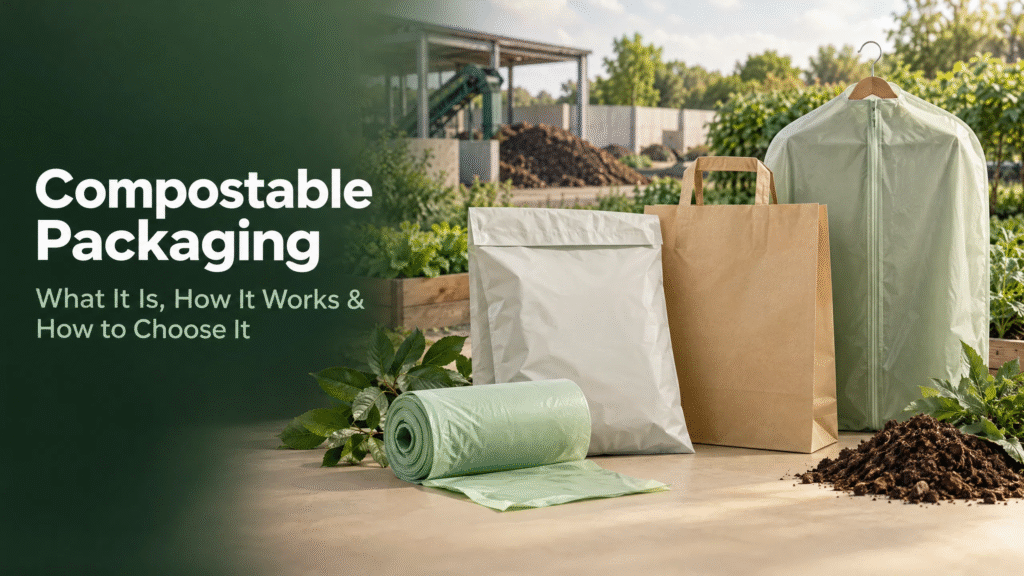
Compostable packaging is packaging designed to break down under specified composting conditions into carbon dioxide, water, biomass, and compost-compatible residues. Certified products are assessed against defined requirements for biodegradation, disintegration, ecotoxicity, and compost quality.
Not all “biodegradable” packaging is compostable, and not all compostable packaging works in every composting system.
What Is Compostable Packaging?
In technical terms, compostable packaging is packaging that meets specific standards for biodegradability, disintegration during biological treatment, effect on the biological treatment process, and effect on the quality of the resulting compost.
This definition comes from EN 13432, the European standard for packaging recoverable through composting and biodegradation. In North America, ASTM D6400 provides specifications for plastics designed for aerobic municipal and industrial composting facilities. ASTM D6868 is also relevant to paper or other substrates with plastic coatings.
ASTM D6400 and ASTM D6868 are technical specifications or standards. Certification is provided by an independent certification body, such as BPI, based on applicable standards and testing requirements. Similarly, EN 13432 is a standard, while BPI, TÜV Austria OK compost, and DIN CERTCO operate certification schemes.
The key distinction is that “compostable” is a defined category with recognized standards and certification systems — not simply a marketing term. Under EN 13432, at least 90% of the organic carbon in the material must biodegrade within six months under the specified test conditions, while disintegration is assessed separately after 12 weeks. Under other standards, the specific test methods and timeframes differ.
Without recognized certification or other appropriate evidence, buyers have less assurance that a compostable claim has been independently verified against a defined standard.
Compostable vs. Biodegradable Packaging
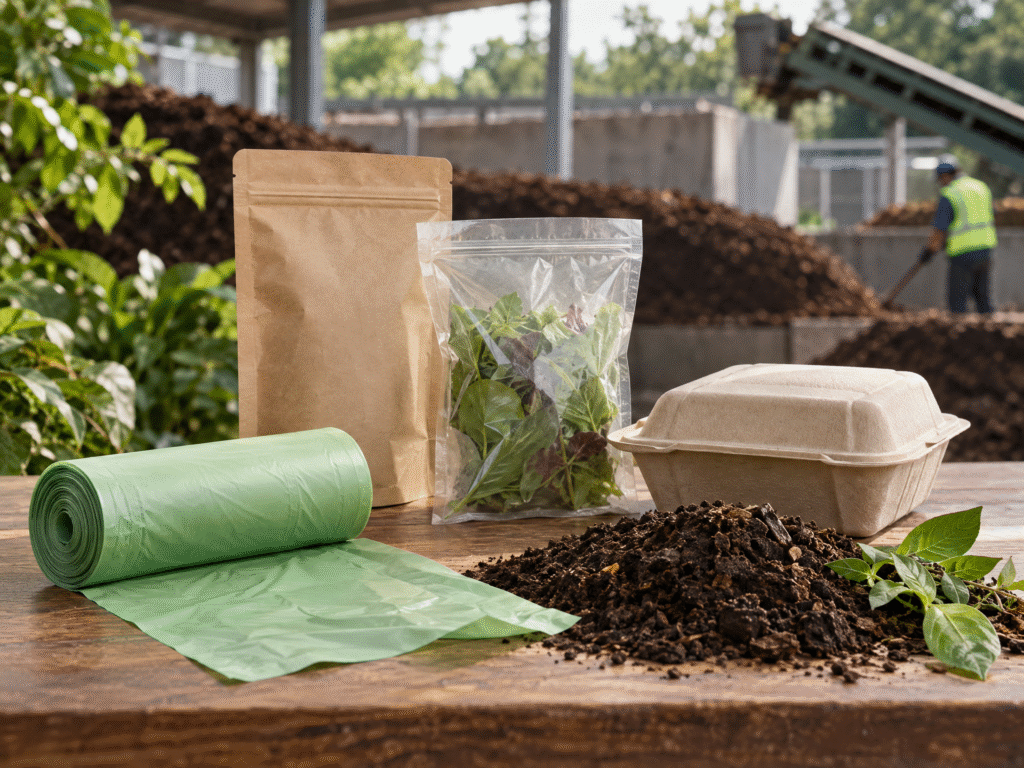
“Biodegradable” and “compostable” are often used interchangeably. They are not the same.
Biodegradable is a broader, weaker term. It indicates that a material can be broken down by microorganisms, but it says nothing about the timeframe, the conditions required, or whether the end products are environmentally safe. A plastic bag can be technically “biodegradable” and still take decades to break down in a landfill.
Compostable is a specific claim tied to standards, test methods, and timeframes. When supported by recognized certification, it can be verified against defined criteria.
The European Commission has stated that “biodegradable” claims must specify how, under which circumstances, and where the material biodegrades — and that biodegradable should in no case be “a licence to litter.” Some jurisdictions, including parts of the United States, have begun restricting confusing terms like “biodegradable” or “made from plants” on packaging.
For buyers: A bag labeled “biodegradable” is not automatically suitable for composting. A bag labeled “compostable” with a recognized certification is.
How Compostable Packaging Works
Composting is a biological process driven by microorganisms. Here is the sequence.
1. Organic material enters the system. Food scraps, yard waste, and compostable packaging are added to the composting environment.
2. Microorganisms begin consuming the organic matter. Bacteria and fungi drive the process.
3. Temperature rises with microbial activity. Industrial composting systems are typically managed to maintain thermophilic conditions, often around 50–60°C (122–140°F), although operating conditions vary by facility.
4. Moisture and oxygen are consumed. Aerobic conditions must be maintained for efficient decomposition.
5. The organic fraction and compostable polymers are biologically processed. The final outcome depends on the product formulation, certification, and composting environment.
6. Finished compost is produced. The result is a dark, crumbly, earthy-smelling soil amendment.
For compostable packaging to break down efficiently, the composting system needs suitable organic material, microorganisms, temperature, moisture, and oxygen. Without the required conditions, composting may slow down or stop entirely.
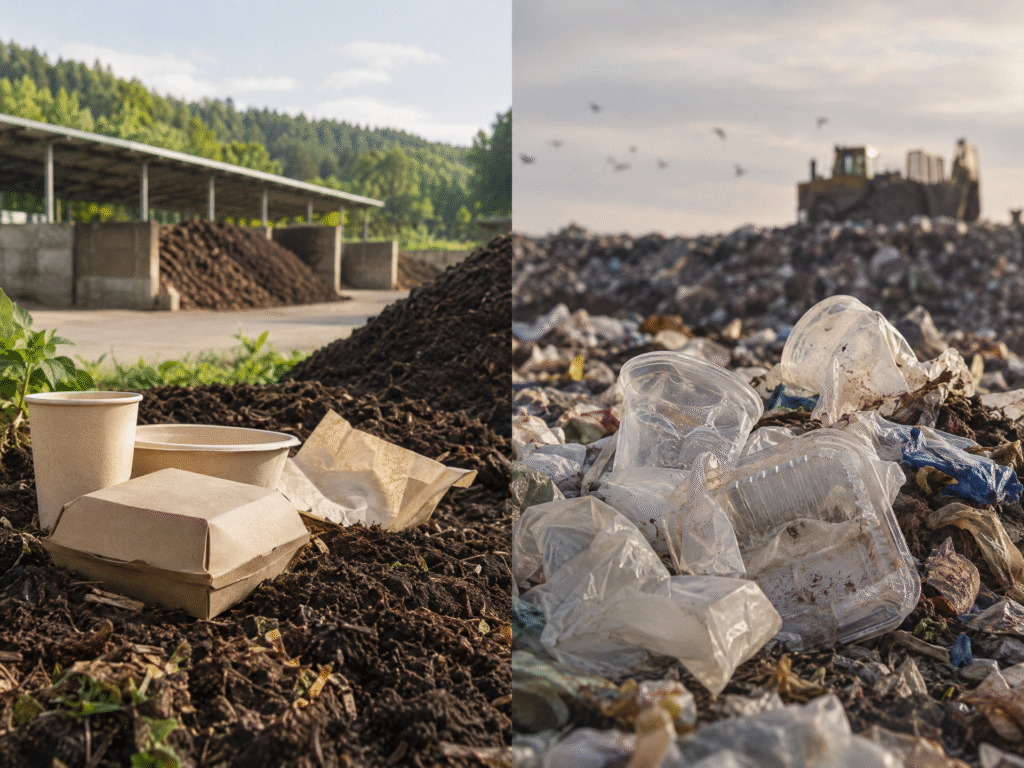
This is why industrial composting facilities — which maintain controlled temperature, moisture, and aeration — are fundamentally different from home compost bins. Packaging designed and certified for industrial composting may disintegrate under controlled commercial conditions but remain substantially intact in a cooler, less managed backyard compost system.
What Materials Are Used in Compostable Packaging?
Compostable packaging is made from a range of materials, both bio-based and fossil-based. The most common include:
| Material | Source | Common Uses |
|---|---|---|
| PLA (Polylactic Acid) | Corn, sugarcane, cassava | Cups, food containers, clear packaging |
| PBAT | Often fossil-derived biodegradable polymer | Trash bags, flexible films |
| PHA (Polyhydroxyalkanoate) | Bacterial fermentation | Food packaging, medical applications |
| Starch blends | Corn, potato, cassava | Bags, films, loose-fill packaging |
| Bagasse | Sugarcane fiber | Food containers, plates, bowls |
| Cellulose | Plant fibers | Compostable films |
| Paper | Wood pulp | Paper bags, wrappers, molded pulp |
A critical point: material alone does not guarantee compostability. According to the CEC’s Milestone Study on Bioplastics Waste Management, approximately half of globally produced bioplastics are biodegradable, while the other half is bio-based non-biodegradable. The compostability of a finished product depends on its formulation, thickness, additives, and printing inks — not just its base material. This is why certification must cover the finished product, not just the resin.
Bioplastics can contain additives such as plasticizers, fillers, and synthetic polymers, and the specific types, amounts, and hazards of these chemicals are rarely disclosed.
What Products Can Be Made From Compostable Materials?
Compostable packaging formats have expanded significantly. Current applications include:
Bags and liners: Compostable garbage bags, food waste liners, pet waste bags, and retail carrier bags.
Food service: Cups, plates, bowls, cutlery, and takeout containers made from PLA, bagasse, or molded fiber.
Flexible packaging: Compostable mailers, garment bags, and films for dry goods.
Retail packaging: Compostable retail bags, produce bags, and branded packaging for consumer goods.
Food-contact packaging: Trays, wraps, and containers for dairy, bakery, and prepared foods.
Common compostable packaging applications include food-waste bags, garbage bags, mailers, garment bags, retail bags, and other flexible packaging formats.
High-barrier compostable flexible packaging remains technically and commercially challenging because barrier layers, coatings, adhesives and inks can affect both performance and end-of-life properties.
Home Compostable vs. Industrially Compostable
This is the most important distinction for buyers — and the source of most consumer confusion.
Industrially compostable packaging is designed to break down under the controlled conditions used in commercial composting facilities, which typically operate at elevated temperatures and controlled moisture and aeration. It may be certified under schemes such as BPI or OK compost INDUSTRIAL, depending on the applicable standard and product structure. Local composting facilities may still apply their own acceptance rules.
Home compostable packaging is designed to break down in backyard compost piles at ambient temperatures (typically 20–30°C). It meets additional testing requirements for lower-temperature conditions and carries certifications such as OK Compost HOME or AS 5810.
The practical implication: A bag certified for industrial composting may not break down in a home compost bin. The TÜV Austria certification system maintains two separate marks — OK Compost INDUSTRIAL and OK Compost HOME — precisely because the conditions are different.
Home compostability is a separate claim from industrial compostability and should be verified against a home-composting standard or certification.
A 2024 study by Bryson et al. published in Waste Management found that home compostable plastic bags are unlikely to fully disintegrate in real-world home composting systems, and that certification test methods may not fully represent the variability of backyard conditions. PubMed record
For buyers: If your packaging will be disposed of in a municipal or commercial composting program, look for industrial compostable certification. If it will go into a home compost pile, look for home compostable certification. They are not interchangeable.
Which Certifications Should You Look For?
Certification is one of the most reliable ways to verify compostability, but buyers should also confirm local facility acceptance and request product-specific documentation.
| Certification / scheme | Typical market | Environment | Underlying standard |
|---|---|---|---|
| BPI Certification | North America | Commercial / industrial composting | ASTM D6400 or ASTM D6868, depending on product |
| OK compost INDUSTRIAL | Europe / global | Industrial composting | EN 13432 / applicable requirements |
| OK compost HOME | Europe / global | Home composting | TÜV AUSTRIA home-compostability requirements |
| AS 5810 | Australia | Home composting | AS 5810 |
| NF T 51-800 | France | Home composting | NF T 51-800 |
What to verify:
- Ask for the certification license number
- Confirm the certification covers the specific finished product, not just the raw material
- Check that the certification matches your disposal environment (industrial vs. home)
- Search the certifying body’s public database to confirm the product is listed
The USDA’s 2025 report notes that third-party organizations including BPI, the Compost Manufacturing Alliance, NSF, and TÜV Austria offer voluntary certification programs for compostable products, while ASTM International and ISO maintain the underlying standards.
How Should Compostable Packaging Be Disposed Of?
Compostable packaging is intended for composting systems, not conventional plastic recycling or littering. Its benefits may not be realized in landfill conditions.
Industrial composting: If the local program accepts certified compostable packaging, it may be placed in organic waste collection along with food scraps and yard waste. Acceptance rules vary by facility and location.
Home composting: Only home compostable certified packaging should go into a backyard compost bin. Industrial compostable packaging will not break down reliably in home systems.
Landfill: Compostable packaging is not designed or tested to deliver its composting benefits in landfill conditions. Landfills generally lack the oxygen, moisture, temperature, and biological conditions required for composting, so buyers should not rely on compostable packaging to break down there.
Plastic recycling: Compostable packaging should not be placed in conventional plastic recycling unless the local recycling program explicitly accepts and sorts it.
Is Compostable Packaging Accepted by Municipal Composting Facilities?
This is one of the most practical questions for buyers — and the answer depends entirely on location.
A major 2024 field study by the Composting Consortium — the largest of its kind in North America — tested over 23,000 packaging units across ten composting facilities. The study found that certified compostable packaging disintegrated effectively under reasonable operating conditions, with compostable plastic packaging achieving an average of 98% disintegration by surface area under the study conditions. This result indicates effective breakdown in the participating facilities, but it should not be interpreted as a universal result for every composting facility.
The study also identified critical factors for successful breakdown: proper moisture (above 50%), temperature, oxygen levels, and mechanical agitation. These conditions are within the control of composting facilities — but not all facilities maintain them consistently.
The practical reality: Access to municipal composting remains limited. The study also emphasized the importance of expanding composting infrastructure in the United States.
For buyers: Before committing to compostable packaging for a specific market, verify whether local composting facilities accept it. Certification verifies the product against defined requirements, but it does not guarantee that a local composting facility will accept it. Buyers should verify both certification and local collection requirements.
How to Choose Compostable Packaging for Your Business
For procurement professionals, the selection process involves several interlocking decisions.
1. Application. What is the packaging for? Food waste collection, retail carrier bags, mailers, food service containers, and garment bags each have different performance requirements — moisture resistance, tear strength, seal integrity, and load capacity.
2. Material. Which material formulation matches the application? PLA, PBAT, starch blends, and paper-based options each have different properties and cost profiles.
3. Thickness. Thicker bags require more material and may take longer to disintegrate. If a thinner formulation meets performance requirements, it reduces material consumption without sacrificing function.
4. Certification. Which certification matches the disposal environment? Industrial compostable (BPI, OK Compost INDUSTRIAL) for municipal programs. Home compostable (OK Compost HOME, AS 5810) for backyard systems.
5. Printing. What inks and adhesives are used? These must be compatible with compostability standards. Manufacturing changes — different inks, different blend ratios — can affect compostability and require separate certification.
6. Packaging format. Bags, mailers, containers, films, or molded fiber. The format must match the use case and the composting system.
7. End-of-life route. Where will the packaging actually go? If there is no composting infrastructure in the target market, the environmental benefit may not be realized.
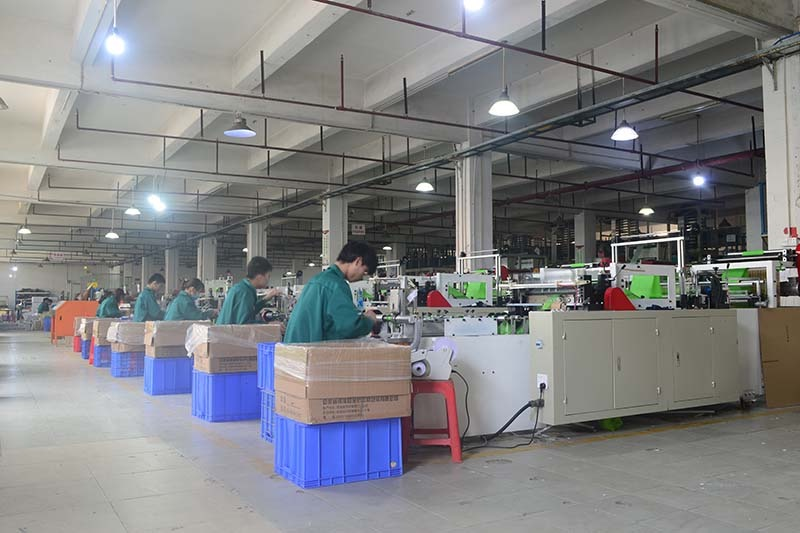
8. Supplier capability. Can the supplier provide certified products at the required volume, with consistent quality and lead times?
For businesses looking for reliable compostable packaging solutions, the right choice depends on the application, certification, customization requirements, and available end-of-life infrastructure.
Questions to Ask a Compostable Packaging Supplier
These questions can help buyers verify a supplier’s certifications, product specifications, and ability to meet the requirements of the intended application.
Certification:
- Which standard does the product meet — EN 13432, ASTM D6400, or another?
- Is the certification for the finished product or only the resin? — This is the key distinction between a genuinely certified compostable product and one where only the raw material has been tested.
- Is it certified for industrial composting, home composting, or both?
- Can you provide the certification license number for verification?
Application:
- What applications has this formulation been tested for?
- What thickness and dimensions are available?
- What performance data (tear strength, load capacity, moisture resistance) can you provide?
Customization:
- What custom sizes, colors, and printing options are available?
- What are the minimum order quantities (MOQ)?
- Can samples be provided before production?
Commercial:
- What is the typical production lead time?
- What quality control processes are in place?
- What is the pricing structure for wholesale volumes?
Disposal:
- Which composting systems accept this product?
- What documentation can you provide for municipal or commercial composting programs?
FAQs
What is the difference between compostable and biodegradable packaging?
“Biodegradable” is a broad term indicating that a material can be broken down by microorganisms, without specifying timeframe or conditions. “Compostable” is a specific, certified claim tied to standards for biodegradation, disintegration, and ecotoxicity.
Is compostable packaging actually compostable in municipal facilities?
A 2024 field study found that certified compostable packaging disintegrates effectively under reasonable operating conditions, with compostable plastic achieving 98% average disintegration by surface area. However, access to municipal composting infrastructure remains limited.
Can compostable packaging go in a home compost bin?
Only if it is certified home compostable (OK Compost HOME, AS 5810, or equivalent). Industrial compostable packaging may not break down reliably in cooler home systems.
Can compostable packaging be recycled?
Compostable packaging should not be placed in conventional plastic recycling unless the local recycling program explicitly accepts and sorts it.
What certifications should I look for?
For industrial composting: BPI (North America) or OK Compost INDUSTRIAL (Europe). For home composting: OK Compost HOME or AS 5810. Always verify that certification covers the finished product, not just the raw material.
What materials are used in compostable packaging?
Common materials include PLA (from corn or sugarcane), PBAT (often fossil-derived biodegradable polymer), PHA (from bacterial fermentation), starch blends, bagasse, cellulose, and paper.
Does compostable packaging leave microplastics?
Compostability certification assesses defined requirements for disintegration, biodegradation, ecotoxicity and compost quality under specified test conditions. It should not automatically be interpreted as proof that a product will never form microscopic fragments under every environmental condition. Buyers concerned about microplastic-related claims should request product-specific test data and ask what the certification and testing actually cover.
Conclusion
Compostable packaging is a defined category with recognized standards and certification systems — not simply a marketing term. Its environmental value depends on material composition, certification matching the disposal environment, and access to composting infrastructure.
For businesses evaluating compostable packaging, the relevant questions are practical. What certification does the product carry? Does that certification match the disposal route? Is composting infrastructure available in the target market? And does the supplier provide verifiable documentation for all of the above?
The 2024 Composting Consortium study provides evidence that certified compostable packaging works in real-world industrial composting conditions. But certification alone is not enough — the infrastructure must exist, and the packaging must be matched to it.
If you are sourcing compostable bags or flexible packaging, HemcBags can provide information on available materials, certifications, documentation, custom sizes, printing, and wholesale requirements. Our guide to compostable certifications explains how to verify that a product meets the requirements for your specific disposal environment.