
Author: HEMCbags Team | Sustainable Packaging Specialists | 10+ Years Experience
Quick Answer: Zero waste lifestyle is a set of principles aimed at reducing waste sent to landfills. Based on the 5 Rs — Refuse, Reduce, Reuse, Recycle, Rot — it focuses on progress, not perfection. Start with one swap: a reusable water bottle or shopping bag.
As zero-waste chef Anne Marie Bonneau famously said, “We don’t need a handful of people doing zero waste perfectly. We need millions of people doing it imperfectly.”
At HEMCbags, we have worked with municipal composting programs, waste haulers, and households across North America and Europe. Based on that experience, we have seen one thing consistently: people don’t fail at zero waste because they don’t care. They fail because they think they have to be perfect.
This guide covers the complete picture — from the science of waste reduction to practical steps for every room in your home — so you can start reducing waste today without overwhelm.
What Is Zero Waste Lifestyle?
Zero waste lifestyle is a set of principles and practices designed to minimize the amount of waste sent to landfills and incinerators. It is not about producing zero trash overnight — it is about making conscious choices to reduce waste wherever possible.
The concept was popularized by Bea Johnson, author of Zero Waste Home, who has been called the “mother of the zero-waste lifestyle” by the New York Times. Her family of four produces just one mason jar of trash per year.
Another prominent voice in the movement is Lauren Singer, a former environmental science student who realized in college that she was creating just as much waste as everyone else. In her TED Talk, she shared the jar technique: for three years, all of her non-recyclable, non-compostable trash fit into a single mason jar.
Singer’s philosophy: “I want to be remembered for the things I did on this planet — not for the trash I left behind.”
Important: Zero waste is not about perfection. It is about progress. Lauren Singer’s iconic mason jar represents years of effort, not overnight success.
The 5Rs of a Zero Waste Lifestyle
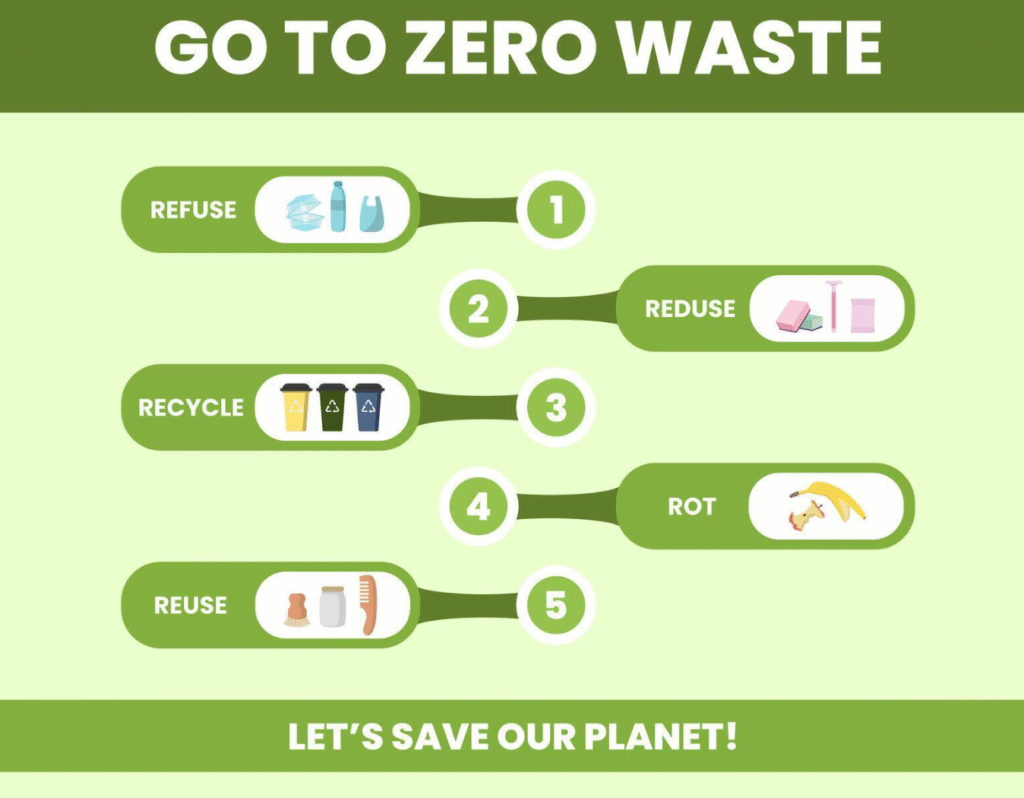
Refuse is the most powerful of the 5 Rs. According to Earth911, avoiding unnecessary items at the source prevents waste before it has a chance to enter your home. This is why the R’s are not just a checklist — they are a hierarchy, and the order matters. This framework was introduced by Bea Johnson and has become the foundation of the zero waste movement.
Refuse
Refuse is the most powerful R. Saying no to what you don’t need — freebies, single-use plastics, junk mail, unnecessary packaging — prevents waste from ever being created. Bea Johnson’s original 3 Rs (Reduce, Reuse, Recycle) often led to too much emphasis on recycling. Adding Refuse at the top shifts the focus to prevention.
Reduce
Reduce means buying less and choosing items with minimal packaging. This is the second most effective action because it reduces demand for resources. Kathryn Kellogg, who runs the blog Going Zero Waste, stopped buying paper towels, K-cups, and plastic containers — and saved $6,000 over a decade. “These simple swaps have saved me $6,000! And they’ve made my life better,” she said.
Before buying anything, ask: “Do I really need this?”
Reuse
Reuse means using what you already have and choosing reusable over disposable. This includes reusable water bottles, shopping bags, coffee cups, and containers. It also means repairing items instead of replacing them.
The unintended bonus: One zero-waste creator’s experiment with this swap eliminated so many repeat purchases that she cut her annual spending significantly.
Recycle
Recycle comes fourth because recycling is not a perfect solution. In fact, most plastic can only be recycled two or three times before it degrades and ends up in a landfill. Recycling is better than landfilling, but it should be the last resort before disposal.
As one sustainability influencer put it, recycling is “the bare minimum” of environmental action.
Rot (Compost)
Rot is the final R. Composting organic waste — food scraps and yard trimmings — returns nutrients to the soil, reduces methane emissions from landfills, and completes the natural cycle. According to the U.S. Environmental Protection Agency (EPA), food scraps and yard waste make up more than 30% of what we throw away, making composting one of the most impactful actions an individual can take.
Why the Order Matters
The hierarchy works because each R is more effective than the one that follows it. Refuse eliminates the problem entirely. Reduce and Reuse prevent waste before it is created. Recycle and Rot manage waste after it exists.
When you start with Refuse, you avoid the entire life cycle impact of a product — extraction, manufacturing, shipping, and disposal. That is why the first R is the most powerful. And when you do have waste, the final R (composting) ensures it returns to the earth instead of a landfill.
What We’ve Learned from Working with Municipal Composting Programs
Based on our experience supplying certified compostable bags to distributors, municipalities, and waste management partners across North America and Europe, we have found that the biggest barrier to reducing household waste is not a lack of motivation — it is uncertainty about where different types of waste belong.
When people are unsure whether something goes in the trash, recycling, or compost bin, they default to trash. This is not laziness. It is a natural response to confusion.
According to the U.S. Environmental Protection Agency (EPA), unclear labeling and confusion about waste sorting are major barriers to increasing recycling and composting rates in the U.S. Studies from the Ellen MacArthur Foundation show that consumer confusion about packaging disposal significantly reduces recycling and compost rates.
In our conversations with municipal waste managers, we have observed that clear labeling and simple guidance are the most effective tools for increasing participation in waste reduction programs. Households that receive clear instructions about what can be composted — and use certified compostable bags for food scraps — consistently reduce their landfill waste faster than those that don’t.
What this means for you: You don’t need to know everything about zero waste to start. You just need one clear, easy action to begin — like separating food scraps for composting.
Why Zero Waste Matters
Zero waste is not just about saving the planet — it’s about addressing specific environmental, economic, and social challenges with measurable data.
The average American generates 4.9 pounds of waste per day. Nationally, that means about 198 million pounds of waste is sent to landfills every single day. The United Nations Environment Programme predicts that global municipal solid waste will grow from 2.1 billion tonnes in 2023 to 3.8 billion tonnes by 2050.
Local governments are increasingly supporting zero waste initiatives. The City of Palo Alto, California, notes that approximately 42% of U.S. greenhouse gas emissions are associated with the materials we use, making waste reduction a critical climate action.
Waste is a Climate Problem
According to the U.S. Environmental Protection Agency (EPA), food scraps and yard waste make up more than 30% of what we throw away. In landfills, this organic material decomposes without oxygen and produces methane — a greenhouse gas more potent than carbon dioxide.
- Landfills account for approximately 15% of U.S. methane emissions
- Reducing organic waste in landfills is one of the most immediate ways to reduce greenhouse gas emissions
Plastic Production is a Resource Problem
A 2020 study published in Science Advances estimated that the global production of plastics has reached approximately 8.3 billion metric tons since the 1950s. Of that, about 6.3 billion tons have become plastic waste, and only about 9% of that has been recycled.
- The production of one plastic bottle requires fossil fuels, water, and energy
- Most plastic is not recycled and ends up in landfills, incinerators, or the environment
The Circular Economy Alternative
The circular economy is a system that designs out waste and pollution, keeps materials in use for as long as possible, and regenerates natural systems. Zero waste is the consumer-level expression of this concept.
| Linear Economy (Take-Make-Waste) | Circular Economy (Reduce-Reuse-Recover) |
|---|---|
| Extract resources → make products → use → discard | Design for durability → use → repair → reuse → recycle → compost |
A report from the European Topic Centre on Circular Economy and Resource Use found that circular economy strategies could reduce global material extraction by about 20-30% by 2050, which would also significantly reduce greenhouse gas emissions.
Despite the growing awareness of circular economy principles, the global circularity rate has actually declined from 9.1% in 2018 to 7.2% in 2023 , according to the Circularity Gap Report. This means the world is becoming less circular, not more — highlighting the urgent need for action at every level, from individual households to global policy.
Life Cycle Assessment (LCA) Perspective
Everything we consume has a carbon footprint across its entire life cycle — extraction, manufacturing, transportation, use, and disposal.
| Item | Carbon Footprint (kg CO2e) |
|---|---|
| One plastic water bottle (500ml) | ~0.15 kg |
| One cotton t-shirt | ~7 kg |
| One smartphone | ~70 kg |
| Annual food waste per household (U.S.) | ~1,000 kg |
Zero waste reduces your carbon footprint at every stage of a product’s life. The waste hierarchy — prevent, minimize, reuse, recycle, recover, dispose — provides a framework for prioritizing actions.
How Much Money Can You Save with Zero Waste?
Zero waste is often perceived as expensive, but the data suggests the opposite. Kathryn Kellogg, a prominent zero-waste influencer, saved $6,000 over a decade by simply stopping purchases like paper towels, K-cups, and Tupperware containers.
“These simple swaps have saved me $6,000! And they’ve made my life better.”
The average American family of four throws out $1,600 a year in produce alone , according to the U.S. Department of Agriculture.
Estimated annual savings:
| Zero Waste Swap | Estimated Annual Savings |
|---|---|
| Reusable water bottle vs. bottled water | $300-500 |
| Reusable coffee cup vs. disposable cups | $200-400 |
| Reusable shopping bags vs. plastic bags | $50-100 |
| Bulk buying vs. packaged goods | $200-500 |
| Home composting vs. trash disposal | $100-300 |
| Total potential savings | $850 – $1,800 per year |
These numbers are estimates based on average U.S. consumption patterns. Actual savings vary by location and lifestyle, but the direction is clear: zero waste saves money.
Household Waste Breakdown
Understanding what you throw away is the first step to reducing waste. Here is a typical breakdown of U.S. household waste:
| Category | Percentage |
|---|---|
| Food scraps | 30% |
| Plastic packaging | 20% |
| Paper and cardboard | 15% |
| Yard trimmings | 10% |
| Glass | 5% |
| Metal | 5% |
| Other (textiles, electronics, etc.) | 15% |
What this tells you: About 30-40% of household waste is food scraps and organic material — which can be composted. Another 20% is packaging, which can be reduced by buying differently.
How to Start Zero Waste Lifestyle (Step-by-Step)
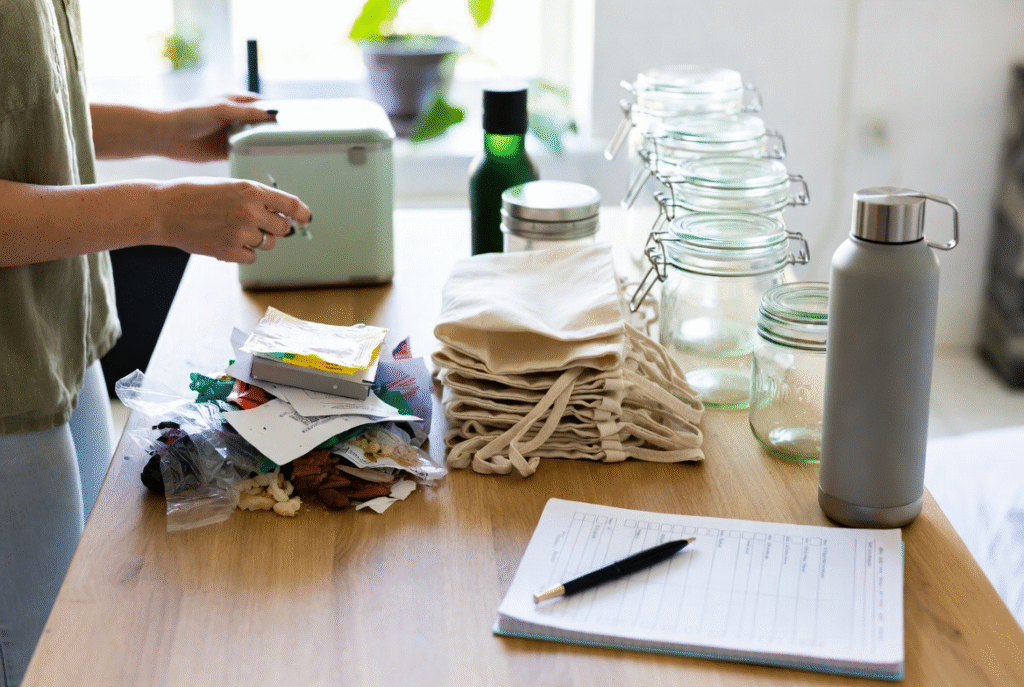
The biggest mistake people make is trying to change everything at once. Here is a practical, step-by-step approach that won’t overwhelm you.
Step 1: Start with a Trash Audit
Before you can start a zero waste lifestyle, you need to know what you are throwing away. A trash audit shows you exactly where your waste comes from.
What to do:
- Collect all the trash your household produces in one week
- Sort it into categories (food scraps, packaging, paper, plastic, etc.)
- Identify the largest categories
Why it matters: You will likely discover that food waste and single-use packaging make up the bulk of your trash. These are the easiest areas to address first. As Lauren Singer noted, understanding her waste pattern was the first step toward changing it.
Step 2: The 30-Day Zero Waste Challenge
A 30-day challenge helps you build habits gradually. Here is a simple daily checklist:
| Day | Action |
|---|---|
| 1 | Refuse a plastic bag — bring your own |
| 2 | Use a reusable water bottle |
| 3 | Bring a reusable coffee cup |
| 4 | Plan meals to reduce food waste |
| 5 | Use cloth napkins instead of paper |
| 6 | Buy one loose produce item instead of packaged |
| 7 | Compost food scraps (or start a collection) |
| 8-30 | Continue these habits and add one new action each day |
Kathryn Kellogg started her zero-waste journey with small swaps like these, and over time, they added up to significant savings and waste reduction.
Step 3: Zero Waste Kitchen
The kitchen is where the most waste is generated. Here is a checklist:
| Action | Impact |
|---|---|
| Buy in bulk with reusable containers | Reduces packaging waste |
| Use glass or stainless steel containers | Reduces single-use plastic |
| Store food properly to extend shelf life | Reduces food waste |
| Use beeswax wraps or lids instead of plastic wrap | Replaces single-use plastic |
| Start composting food scraps — it diverts 30% of household waste | Diverts 30% of waste |
Kitchen swaps:
| Swap This | For This |
|---|---|
| Paper towels | Reusable cloth towels or rags |
| Plastic wrap | Beeswax wraps or silicone lids |
| Plastic bags | Reusable silicone bags or glass containers |
| Dish soap in plastic | Bulk refill or solid dish soap |
| Regular plastic trash bags | Certified compostable bags for food scraps |
Kathryn Kellogg saved thousands of dollars by eliminating paper towels, K-cups, and Tupperware — instead using reusable cloths, brewing coffee without pods, and repurposing glass jars from food purchases.
Step 4: Zero Waste Bathroom
The bathroom is another major source of plastic waste. Here is a checklist:
| Action | Impact |
|---|---|
| Switch to bar soap instead of liquid soap | Reduces plastic bottles |
| Use bamboo toothbrushes | Reduces plastic toothbrushes |
| Choose shampoo bars or refillable options | Reduces plastic bottles |
| Use reusable cotton pads or washable cloths | Reduces disposable cotton waste |
| Look for plastic-free toilet paper packaging | Reduces plastic wrapping |
Bathroom swaps:
| Swap This | For This |
|---|---|
| Liquid soap in plastic bottle | Bar soap in paper |
| Plastic toothbrush | Bamboo toothbrush |
| Shampoo bottles | Shampoo bars |
| Disposable cotton pads | Washable cotton rounds |
Step 5: Zero Waste Laundry
Laundry produces microplastics and packaging waste. Here is a checklist:
| Action | Impact |
|---|---|
| Use a microfiber filter in your washing machine | Reduces microplastic pollution |
| Switch to concentrated or bulk laundry detergent | Reduces plastic packaging |
| Use wool dryer balls instead of dryer sheets | Reduces disposable waste |
| Line dry when possible | Reduces energy use |
Step 6: Zero Waste On-the-Go
Preparing for time away from home prevents impulse waste.
Zero waste on-the-go kit:
| Item | Purpose |
|---|---|
| Reusable water bottle | Hydration without plastic |
| Reusable coffee cup | Coffee and takeout drinks |
| Reusable shopping bag | Any unexpected purchases |
| Stainless steel or bamboo cutlery | Takeout meals |
| Cloth napkin | Replaces paper napkins |
| Small container for leftovers | Takeout leftovers |
Common Zero Waste Myths
Myth 1: “Zero waste is too expensive”
Reality: Zero waste often saves money. Buying less, avoiding single-use items, and cooking at home instead of ordering takeout all reduce spending. A household can save $850–$1,800 per year with simple zero waste swaps. Kathryn Kellogg saved $6,000 over a decade by eliminating paper towels, K-cups, and Tupperware — and she said these changes “have made my life better.”
Myth 2: “Zero waste requires buying expensive eco-products”
Reality: The best zero waste swaps use what you already have. You don’t need to buy bamboo utensils, stainless steel straws, or glass containers to start. Use your existing plates, cups, and containers first. Replace items only when needed. Even the pioneers of the movement, like Bea Johnson, emphasize using what you already own.
Myth 3: “One person’s effort doesn’t matter”
Reality: Individual actions add up. If 1 million people each reduce their waste by 1 pound per week, that is 52 million pounds of waste prevented per year. More importantly, individual actions create a culture shift. Lauren Singer’s mason jar inspired thousands of people to reconsider their own waste.
Myth 4: “Zero waste means no trash at all”
Reality: Zero waste is an aspiration, not a strict requirement. Even Bea Johnson, the movement’s pioneer, admits her family occasionally creates waste. The goal is to reduce waste as much as possible, not to produce zero trash instantly. As Anne Marie Bonneau said, “We don’t need a handful of people doing zero waste perfectly. We need millions of people doing it imperfectly.”
Zero Waste for Different Lifestyles
For Families
| Challenge | Solution |
|---|---|
| Kids generate waste (snacks, activities) | Buy snacks in bulk, use reusable containers for school lunches, choose toys made from natural materials |
| Diapers | Consider cloth diapers (modern ones are easy to use) or look for compostable diaper options |
| Time constraints | Focus on the biggest waste categories first: food waste, packaging, and diapers |
For Singles/Couples
| Challenge | Solution |
|---|---|
| Smaller quantities harder to buy bulk | Find a bulk store that allows small quantities, or share bulk purchases with friends |
| More meal variety = more packaging | Plan meals to minimize waste, choose loose produce |
| Limited space | Use small containers, focus on reusing existing items |
For Urban Dwellers
| Challenge | Solution |
|---|---|
| No outdoor space for compost | Worm bin, bokashi, or municipal collection |
| Small kitchen | Use compact reusable containers |
| Limited storage | Prioritize multi-use items and reuse packaging |
Zero Waste Shopping Checklist
| Action | Impact |
|---|---|
| Bring reusable bags | Reduces plastic bag waste |
| Buy loose produce | Reduces packaging waste |
| Shop bulk bins | Reduces packaging waste |
| Choose glass over plastic | Easier to recycle, less toxic |
| Avoid individually wrapped items | Reduces packaging waste |
| Plan meals before shopping | Reduces food waste |
FAQ
What are the 5 R’s of zero waste living?
The 5 R’s are Refuse, Reduce, Reuse, Recycle, and Rot. Refuse what you don’t need. Reduce what you do need. Reuse what you have. Recycle what you can. Rot (compost) the rest. This framework was introduced by Bea Johnson, a pioneer of the zero waste movement.
What are the 7 R’s of zero waste?
The 7 R’s expand on the original 5: Rethink, Refuse, Reduce, Reuse, Repair, Recycle, and Rot. Rethink your consumption habits. Repair items before replacing them. The additional steps encourage a more mindful approach before anything reaches the waste stream.
What are three things you could do to live a zero waste lifestyle?
Three simple starting points: 1) Bring a reusable water bottle and shopping bag everywhere. 2) Compost food scraps instead of throwing them in the trash. 3) Buy groceries in bulk using reusable containers instead of packaged goods. These three actions eliminate the most common household waste categories.
How to start a zero waste lifestyle?
Start with a trash audit. Collect your household waste for one week, sort it by category, and identify the largest sources. Most people find food scraps and packaging are the biggest categories. Then focus on those first — start composting food scraps and switch to reusable shopping bags and water bottles.
What is the first thing to do to start zero waste?
The first thing is to stop buying single-use plastic water bottles and switch to a reusable bottle. This is the easiest swap, saves money immediately, and eliminates hundreds of plastic bottles per year from your waste stream. It requires almost no effort and builds momentum for bigger changes. As Kathryn Kellogg noted, starting with one simple swap like this made a huge difference over time.
How to live a zero waste life?
Living zero waste is a gradual process, not an overnight transformation. Apply the 5 R’s in order — Refuse, Reduce, Reuse, Recycle, Rot. Focus on progress, not perfection. Start with the biggest waste sources in your home (food scraps and packaging) and work through each room of your house systematically.
Where do I start a waste free home?
Start in the kitchen — it is where most household waste is generated. Compost food scraps, switch to reusable bags and containers, and buy in bulk. Then move to the bathroom (reduce plastic packaging, use bar soap). Then the laundry room (use wool dryer balls, bulk detergent). This room-by-room approach makes the process manageable.
Conclusion
Zero waste lifestyle is not about being perfect. It is about making better choices where you can, reducing waste where possible, and focusing on progress over perfection.
As Anne Marie Bonneau said, “We don’t need a handful of people doing zero waste perfectly. We need millions of people doing it imperfectly.” And as Lauren Singer demonstrated with her mason jar, small changes over time add up to big impact. Living a zero waste lifestyle doesn’t require perfection — it requires starting with one small change.
Key takeaways:
- Zero waste is built on the 5 R’s: Refuse, Reduce, Reuse, Recycle, Rot
- Start small with a reusable water bottle and shopping bag
- Compost food scraps to eliminate a major waste category
- You can save $850-$1,800 per year by reducing waste
- Progress matters more than perfection
Ready to start your zero waste journey?
If you are ready to start reducing waste in your kitchen, certified compostable bags make collecting food scraps clean and simple. Learn more about composting basics to get started.
Author Bio
HEMCbags Team is a group of sustainable packaging specialists with over a decade of experience working with households, municipalities, and waste management programs. We are committed to practical, realistic solutions for reducing waste.