
Quick Answer
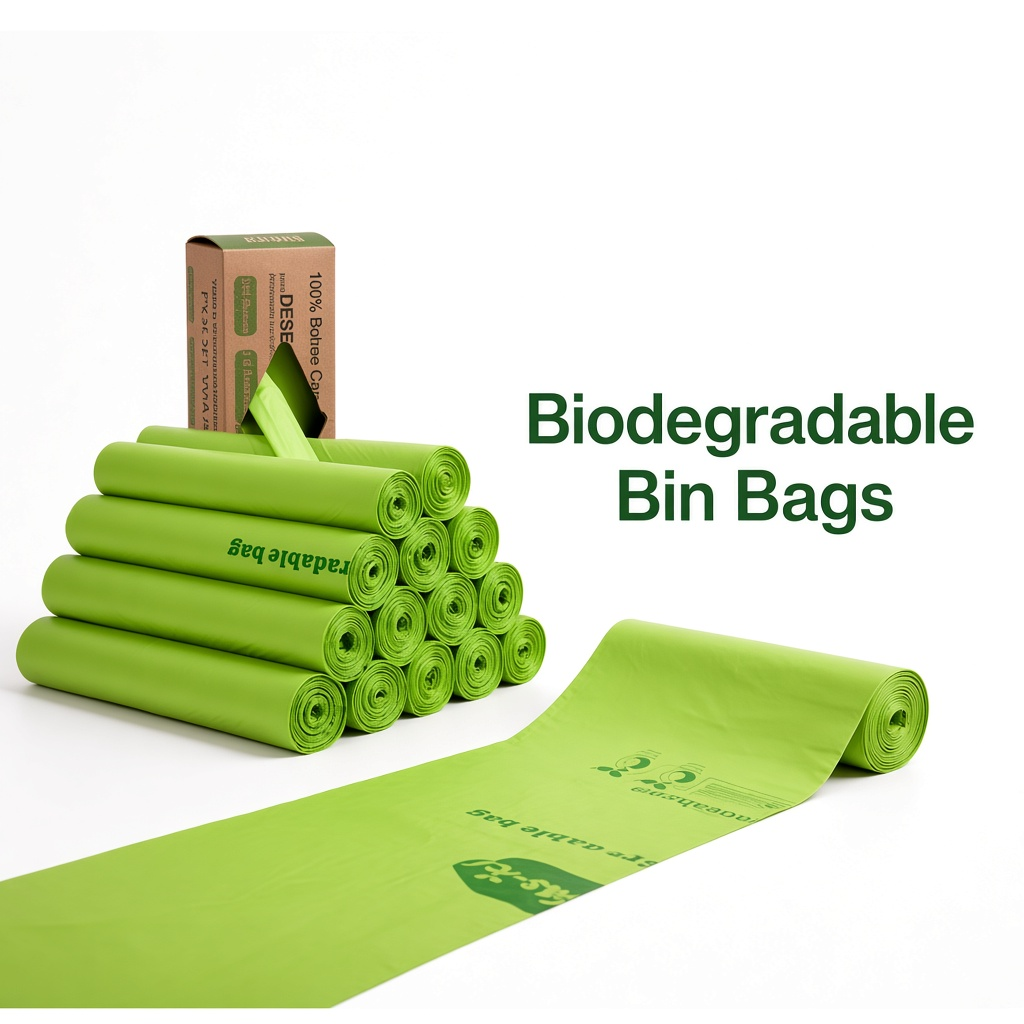
Biodegradable bin bags are waste liners designed to break down through microbial activity under specified conditions. Before buying, check the material, finished-product certification, capacity, thickness, leak resistance, and disposal route. A bag labelled “biodegradable” is not automatically compostable, home-compostable, or suitable for landfill disposal.
What Are Biodegradable Bin Bags?
The term “biodegradable bin bags” is used broadly in the market, but biodegradable, compostable, and degradable are not interchangeable claims. Buyers should check the material, test method, certification, and disposal conditions behind each claim.
The naming also varies by region. In the UK and Europe, the common terms are bin bags, refuse sacks, and kitchen bin liners. In the US, garbage bags and trash bags are more familiar. These words often describe the same product type: a liner for household, commercial, or municipal waste bins.
| UK term | US equivalent | Typical use |
|---|---|---|
| Bin bags | Garbage bags / trash bags | General household waste |
| Refuse sacks | Heavy-duty trash bags | Commercial and municipal collection |
| Kitchen bin liners | Kitchen trash bags | Kitchen bins and food waste caddies |
| Food waste caddies | Food scrap bins / countertop food waste bins | Small kitchen food-waste collection |
| Wheelie bins | Roll-out carts | Curbside collection |
Biodegradable vs. Compostable vs. Degradable: What UK Buyers Need to Know
Biodegradable Bags
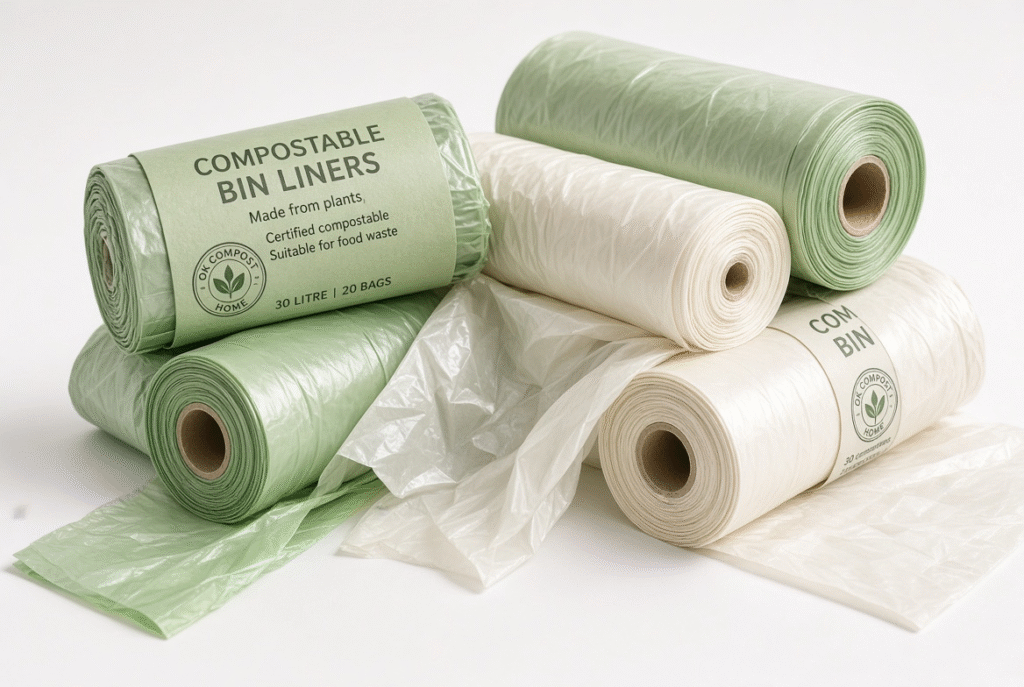
A biodegradable bag is designed to break down through microbial action. But “biodegradable” has no universal standard for how long breakdown takes, what conditions are required, or what remains afterward.
Compostable Bags
Compostable bags are a more specific category. They must meet defined standards — such as EN 13432 and ASTM D6400, or third-party certification programmes such as BPI and TÜV AUSTRIA OK compost — for biodegradation, disintegration, and ecotoxicity under specified composting conditions. Compostable bags are divided into industrial and home compostable grades, and they are not interchangeable.
Degradable Plastic Bags
“Degradable” is the vaguest term of the three. It can refer to oxo-degradable plastics, which fragment into smaller pieces rather than fully biodegrade. Degradable does not mean compostable.
For a detailed comparison of materials, certification schemes, and disposal routes, see our biodegradable waste bags guide. This article focuses on what UK buyers need to verify before placing a bulk order.
Do Biodegradable Bin Bags Break Down in Landfills?
Not necessarily. Biodegradable or compostable bags may not break down as intended in ordinary landfills, because landfill conditions may not provide the oxygen, moisture, heat, or microbial activity required by the relevant test conditions.
Match the bag to the disposal system — do not assume that “biodegradable” means “landfill-safe.”
What UK Buyers Must Verify Before Ordering
These checks help buyers avoid certification, fit, and performance problems after placing an order. Four checks matter more than the label on the box.
Which Certification the Target Facility Actually Accepts
UK composting facilities and local authority collection programmes do not all accept the same certification. Some specify EN 13432-based certification. Others accept OK compost INDUSTRIAL. A product certified only against ASTM D6400 requirements may not be accepted if the facility requires EN 13432, OK compost INDUSTRIAL, or another specific scheme.
What to do: Contact the target composting facility or the local authority’s waste team before ordering. Ask which certification they require for compostable bags in organic waste collection. Get the answer in writing if possible.
Alternatively, ask the supplier whether they can recommend which certification marks and logos are typically required for the target market — a supplier with UK experience should be able to advise on this before you contact the facility.
Whether the Bag Actually Fits the Bin
Litre capacity is a starting point, not a guarantee. Two bags labelled 50L can have different widths, lengths, and gussets. A bag that is too short will slip into the bin; a bag that is too narrow will tear at the rim.
What to do: Measure the bin’s opening, height, and shape. Compare against the supplier’s finished bag dimensions — flat width, length, gusset, and overhang. Request a physical sample and test the fit before committing to a bulk order.
For step-by-step measurement methods and a bin size matching calculator, see our guide to what size trash bag you need.
Whether the Bag Performs Under the Intended Load
A bag that passes certification testing can still fail in real use. Wet food waste, sharp objects, and heavy loads place different demands on film strength and seal integrity.
What to do: Test samples with the actual waste stream — not just dry paper. Check leak resistance, tear resistance, bottom-seal integrity, and load-bearing capacity. Ask the supplier for leak-testing and puncture-resistance data for the specific product.
Bin Bag Capacities Commonly Used in the UK
UK buyers typically specify bin bags by litre capacity rather than gallon rating. The ranges below are practical starting points, not universal standards. The correct bag also depends on the bin’s opening, height, shape, gusset, and required overhang.
| Capacity range | Typical use |
|---|---|
| 5L–10L | Small food-waste caddies and bathroom bins |
| 20L–30L | Small household, office and bedroom bins |
| 50L–60L | Standard kitchen bins |
| 90L–120L | Commercial bins and wheelie bins |
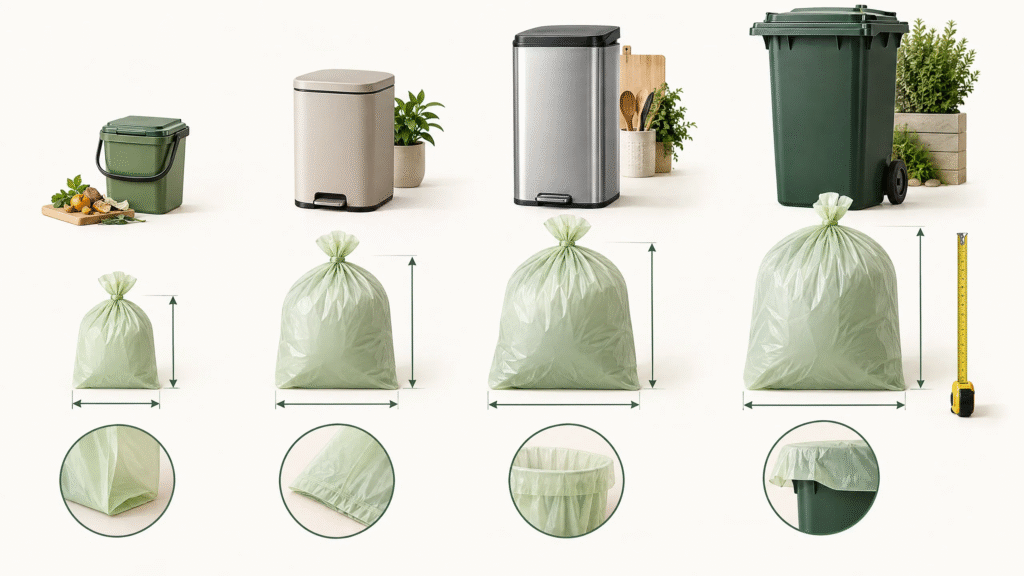
Capacity alone does not guarantee a good fit. Two bags with the same litre rating may have different widths and lengths. For a step-by-step method to measure a bin and calculate the required bag dimensions, see our guide to what size trash bag you need.
Before placing a bulk order, request the finished bag dimensions and confirm the width, length, gusset, and closure against the target bin.
Home Compostable vs. Industrial Compostable: Which Do You Need?
This is the decision UK buyers most often get wrong. The answer depends on where the bag will actually be processed, not on which label sounds more environmentally friendly.
| Your disposal route | Required certification | What to verify |
|---|---|---|
| Local authority food-waste collection | Often industrial compostable, but always confirm with the council or collection operator | Confirm with the council’s waste team |
| Commercial composting facility | Industrial compostable | Confirm the facility accepts the specific certification |
| Home compost bin | Home compostable (OK compost HOME or equivalent) | Only use if the product carries home-compostable certification |
| General waste / landfill | Neither certification delivers its intended benefit | Do not claim compostability for landfill disposal |
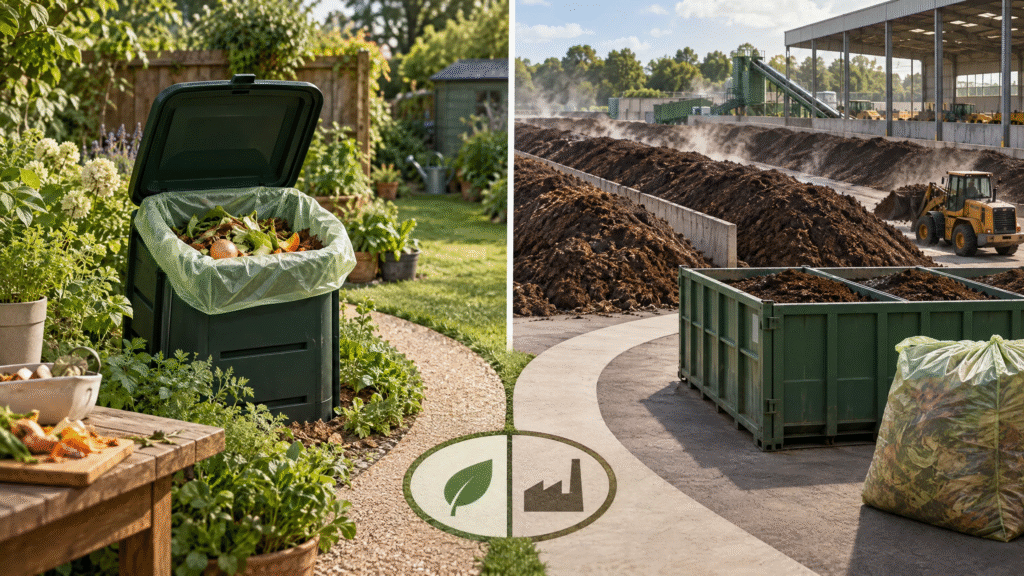
Decision rule: If you do not know where the bag will be processed, ask before you order. A bag certified for one route may not work in the other.
What Specifications Should Buyers Compare?
Capacity. Use litre capacity as a starting point, then compare the bag’s flat width, length, gusset, and overhang with the actual bin.
Thickness. Thickness should match the waste type. Some household compostable liners are produced in the 15–25 micron range, while thicker gauges may be used for wet waste, heavy loads, or commercial applications. The appropriate thickness depends on the material formulation, bag type, and load.
Seal and Leak Resistance. Star seal, flat seal, eight-fold sealing, side seal, and bottom seal all behave differently with wet waste. Ask for leak-testing data for the intended application.
Closure. Flat top, drawstring, tie handles, star-sealed bottom, and perforated roll formats serve different use cases.
Packaging. Bags per roll, rolls per carton, retail packaging, bulk packaging, and private-label options all affect landed cost.
B2B Specification Checklist
Use this checklist when comparing suppliers. Request written confirmation for each item.
| Item | What to confirm |
|---|---|
| Certification | Finished-product certificate number; current and valid; covers the exact SKU and printed version |
| Facility acceptance | Target UK facility or council accepts the specified certification |
| Dimensions | Flat width, length, gusset, overhang; confirmed against the actual bin |
| Thickness | Micron gauge; test data for the intended load type |
| Seal | Seal type; leak-test data for wet waste |
| Printing | Inks and adhesives compatible with the certification scope |
| Packaging | Bags per roll, rolls per carton, retail or bulk format |
| MOQ | Confirmed for the specific size, material, and printing |
| Samples | Physical samples of the finished, printed bag before bulk production |
| Lead time | Production and UK delivery timeline confirmed in writing |
UK Wholesale: What Buyers Should Confirm Before Ordering
UK retailers, distributors, and commercial buyers sourcing biodegradable bin bags typically need information that a consumer page does not cover.
Price positioning. Retail pricing varies substantially according to bag capacity, bags per roll, material formulation, certification, packaging, and brand positioning. For wholesale buyers, factory-gate pricing should be requested against a fixed specification rather than estimated from retail prices.
Key considerations:
- Certification for the UK market.
- Packaging formats. Retail-ready roll packs, bulk cartons, and private-label packaging all require different specifications.
- Custom dimensions. UK bin sizes (50L–60L kitchen bins, 90L–120L wheelie bins) may not match standard US gallon-based formats.
- Sample approval. Request samples of the finished, printed bag before committing to a bulk order.
- Lead time and shipping. Confirm production lead time and UK shipping arrangements in writing.
HemcBags Capabilities for UK Buyers
HemcBags can produce custom dimensions, custom logo printing, and any Pantone colour, with production lead time typically 15–20 days depending on order size. Certification documentation is available on request.
MOQ depends on the bag size, material, printing and packaging requirements. Standard products may support lower-volume trial orders, while custom orders usually require a higher minimum quantity. Confirm the MOQ when requesting a quotation.
If you are unsure about the right size or thickness for your application, the team can recommend options based on how the bag will be used.
What Should Be Included in a UK Wholesale Quote?
- Bag capacity
- Width × length
- Thickness
- Material
- Certification requirement
- Bags per roll
- Rolls per carton
- Custom printing
- Private-label packaging
- MOQ
- Sample approval
- Production lead time
- UK delivery terms
Choose Your Sample
Not all samples are the same. Request the sample that matches your actual application.
- 50L kitchen bin bag sample — for standard UK kitchen bins and food waste caddies
- 120L refuse sack sample — for commercial bins and wheelie bins
- Custom size sample — for private-label or non-standard bin formats
Request a 50L kitchen bin bag sample · Request a 120L refuse sack sample · Request a custom size sample
FAQs
Are biodegradable bin bags really biodegradable?
They may be, but the claim depends on the material, test method, and disposal conditions. Ask for evidence covering the finished bag rather than relying on the word “biodegradable” alone.
What is the difference between biodegradable and compostable bin bags?
Compostable bags are a specific category of biodegradable products that must meet defined requirements under specified composting conditions. Not every biodegradable bag is certified compostable.
Do biodegradable bin bags break down in landfills?
Not necessarily. Ordinary landfill conditions may not provide the oxygen, moisture, heat, or microbial activity required for meaningful degradation.
Can biodegradable bags go in a home compost bin?
Only when the finished product is specifically certified for home composting and accepted by the relevant local system.
Are biodegradable bin bags suitable for wet waste?
They can be suitable when the bag has the correct formulation, thickness, and seal design. Buyers should test the finished bag with the intended wet waste before placing a bulk order.
What size biodegradable bin bag do I need?
Start with the bin’s litre capacity, then confirm the bag’s width, length, gusset, and overhang against the actual container. For detailed measurement instructions and a bin size matching calculator, see our trash bag size guide.
Can I order custom biodegradable bin bags?
Many manufacturers offer custom dimensions, thickness, printing, roll formats, and private-label packaging, subject to material, certification, and minimum-order requirements.
Sources and Further Reading
- UK Competition and Markets Authority — Green Claims Code
- European Commission — Bio-based, biodegradable and compostable plastics
- BPI — Compostability Certification
- Federal Trade Commission — Environmental Claims: Summary of the Green Guides
- HemcBags — What Size Trash Bag Do I Need?
- HemcBags — Compostable Certifications Guide
- HemcBags — Biodegradable Waste Bags Guide
- HemcBags — Compostable Food Waste Bags
- HemcBags — Heavy Duty Compostable Garbage Bags
Reviewed by: HemcBags Product and Compliance Team