
Quick Answer
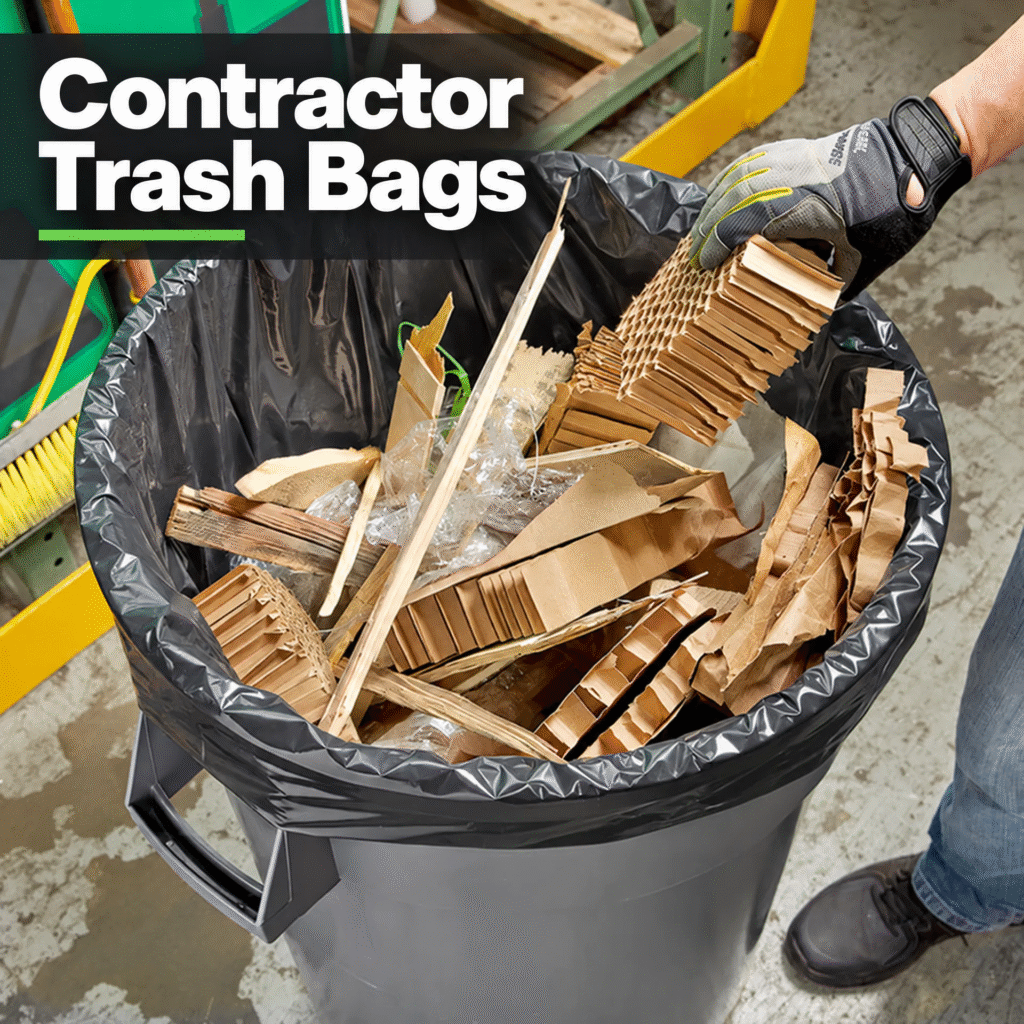
Contractor trash bags are large, thick waste bags designed for construction cleanup, renovation debris, landscaping waste, and demanding commercial applications. Contractor bags commonly range from 33 to 60 gallons and are selected by capacity, mil thickness, dimensions, seal style, and load requirements. Before ordering in bulk, test a finished bag with the intended waste and confirm whether the receiving facility accepts its certification.
This guide is written for US gallon-based contractor bag specifications and commercial procurement. In US product searches, the terms heavy duty garbage bags, heavy duty trash bags, contractor bags, and contractor trash bags are often used for overlapping product categories, but the actual thickness, dimensions, and performance can vary by manufacturer.
What Are Contractor Trash Bags?
Contractor trash bags — also called contractor bags or contractor garbage bags — are a category of heavy-duty waste bags built for construction, renovation, and large-scale cleanup. They are typically thicker and larger than standard household trash bags, and they are selected for puncture resistance, tear strength, and load capacity rather than for general household use.
Common applications include construction cleanup, renovation debris, landscaping waste, warehouse packaging, event cleanup, and commercial facility maintenance.
Heavy Duty Trash Bags vs. Contractor Bags
The two terms overlap, but they are not identical.
| Feature | Heavy-duty trash bags | Contractor bags |
|---|---|---|
| Typical use | Commercial, outdoor, and general heavy waste | Construction, renovation, and cleanup debris |
| Common capacity | 20–55 gallons | 33–60+ gallons |
| Typical thickness | Varies by product | Often 3 mil or thicker |
| Main requirement | Leak resistance and general strength | Puncture, tear, and load resistance |
| Common waste | Wet waste, yard waste, commercial refuse | Wood scraps, drywall, packaging, debris |
Specifications vary by manufacturer. Thickness alone does not determine the strength of a finished bag. Naming conventions also vary by retailer — some products labeled “heavy duty” meet contractor-grade thickness; others do not. Always confirm the actual mil thickness and test data for the specific product.
What Size Contractor Bag Do You Need?
Capacity is the first specification most buyers compare.
| Contractor bag size | Typical application |
|---|---|
| 33 gallon | Light construction cleanup, office and commercial waste |
| 42 gallon | General contractor work, renovation, and large cleanup |
| 50–55 gallon | Construction debris, landscaping, and industrial waste |
| 60+ gallon | Large commercial operations and high-volume cleanup |
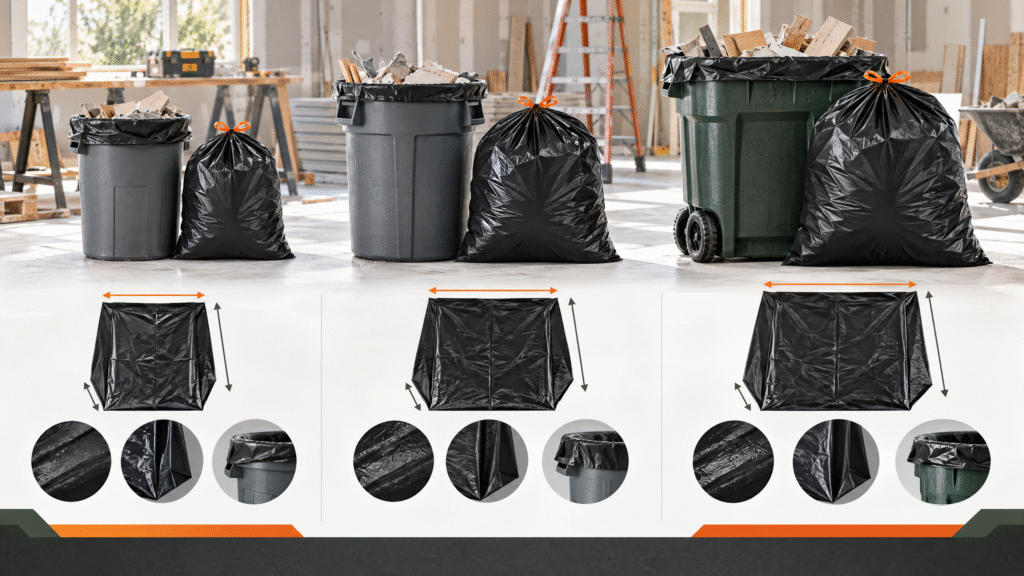
Gallon capacity is only a starting point. To choose the right contractor bag, compare the bag’s flat width and length with the bin opening and height, then allow enough overhang for securing the bag. Two bags with the same gallon rating can have different dimensions.
For detailed measurement formulas and a size calculator, see our trash bag size guide.
How Thick Should a Contractor Trash Bag Be?
The following ranges are practical buying references, not universal industry classifications. Available specifications vary by manufacturer, material, and application.
1.5–2.0 mil bags
Suitable for light cleanup, packaging materials, leaves and lighter yard waste, and general commercial refuse.
3.0 mil contractor bags
Suitable for renovation cleanup, wood scraps, heavier packaging, and general construction and commercial waste. Many contractor-grade products sit in this range.
4.0–6.0 mil bags
Suitable for heavier construction cleanup, sharp or rough debris, and high-strength industrial applications.
Mil thickness is only one part of bag performance. Film formulation, layer structure, dimensions, seal design, and puncture testing also affect strength. A 3 mil bag from one manufacturer may outperform a 4 mil bag from another depending on formulation and construction.
What Can Contractor Trash Bags Be Used For?
Common applications include:
- Construction cleanup
- Demolition and renovation
- Drywall and insulation
- Wood scraps
- Landscaping and yard waste
- Warehouse packaging
- Commercial facility cleanup
- Event and stadium cleanup
- Municipal waste collection
Important limitation: Contractor bags are not automatically suitable for liquids, chemicals, asbestos, medical waste, broken glass, or other regulated materials. Follow the applicable safety and waste-disposal requirements for the material being handled.
Contractor Bag Styles and Seal Options
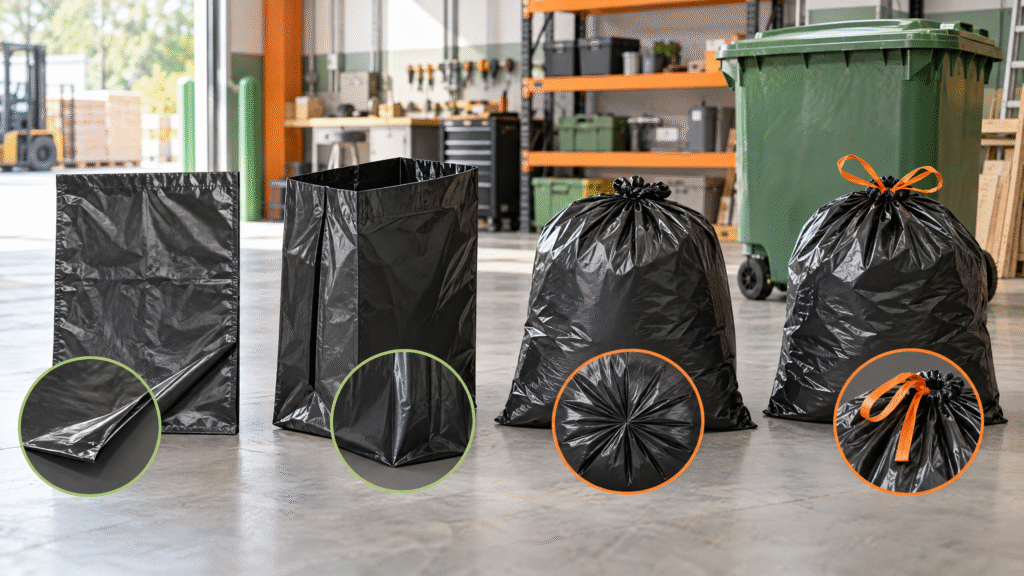
Flat contractor bags
Suitable for simple packaging, general cleanup, and heat-sealed or hand-tied closures.
Gusseted contractor bags
Suitable for larger volume, irregularly shaped waste, and commercial or industrial bins.
Star-seal contractor bags
Suitable for wet waste, applications requiring better leak control, and loads that put stress on the bottom seal.
Drawstring or tie-handle bags
Suitable for quick closure, frequent manual handling, and commercial cleanup or event use.
How to Test a Contractor Bag Before Bulk Ordering
A bag can meet a certification requirement and still perform poorly in a specific real-world application. Test samples with the actual waste stream before committing to a bulk order.
- Puncture test — test sharp or rough debris against the film.
- Tear test — check the bag opening, sides, and bottom seal.
- Leak test — test with wet waste or a specified liquid load.
- Load test — test lifting and carrying at the target load.
- Seal integrity test — check star seal, flat seal, or gusset seal.
- Fit test — confirm width, length, gusset, and overhang against the actual bin.
- Storage test — check the effect of heat, moisture, sunlight, and long-term storage.
Request a finished-bag sample before placing a bulk contractor bag order.
Compostable Contractor Bags vs. Conventional Contractor Bags
This is where the choice becomes more specific. Conventional contractor bags are made from polyethylene or recycled plastic. Compostable contractor bags are made from certified compostable materials — but they are not a universal replacement.
| Feature | Conventional contractor bags | Compostable contractor bags |
|---|---|---|
| Typical material | Polyethylene or recycled plastic | PLA, PBAT, starch-based blends, or other certified formulations |
| Main advantage | Broad availability and conventional heavy-duty performance | Compostability where the receiving facility accepts the certification |
| Disposal | Follow local waste rules | Must match the certified composting route |
| Certification | Usually not compostability-certified | Verify which certification the finished product holds |
| Best for | General construction and commercial waste | Approved organic-waste or sustainability-focused programs |
Compostable does not mean suitable for every waste stream or every disposal facility. The bag’s certification does not make the waste inside it compostable. Drywall, glass, metal, chemicals, and treated wood are not compostable feedstocks. Follow the receiving facility’s waste-acceptance rules.
Certification note: Certification options vary by product. Confirm whether the finished bag is certified under OK compost HOME, OK compost INDUSTRIAL, EN 13432, ASTM D6400, or another applicable scheme, and verify that the target facility accepts it. Home-compostable and industrially compostable certifications are not interchangeable. A product certified for home composting is not automatically accepted by industrial composting facilities.
How to Choose Between 42-Gallon and 50–60-Gallon Contractor Bags
| Use case | Suggested starting point |
|---|---|
| Standard heavy-duty commercial cleanup | 42-gallon contractor bag |
| Renovation and construction debris | 42–55 gallon bag, depending on bin size |
| High-volume commercial or industrial waste | 50–60 gallon reference range; custom dimensions available |
| Custom or non-standard receptacles | Confirm finished dimensions and request a sample |
Do not choose by gallon capacity alone. Confirm the actual bag dimensions against the container.
Decision rule: If your bin is a standard 45–55 gallon industrial can and the waste is general construction debris, start with the 42-gallon bag. If your bin is larger, or the load is high-volume commercial waste, start with the 50–60 gallon reference range. The 50–60 gallon range is a reference point, not a fixed catalog size — custom dimensions are available. Confirm finished width, length, and gusset before ordering.
Wholesale Contractor Trash Bags: What Should You Specify?
For a custom quote, send the supplier the following information:
- Bag capacity
- Flat width × length
- Gusset
- Thickness in mil
- Material
- Seal style
- Closure
- Color
- Printing
- Bags per roll
- Rolls per carton
- MOQ
- Sample approval
- Production lead time
HemcBags Compostable Contractor Bag Options
42-Gallon Compostable Contractor Bags
Suitable for large cleanup, industrial waste, and 42-gallon applications requiring contractor-grade strength. The standard specification is 42 gallons / approximately 160 liters and 3.0 mil. Available material and certification options depend on the finished product and target market. Confirm the required certification when requesting a sample or quote.
View our 42-gallon heavy duty compostable garbage bags.
50–60-Gallon Compostable Contractor Bags
Suitable for construction, commercial facilities, high-volume waste, larger contractor bins, and OEM or private-label orders. Dimensions are fully custom — the 50–60 gallon range is a reference point, not a fixed catalog size. Confirm the certification required for your target facility when requesting a quote.
Explore our 50–60-gallon compostable contractor bags.
FAQs
What are contractor bags used for?
Contractor bags are used for construction cleanup, renovation debris, landscaping waste, warehouse packaging, event cleanup, and commercial facility maintenance. They are selected for puncture resistance, tear strength, and load capacity.
Are contractor bags stronger than regular trash bags?
Contractor bags are typically thicker and larger than standard household trash bags, but naming conventions vary by manufacturer. A product labeled “contractor grade” should be confirmed against actual mil thickness and test data.
What is the difference between heavy-duty trash bags and contractor bags?
Heavy-duty trash bags are a broad category for demanding waste. Contractor bags are typically larger and designed for construction, renovation, and cleanup debris. The two terms overlap in the market.
What size contractor bag do I need?
Common sizes are 33, 42, 50–55, and 60+ gallons. Gallon capacity is only a starting point — confirm flat width, length, gusset, and overhang against the actual bin before ordering.
How thick is a contractor-grade trash bag?
Many contractor-grade bags sit around 3 mil, with heavier grades at 4–6 mil. Thickness alone does not determine strength — film formulation, layer structure, and seal design also matter.
Are 3 mil contractor bags strong enough for construction debris?
They can be, depending on the film formulation and the type of debris. Test a finished bag with the actual waste stream before committing to a bulk order.
Can contractor bags hold wet waste?
They can, if the bag has the correct formulation and seal design for wet loads. Ask the supplier for leak-test data for the intended application.
Are compostable contractor bags suitable for every facility?
No. Compostable bags must match the receiving facility’s accepted certification. Home-compostable and industrially compostable certifications are not interchangeable, and the bag’s certification does not make the waste inside it compostable.
Can I order custom contractor bags wholesale?
Yes, subject to material, certification, and minimum-order requirements. Custom dimensions, thickness, printing, and private-label packaging are available — confirm specifications when requesting a quote.
What should I test before placing a bulk order?
Puncture resistance, tear resistance, leak resistance, load capacity, seal integrity, fit against the actual bin, and storage stability.
Sources and Further Reading
- HemcBags — What Size Trash Bag Do I Need?
- HemcBags — Compostable Certifications Guide
- HemcBags — 42-Gallon Heavy Duty Compostable Garbage Bags
- HemcBags — 50–60-Gallon Compostable Contractor Bags Wholesale
- BPI — Compostability Certification
- Federal Trade Commission — Environmental Claims: Summary of the Green Guides
Reviewed by: HemcBags Product and Compliance Team