
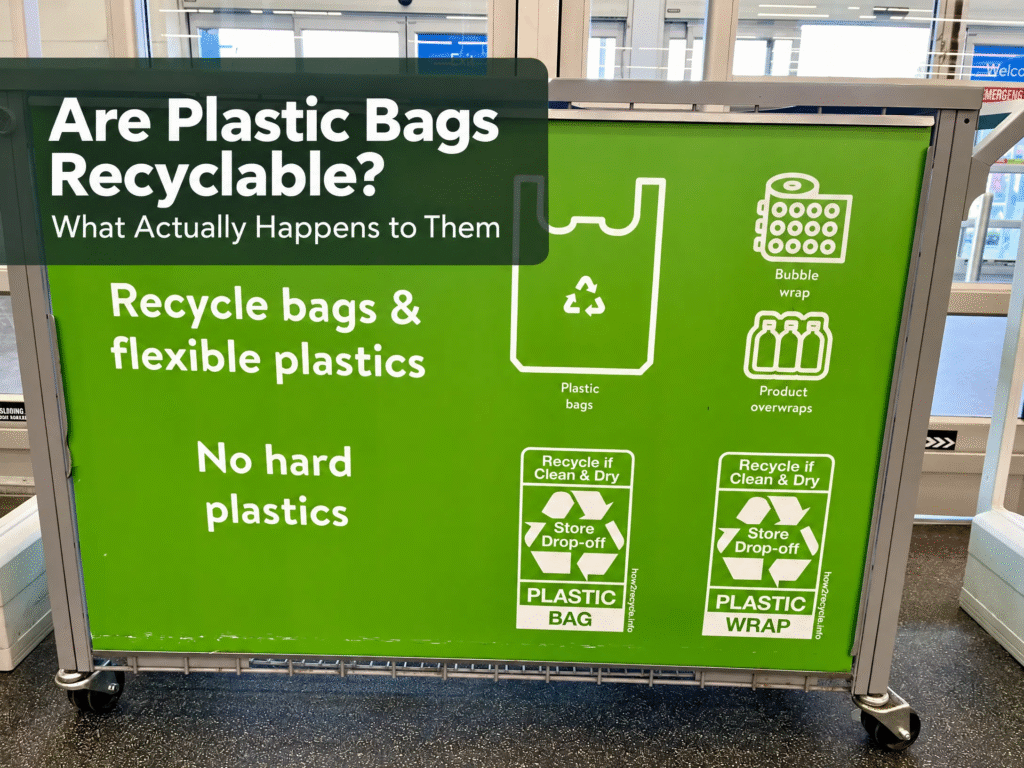
Scope note: Recycling rules vary by country, state, municipality, and waste-management provider. This article focuses primarily on the United States, with additional notes for other markets where relevant. Always confirm local requirements before disposal or bulk purchasing.
Quick Answer
Are plastic bags recyclable? Technically, yes — many polyethylene bags, including HDPE (#2), LDPE (#4), and LLDPE, can be recycled. But most U.S. curbside programs do not accept them because flexible film wraps around sorting equipment and contaminates other recyclables. In the United States, household recycling of plastic bags usually depends on store drop-off programs, municipal depots, or specialized collection services. Collection and recycling access remain limited and vary substantially by market.
For B2B buyers, the real question is not “can this bag be recycled” but “what disposal pathway actually exists in my target market.”
Can Plastic Bags Go in the Recycling Bin?
Usually not. Most curbside recycling programs reject plastic bags and films because flexible film can wrap around sorting equipment and contaminate other recyclable materials.
Flexible film wraps around the rotating shafts and screens inside a single-stream recycling facility. Workers must stop equipment and cut the film free, which creates costly downtime and safety risks. For this reason, most municipal programs list plastic bags as a prohibited item.
Portland’s official guidance explains that plastic bags can tangle sorting equipment and should be taken to designated drop-off locations rather than placed in curbside bins.
What to do instead: Use a store drop-off point, a municipal depot, or a specialized film collection service if one exists in your area. If no verified option exists, do not place plastic bags in the curbside bin.
Why Plastic Bags Jam Recycling Equipment
The Sorting Problem
When plastic bags enter a single-stream facility, they behave differently from rigid plastics. They wrap around rotating equipment and screens, forcing manual removal. This is not an occasional inconvenience — it is a recurring operational disruption.
The Contamination Problem
Flexible film also behaves like paper during sorting. It flows with paper products and ends up in paper bales sent to mills. When a paper bale is contaminated with plastic film, the quality of the recovered paper is reduced.
This is why many materials recovery facilities treat plastic bags as a contaminant rather than a commodity.
How Four U.S. Cities Handle Plastic Bags Differently
To show how much local rules differ, this article compares official guidance from four U.S. cities and metro areas. It is an illustrative comparison, not a national survey.
| City / Metro | Official position on plastic bags | Collection pathway | Source |
|---|---|---|---|
| New York City | Large retailers are required by local law to provide collection bins for plastic bags | Retailer take-back obligation | NYC Council |
| San Francisco | Clean polyethylene film is accepted at store drop-off; not accepted in curbside bins | Dedicated film collection via grocery stores | SF Environment |
| Seattle | Plastic bags are listed as “Not Accepted” at city recycling facilities | Prohibited in curbside bins | Seattle Public Utilities |
| Portland | Plastic bags are not allowed in home recycling bins; drop-off only | Prohibited in curbside bins | City of Portland |
These four examples show that “recyclable” means different things in different cities. A bag that carries a “recyclable” label may be accepted in one city and rejected in another.
Where Plastic Bags Can Be Recycled
What Happens After Plastic Film Is Collected?
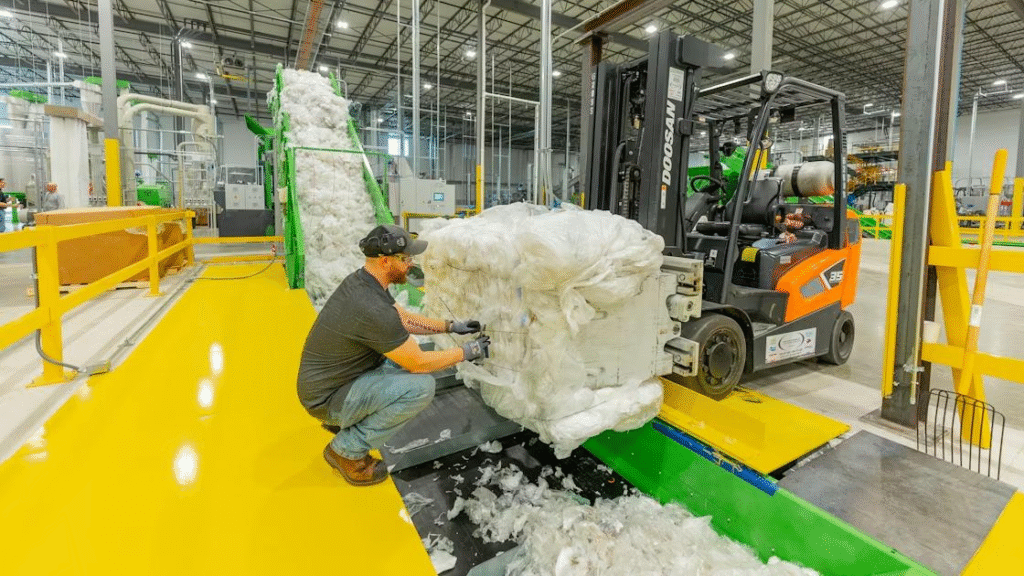
Store drop-off is only the first step. After collection, polyethylene bags and flexible plastic film must be sorted, compressed, transported, and processed by specialized recyclers. The material may then be converted into recycled resin, composite products, new film, or other plastic goods. This is why collection access alone does not guarantee that a bag will ultimately be recycled.
Store Drop-Off Programs
Some participating grocery stores, retailers, and municipal depots accept plastic bags and film for separate recycling. Materials must be clean and dry. Receipts, rigid items, and paper should be removed.
How to Check What’s Accepted Locally
Use a dedicated directory:
- Plastic Film Recycling Directory (managed by FFRA)
- NexTREX (Trex’s drop-off finder)
Call ahead to confirm the location accepts plastic bags. Not all stores that display a recycling bin accept all types of film.
Why Coverage Varies So Much
Store drop-off programs exist where retailers choose to fund them. They are not mandated by federal law in the U.S. Some states and municipalities have extended producer responsibility (EPR) programs, but plastic film is often excluded because of the sorting challenges.
If no verified recycling or take-back option exists in the target market, do not place the bags in the curbside recycling bin. Follow the local waste provider’s instructions.
Are Compostable Bags Recyclable?
Generally, no — compostable bags are not accepted in conventional polyethylene film recycling programs unless the relevant program explicitly accepts them. They are made from different polymers — PLA, PBAT, or starch blends — that do not melt or process like polyethylene.
Compostable bags belong in composting systems, not mechanical recycling. Putting them in a store drop-off bin contaminates the PE film stream.
The Biodegradable Products Institute (BPI) makes this distinction clear: BPI-certified products are designed for accepted commercial composting systems. Home-compostable products require separate certification and should not be treated as equivalent to commercially compostable products.
Important: A compostable bag is only useful when the relevant composting system accepts it. Certification alone does not guarantee that a local facility will process the product. Industrially compostable and home-compostable products are not interchangeable.
For a detailed explanation of certification requirements, see our guide to compostable bag certifications.
Recyclable vs. Recycled vs. Compostable
| Term | What it describes | Typical disposal |
|---|---|---|
| Recyclable | Potential to be collected and processed | Store drop-off / film recycling |
| Recycled | Contains material recovered from previous use | Depends on the material |
| Compostable | Designed to break down under defined composting conditions | Industrial or home composting |
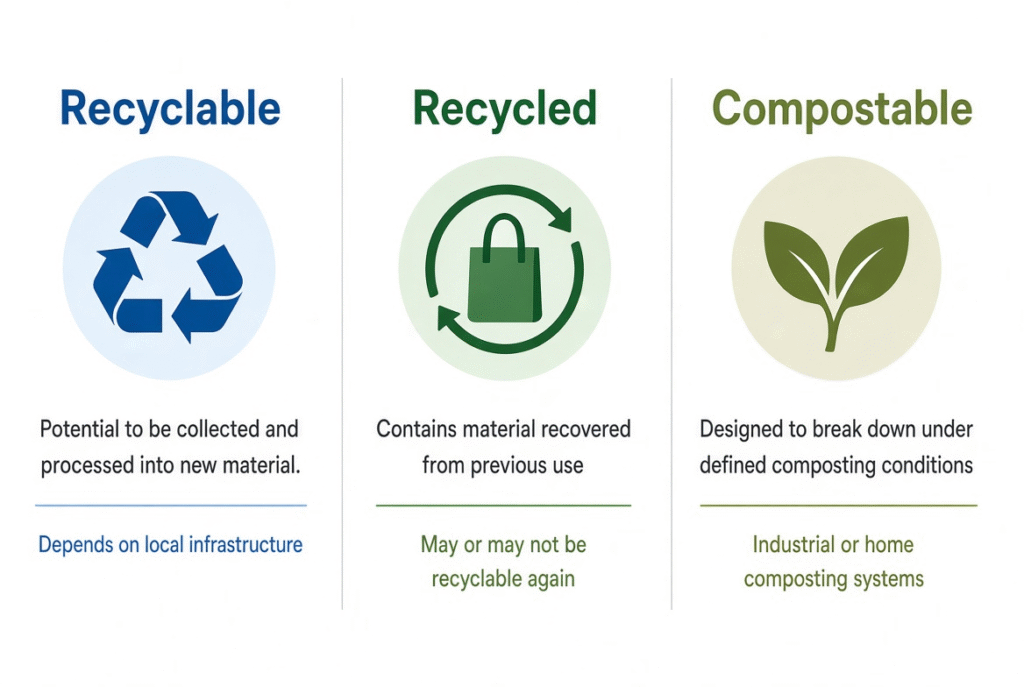
A bag can be one, both, or neither. A bag made from 100% recycled content may not be accepted by any local recycling program. A bag with no recycled content may be perfectly recyclable in a market with the right infrastructure.
Recyclable and compostable describe different end-of-life pathways. Neither label alone guarantees that suitable collection and processing infrastructure is available in every market.
These terms are often confused, but they describe different material properties and end-of-life pathways. Read our guide to recycled vs. recyclable vs. compostable bags for a detailed comparison.
What Businesses Should Ask Bag Suppliers
Before placing a bulk order, ask:
- What is the exact material and resin type?
- Is the bag certified for a specific disposal pathway, or is it a generic claim?
- Does the certification cover the finished product, not just the raw material?
- In which markets is the intended disposal pathway actually available?
- Can the supplier provide certification documentation?
In the United States, the Federal Trade Commission’s Green Guides advise businesses to qualify recyclable claims when appropriate recycling facilities are not available to a substantial majority of consumers or communities where the product is sold. Packaging claims should reflect real-world access to recycling, not just the theoretical properties of a material.
How to Choose Between Recyclable and Compostable Bags
The right bag depends on the material, application, local infrastructure, and disposal pathway.
| Application | What to prioritize |
|---|---|
| Retail shopping bags | PE type, thickness, reusability, local recycling access |
| Food waste collection | Compost certification matching the local facility |
| Kitchen waste | EN 13432, ASTM D6400, BPI, or OK compost certification |
| Courier and mailing | Strength, certification, end-of-life pathway |
| Commercial waste handling | Materials accepted by the local waste operator |
In some applications, recyclable PE bags are a reasonable choice. In organic waste collection, certified compostable bags are a better match — but only if the local composting system accepts them.
UK Plastic Packaging Tax: A Separate Compliance Consideration
This section applies to the UK market only and should not be confused with U.S. recycling rules.
The UK Plastic Packaging Tax applies to plastic packaging with less than 30% recycled content. The tax rate is updated annually. For the current rate, threshold, and registration requirements, see the official GOV.UK Plastic Packaging Tax guidance.
This tax creates a financial incentive to use recycled content — but only where recycling infrastructure exists to supply it. It is a separate compliance requirement from U.S. recycling rules.
FAQs
Are plastic bags recyclable?
Are plastic bags recyclable? Yes, many polyethylene bags can be recycled. But most curbside programs do not accept them. Recycling depends on store drop-off programs, municipal depots, or specialized collection services, which vary widely by region.
Can you recycle plastic bags in your curbside bin?
Usually not. Most curbside programs reject plastic bags because they jam sorting equipment and contaminate other recyclables.
Where can you recycle plastic bags?
Some participating grocery stores, retailers, and municipal depots accept plastic bags and film. Use a dedicated directory to find locations near you. Availability varies by region.
Are compostable bags recyclable?
Generally, no — compostable bags are designed for composting systems, not mechanical recycling. They should not be placed in plastic film recycling bins unless the relevant program explicitly accepts them.
What’s the difference between recyclable and recycled plastic bags?
“Recyclable” means a bag can potentially be collected and processed. “Recycled” means it contains material recovered from previous use. A bag can be one, both, or neither.
Conclusion
The recyclability of plastic bags is a conditional claim, not a guarantee. Many polyethylene bags can technically be recycled. In practice, most curbside programs reject them, and the viable pathway — store drop-off — depends on retail infrastructure that varies enormously by market.
For B2B buyers, the relevant question is not “is this bag recyclable” but “does my target market have the infrastructure to actually recycle it.”
If your goal is organic waste collection — food scraps, compost, or biowaste — recyclable plastic bags are not the answer. You need bags certified for the composting system that actually exists in your market.
HEMCbags Product Guidance
HEMCbags can help buyers compare recyclable PE bags and certified compostable bags based on the destination market, intended use, required certifications, and available disposal infrastructure.
- Certified Compostable Bags and Packaging
- Compostable Trash Bags
- Compostable Shopping Bags
- Compostable Courier Bags
- Compostable Certifications Guide
- Contact HEMCbags
Contact our team to request product specifications and certification documents.
Sources and Further Reading
- U.S. EPA — How Do I Recycle Common Recyclables?
- Flexible Film Recycling Alliance — Plastic Film Recycling Directory
- NexTREX — Plastic Bag & Film Recycling
- Association of Plastic Recyclers — Film Recycling
- Biodegradable Products Institute (BPI)
- Federal Trade Commission — Environmental Claims: Summary of the Green Guides
- GOV.UK — Plastic Packaging Tax
- Local waste-management program requirements — check your municipality or regional authority.