
Author: HEMCbags Technical Team | BPI and OK Compost Certified Manufacturer | 10+ Years Experience
Quick Answer: The key difference between home compostable vs industrial compostable packaging is the environment and temperature required for breakdown. Home compostable packaging decomposes in backyard compost piles at ambient temperatures (around 25°C) within 6-12 months. Industrial compostable packaging requires high-heat facilities (55-60°C) and breaks down within 90-180 days. A home compostable product will also work in industrial facilities, but the reverse is not true .
Key Takeaways:
- ✔ Home compostable = backyard compost bin (ambient temperature, slower)
- ✔ Industrial compostable = municipal composting facility (high heat, faster)
- ✔ Home compostable works in industrial facilities; industrial compostable does NOT work in home piles
- ✔ Look for OK Compost HOME or BPI Commercial & Home for home use
- ✔ Look for BPI, OK Compost INDUSTRIAL, or EN 13432 for industrial use
Home Compostable vs Industrial Compostable: What’s the Difference?
The difference comes down to one thing: temperature .
| Home Compostable | Industrial Compostable | |
|---|---|---|
| Temperature | Ambient (~25°C / 77°F) | 55-60°C (131-140°F) |
| Timeframe | 6-12 months | 90-180 days |
| Environment | Backyard compost pile | Municipal composting facility |
| Certification | OK Compost HOME, BPI Home | BPI, OK Compost INDUSTRIAL, EN 13432 |
| Infrastructure needed | None | Specialized facility |
The most important rule: A home compostable product will also break down in an industrial facility. But an industrial compostable product is not designed to reliably break down in home composting conditions and may remain intact for a very long time .
Which Certification Do You Need? A Decision Tree
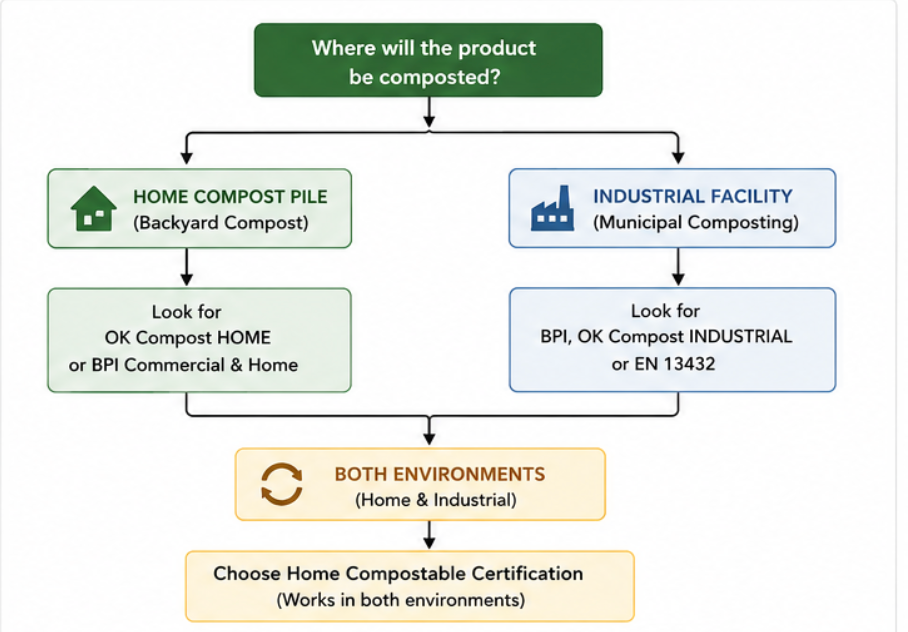
Where will the product be composted?
↓
HOME COMPOST PILE
↓
Look for OK Compost HOME logo or BPI Commercial & Home logo
↓
INDUSTRIAL FACILITY
↓
Look for BPI, OK Compost INDUSTRIAL, or EN 13432
↓
BOTH
↓
Look for OK Compost HOME or BPI Commercial & Home
(Home compostable works in both environments)
Remember: Home compostable = works in both. Industrial compostable = works only in industrial facilities.
HEMCbags Technical Insight
At HEMCbags, we’ve supplied more than 50 million certified compostable bags to customers across North America and Europe. The single biggest misconception we encounter is this:
“If it says compostable, it should break down in my backyard, right?”
Wrong. Most certified compostable products are industrial compostable only. When customers put these bags in their backyard piles and find them intact months later, they blame the product. In reality, they used the wrong product for the wrong environment.
That’s why we always ask: “Where will your customers compost?” The answer determines which certification you need .
Real-World Examples: Which Product for Which Use?
| Application | Best Choice | Why |
|---|---|---|
| Kitchen caddy liners | Home Compostable | Disposed in backyard or community compost |
| Produce bags | Home Compostable | Often ends up in home compost systems |
| Food service packaging | Industrial Compostable | Commercial kitchens have industrial collection |
| Stadium food waste | Industrial Compostable | Large-scale waste handling |
| Coffee capsules | Industrial Compostable | High-volume commercial programs |
| Tea bags | Industrial Compostable | Typically composted at municipal scale |
| Municipal green bin liners | Industrial Compostable | Designed for facility processing |
What Does Home Compostable Mean?
Home compostable means a product can break down completely in a domestic composting environment—a backyard compost pile, a rotating drum composter, or a community garden bin .
Key Characteristics
- Temperature: Around 25°C (77°F) — ambient conditions
- Timeframe: 6-12 months for complete breakdown
- Process: Slower, less controlled, relies on natural microbial activity
According to the Intertek Compostable Certification Program, home compost piles have lower and less consistent temperatures than industrial facilities, typically operating around 20-30°C compared to 58°C in commercial systems . This makes home composting a more difficult, slower-paced process .
Certifications for Home Compostable
| Certification | Region | Standard |
|---|---|---|
| OK Compost HOME | Global | TÜV Austria scheme |
| BPI Commercial & Home | North America | ASTM D6400/D6868 |
| AS 5810 | Australia | Home compostable plastics |
| NF T 51-800 | France | Plastics for home composting |
| EN 17427 | Europe | Carrier bags for home composting |
According to the TÜV Austria OK Compost certification program, OK Compost HOME certification does not refer to a single standard. Instead, it was developed by TÜV Austria in 2003 and has since served as the basis for multiple national home compostability standards.
In 2025, BPI launched its Commercial & Home Compostable Certification program, allowing products to carry a single label for both environments. According to BPI’s equivalency table, the BPI Home Compostability Certification exceeds the requirements of OK Compost HOME in some areas, including stricter heavy metal limits and more rigorous disintegration testing.
Certification Logo Gallery
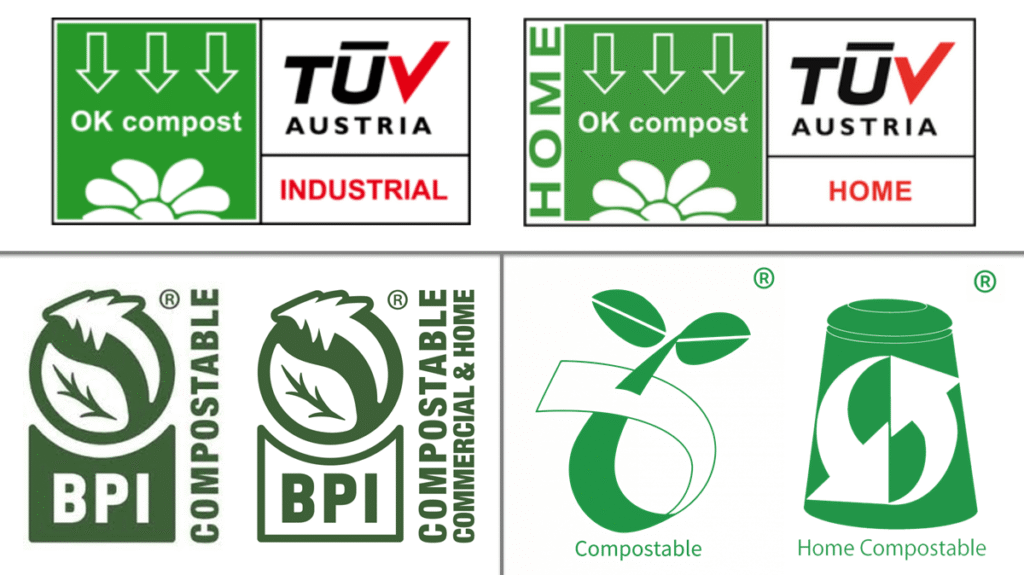
Look for these logos to identify genuine certified products:
| Certification Logo | What It Means | Disposal Environment |
|---|---|---|
| BPI | Industrial compostable (North America) | Commercial facility only |
| OK Compost HOME | Home compostable (Global) | Backyard or commercial |
| OK Compost INDUSTRIAL | Industrial compostable (Global) | Commercial facility only |
| DIN CERTCO | European standard compliance | Depends on certification |
| Seedling Logo | Industrial compostable (Europe) | Commercial facility only |
| BPI Commercial & Home | Both environments (New 2025) | Backyard or commercial |
What Does Industrial Compostable Mean?
Industrial compostable means a product is designed to break down in large-scale composting facilities with controlled conditions .
Key Characteristics
- Temperature: 55-60°C (131-140°F) — maintained throughout the process
- Timeframe: 90-180 days
- Process: Controlled humidity, regular aeration, optimized conditions
Industrial composting facilities handle large volumes of waste and monitor conditions to ensure rapid, efficient decomposition. These facilities are a key part of the circular economy, particularly for food service operators, stadiums, universities, and caterers .
Certifications for Industrial Compostable
| Certification | Region | Standard |
|---|---|---|
| BPI | North America | ASTM D6400/D6868 |
| OK Compost INDUSTRIAL | Global | EN 13432 |
| EN 13432 | Europe | Packaging compostability |
| ASTM D6400 | US | Compostable plastics |
| AS 4736 | Australia | Biodegradable plastics for composting |
The Four EN 13432 Tests
To earn OK Compost INDUSTRIAL certification, products must pass four tests :
- Biodegradation — Chemical breakdown of the polymer (≥90% carbon conversion within 6 months)
- Disintegration — Physical breakdown into small fragments (under 2mm within 12 weeks)
- Ecotoxicity — No negative effect on plant growth
- Heavy metal limits — Strict limits on toxic elements
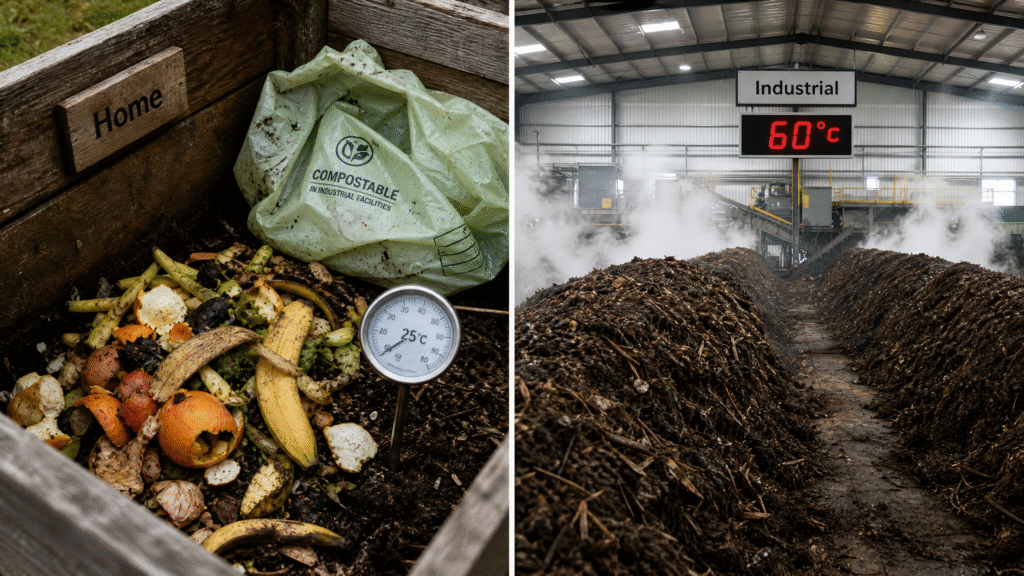
Industrial vs Home Compostable: Side-by-Side Comparison
| Aspect | OK Compost HOME | OK Compost INDUSTRIAL |
|---|---|---|
| Environment | Household compost pile | Industrial facility |
| Temperature | 20-30°C | 55-60°C |
| Timeframe | 6-12 months | 90-180 days |
| Standard | Multiple national standards | EN 13432 |
| Certification | TÜV Austria, BPI | TÜV Austria, BPI, DIN CERTCO |
| Target users | Consumers, retail | Municipalities, businesses |
| Product types | Small bags, produce bags | Large waste bags, industrial films |
Which One Should You Choose?
For Homeowners
- Need bags for kitchen scraps in a backyard pile → OK Compost HOME or BPI Commercial & Home
- Check your local guidelines before buying—not all home compost piles reach the temperature required for home certification
For Retailers
- Stocking products for consumers who compost at home → OK Compost HOME certified products
- Stocking products for green bin programs → BPI or OK Compost INDUSTRIAL
- Clearly label which certification is on the product to avoid confusion
For Municipalities
- Providing liners for residents → BPI or OK Compost INDUSTRIAL
- Green bin programs typically require industrial compostable certification
- Check with your facility operator before purchasing
For Brands
- Private label packaging → ask: “Where will my customers compost?”
- If the answer includes “both home and industrial” → choose OK Compost HOME or BPI Commercial & Home
- If the answer is “industrial only” → BPI or OK Compost INDUSTRIAL is sufficient
Common Mistakes
Many buyers and consumers make the same mistakes when it comes to compostable packaging:
| Mistake | Why It’s Wrong | What To Do Instead |
|---|---|---|
| Buying industrial bags for home compost | They won’t break down in backyard conditions | Look for OK Compost HOME |
| Throwing compostable bags into recycling | They contaminate recycling streams | Dispose in compost bin |
| Putting industrial bags into garden compost | They may persist for months or years | Only use OK Compost HOME in garden |
| Ignoring certification logos | The word “compostable” alone is unreliable | Always check the certification logo |
Why Does This Difference Matter?
For Consumers
Buying a product labeled “compostable” without checking the certification can lead to frustration. If you put an industrial compostable bag in your backyard pile, it will not break down as expected—you’ll find it months later, still intact .
For Businesses
Choosing the wrong certification can mean:
- Customer complaints — when products don’t break down as expected
- Compliance issues — if your local facility requires a specific certification
- Brand damage — when customers perceive your product as “greenwashing”
In the EU, the new Packaging and Packaging Waste Regulation (PPWR) will require certain packaging types to be industrially compostable from February 2028. European Bioplastics supports the upcoming harmonisation of home compostability standards under the PPWR, noting that home composting should be seen as a complementary option within the broader organic waste management system.
According to the European Parliament, the Commission will request harmonised standards for home compostability by 12 February 2026, based on the latest scientific and technological developments.
For Municipalities
Industrial composting facilities need products that break down within their processing windows. Products that are “home compostable only” may not be accepted—and some facilities reject all compostable plastics regardless of certification .
Common Myths
Myth 1: “Compostable” means it works anywhere
False. “Compostable” without a specific certification usually means industrial compostable only. Always check the logo .
Myth 2: Industrial compostable products will eventually break down at home
False. They are not designed to reliably break down in home composting conditions and may remain intact for a very long time because temperatures never reach the 55-60°C required for industrial breakdown .
Myth 3: Home compostable is better than industrial compostable
False. They serve different purposes. Home compostable offers flexibility where industrial infrastructure doesn’t exist. Industrial compostable is designed for scale and speed .
Myth 4: Biodegradable and compostable mean the same thing
False. According to the Ellen MacArthur Foundation, biodegradable has no specified timeframe or conditions, while compostable requires breakdown within a defined timeframe under specific conditions .
Regulatory Trends: The Future of Compostability
EU PPWR (2028)
From February 2028, the following packaging types must be industrially compostable in the EU:
- Sticky labels on fruit and vegetables
- Permeable tea, coffee, and beverage bags
- Soft single-serve units disposed with the product
Member states may also require home compostability for additional packaging types where infrastructure exists.
Singapore Green Labelling Scheme (2026)
Singapore launched new categories for Home Compostable (044A) and Industrial Compostable (044B) products in January 2026, providing clearer definitions for the market.
Washington State Law
Washington State requires that products labeled “home compostable” must also meet ASTM standards for industrial composting—meaning they cannot be “home compostable only.”
BPI’s New Home Certification (2025)
The Biodegradable Products Institute now certifies products for both commercial and home composting, with the home certification requiring additional testing at lower temperatures.
How to Identify Genuine Home vs Industrial Compostable Products
| Look For | Means |
|---|---|
| OK Compost HOME or BPI Commercial & Home | ✅ Good for home compost |
| OK Compost INDUSTRIAL or BPI | ⚠️ Industrial facility only |
| EN 13432 | ⚠️ Industrial facility only |
| ASTM D6400 | ⚠️ Industrial facility only |
| AS 5810 | ✅ Home compostable |
| “Biodegradable” alone | ❌ No standard—avoid |
Tip: Look for the certification logo, not just the word “compostable.”
FAQ
What is the difference between compostable and industrial compostable?
“Compostable” is a broad term that includes both home and industrial compostable products. Industrial compostable is a subset — it requires high heat (55-60°C) and commercial facilities. Home compostable products also work in industrial settings, but industrial compostable products are not designed to reliably break down at home.
What is industrial compostable packaging?
Packaging that breaks down only in commercial composting facilities. It requires high heat (55-60°C) and controlled conditions — and will not break down reliably in home compost piles or landfills.
What is home compostable packaging?
Packaging designed to break down in backyard compost piles at ambient temperatures (around 25°C) over 6-12 months. It carries certifications like OK Compost HOME or BPI Commercial & Home.
What does “certified industrially compostable” mean?
A product independently tested to break down completely in commercial composting facilities. It must meet ASTM D6400 or EN 13432 standards and carry logos like BPI, OK Compost INDUSTRIAL, or DIN CERTCO.
What should not go in home compost?
Meat, fish, dairy, cooking oils, and pet waste. Also avoid industrial compostable products, diseased plants, weeds with seeds, and treated wood.
Conclusion
The difference between home compostable and industrial compostable packaging is straightforward once you understand the temperature requirements.
Key takeaways:
- Home compostable = works in backyard piles (ambient temperature, 6-12 months)
- Industrial compostable = requires municipal facilities (55-60°C, 90-180 days)
- Home compostable works in both environments; industrial compostable is not designed to work at home
- Look for OK Compost HOME or BPI Commercial & Home for home composting
- Look for BPI, OK Compost INDUSTRIAL, or EN 13432 for industrial composting
- The word “compostable” alone is not enough—always check the certification logo
Beyond disposal: preventing waste at the source.
Since organic waste is the main component of home composting, the best strategy is to combine composting with waste reduction. Composting is one part of the solution. The most effective approach starts with reducing food waste in the first place. See our guide on how to reduce food waste for practical tips.
Ready to source the right certified compostable products for your needs?
Browse HEMCbags compostable bags | Learn more about compostable certifications