
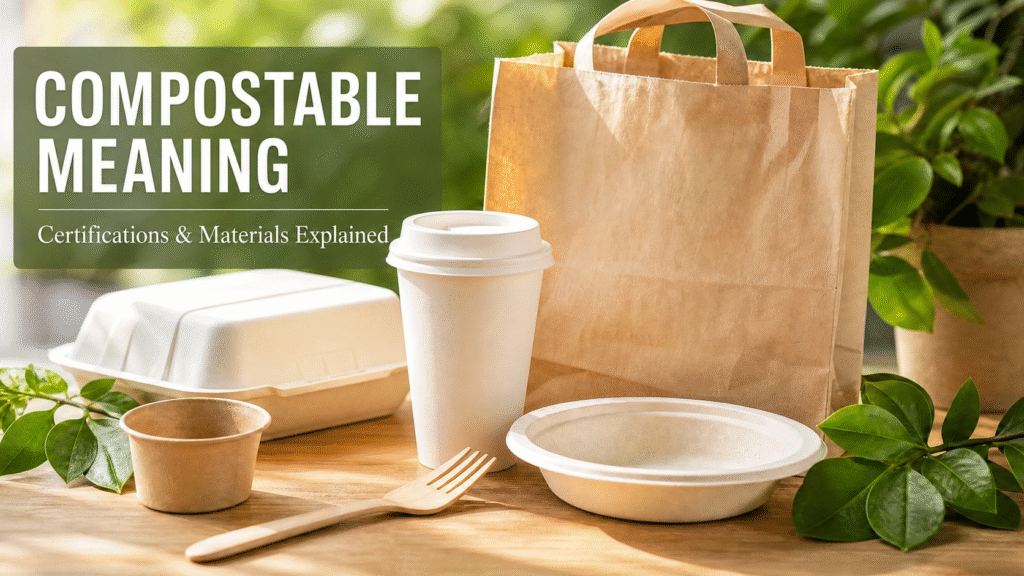
Author: HEMCbags Technical Team | BPI and OK Compost Certified Manufacturer | 10+ Years Experience
Quick Answer: Compostable meaning a product can break down into water, CO₂, and biomass within a specific timeframe under controlled composting conditions. Most certified compostable bags require industrial composting. Look for BPI or TÜV certification before buying. Compostable does not always mean home compostable.
Key Takeaways:
- ✔ Compost products require microorganisms to break down into water, CO₂, and biomass.
- ✔ Most certified compostable bags require industrial composting (50-60°C / 122-140°F).
- ✔ Look for BPI or TÜV certification before buying — logos matter more than claims.
- ✔ Compostable does not always mean home compostable. Only OK Compost HOME bags work in backyard piles.
What is Compostable Meaning?
Scientific Definition: Compost materials are organic substances that can undergo biological decomposition in a composting environment, breaking down into carbon dioxide, water, inorganic compounds, and biomass at a rate consistent with known compost materials (ASTM D6400).
Dictionary Definition: “Compost” means a product or material is capable of breaking down into natural elements in a composting environment, leaving no toxic residue behind.
EPA Definition: According to the U.S. Environmental Protection Agency, composting is the controlled biological decomposition of organic materials. A “compost” product is one that can fully break down in a composting system.
Real-world Example: A compost trash bag made from cornstarch and PLA, placed in a municipal composting facility at 55°C, will break down completely within 90-180 days — turning into soil that can be used in gardens.
Common Misunderstanding: Many people think “compost” means a product will break down anywhere — in a landfill, in the ocean, in their backyard. This is incorrect. Compost products require specific conditions to break down.
HEMCbags Technical Insight
At HEMCbags, we’ve supplied more than 50 million certified compost bags to customers in North America and Europe.
One of the biggest misconceptions we hear is that every compostable bag works in a backyard compost pile. In reality, most certified bags are designed for industrial composting facilities unless they specifically carry the OK Compost HOME certification.
That’s why we always encourage buyers to verify the certification — not just the material.
How Composting Actually Works
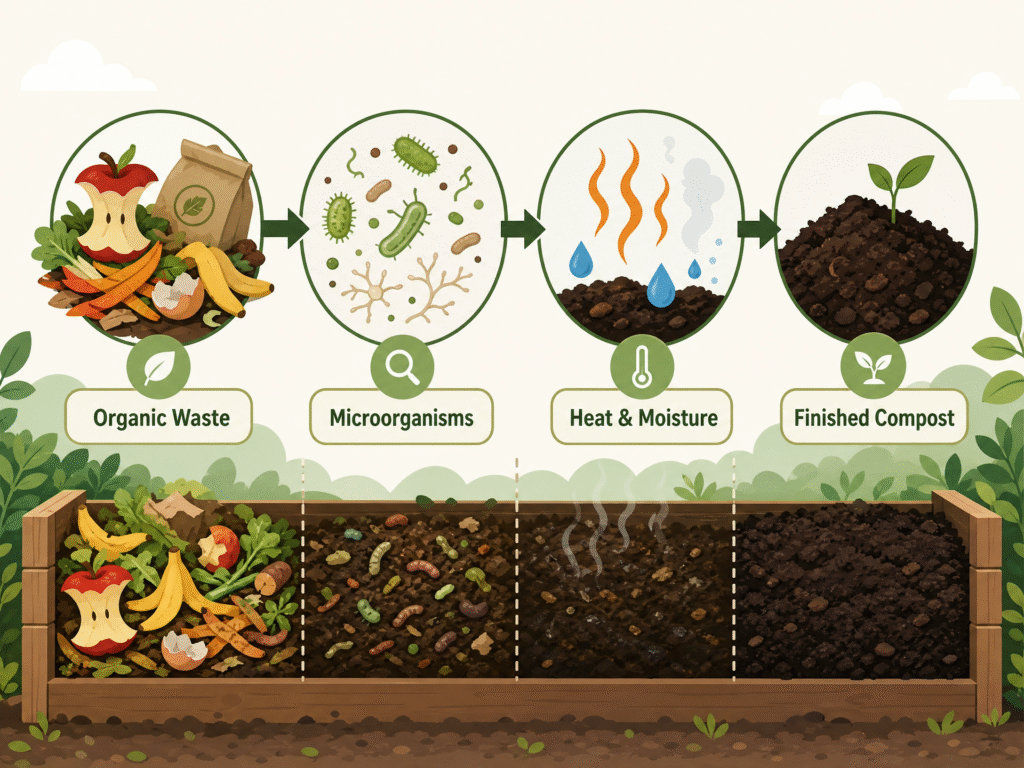
Composting is a biological process driven by microorganisms. Here is how it works:
The Composting Process:
Organic Material (food scraps, yard waste, compost bags)
↓
Microorganisms (bacteria, fungi) begin breaking down organic matter
↓
Heat is generated (pile temperature rises to 50-60°C / 122-140°F)
↓
Moisture and oxygen are consumed by microorganisms
↓
Organic matter is converted into CO₂, water, and humus
↓
Finished compost (dark, crumbly, earth-smelling soil amendment)
The Four Essential Elements:
| Element | Role in Composting |
|---|---|
| Organic Material | Food scraps, yard waste, and compost products |
| Microorganisms | Bacteria, fungi, and other microbes that consume organic matter |
| Heat | Generated by microbial activity; speeds up breakdown |
| Moisture | Essential for microbial survival and activity |
| Oxygen | Required for aerobic decomposition |
Without any of these elements, composting slows down or stops entirely.
What Makes a Product Compostable?
A product is compost when it meets these criteria:
| Criteria | What It Means |
|---|---|
| Carbon-based materials | Made from organic matter (plant-based polymers, paper, or other biodegradable materials) |
| Microorganisms | Bacteria and fungi can consume the material |
| Timeframe | Must break down within a specific period (typically 90-180 days for industrial composting) |
| Complete decomposition | Breaks down entirely into CO₂, water, and biomass — no microplastics |
| No toxic residue | The finished compost must support plant growth |
| Certification | Must be verified by a third-party certifier (BPI, OK Compost, ASTM D6400) |
Why this matters: A product cannot simply claim “compost” — it must meet all six of these criteria and be certified by a recognized body.
Compostable Materials: What Are They Made Of?
Compost materials come from renewable resources. The most common materials include:
| Material | Source | Common Uses |
|---|---|---|
| PLA (Polylactic Acid) | Corn, sugarcane, cassava | Cups, food containers, clear packaging |
| PBAT | Fossil-based (biodegradable polymer) | Trash bags, flexible films |
| PHA (Polyhydroxyalkanoate) | Bacterial fermentation | Food packaging, medical applications |
| Corn Starch | Corn | Blends for bags and packaging |
| Bagasse | Sugarcane fiber | Food containers, plates, bowls |
| Cellulose | Plant fibers | Compost films |
| Paper | Wood pulp | Paper bags, wrappers |
| Wood Fiber | Wood pulp | Compost packaging, molded pulp |
Key takeaway: Material alone does not guarantee compostability. Certification matters more than the material itself.
Compost Certifications: How to Know It’s Real
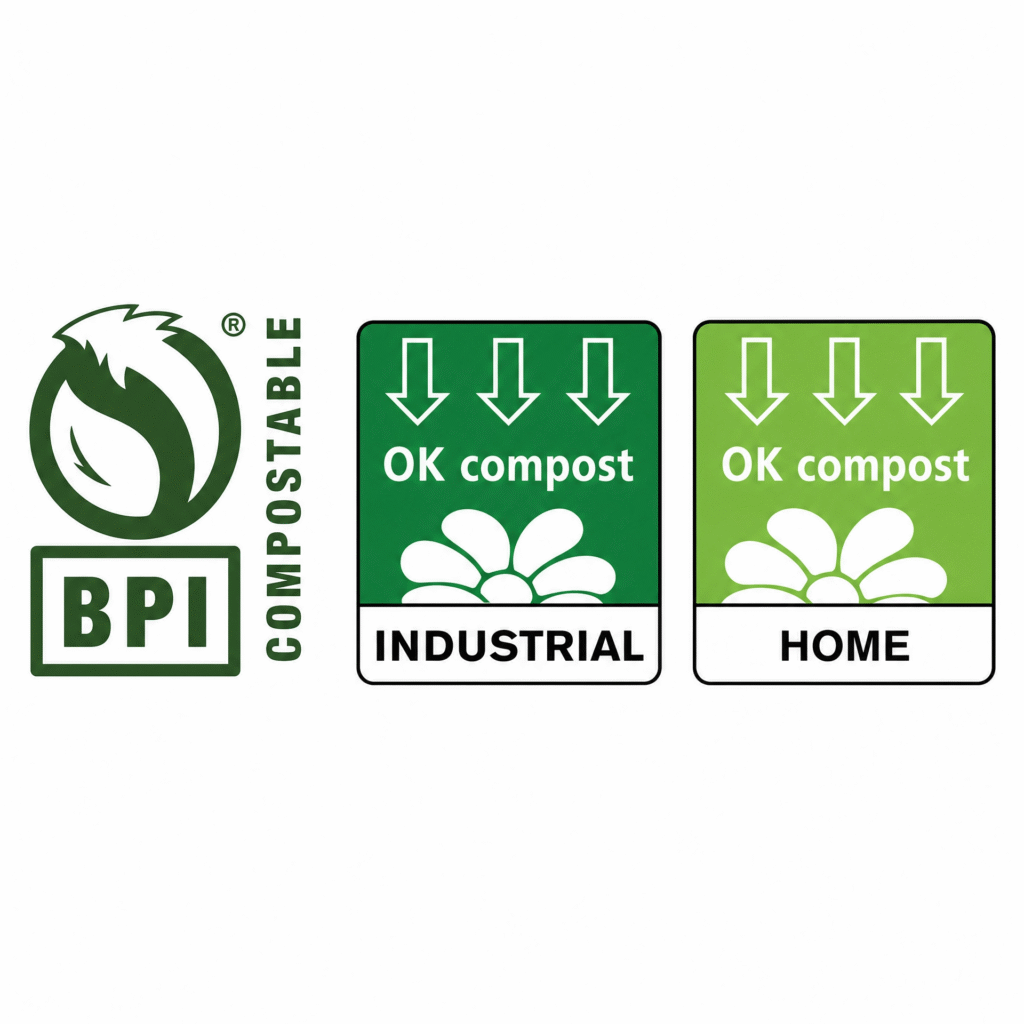
Certifications are the only reliable way to verify that a product is truly compostable. According to the Biodegradable Products Institute (BPI), third-party verification is essential to confirm compostability claims.
| Certification | Market | Environment | Key Requirement |
|---|---|---|---|
| BPI | North America | Industrial composting | ASTM D6400 compliance + annual testing |
| OK Compost INDUSTRIAL | Europe / Global | Industrial composting | EN 13432 compliance |
| OK Compost HOME | Europe / Global | Home composting | EN 13432 + home compost testing |
| ASTM D6400 | US | Industrial composting | 90% biodegradation in 180 days |
| EN 13432 | Europe | Industrial composting | 90% biodegradation in 180 days |
How to Verify Compost Certifications
Use this checklist to verify a product’s certification:
- ✓ Ask for the license number. Every certified product has a unique license number from the certifying body.
- ✓ Look for the certification logo. Products should display the BPI logo, OK Compost logo, or other recognized marks.
- ✓ Search the certification database. BPI and TÜV Austria maintain public lists of certified products.
- ✓ Confirm the exact product is listed. The certification must cover the specific product name and specifications.
- ✓ Verify with the manufacturer. Ask for the certification number and confirm it matches the database.
Industrial Compostable vs Home Compostable
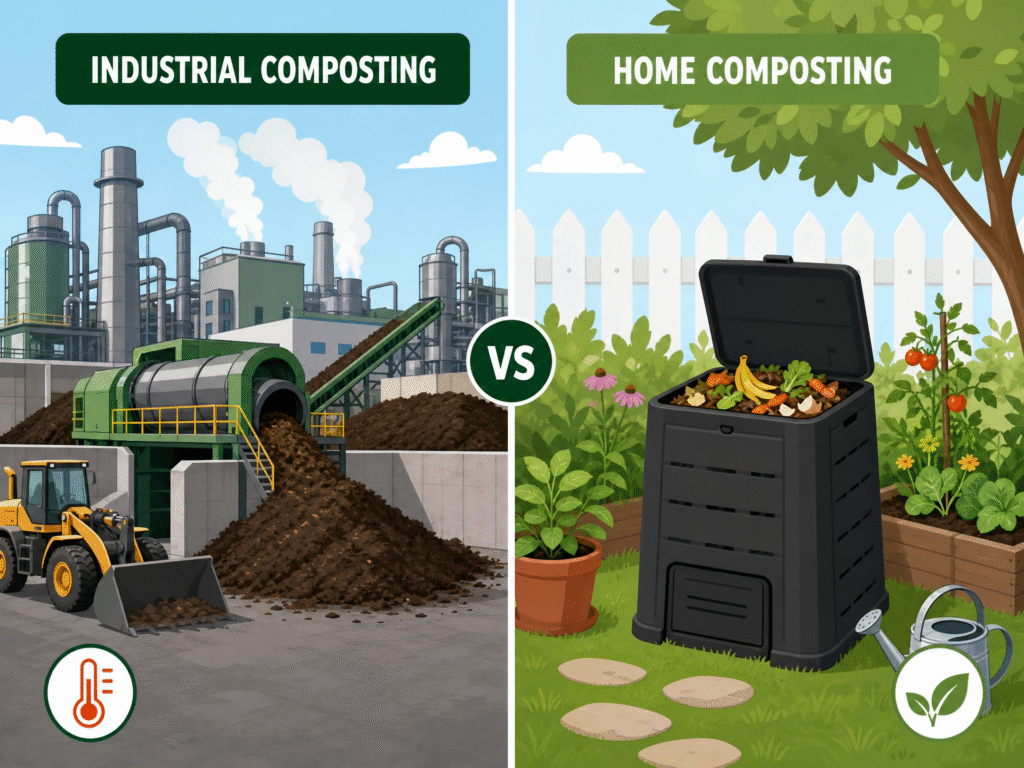
Not all compost products are the same. The most important distinction is between industrial and home compostable.
Decision Tree: Which Certification Do You Need?
Do you compost at home?
↓
YES
↓
Look for OK Compost HOME or TÜV HOME
↓
NO
↓
Do you have access to municipal composting?
↓
YES
↓
Look for BPI or OK Compost INDUSTRIAL
↓
NO
↓
Use regular trash and focus on waste reduction
Comparison Table
| Industrial Compostable | Home Compostable | |
|---|---|---|
| Temperature | 50-60°C (122-140°F) | Ambient (~25°C / 77°F) |
| Timeframe | 90-180 days | 6-12 months |
| Facility | Municipal composting | Backyard compost pile |
| Certifications | BPI, OK Compost INDUSTRIAL, ASTM D6400 | OK Compost HOME, TÜV HOME |
Compostable vs Biodegradable: The Key Difference
| Compostable | Biodegradable | |
|---|---|---|
| Legal standard | Yes (ASTM D6400 / EN 13432) | No (unregulated) |
| Timeframe | Yes (90-180 days) | No (unspecified) |
| Environment specified | Yes (industrial or home composting) | No |
| Third-party certification | Yes (BPI, OK Compost) | No |
| Leaves microplastics | No (when composted correctly) | Often yes |
| Works in landfill | No | No |
📖 Want to understand biodegradable in depth? Read our companion guide: Biodegradable Explained: Meaning, How It Works, Benefits & Compostable Comparison (2026 Guide).
Common Myths About Compost Products
Myth 1: Compostable = Biodegradable
False. All compost products are biodegradable, but very few biodegradable products are compost. Compost has a legal standard; biodegradable does not.
Myth 2: Compostable = Home Compostable
False. Most compost products require industrial composting (50-60°C). Only products with OK Compost HOME certification are suitable for backyard composting.
Myth 3: Compost products dissolve anywhere
False. Compost products require specific conditions — heat, moisture, oxygen, and microorganisms. They do not dissolve in landfills, oceans, or soil.
Where Are Compostable Materials Used?
Compost materials are used across multiple industries:
Consumer
- Kitchen Waste Bags
- Shopping Bags
- Produce Bags
- Dog Poop Bags
Commercial
- Mailers
- E-commerce Packaging
- Disposable Gloves
Agriculture
- Agricultural Film (mulch films)
- Plant Pots
Medical
- Certain medical packaging
- Single-use medical supplies
Food Service
- Cups
- Plates
- Bowls
- Utensils
- Food Containers
E-commerce
- Shipping Mailers
- Protective Packaging
- Void Fill
How to Dispose of Compost Products Correctly
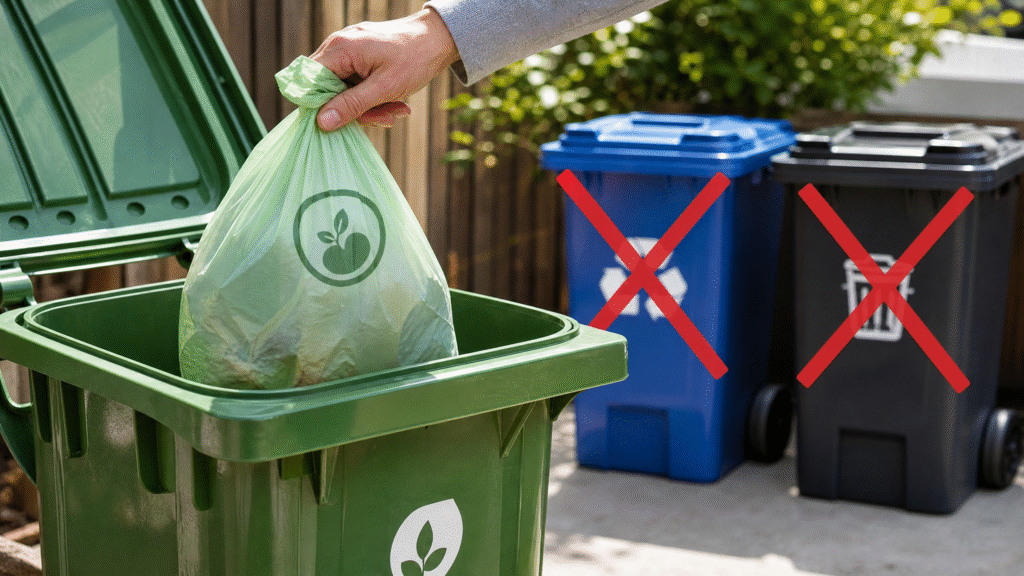
Proper disposal is the key to realizing the environmental benefit of compost products.
Disposal Options:
| Disposal Method | Best For | Notes |
|---|---|---|
| Municipal green bin | BPI or OK Compost INDUSTRIAL certified products | Curbside collection; most cities accept |
| Backyard compost pile | Only OK Compost HOME or TÜV HOME certified products | Requires proper maintenance |
| Industrial composting facility | All certified compost products | Drop-off locations available in some areas |
| Trash (landfill) | Not recommended | Products won’t break down in landfills; only use if no other option |
What NOT to do:
- ❌ Do not put compostable products in your recycling bin
- ❌ Do not litter (they won’t break down in the environment)
- ❌ Do not flush unless specifically labeled for flushability
Before You Buy Checklist
- ✓ BPI Logo — Look for the BPI certification mark on the packaging
- ✓ OK Compost Logo — Look for OK Compost INDUSTRIAL or HOME
- ✓ Home or Industrial — Confirm whether the product is designed for home or industrial composting
- ✓ Certification Number — Every certified product has a unique license number
- ✓ Correct Disposal — Verify your local composting facility accepts the product
📖 Learn more: Composting 101 Guide | Compostable Certifications Explained
FAQ
What does compostable mean?
Compostable means a product can break down into CO₂, water, and biomass within a specific timeframe under controlled composting conditions, leaving no toxic residue. It requires third-party certification.
Is compostable better than recyclable?
It depends. Both are better than landfill. Compostable is ideal for organic waste (food scraps, paper) and products that contaminate recycling. Recyclable is better for materials that can be reprocessed multiple times.
Can compostable bags go in the green bin?
Yes — if they carry BPI or OK Compost certification. Always check your local municipality’s guidelines, as some green bin programs do not accept any compostable plastics.
Do compostable bags leave microplastics?
No — when disposed of correctly in a composting facility. Certified compostable bags break down completely into CO₂, water, and biomass.
Are compostable bags made from corn?
Many are. PLA, the most common compostable plastic, is made from corn starch. Some bags also use sugarcane, cassava, or other plant sources.
Can compostable products go into landfill?
Yes, they physically can, but they will not break down as designed. Landfills lack the oxygen, heat, and moisture required for composting.
Are compostable plastics really plastic?
Yes — they are plastics, but they are made from renewable resources (plant-based) rather than fossil fuels, and they are designed to break down completely in composting conditions.
How long does compostable take to break down?
In industrial composting: 90-180 days. In home composting: 6-12 months (if OK Compost HOME certified). In landfills: unknown — not designed for landfill conditions.
Can I put compostable bags in my home compost?
Only if the bag carries OK Compost HOME or TÜV HOME certification. Most certified bags require industrial composting.
How do I know if a product is really compostable?
Look for certification logos (BPI, OK Compost, ASTM D6400, EN 13432). Logos matter more than words on packaging.
Conclusion
Compost products offer a genuine alternative to conventional plastics — but only when disposed of correctly. The key is understanding what “compost” actually means: a certified, time-bound breakdown in specific conditions.
Key takeaways:
- Compostable is a legally defined term with standards and certification
- Most compost products require industrial composting
- Look for BPI or OK Compost logos — not just the word “compostable”
- Home compost products exist, but they are rare and clearly labeled
- Correct disposal is essential for environmental benefit
Ready to explore compost products?
Browse HEMCbags certified compostable bags | Learn more about certifications