
Quick Answer:
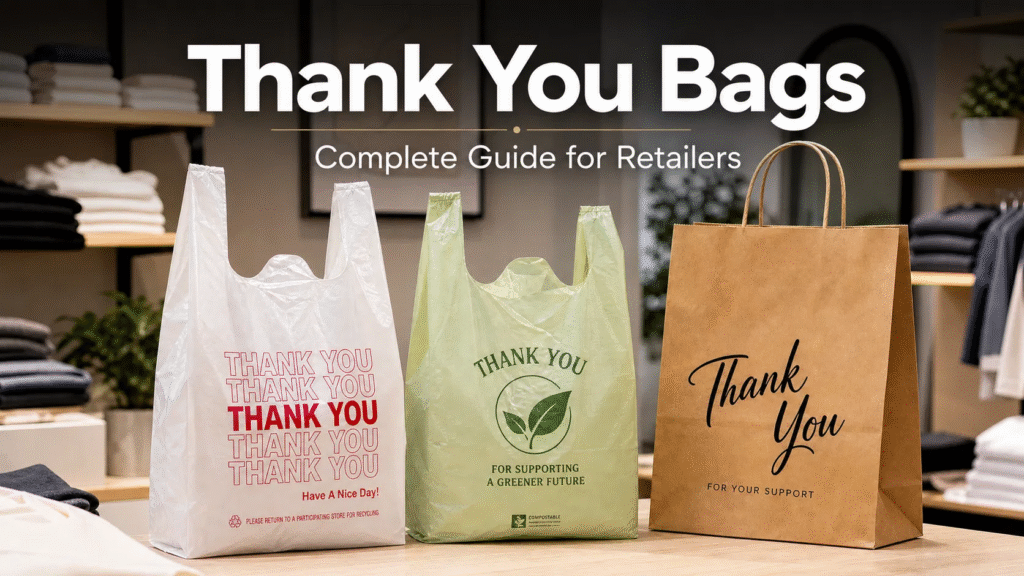
Thank you bags are retail checkout bags printed with a “thank you” message, usually made from HDPE and commonly produced in the T-shirt bag style. They are widely used by retail stores, boutiques, grocery stores, restaurants, and other businesses for carrying purchases. Traditional versions are made from HDPE plastic, while certified compostable alternatives are increasingly available for brands seeking sustainable packaging.
Key Takeaways:
- Thank you bags are the familiar white plastic bags with “thank you” printed in red—often called “T-shirt bags” because the handle cutouts resemble a shirt on a hanger
- Traditional options are made from HDPE plastic—lightweight, waterproof, and cost-effective, but not eco-friendly
- Compostable alternatives are available in certified PBAT/PLA blends with EN 13432, BPI, or OK Compost certification
- Key purchase specs: thickness (mil), size, handle style, gusset depth, and certification
- Bulk buying offers significant cost savings, though MOQ depends on stock vs custom, printing, and supplier
What Are Thank You Bags?
A thank you bag is a retail checkout bag printed with a “thank you” message—typically a white plastic T-shirt bag with red lettering and cut-out handles. It gets its nickname from the two wide handle cutouts that resemble a T-shirt hanging on a hanger.
The printed “thank you” design goes back decades in US retail. It stuck around because:
- It’s a low-cost way to add a customer-facing touch to a plain functional bag
- No custom printing required—comes as a standard stock design
- It reinforces customer appreciation and professional presentation
Are Thank You Bags the Same as T-Shirt Bags?
Often, but not always.
A “T-shirt bag” describes the bag’s handle and construction, while a “thank you bag” describes the printed message. Many thank you bags use the T-shirt bag format, so the terms are often used interchangeably in product listings.
- If a bag has T-shirt handles but no “thank you” print → it’s a T-shirt bag
- If a bag has the “thank you” print but a different handle style → it’s a thank you bag
- If it has both → it can be called either, depending on which feature is being emphasized
The same bag can be all three. A single bag can simultaneously be a thank you bag (print), a T-shirt bag (construction), and a grocery bag (use case).
What Are Thank You Bags Made Of? HDPE, LDPE & Compostable Materials
Most thank you bags are made from high-density polyethylene (HDPE) film.
| Material | Properties | Best Use |
|---|---|---|
| HDPE (High-Density Polyethylene) | Thin, crinkly, strong tear resistance for its weight | Standard choice for this bag style |
| LDPE (Low-Density Polyethylene) | Softer, more flexible, slightly thicker | Some alternatives |
| PBAT/PLA (Compostable) | Compostable polymer blends; formulations may include bio-based components such as PLA or starch | Sustainable alternative |
Are Thank You Bags Recyclable?
HDPE film bags are technically recyclable, but recycling availability depends on local collection systems. In the U.S., these bags are generally not accepted in curbside recycling and may instead be accepted through designated store drop-off programs. Compostable thank you bags require industrial composting facilities and should not be placed in recycling bins.
Thank You Bag Sizes: Complete Size Guide
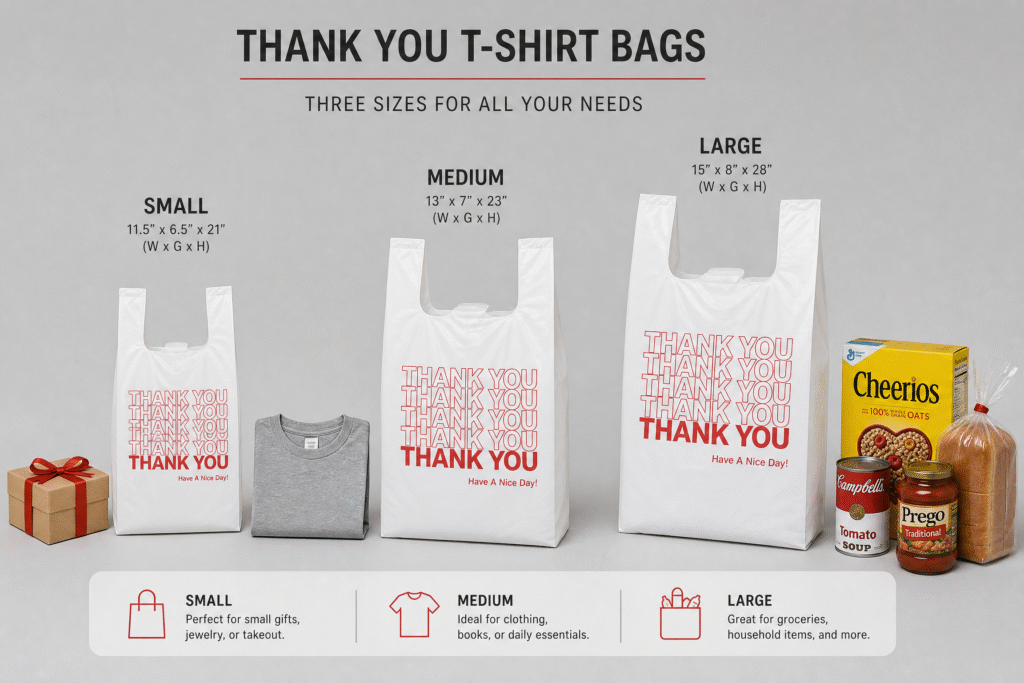
Choosing the right size is one of the most important purchasing decisions. Most suppliers offer standard sizes measured as Width × Gusset × Height.
A commonly offered size is 10″ × 5″ × 19″, although suppliers offer many other combinations. The ideal size depends on the products being packed.
| Size | Typical Use |
|---|---|
| 8″ × 5″ × 15″ | Small retail items, jewelry, gifts |
| 10″ × 5″ × 15″ | T-shirts, accessories, cosmetics |
| 10″ × 5″ × 19″ | Boutiques, cosmetics, general retail |
| 11.5″ × 6.5″ × 21″ | General retail and grocery |
| 12″ × 7″ × 21″ | Clothing and larger purchases |
| 15″ × 7″ × 26″ | Bulky retail items |
| 18″ × 8″ × 30″ | Large or high-volume purchases |
Actual load capacity depends on film material, thickness, bag dimensions, gusset design, seal strength, and handle construction. Ask the supplier for tested load performance when weight capacity is critical.
What Size Thank You Bag Is Best for a Clothing Store?
A 10″ × 5″ × 19″ bag is a common choice for clothing retailers, although the best size depends on the products and packing requirements. For hoodies or multiple items, consider 12″ × 7″ × 21″.
What Size Thank You Bag Is Best for a Boutique?
10″ × 5″ × 15″ to 10″ × 5″ × 19″. The smaller size works well for accessories and jewelry, while the larger size accommodates clothing and gift boxes.
What Size Thank You Grocery Bag Is Best?
11.5″ × 6.5″ × 21″ to 15″ × 7″ × 26″. The larger gusset (6.5-7 inches) provides the expandable capacity needed for produce and boxed items.
How Thick Should a Thank You Bag Be?
Many standard HDPE T-shirt bags are produced in relatively thin film gauges, but thickness varies by supplier, bag size, and intended load. Always confirm the actual gauge before ordering.
Commonly available thickness ranges include:
- Lightweight retail bags: around 0.5 mil
- Thicker/heavy-duty options: available upon request
| Thickness | Typical Use | Durability |
|---|---|---|
| ~0.5 mil (~12–13 microns) | Lightweight everyday retail | Light |
| Thicker gauges | Heavy-duty applications | Varies |
| 25–50 microns | Compostable alternatives | Varies by formulation |
Film Thickness Does Not Equal Load Capacity
Film thickness alone does not determine how much weight a thank you bag can carry. Material formulation, bag dimensions, gusset design, seal strength, and handle construction also affect load performance. A thicker film does not automatically mean a stronger bag if other design factors are not aligned.
Checklist for choosing thickness:
As a general purchasing reference, lightweight HDPE T-shirt bags may use thinner film, while heavier-duty applications require thicker film or a different material formulation. Always confirm the supplier’s actual thickness and tested load performance rather than selecting thickness alone.
Thank You Plastic Bags: Traditional HDPE Options
HDPE thank you bags remain the most common option due to their low cost and wide availability.
Advantages
- Lightweight — reduces shipping costs
- Waterproof — protects contents from moisture
- Tear-resistant — withstands normal retail use
- Cost-effective — the most affordable option
- Bulk-packed — typically 500-2,000 per case
Disadvantages
- Single-use — thin and not designed for reuse
- Plastic-based — derived from fossil fuels
- Recycling challenges — requires store drop-off, not curbside
Typical Bulk Packaging Quantities
| Quantity per Case | Common Use |
|---|---|
| 500 | Small retailers, low volume |
| 1,000 | Standard retail, boutiques |
| 2,000 | High-volume retail, grocery |
Compostable Thank You Bags
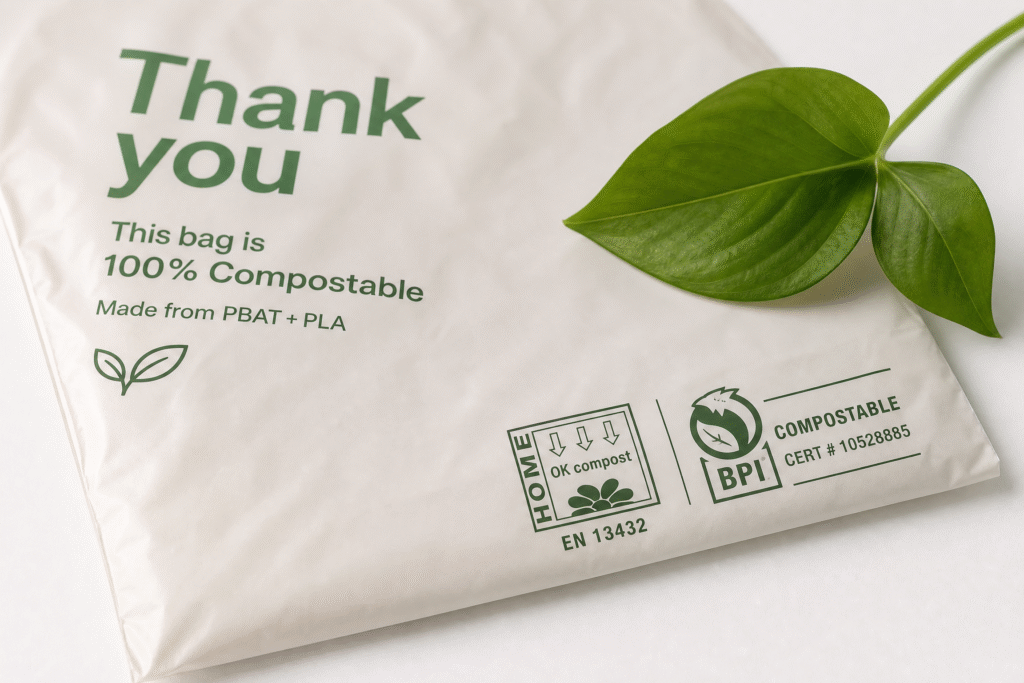
Certified compostable thank you bags are entering the market as a sustainable alternative to traditional PE bags. They are made from certified compostable polymer blends such as PBAT/PLA, sometimes with starch or other bio-based components. Certification depends on the finished product and the applicable standard.
What “Certified Compostable” Actually Means
A “certified compostable” claim should be supported by certification to an applicable compostability standard. For example, EN 13432 applies to packaging recoverable through industrial composting and biodegradation, while BPI certification in North America is based on applicable ASTM standards.
Compostability certification evaluates properties such as biodegradation, disintegration, ecotoxicity, and the effect of the product on the composting process, depending on the applicable standard.
Certification by Market
| Market / Certification | What to Check |
|---|---|
| North America | BPI certification and applicable ASTM requirements |
| Europe | EN 13432 and/or relevant certification |
| Industrial composting | OK compost INDUSTRIAL |
| Home composting | OK compost HOME |
Advantages
- Lower reliance on conventional fossil-based plastic — depending on the formulation
- Certified compostability — when the finished product meets the applicable certification requirements
- Suitable for sustainability-focused brands
- Can support organic waste collection applications where accepted by local composting programs
Disadvantages
- Higher cost — generally more expensive than HDPE; certification and disposal requirements should also be considered
- Requires composting infrastructure — Most certified compostable thank you bags are intended for industrial composting, while some products are also certified for home composting. Always check the finished-product certification and disposal instructions
- Shelf life can be more sensitive to heat, humidity, and storage conditions than conventional PE bags, depending on the formulation
- Not accepted in curbside recycling
The compostable-packaging landscape is dynamic. Not all municipal composting services accept compostable bags—check with your local hauler first.
Key Specifications to Look For
| Specification | What to Ask |
|---|---|
| Material | PBAT/PLA/starch or other certified compostable blend |
| Thickness | 25-50 microns (0.98-1.0 mil) |
| Certification | BPI, EN 13432, OK Compost INDUSTRIAL or OK Compost HOME, depending on the intended market and composting environment |
| Shelf life | Varies by formulation; check supplier |
| Storage conditions | Store in cool, dry place away from humidity |
Look for finished-product certification such as EN 13432, BPI, or OK Compost, rather than relying only on certification of the raw material. The EN 13432:2000 standard specifies requirements and procedures to determine compostability by addressing four characteristics: biodegradability, disintegration during biological treatment, effect on the biological treatment process, and effect on the quality of the resulting compost.
Are Compostable Thank You Bags Worth It?
Compostable thank you bags can be worthwhile when the packaging, certification, disposal infrastructure, and customer expectations are aligned. They are not automatically the best choice for every retailer. Key factors to evaluate:
- Brand positioning — can support a sustainability-focused packaging strategy when the environmental claim is accurate and properly substantiated
- Regulatory considerations — may help businesses adapt to local restrictions on conventional plastic bags, depending on the market and applicable rules
- Disposal infrastructure — requires access to industrial composting or certified home composting
- Product compatibility — must match the weight and durability requirements of your products
- Total cost — includes unit cost, storage, and disposal considerations
Paper Thank You Bags
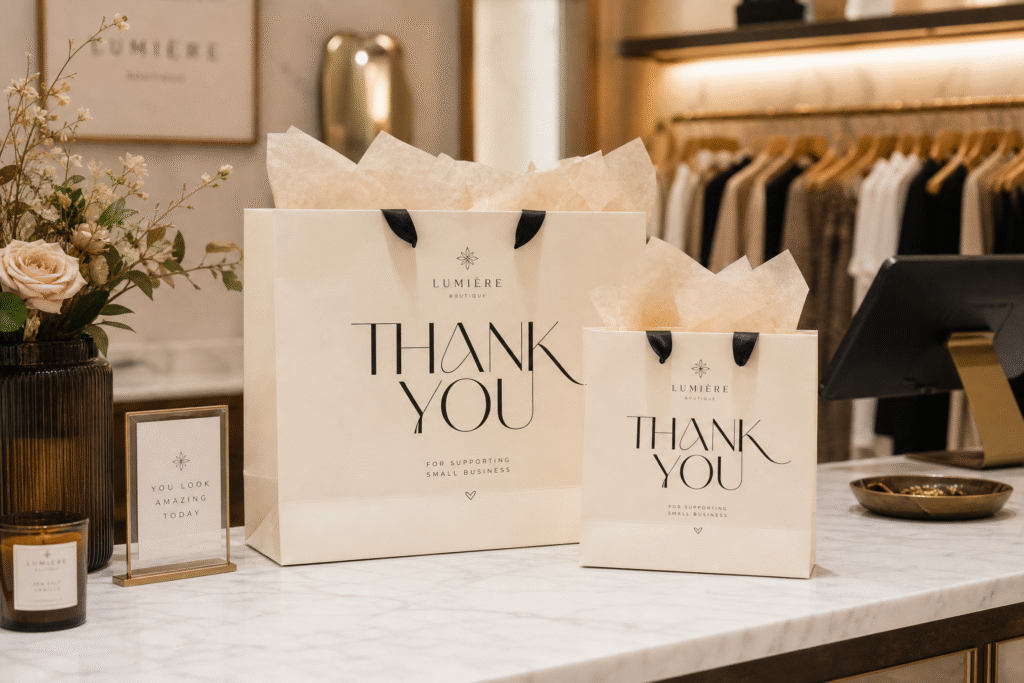
Paper thank you bags offer an eco-friendly alternative with a natural, premium feel.
Advantages
- Widely recyclable and biodegradable under appropriate conditions
- Better brand image — perceived as higher quality and more environmentally friendly
- Customizable — available in various sizes, colors, and designs
- Kraft vs white — kraft paper offers a natural, rustic look; white paper provides a cleaner, more polished appearance
- Handle options — available with flat paper handles, twisted paper handles, or die-cut handles
Disadvantages
- Limited weight capacity — not suitable for heavy items
- No water resistance — can tear when wet; not suitable for damp or refrigerated products
- Higher cost than standard HDPE bags
- Recyclability depends on local systems — while paper is widely recyclable, some coated or laminated papers may not be accepted
- Storage — paper bags take up more space than flat-packed plastic bags
When to Choose Paper Thank You Bags
Paper thank you bags are best suited for:
- Boutiques and retail stores where presentation is a priority
- Lightweight items such as clothing, gifts, and books
- Brands that want to reinforce a natural or sustainable brand image
- Environments where the bag will not be exposed to moisture
Thank You Bags vs T-Shirt Bags vs Grocery Bags
| Feature | Thank You Bag | T-Shirt Bag | Grocery Bag |
|---|---|---|---|
| Primary use | Retail checkout, boutiques | General retail, takeout | Grocery shopping |
| Handle type | Cut-out T-shirt handles | Cut-out T-shirt handles | Flat, die-cut, or T-shirt |
| Printing | “Thank you” standard | Can be plain or printed | Often branded |
| Thickness | Commonly around 0.5 mil | Similar | Can be thicker |
| Gusset | 3-5 inches | 3-5 inches | 5-7 inches |
Key distinction: “T-shirt bag” describes the shape; “thank you bag” describes the print; “grocery bag” describes the use case. The same bag can be all three.
Which Thank You Bag Should You Choose?
Decision Matrix
| If you need… | Consider |
|---|---|
| Lowest upfront cost | HDPE |
| Lightweight everyday retail use | HDPE T-shirt bag |
| Premium presentation | Paper |
| Compostable packaging | Certified compostable film |
| Custom branding | Custom-printed bag |
| High moisture resistance | Plastic film |
| Home-compostable option | Product specifically certified for home composting |
Buying Summary
| Buying Priority | Best Starting Option |
|---|---|
| Lowest cost | HDPE |
| Sustainable packaging | Certified compostable |
| Premium retail presentation | Paper |
| Custom branding | Custom-printed bags |
| International wholesale | Compare landed cost |
A Simple Buying Rule
- If you sell lightweight clothing → prioritize size and presentation.
- If you sell groceries → prioritize gusset, seal strength, and load performance.
- If you need compostability → verify finished-product certification first.
- If you need custom printing → confirm MOQ, printing colors, cylinder/plate costs, and sample approval.
- If shipping internationally → compare unit price together with carton quantity, CBM, and shipping cost.
For most retailers, the right choice comes down to four factors: product weight, required durability, disposal method, and budget.
- If cost is the priority, HDPE is usually the starting point.
- If compostability is required, choose a certified compostable bag that matches the intended disposal environment.
- If presentation is the priority, paper or custom-printed bags may be more appropriate.
Key Specifications to Consider
- Size: Match to typical product dimensions
- Gusset: 4-7 inches for expandable capacity
- Thickness: commonly around 0.5 mil for lightweight HDPE; confirm with supplier
- Handle style: T-shirt (cutout) or die-cut
- Printing: Pre-printed “thank you” vs. custom logo
- Certification: EN 13432/BPI for compostable claims
- MOQ: Varies significantly by supplier and production setup; request a quotation based on your exact specification
Thank You Bags Wholesale
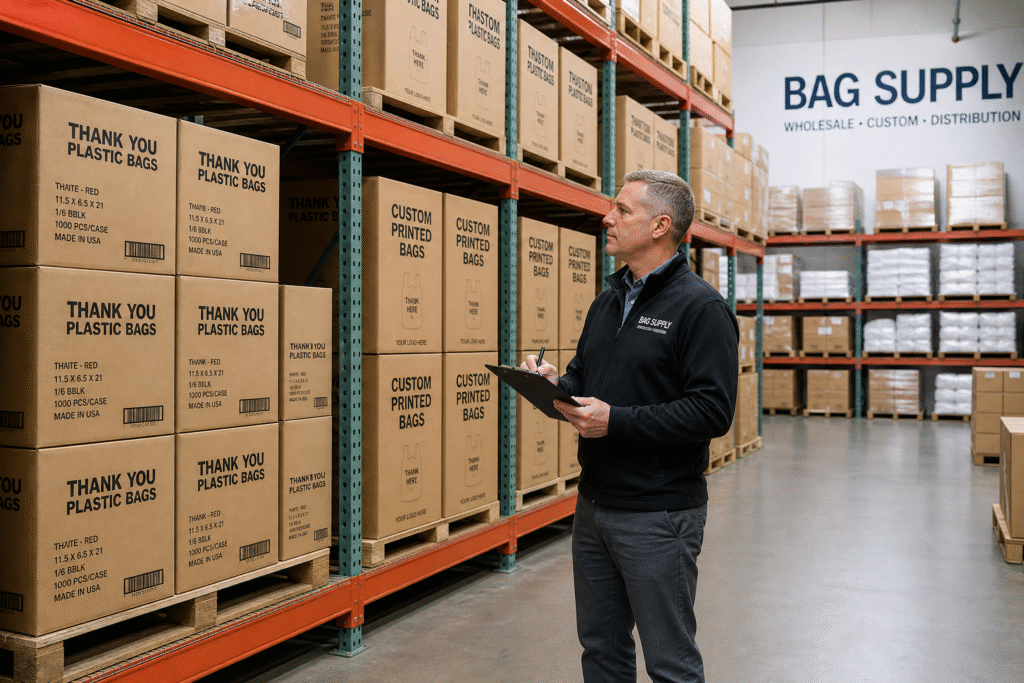
Why Buy in Bulk?
| Benefit | Explanation |
|---|---|
| Cost savings | Lower per-unit cost with volume |
| Convenience | Always stocked; reduces reorder frequency |
| More selection | Suppliers offer wider variety for bulk orders |
| Shipping savings | Consolidate shipping costs |
What to Factor In
- Storage space: Bulk orders need warehouse space
- Shipping costs: Especially from international suppliers
- Lead time: 10–35 days depending on customization
- Customization MOQ: Often higher for custom printing
Typical Quantities per Case
| Quantity | Use Case |
|---|---|
| 500 bags/case | Small retailers, low volume |
| 1,000 bags/case | Standard retail, boutiques |
| 2,000 bags/case | High-volume retail, grocery |
Order Type and MOQ Considerations
| Order type | Typical purchasing situation |
|---|---|
| Stock bags | Lower quantities may be available |
| Custom printing | Usually requires a higher MOQ |
| Custom compostable bags | MOQ depends on film, printing, and production setup |
MOQ varies significantly by supplier and production setup, so buyers should request a quotation based on their exact specification.
What Determines Thank You Bag Cost?
| Cost factor | Why it matters |
|---|---|
| Material | HDPE, LDPE, compostable film and paper have different costs |
| Size | Larger bags use more material |
| Thickness | Thicker film increases material consumption |
| Printing | More colors and printing coverage can increase cost |
| Quantity | Larger orders generally reduce unit cost |
| Packaging | Retail-ready packaging adds cost |
| Certification | Certain certified compostable products may have additional costs |
| Shipping | International freight can materially affect landed cost |
For imported bags, compare landed cost rather than unit price alone. A lower ex-factory price does not necessarily mean a lower total purchasing cost.
Custom Thank You Bags for Retail Brands
Custom-printed thank you bags allow retailers to replace the standard red “thank you” with their own logo, brand colors, or messaging.
Common Customization Options
| Customization | Options |
|---|---|
| Printing | Flexographic, up to 8 colors, 1 or 2 sides |
| Material | HDPE, LDPE, PBAT/PLA/starch (compostable) |
| Size | Custom dimensions available |
| Thickness | Custom mil/micron range |
| Handle | T-shirt cutout, die-cut, or reinforced handles |
MOQ for Custom Printing
Custom-printed thank you bags typically require higher MOQs:
- HDPE: Typically requires higher minimums than stock
- Compostable: MOQ depends on film, printing, and production setup
- Paper: Varies by supplier
What Specifications Should You Send a Thank You Bag Manufacturer for a Quote?
For an accurate quotation, provide the following information to your supplier:
| Specification | Details to Include |
|---|---|
| Bag dimensions | Width × Gusset × Height (in inches or cm) |
| Material | HDPE, LDPE, or compostable (PBAT/PLA/starch) |
| Thickness | In mil or microns |
| Gusset | Standard or expandable (in inches) |
| Handle style | T-shirt cutout, die-cut, flat, or reinforced |
| Printing | Logo, colors, number of sides, special effects |
| Quantity | Number of bags per order |
| Packaging | Bulk, retail-ready, or custom-packaged |
| Destination | Shipping address / port / country |
| Certification requirements | EN 13432, BPI, OK Compost, or other |
Providing these details upfront helps suppliers give you a more accurate price, lead time, and specification recommendation. It also saves time in back-and-forth communication and reduces the risk of incorrect specifications.
What to Ask a Compostable Thank You Bag Supplier
When sourcing compostable thank you bags, asking the right questions helps verify quality and certification claims.
| Question | Why It Matters |
|---|---|
| Is the finished bag certified? | Raw material certification alone is not enough—the finished product must be certified |
| Which standard does it meet? | Determines the intended composting environment (industrial vs. home) |
| What is the film formulation? | Affects strength, shelf life, and reusability |
| What is the recommended storage condition? | Compostable films can be storage-sensitive |
| What is the MOQ? | Affects total purchasing cost |
| Can you provide samples? | Allows testing before bulk production |
Frequently Asked Questions
What are thank you bags made of?
Most are made from HDPE (high-density polyethylene) film. Compostable alternatives use PBAT/PLA/starch blends with certification.
Are thank you bags recyclable?
HDPE film bags are technically recyclable, but recycling availability depends on local collection systems. In the U.S., these bags are generally not accepted in curbside recycling and may instead be accepted through designated store drop-off programs.
What is the difference between thank you bags and T-shirt bags?
A “T-shirt bag” describes the bag’s handle and construction, while a “thank you bag” describes the printed message. Many thank you bags use the T-shirt bag format, so the terms are often used interchangeably in product listings.
What size thank you bag should I use?
The best size depends on your products. A commonly offered size is 10″ × 5″ × 19″ for clothing and general retail. For groceries, larger sizes with a bigger gusset (6.5-7 inches) are typically used.
Are thank you bags food safe?
Not automatically. For direct food-contact applications, buyers should confirm that the bag is specifically manufactured and compliant for the intended food-contact use.
Are thank you bags waterproof?
HDPE and LDPE thank you bags are waterproof. Paper thank you bags are not water-resistant and can tear when wet.
Can thank you bags be custom printed?
Yes. Custom printing is available for HDPE, compostable, and paper thank you bags, with options including flexographic printing, up to 8 colors, and one or two sides.
Are compostable thank you bags available?
Yes—certified compostable versions are available with EN 13432, BPI, and OK Compost HOME certifications.
How should compostable thank you bags be stored?
Store in a cool, dry place away from direct sunlight and humidity. Compostable films can be sensitive to heat and moisture, which may affect shelf life and performance.
What information should I provide when requesting a quote?
Provide bag dimensions (Width × Gusset × Height), material, thickness, handle style, printing details, quantity, packaging requirements, destination, and any certification requirements.
About HEMCBags
HEMCBags is a manufacturer of certified compostable bags, including custom-printed compostable thank you bags and retail shopping bags. Depending on the product and target market, we can support compostable bag specifications designed to meet applicable certification requirements, including EN 13432, BPI, or OK compost programs.
Looking for custom compostable thank you bags?
HEMCBags supplies custom compostable retail bags for brands, distributors, and retailers. Depending on the target market and product requirements, we can support custom sizes, film thicknesses, printing, and applicable compostability certification requirements.
If you are evaluating compostable thank you bags for retail or food-service applications, send us your target size, quantity, material preference, and printing requirements. We can help evaluate the specification and provide samples for testing.