
Quick Answer
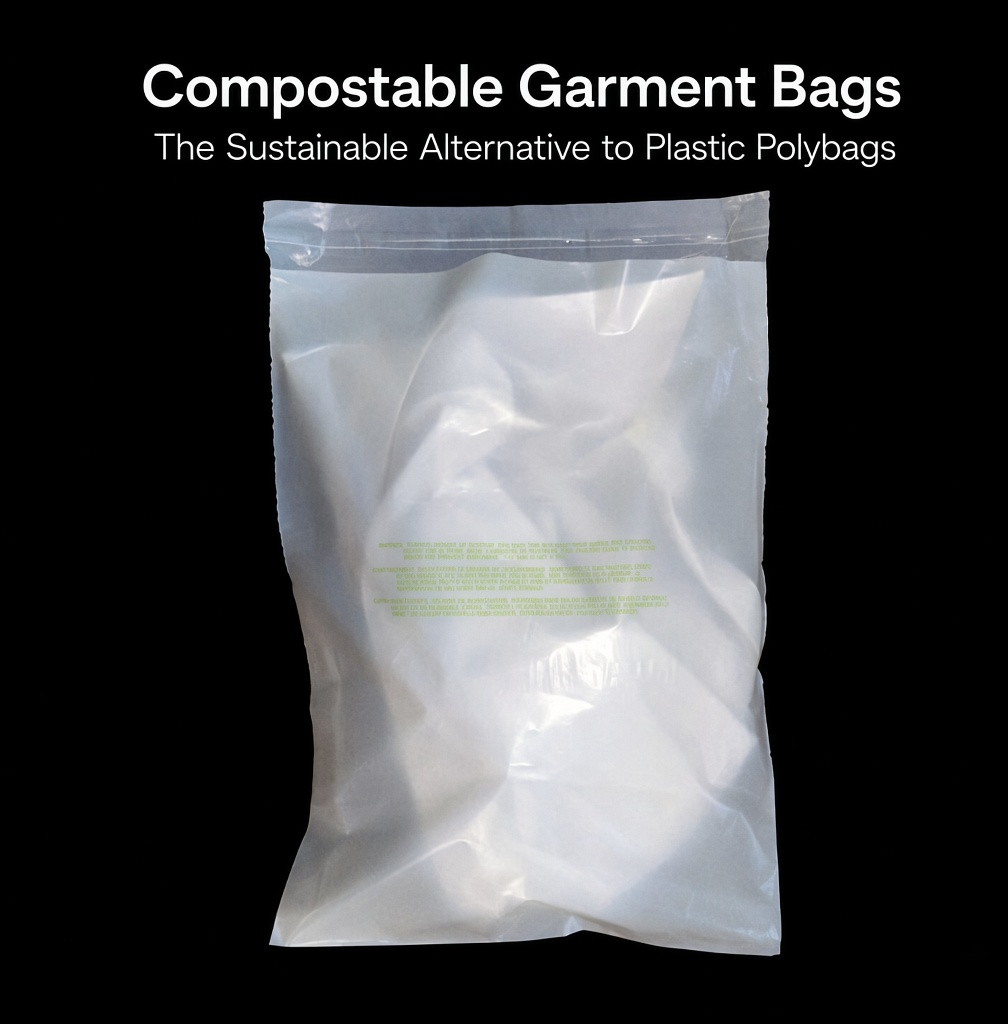
Compostable garment bags are certified sustainable packaging bags used by fashion brands to replace traditional plastic polybags for clothing protection. They are typically made from PBAT+PLA blends, starch, or other compostable polymers and meet standards such as ASTM D6400 (ASTM International) (US) or EN 13432 (Europe). Brands use them for garment manufacturing, retail, e-commerce, and dry cleaning. They can be customized with different sizes, thicknesses, printing designs, and closure options according to brand requirements.
Why Fashion Brands Are Moving Away From Plastic Polybags
According to estimates cited by material innovation company Sway, the fashion industry uses approximately 180 billion plastic polybags annually, highlighting the scale of single-use packaging challenges. Most garment polybags are not recycled through conventional curbside programs because flexible films are difficult to process. Here’s why brands are switching:
| Problem | Impact |
|---|---|
| Single-use waste | Most polybags end up in landfills or oceans |
| Recycling failure | Flexible films tangle in recycling equipment; curbside programs don’t accept them |
| Regulatory pressure | EU PPWR, California AB1201, and state EPR programs mandate sustainable packaging |
| ESG commitments | Brands need verifiable plastic reduction strategies |
| Consumer expectations | Growing demand for sustainable packaging |
Many brands now use compostable garment bags as part of their sustainable garment packaging strategy.
What Are Compostable Garment Bags?
A compostable garment bag is a clothing packaging bag designed to break down into CO₂, water, and biomass under controlled composting conditions. To be recognized as certified compostable, a bag must meet three requirements under standards such as ASTM D6400 or EN 13432:
- Biodegradation: ≥90% in 180 days
- Disintegration: ≤10% remains on a 2mm sieve after 84 days
- Eco-toxicity: Compost must support plant growth
Compostable vs. Biodegradable: Only “compostable” requires certification and a specific timeframe. “Biodegradable” is unregulated and often misleading. According to the Biodegradable Products Institute (BPI), “compostable” means the material disintegrates into small particles within a specific timeframe under controlled conditions, biodegrades into CO₂, water, and biomass through microbial action, and supports soil health by leaving behind compost that is non-toxic and free from harmful residues.
Related Reading: What Are Compostable Bags Made Of? | Compostable vs Biodegradable
What Materials Are Compostable Garment Bags Made From?
| Material | Properties | Best For |
|---|---|---|
| PBAT + PLA (Most common) | Flexible, strong, tear-resistant | E-commerce, factory packaging, retail |
| Starch Blends | Cost-effective, moisture-sensitive | Dry cleaning, cost-sensitive applications |
| PLA (100%) | Clear, stiff, heat-sensitive | Retail display |
| Seaweed-based | Regenerative, premium, early stage | Premium brands, marketing story |
Why PBAT+PLA is the industry standard: PLA provides stiffness and bio-based content. PBAT provides flexibility and toughness. The blend meets ASTM D6400 / EN 13432 while offering flexibility and durability suitable for many LDPE replacement applications.
For a detailed breakdown of each material’s properties, see our guide: PLA vs PBAT vs Cornstarch.
Applications Across Fashion Supply Chains
| Stage | Specs |
|---|---|
| Garment Factory | PBAT+PLA, 30-50 microns, flat or gusseted |
| Retail Display | PLA or clear PBAT+PLA, 15-25 microns, printed |
| E-commerce Shipping | PBAT+PLA, 30-60 microns, adhesive closure |
| Dry Cleaning | Starch blend or PLA, 15-25 microns, hanger hole |
Compostable vs. Plastic: Side-by-Side
| Factor | Traditional Plastic Polybags | Compostable Garment Bags |
|---|---|---|
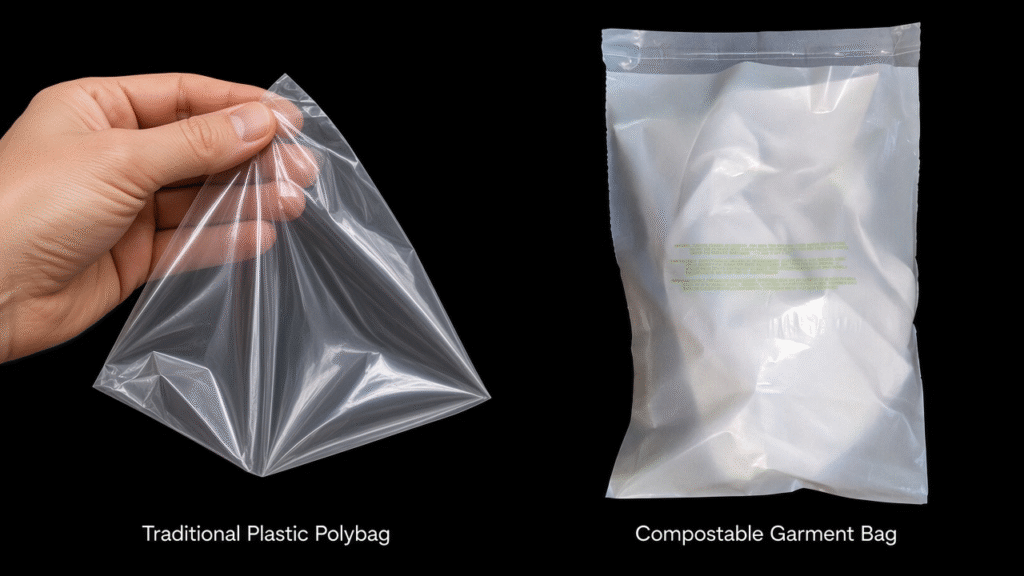
| Material | LDPE/LLDPE (fossil-based) | PBAT+PLA, starch (plant-based) |
| End of Life | Persists for hundreds of years | Biodegrades in certified industrial composting facilities |
| Recycling | Not accepted in curbside recycling | Not recycled—composts instead |
| Standard | None | EN 13432 (EU) / ASTM D6400 (US) |
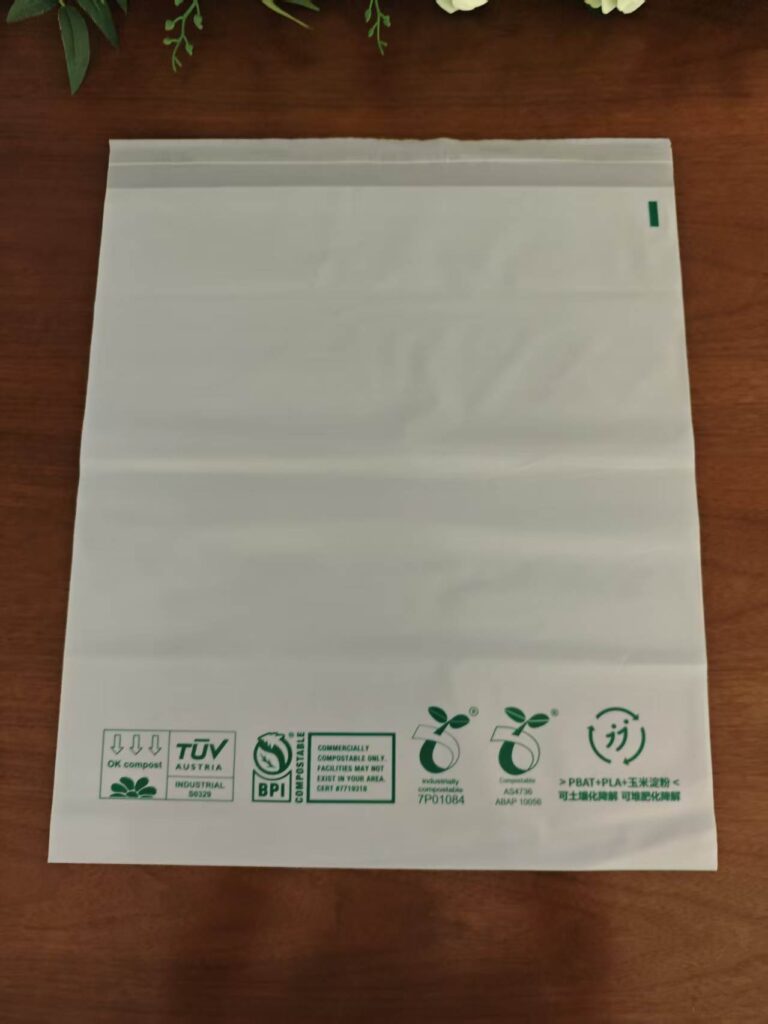
| Certification | None | OK compost INDUSTRIAL (by TÜV Austria) / BPI (US) |
| Shelf Life | Indefinite | 8-12 months (depending on formulation) |
| Cost | Baseline | Generally higher (depends on spec) |
Are Compostable Garment Bags Strong Enough?
Yes, with proper formulation. Compostable garment bags with PBAT+PLA blends provide comparable tensile strength to LDPE.
Thickness Selection Guide
| Application | Recommended Thickness |
|---|---|
| Retail display | 15-25 microns |
| E-commerce (light apparel) | 30-40 microns |
| E-commerce (heavy/coats) | 40-60 microns |
| Factory packaging | 40-50 microns |
Custom Options for Compostable Garment Bags
Fashion brands often require specific bag designs beyond basic sizing. Common custom options include:
| Feature | Description |
|---|---|
| Custom dimensions | Sized to specific garment types (shirts, coats, suits) |
| Hanger hole | For retail display on hangers |
| Self-sealing adhesive flap | For secure e-commerce closure |
| Gusseted bags | For bulky or multiple garments |
| Perforation | For easy opening |
| Film transparency | Transparent, milky white, or natural compostable film options |
| Custom printing | Flexographic printing for logos, instructions, and compliance information |
What Color Should You Choose?
Recommendation: Natural/undyed (off-white/beige).
- Minimizes the risk of color transfer onto garments because no additional dyes are added to the film
- Clean, sustainable aesthetic that communicates “eco-friendly” at a glance
- Usually the most cost-effective option because no additional color masterbatch or printing coverage is required
For luxury and premium apparel: some brands choose transparent or milky-white compostable films to maintain product visibility while keeping a clean sustainable appearance.
For dark colors: Dark colors are also possible, but brands should confirm ink compatibility and testing requirements before production to ensure compostability certification is maintained.
Certifications: What to Look For
For the European market, the most recognized certification for industrial composting is OK compost INDUSTRIAL, which is awarded by TÜV Austria. This certification is based on the technical standard EN 13432, which defines the testing requirements for a product to be deemed industrially compostable. A product carrying the OK compost INDUSTRIAL label guarantees compliance with the EU Packaging Directive requirements.
| Certification | Standard | Region |
|---|---|---|
| OK compost INDUSTRIAL | EN 13432 | Europe |
| OK compost HOME | OK compost HOME scheme | International |
| BPI Certified | ASTM D6400 | US |
For European markets, OK compost INDUSTRIAL (based on EN 13432) is commonly requested. For US buyers, BPI certification (based on ASTM D6400) is often preferred. The certification bodies maintain searchable product catalogs—buyers can verify certified compostable garment bags directly through the TÜV Austria or BPI websites.
For a full comparison of certification requirements, see our guide: Compostable Certifications Explained.
Important: Applicable compostability certification marks should only be printed when authorized by the certifying body. BPI, TÜV Austria, and DIN CERTCO have specific logo usage rules.
How to Choose a Supplier
What to Ask
- Can you provide current ASTM D6400 / EN 13432 certificates?
- What is the exact material composition?
- What are your MOQ, lead time, and customization capabilities?
Typical MOQ Considerations
MOQ depends on bag size, material structure, printing requirements, and packaging method. Larger production quantities usually achieve better unit pricing.
Typical Lead Times
| Order Type | Typical Timeline |
|---|---|
| Sample orders | ~7 days |
| Bulk orders | ~15-20 days |
What to Print on Your Bags
| Element | Note |
|---|---|
| Brand logo | Standard |
| Compostability certification marks | Only when authorized by certifying body |
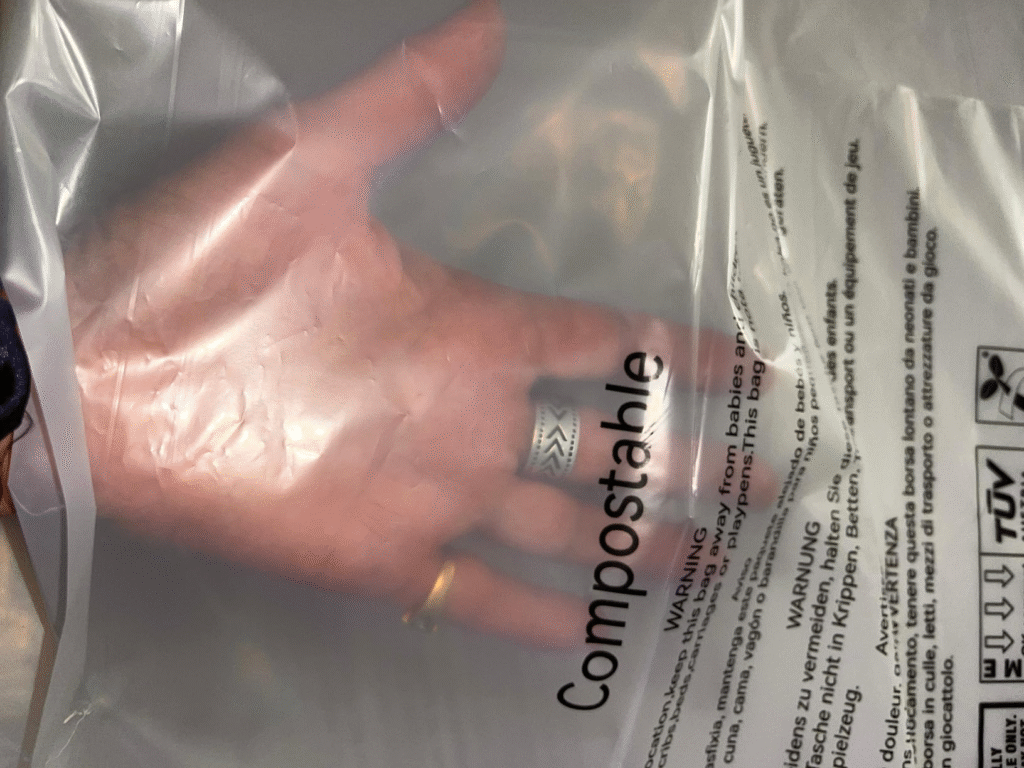
| Disposal instructions | Tailored to target market requirements |
| Suffocation warning | Required in many markets |
Need help with your bag design? Request our free printing template with disposal instructions tailored to your target market.
Cost Considerations
Compostable garment bags generally cost more than conventional PE polybags due to material costs and certification requirements. The final price depends on:
- Material formulation
- Thickness (microns)
- Printing (colors, coverage)
- Size and design features
- Order quantity
Larger production quantities normally reduce the unit cost. For accurate pricing, request a quote with your specific specifications.
Real Brands Testing Compostable Garment Packaging
Sway + Alex Crane, Faherty, Florence, prAna: Material innovation startup Sway launched its compostable seaweed-based polybags in collaboration with four fashion brands. Dubbed “The Sway Innovation Coalition,” this multi-brand partnership aims to disrupt the industry’s reliance on conventional plastic polybags with packaging made with regenerative, renewable, and home compostable ingredients.
Howies (UK): Uses corn starch-based garment bags, home compostable.
What to learn: Test specific product lines first, partner with material innovators, and use the switch as a marketing story.
FAQ
Are compostable garment bags home compostable?
Not usually. Most require industrial composting (ASTM D6400 / EN 13432). Only OK compost HOME certified bags are designed for home composting, as they are tested to break down at the lower, less constant temperatures found in garden compost heaps.
What thickness do I need?
See thickness selection guide above.
Can I print my logo?
Yes. Most suppliers offer flexographic printing. HEMCbags provides free printing templates—we’ll design your artwork and send it for your review.
What should I print on the bag?
Include: brand logo, applicable compostability certification marks (when authorized), disposal instructions specific to your target market, and suffocation warning.
Can compostable garment bags be used for international shipping?
Yes. Compostable garment bags can be used for international supply chains when the correct thickness and sealing structure are selected. For long-distance shipping, PBAT+PLA blends with higher tear resistance are commonly preferred to withstand handling and transport conditions.
What are typical lead times?
Samples: ~7 days
Bulk orders: ~15-20 days
How much do compostable garment bags cost?
Compostable garment bags generally cost more than conventional PE polybags. Final price depends on material, thickness, printing, size, and quantity. Larger volumes reduce unit cost.
Are compostable garment bags recyclable?
No. They are designed to compost, not recycle. Do not place them in conventional plastic recycling streams.
Conclusion
Compostable garment bags are a practical, commercially viable alternative to plastic polybags. Here’s how to start:
- Start with a pilot — test one product line first
- Choose PBAT+PLA for shipping, PLA for retail
- Verify certifications — ASTM D6400 or EN 13432
- Work with an experienced partner
Contact HEMCbags for Specification Review, Samples, and a Customized Quotation
HEMCbags supplies custom compostable garment bags to fashion brands, apparel manufacturers, and sustainable packaging buyers.
| Service | What We Offer |
|---|---|
| Custom sizes & thickness | Any configuration |
| Material options | PBAT+PLA, starch blends, PLA |
| Certifications | ASTM D6400 / EN 13432 with full documentation |
| Printing | Up to 4 colors; free design templates available |
| Private label | Custom packaging for retailers and distributors |
| Export experience | US and EU markets with compliance support |
| Lead times | Samples ~7 days; Bulk ~15-20 days |
Our team can provide material recommendations, printing templates, certification documents, and samples for evaluation. Contact HEMCbags today.