
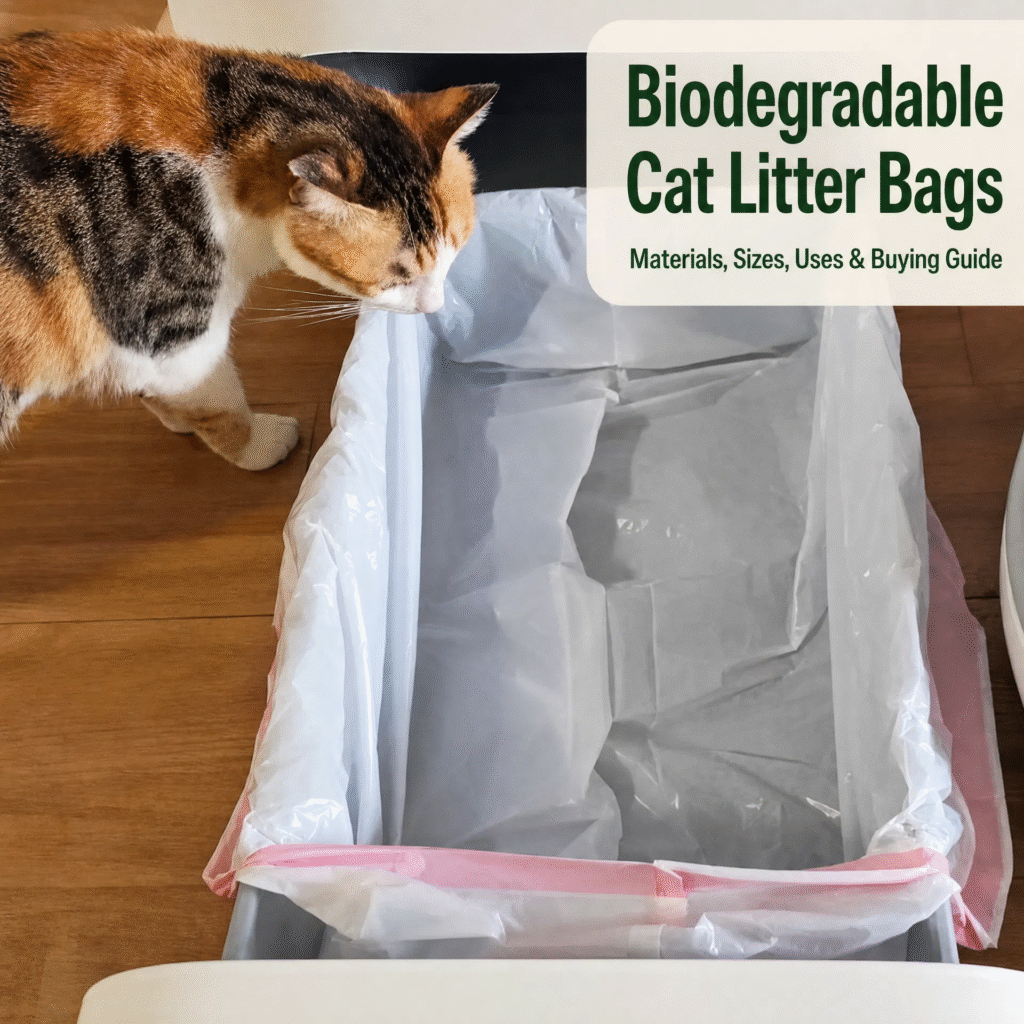
Quick Answer
Biodegradable cat litter bags are waste bags made from biodegradable or compostable materials and designed to collect used cat litter. Common materials include PBAT, PLA, starch blends, and other compostable formulations. The right bag should provide sufficient strength, leak resistance, capacity, and a closure suitable for the amount of litter being disposed of.
Key considerations: material, certification, size, thickness, strength, and disposal.
What Are Biodegradable Cat Litter Bags?
Biodegradable cat litter bags, also called biodegradable kitty litter bags, are bags designed specifically for collecting and disposing of used cat litter. They are typically made from biodegradable or compostable formulations intended to break down under specific conditions. Their primary purposes are to contain odors, prevent leakage, and provide a hygienic way to manage daily cat litter waste.
For most cat owners, the key practical requirements are that the bag is strong enough to hold wet clumps without tearing, large enough for daily scooping, and easy to tie securely to contain odors.
Cat litter bags are available in different sizes, thicknesses, closures, and material formulations to suit various household types and disposal preferences.
Cat Litter Waste Bags, Cat Poop Bags, and Litter Box Liners: What’s the Difference?

| Product Type | Main Use | Typical Capacity | Best For |
|---|---|---|---|
| Cat litter waste bags | Collecting used litter and waste clumps | Medium to large (4–20L+) | Daily scooping, multi-cat households |
| Cat poop bags | Collecting feces or small waste amounts | Small (1–4L) | Quick cleanup, single-scoop disposal |
| Litter box liners | Lining the entire litter box | Very large (fits standard boxes) | Full litter changes, protecting the box |
| Large litter disposal bags | Disposing of large quantities of used litter | Large (15–30L+) | Deep-cleaning, multi-cat homes |
Note: Cat litter waste bags and cat poop bags can overlap in use, but litter box liners serve a different function—they line the box itself rather than being used for daily waste disposal.
What Is Biodegradable Cat Litter and How Does It Relate to Cat Litter Bags?
Biodegradable cat litter refers to the litter material itself, while biodegradable cat litter bags are used to collect and dispose of used litter.
Biodegradable cat litter is a broader category referring to the litter itself, not the disposal bag. It is typically made from plant-based, renewable, or compostable materials that are intended to break down more easily than traditional clay litter.
Common types of biodegradable cat litter include:
| Material | Source | Key Properties |
|---|---|---|
| Wood pellets | Pine, cedar, or other softwoods | Natural odor control, absorbent, dust-free |
| Paper-based | Recycled paper | High absorbency, low dust, lightweight |
| Corn-based | Corn kernels or corn starch | Clumping, biodegradable, good odor control |
| Wheat-based | Wheat byproducts | Clumping, absorbent; disposal depends on local rules and plumbing conditions |
| Walnut shell | Crushed walnut shells | Absorbent, good odor control, low dust |
Note: The fact that the litter itself is biodegradable does not mean the disposal bag is also biodegradable. Cat owners should separate the concepts of “biodegradable litter” and “biodegradable waste bag.”
How Do You Dispose of Biodegradable Cat Litter?

The safest disposal method depends on both the bag certification and local waste rules. In most cases, used cat litter and the bag should be placed in general waste because many composting programs do not accept pet waste.
General Disposal Guidelines
| Disposal Method | Suitability | Notes |
|---|---|---|
| General waste | Most common option | When in doubt, seal the bag and place it in general waste. This is the most widely accepted method |
| Industrial composting | Only if the bag is certified and the facility accepts pet waste | Many municipal composting programs do not accept cat waste or used cat litter because of pathogen and contamination concerns. Acceptance rules vary by location |
| Home composting | Only if the bag is specifically certified for home composting and local guidance allows pet waste. A home-compostable certification applies to the bag under specified test conditions; it does not automatically make cat feces or used cat litter suitable for home composting | Even then, the resulting compost should not be used on edible plants |
| Flushing | Generally not recommended | Flushing is generally not recommended unless your local wastewater authority specifically permits it. Cat feces can contain pathogens such as Toxoplasma gondii, and plumbing or wastewater systems may not be designed to manage cat litter |
Important: Do not assume that a bag labeled “compostable” means the used litter inside is accepted by your local composting program. Check the instructions of your local waste or composting facility.
Recommended Disposal Practice
- Scoop used litter into a biodegradable or compostable bag
- Tie the bag securely to contain odors and prevent leakage
- Place the tied bag into your regular general waste bin
What Are Biodegradable Cat Litter Bags Made Of?

| Material | Source | Key Properties |
|---|---|---|
| PBAT | Compostable fossil-based polymer (fossil-fuel-derived and used in certified compostable formulations) | Flexible, durable, strong, tear-resistant; commonly blended with other materials |
| PLA | Bio-based (corn starch, sugarcane, or other plant starches) | Stiff, clear, bio-based; often blended with PBAT for flexibility |
| Starch Blends | Corn, potato, or other plant starches | Renewable content, cost-effective, can be moisture-sensitive |
| Composite Blends | Combinations of PBAT, PLA, starch, and other biodegradable polymers | Performance is formulation-dependent; specific properties vary by product |
Material Performance Comparison
| Material | Flexibility | Strength | Moisture Resistance | Typical Use | B2B Consideration |
|---|---|---|---|---|---|
| PBAT-rich blends | High | High | Good | Heavy, wet waste | Flexible, tough, good for cat litter |
| PLA-containing blends | Moderate | Varies | Moderate | Dry or light waste | Performance depends strongly on formulation and proportion of PLA and other polymers |
| Starch blends | Moderate | Moderate | Moderate to low | Cost-sensitive applications | Renewable content, formulation-dependent |
Important Distinction
Common compostable bag formulations may include PLA, PBAT, starch-based materials, or blends of these materials. PLA is commonly bio-based, while PBAT is generally a compostable fossil-based polymer. The environmental and performance profile depends on the full formulation, manufacturing process, certification, and disposal conditions.
For a deeper comparison of these materials, see our PLA vs PBAT vs Cornstarch guide.
Biodegradable vs Compostable Cat Litter Bags
In short: “biodegradable” describes a biological breakdown property, while “compostable” is generally tied to defined conditions and requirements. A bag should not be considered compostable simply because it is marketed as biodegradable.
| Feature | Biodegradable Cat Litter Bags | Compostable Cat Litter Bags |
|---|---|---|
| Definition | Designed to break down through biological activity; timeframe and conditions vary | Designed to meet defined compostability requirements under specified conditions |
| Certification | Not necessarily certified | May be supported by a finished-product certification |
| Breakdown Conditions | Vary by formulation and environment | Defined by applicable certification |
| Disposal | Typically general waste | Depends on certification and facility acceptance |
Key Insight: The term “biodegradable” alone does not specify the timeframe, test conditions, or end-of-life outcome. For a more defined compostability claim, check the certification of the finished bag. “Compostable” generally refers to a product designed to break down under defined composting conditions and according to a relevant standard or certification. Consumers should review the exact certification and disposal requirements instead of relying on the word “biodegradable” alone.
For more details, see our Compostable vs Biodegradable guide.
Standards and Certifications
| Standard or Certification | What It Generally Indicates | Source |
|---|---|---|
| ASTM D6400 | Compostability requirements commonly used in North America for commercial or industrial composting | ASTM International |
| EN 13432 | Requirements for packaging recoverable through industrial composting and biodegradation in Europe | CEN / DIN CERTCO |
| BPI certification | A North American certification program based on applicable compostability requirements | Biodegradable Products Institute |
| OK Compost INDUSTRIAL | Suitability for industrial composting under specified conditions (55–60°C) | TÜV Austria |
| OK Compost HOME | Certification for home composting under specified test conditions | TÜV Austria |
Important: Certification does not mean that the bag can be placed in every compost bin. Always check whether the certification is for home or industrial composting and whether the local facility accepts pet waste. Products with only OK Compost INDUSTRIAL certification should not go into home compost bins.
See our ASTM D6400 guide for more detailed certification information.
What Size Cat Litter Bag Do You Need?
Important: There is no universal standard size for cat litter bags. The ranges below are practical starting points rather than industry specifications. Actual capacity varies by bag shape, gusset design, opening size, litter type, and how full the bag is filled.
| Household Type | Recommended Size | Notes |
|---|---|---|
| Single cat, one or two scoops daily | Small to medium (~4–8L capacity) | Suitable for daily disposal |
| Single cat, clumping litter | Medium (~8–12L capacity) | Clumping litter generates more volume |
| Multiple cats or multi-day collection | Large (~12–20L capacity) | More capacity for heavier loads |
| Multi-cat household with large clumps | Extra large (20L+) | More room for waste and easy tying |
Cat Litter Bag Size vs. Bag Dimensions
Retail consumers often think in litres, while manufacturers usually quote bags by dimensions and thickness. Capacity ≠ physical dimensions. Key dimensional factors to consider:
| Buying Factor | What to Check | Why It Matters |
|---|---|---|
| Usable capacity | Interior volume rather than external dimensions only | Ensures enough room for litter and tying |
| Opening size | Wide opening for scooping | Reduces spills during transfer |
| Closure | Tie handles, drawstring, or sealable top | Helps contain odors and prevent leakage |
| Wet strength | Performance after contact with moisture | Important because used litter can be heavy and wet |
| Storage stability | Recommended storage conditions and shelf life | Compostable films may be sensitive to heat and humidity |
Supplier Tip: When evaluating compostable cat litter bags, compare samples using the same amount of wet litter. Check whether the bottom seal, side seal, and film withstand lifting and tying. A bag that performs well when empty may still fail under actual load.
How Strong Should a Cat Litter Bag Be?
The strength of a cat litter bag is crucial because used litter is often heavier and wetter than dry trash. A bag that tears or leaks creates an unpleasant cleaning problem.
A standard dog poop bag may work for a small amount of cat waste, but larger cat litter bags are usually more convenient for wet clumps, multiple scoops, or multi-cat households. When comparing products, focus on usable capacity, opening size, leak resistance, puncture resistance, and closure design rather than the product label alone.
| Performance Factor | What to Check |
|---|---|
| Puncture resistance | Resistance to sharp litter particles |
| Tear resistance | Ability to withstand handling without tearing |
| Wet strength | Performance after contact with moisture |
| Seal integrity | Bottom and side seals must hold under load |
| Odor containment | Material and closure should minimize odor escape |
For B2B Buyers: Request samples and test the bag with actual litter—filled, tied, and handled as in real use. An empty-bag test will not reveal performance issues.
High-quality bags made from suitable PBAT-rich or other compostable formulations can be engineered for good puncture resistance, tear resistance, and leak resistance when used with wet litter.
How to Choose Biodegradable Cat Litter Bags
| Step | What to Consider |
|---|---|
| 1. Check the material | Identify whether the bag is PBAT, PLA, starch, or a blend. Performance varies |
| 2. Verify certification | Look for applicable standards and certifications, such as ASTM D6400, EN 13432, BPI certification, or OK Compost certification. Confirm that the certification applies to the finished bag rather than only to the raw material |
| 3. Choose the right size | Select a bag that fits your scooping volume. Consider both capacity and opening size |
| 4. Ensure adequate thickness | A thin bag may tear with wet or heavy litter. Balance durability with cost |
| 5. Consider the closure | Drawstrings and tie handles are easier to secure than flat open-top bags |
| 6. Check disposal acceptance | Confirm with your local waste program whether pet waste bags are accepted in any composting stream |
| 7. Test before bulk ordering | Request samples and test with your actual litter and handling process |
What Specifications Should You Give a Cat Litter Bag Manufacturer?
To request an accurate quotation, provide:
| Specification | What to Provide |
|---|---|
| Bag style | Flat, gusseted, drawstring, tie-handle |
| Flat width | Width of the bag in millimeters or inches |
| Length | Length of the bag in millimeters or inches |
| Thickness | Microns (or mils) |
| Material | PBAT, PLA, starch blend, or custom formulation |
| Closure type | Drawstring, tie handles, flat seal, or other |
| Printing | Colors, artwork, position, design files |
| Bags per roll | Number of bags per roll or pack |
| Rolls per carton | Packaging configuration for wholesale |
| Carton dimensions | For shipping and storage planning |
| Target order quantity | Estimated MOQ and annual volume |
| Required certification | ASTM D6400, EN 13432, BPI, OK Compost, etc. |
Biodegradable Cat Litter Bags for Wholesale and Private Label
For brands, retailers, and distributors, biodegradable cat litter bags are a growing product category driven by consumer demand for sustainable pet products.
What Should You Ask a Cat Litter Bag Manufacturer?
When comparing suppliers, do not evaluate the unit price alone. Confirm whether quotations are based on the same bag dimensions, thickness, material formulation, packaging configuration, certification requirements, and order quantity.
For private-label projects, buyers should also confirm artwork requirements, printing colors, packaging format, production lead time, shelf life, storage conditions, and pre-production samples.
Typical Wholesale Specifications
| Specification | What to Specify |
|---|---|
| Size | Width × length or capacity in litres |
| Thickness | Microns |
| Material | PBAT, PLA, starch, or blend |
| Closure | Drawstring, tie handles, flat seal |
| Packaging | Bags per roll, retail-ready, or bulk packaging |
| Certification | ASTM D6400, EN 13432, BPI, OK Compost |
| Printing | Custom artwork, logo, instructions |
| MOQ | Minimum order quantity |
| Lead time | Production and shipping timeline |
For specific pricing, MOQ, and custom options, see our compostable cat litter bags wholesale product page.
FAQs
What are biodegradable cat litter bags?
Biodegradable cat litter bags, also called biodegradable kitty litter bags, are waste bags made from biodegradable or compostable materials, designed to collect used cat litter. They are designed to biodegrade under specific conditions, while some products are also certified to meet compostability requirements under defined composting conditions.
Are biodegradable cat litter bags really biodegradable?
The term “biodegradable” alone does not provide enough information to determine how or under what conditions a bag will break down. Buyers should check the material formulation, applicable certification, and disposal conditions of the finished bag.
Are biodegradable cat litter bags compostable?
Not automatically. A compostable claim should be supported by applicable standards or certification, such as ASTM D6400 or EN 13432, depending on the intended market and disposal conditions.
What are biodegradable kitty litter bags made of?
Common materials include PBAT, PLA, starch blends, and other biodegradable polymer formulations. PLA is typically bio-based, while PBAT is generally a compostable fossil-based polymer.
What size cat litter bag should I buy?
The size depends on your litter type and scooping volume. Single cats typically need small to medium bags (~4–8L). Multiple cats or clumping litter may require larger bags (12–20L or more). Confirm actual bag dimensions with the supplier.
Can biodegradable cat litter bags go in the compost?
Only if the bag is specifically certified for composting (e.g., ASTM D6400, EN 13432, OK Compost). Even then, check whether your local facility accepts pet waste.
Can you flush cat litter bags?
Generally not recommended. Cat feces can contain pathogens such as Toxoplasma gondii, and plumbing or wastewater systems may not be designed to manage cat litter. Check local regulations.
Are biodegradable cat litter bags strong enough for wet litter?
Yes, when properly designed. High-quality bags made from suitable PBAT-rich or other compostable formulations can be engineered for good puncture resistance, tear resistance, and leak resistance when used with wet litter.
What certifications should I look for?
Look for applicable standards and certifications, such as ASTM D6400, EN 13432, BPI certification, or OK Compost certification. Confirm that the certification applies to the finished bag rather than only to the raw material.
Can I order custom biodegradable cat litter bags wholesale?
Yes. Custom options can include size, thickness, material, closure, printing, and packaging. Buyers should confirm MOQ, lead time, certification requirements, and pricing with the supplier.
Conclusion
Choosing the right biodegradable cat litter bags depends on more than the word “biodegradable” on the package. Buyers should consider the bag’s material, size, thickness, strength, closure, certification, and intended disposal method.
For household use, the bag should be large enough for the amount of litter being collected and strong enough to handle wet, heavy clumps without tearing or leaking. For wholesale and private-label projects, buyers should also compare material formulations, bag dimensions, packaging, certification, MOQ, printing, and production requirements.
If you are sourcing biodegradable or compostable cat litter bags for retail, distribution, or private-label use, testing samples with actual cat litter before placing a bulk order is recommended.
Written by: Chris, Packaging Content Specialist at HEMCbags
Reviewed by: HEMCbags Product & Compliance Team