
Quick Answer
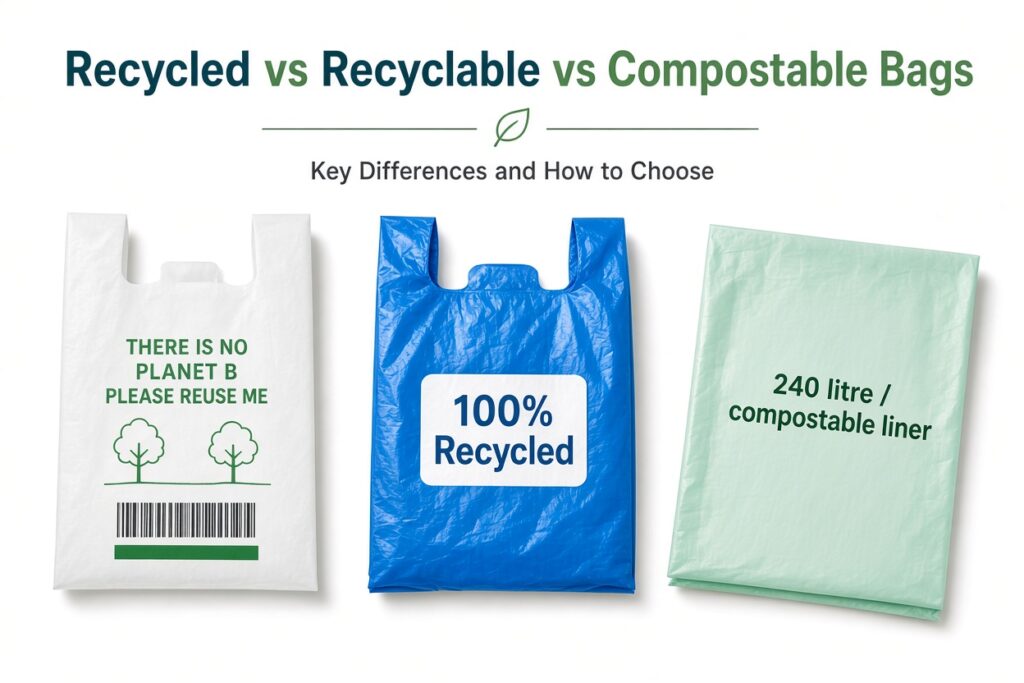
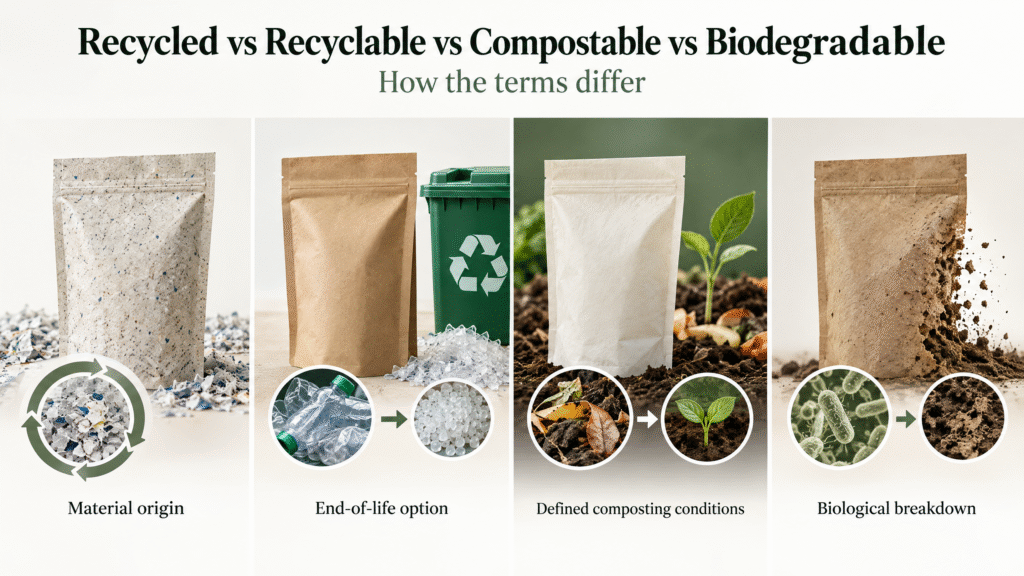
Recycled vs recyclable vs compostable — these three terms describe different things. Recycled describes material that has been recovered and reprocessed into a new material or product. Recyclable describes a product’s potential to be collected and processed again. Compostable describes a material designed to break down under defined composting conditions.
| Term | Main question it answers | Typical disposal |
|---|---|---|
| Recycled | What was this bag made from? | Depends on the material and local system |
| Recyclable | Can this bag be collected and processed again? | Recycling facility or designated drop-off |
| Compostable | Can this bag break down in an approved composting system? | Industrial or home composting, depending on certification logo, and local facility requirements. |
Recycling and composting rules vary by country, municipality, and facility. Always check the requirements of the local program before disposal or bulk purchasing.
What Does “Recycled” Mean?
“Recycled” generally describes material that has been recovered and reprocessed into a new material or product. It does not describe what will happen to the bag after use.
There are several types of recycled content:
- Post-consumer recycled material — material used by a consumer and returned to a recycling system
- Pre-consumer recycled material — material recovered from manufacturing before it reached a consumer. This is also referred to as post-industrial recycled material in some markets and standards.
A bag can contain recycled LDPE and still need to go through a plastic film recycling program rather than a curbside recycling bin. Using recycled material does not make a product compostable, and it does not guarantee that the product will be accepted by any recycling system.
Key point: Using recycled content can reduce demand for virgin material, but it does not change the bag’s disposal pathway.
What Does “Recyclable” Mean?
Most curbside recycling programs do not accept plastic bags and films, according to the U.S. EPA. Flexible plastic bags can jam sorting equipment and contaminate other recyclables.
Recyclability depends on:
- The material type
- The level of contamination
- Local facility capabilities
- Whether a collection system exists for that material
Many areas rely on store drop-off programs for plastic film. HDPE and LDPE bags may be accepted at designated retail locations, but this varies by region.
For more detail, see our guide to how to recycle plastic bags.
Key point: “Recyclable” is a conditional claim. It only means something when a facility that accepts the material is actually available.
What Does “Compostable” Mean?
“Compostable” describes a material’s designed end-of-life pathway. It means the product meets defined standards for biodegradation, disintegration, and ecotoxicity under specific composting conditions.
In commercial packaging, a credible compostable claim should be supported by recognized testing or third-party certification. Certification provides stronger evidence than an unsupported manufacturer claim.
Certification applies to the finished product and its defined specifications, not simply to the raw material.
Two conditions matter:
Industrial composting uses controlled, oxygen-rich conditions and thermophilic temperatures. The exact temperature profile varies by facility and certification standard. Home composting runs at lower, more variable temperatures. A bag certified for industrial composting should not be assumed to fully break down in a home compost pile, and vice versa.
A compostable bag is not designed to disappear in any environment. It requires the right conditions, and it should not be placed in a conventional plastic recycling stream. Compostable bags are generally not accepted in conventional plastic film recycling programs. Disposal rules may vary by local facility.
Key point: Compostable describes a specific disposal pathway — not a general environmental claim.
For an overview of compostable packaging formats, see our compostable packaging options.
How Is Biodegradable Different From Compostable?
Biodegradable describes a biological degradation process. By itself, it does not specify a required timeframe, environment, or disposal system. A product can be described as biodegradable without meeting any defined standard for how quickly or under what conditions it breaks down.
Compostable is a more specific claim tied to defined conditions and applicable standards. When a product carries a recognized compostability certification, it has been tested against criteria for biodegradation, disintegration, and ecotoxicity under specified conditions.
Key point: Every compostable product is biodegradable by definition. Not every biodegradable product is compostable.
Recycled vs Recyclable vs Compostable: Comparison Table
| Feature | Recycled | Recyclable | Compostable |
|---|---|---|---|
| What it describes | Material origin | Disposal potential | Breakdown pathway |
| Does it automatically mean environmentally preferable? | Not automatically | Not automatically | Depends on disposal conditions |
| Can it be recycled? | Not necessarily | Possibly, if local system accepts it | Generally not accepted in conventional plastic recycling |
| Can it be composted? | Usually no, unless specifically designed and certified for composting | Usually no, unless specifically designed and certified for composting | Yes, under certified conditions |
| Key limitation | May still be a single-use product | Local facility acceptance varies | Requires appropriate composting infrastructure |
| Typical use case | Reducing reliance on virgin material | Markets with established recycling systems | Markets with appropriate composting systems |
Certification Does Not Guarantee Local Acceptance
The recycled vs recyclable vs compostable distinction matters most when you are verifying certification. A certification confirms that a product meets defined technical requirements. It does not guarantee that every local recycling or composting facility will accept it.
Some composting facilities reject compostable bags, including certified products, because of contamination concerns or because their systems are not designed to process them. BPI notes that acceptance depends on the specific facility and program.
Before ordering bags, confirm:
- Which certification the facility recognizes
- Whether it accepts bags or only food scraps
- Whether the program is industrial or home composting
- Whether the facility accepts printed products
- Whether the bag must be removed before processing
For a detailed breakdown of certification types, see our guide to compostable bag certifications.
Which Bag Should You Choose?
| Your situation | Recommended option | What to verify |
|---|---|---|
| Plastic film recycling is available | Recyclable or recycled-content bag | Accepted resin type, collection point, contamination rules |
| Food scraps go to industrial composting | Certified compostable bag | Accepted certification and facility requirements |
| Customers compost at home | Home-compostable bag | A recognized home-compostability certification, such as TÜV OK compost HOME, where accepted by the local program |
| No recycling or composting facility exists | Reduce material or use reusable packaging | Local waste infrastructure and regulations |
| Need long shelf life | Select material based on storage and application | Thickness, humidity, heat, shelf life |
| Need private-label packaging | Custom printed bag | Printing ink, MOQ, certification coverage |
Looking for bags made for a specific recycling or composting system? HEMCbags supplies compostable trash bags, compostable shopping bags, compostable courier bags, pet waste bags, and custom sustainable packaging solutions. Contact us to discuss your material, certification, size, and printing requirements.
Common Sourcing Mistakes
Mistake 1: Confusing raw-material certification with finished-product certification. A certified raw material does not automatically mean that every finished bag is certified. Thickness, additives, inks, adhesives, and production conditions can affect the final result.
Mistake 2: Choosing a certification without checking the disposal facility. A bag may carry a valid certification but still be rejected by a local composting facility.
Mistake 3: Assuming “compostable” means home compostable. Most compostable bags are designed for industrial composting, not backyard composting.
What to Ask a Bag Supplier
Before placing a bulk order, ask:
- What is the exact material?
- Is the finished bag certified, or only the raw material?
- Which certification covers the exact size and thickness?
- Are the printing inks and adhesives included in the certification?
- What disposal environment is required?
- Does the target facility accept this type of bag?
- Can the supplier provide a certificate, test report, and sample?
FAQs
Can compostable bags go in the recycling bin? recyclable?
No. Compostable bags are generally not accepted in conventional plastic recycling programs. They are designed for composting systems, not mechanical recycling. Disposal rules may vary by local facility, so check your local program before disposing of them.
tems, not mechanical recycling. Disposal rules may vary by local facility.
Are recycled bags recyclable?
Not necessarily. A bag made from recycled material may or may not be accepted by local recycling systems. Recycled content describes the material’s origin, not its disposal pathway. Check whether the finished bag is accepted by your local program.
Is biodegradable the same as compostable?
No. “Biodegradable” describes a biological degradation process without specifying timeframe, environment, or disposal system. “Compostable” is a more specific claim tied to defined standards for biodegradation, disintegration, and ecotoxicity under specified conditions.
What does “recyclable” actually mean for plastic bags?
“Recyclable” means a product can potentially be collected and processed into new material — not that your local system will accept it. Most curbside programs do not accept plastic bags because they jam sorting equipment. Many areas rely on store drop-off programs instead, and availability varies by region.
Are recyclable bags better than compostable bags?
Neither is universally better. The right choice depends on what infrastructure exists in your market. Recyclable bags need a recycling system that accepts them. Compostable bags need a composting system that accepts them. Without the matching infrastructure, neither delivers its intended benefit.
Can a compostable bag contain recycled material?
It depends on the material formulation and product specification. Recycled content and compostability describe different characteristics. If a bag is marketed as compostable, the finished product must meet the applicable compostability requirements for the relevant certification or standard.
Conclusion
Recycled vs recyclable vs compostable — these three terms describe different things. Recycled is about material origin. Recyclable is about disposal potential. Compostable is about a defined breakdown pathway under specific conditions.
None of these terms is a universal environmental guarantee. Each depends on infrastructure, certification, and local acceptance rules. For businesses sourcing bags, the right question is not “which term sounds best” but “which disposal pathway actually exists in my market.”
Tell us your target market, bag application, required size, certification, printing needs, and estimated order quantity. HEMCbags can recommend a suitable material and provide samples or product documentation.
Sources and Further Reading
- U.S. EPA — How Do I Recycle Common Recyclables?
- BPI — Compostability Certification FAQ
- European Bioplastics — EN 13432
- TÜV Austria — OK compost HOME Certification
- Local waste-management program requirements — check your municipality or regional authority.