
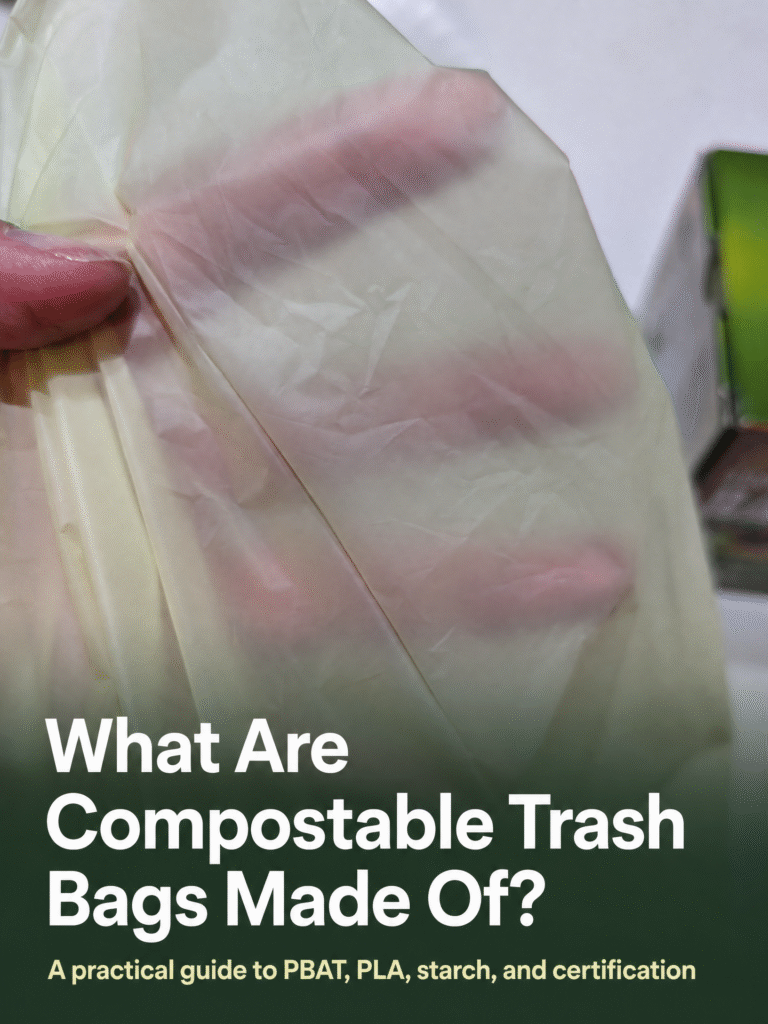
Quick Answer:
If you’re wondering what are compostable trash bags made of, the answer is typically a blend of PBAT, PLA, starch-based materials, and other compostable components. PBAT provides flexibility and toughness, PLA contributes stiffness and strength, while starch-based materials can increase bio-based content and modify processing and cost. The exact formulation varies by manufacturer, application, and certification requirements.
Key Takeaways:
- Core materials include PBAT (flexibility), PLA (strength), and starch blends (bio‑based content)
- Certification matters: Look for EN 13432, ASTM D6400, BPI, or OK Compost logos—not just the word “compostable”
- Industrial vs. home: Many compostable trash bags are designed for industrial or commercial composting rather than home composting
- Formulation matters: The material list is only the starting point—not the specification of a finished compostable trash bag
- The right bag depends on your disposal system: Choose based on where your waste actually goes
What Are Compostable Trash Bags Made Of?
To understand what are compostable trash bags made of, it helps to start with the most common ingredients used in commercial formulations. Most compostable trash bags are made from a blend of biodegradable polymers and bio‑based materials rather than a single material.
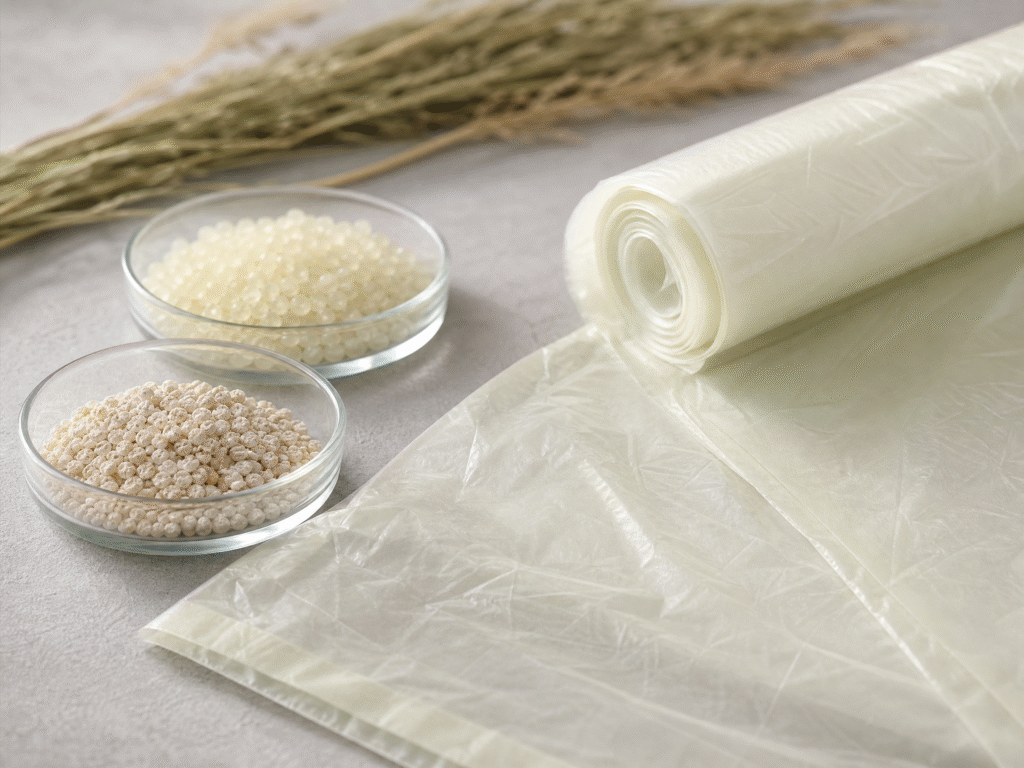
| Material | Main Function | Typical Characteristics |
|---|---|---|
| PBAT | Flexibility and toughness | Flexible, ductile; often fossil‑derived but biodegradable |
| PLA | Stiffness and strength | Bio‑based (from fermented plant sugars or starches), relatively rigid |
| Starch | Bio‑based content and formulation support | Renewable, moisture‑sensitive |
| Other components | Processing / performance | Depends on formulation |
PBAT, PLA and Starch: What Does Each Material Do?
PBAT — Flexibility and Toughness
PBAT is a biodegradable polyester that provides the flexibility and toughness that makes a bag feel and perform like conventional plastic. It is commonly used as a major component in flexible compostable film formulations, although the exact proportion varies by manufacturer and application.
- Role: Ensures the bag stretches, seals, and resists tearing during use
- Compostability: Commonly used in formulations designed for industrial compostability
- Source: Typically fossil‑derived but designed to biodegrade
Whether a finished bag is compostable depends on the complete formulation, product design and applicable certification—not on PBAT alone.
PLA — Stiffness, Strength and Heat Resistance
PLA is produced from lactic acid, which can be derived from fermented plant‑based sugars or starches such as corn or sugarcane. It can contribute stiffness, tensile performance and heat resistance to a formulation, but excessive PLA can reduce flexibility.
- Role: Adds stiffness, tensile performance, and heat resistance
- Feedstock: Often derived from fermented plant‑based sugars or starches
- Compostability: Typically requires industrial composting conditions unless specifically certified otherwise
Starch — Bio‑Based Content and Formulation Support
Many compostable bags include starch‑based materials (from corn, potato, or tapioca) to increase bio‑based content and improve processability.
- Role: Bio‑based content, processability, can reduce polymer usage and cost
- Source: Agricultural crops (corn, potato, tapioca)
- Potential limitation: Moisture sensitivity
- Compostability: Can contribute to biodegradation, but finished‑product compostability depends on the complete formulation and certification
Other Additives and Fillers
Some manufacturers add biomass powders—such as bamboo powder, lignin, or straw powder—to modify mechanical properties or reduce cost. The role of these components is to modify properties or reduce cost, but excessive loading can affect performance.
What Goes Into a Compostable Trash Bag Formulation?
| Component | Typical Role | What It Affects |
|---|---|---|
| PBAT | Flexibility and toughness | Elongation, tear resistance |
| PLA | Stiffness and strength | Rigidity, tensile performance |
| Starch | Bio‑based content and formulation | Cost, processability, biodegradation |
| Plasticizers | Flexibility | Elongation, softness |
| Compatibilizers | Blend compatibility | Film uniformity |
| Processing aids | Extrusion performance | Melt processing |
| Mineral/biomass fillers | Cost/property modification | Stiffness, opacity, processing |
Important: The exact formulation varies by manufacturer, application, and certification requirements. The material list is only the starting point—not the specification of a finished compostable trash bag.
Why Are Compostable Trash Bags Made From Blends?
No single material provides every property required for a practical trash bag.
| Property | What Affects It |
|---|---|
| Flexibility | PBAT content, plasticizer/formulation balance |
| Tensile strength | Polymer blend + film orientation + thickness |
| Tear resistance | Film formulation + thickness |
| Seal strength | Material formulation + sealing conditions |
| Moisture resistance | Material structure + formulation |
| Stiffness | PLA/starch/filler balance |
| Compostability | Entire formulation + product design + certification |
Manufacturers must balance these factors against each other. A bag that is strong enough for heavy wet waste may require a different formulation than a bag designed for light dry trash. This is why the same material combination can produce very different finished bags.
How Are Compostable Trash Bags Manufactured?
Compostable bags are made using processes similar to conventional plastic bags, but with different materials and stricter quality controls.
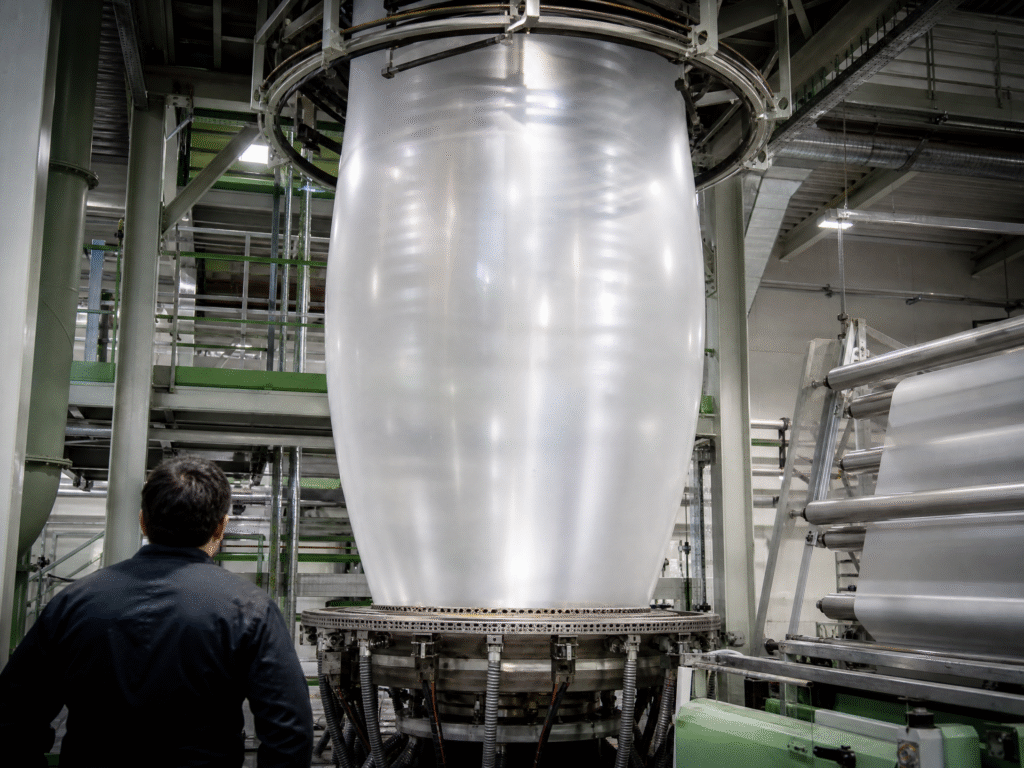
- Material compounding: PBAT, PLA, starch, and other components are blended according to the specific formulation
- Pellet preparation: The blend is melted, mixed, and formed into resin pellets
- Blown‑film extrusion: The resin is melted and blown into a thin “bubble,” then cooled and flattened into film sheets
- Film thickness control: Thickness consistency matters because film thickness affects strength, sealing performance and composting behavior
- Bag forming and heat sealing: The film is cut and heat‑sealed into bag shapes
- Printing and converting: Printing is performed using inks and processes compatible with the product specification and applicable certification requirements
- Quality control: Each batch is tested for strength, seal integrity, thickness consistency, and—crucially—compostability under the relevant standards
Why Film Manufacturing Matters
Two bags made from similar compostable resin blends can have different mechanical performance because film orientation, extrusion temperature, cooling conditions and thickness uniformity affect the final film structure.
For a detailed look at the production process, see our guide to How Compostable Bags Are Made.
Why Can Similar Compostable Bags Perform Differently?
Even if two bags both list “PBAT + PLA + starch” on their packaging, they can perform very differently.
- Formulation ratio: The relative proportions of PBAT, PLA, starch and other components can affect flexibility, stiffness, tensile performance and tear resistance
- Resin quality: Different suppliers produce different quality resins
- Extrusion conditions: Temperature, pressure, and cooling affect film orientation and strength
- Film thickness: Consistent thickness affects strength and sealing performance
- Sealing temperature: Incorrect sealing can weaken the bag
- Bag dimensions: Size and gusset design affect load capacity
- Additives: Plasticizers, compatibilizers, and processing aids affect performance
- Storage conditions: Heat and humidity can affect shelf life
Manufacturer’s takeaway:
The material list is only the starting point—not the specification of a finished compostable trash bag. Finished‑bag performance depends on formulation, thickness, processing, sealing, bag design and storage conditions. Two bags made from similar materials can perform very differently depending on how they are formulated and manufactured.
What Manufacturers Actually Adjust During Production
| Factor | Why It Matters |
|---|---|
| Formulation | Different applications require different flexibility, stiffness and tear resistance. There is no single “best” formulation for every bag. |
| Film thickness | Thickness must be matched to bag size, waste load, material formulation and target cost—thicker is not always better. |
| Extrusion conditions | Temperature, cooling, stretch and film orientation all affect final mechanical performance. |
| Bag design | Gusset design, dimensions, bottom seal and roll configuration all affect actual load capacity and handling. |
| Sealing | Even with the same material, if the sealing window is not properly controlled, the seal may become the first point of failure. |
| Resin quality | Different resin lots or suppliers can affect film consistency and performance. |
| Storage conditions | Heat and humidity can affect shelf life and performance before the bag is even used. |
Bio‑Based vs Biodegradable vs Compostable
People often get these terms mixed up, but they do not mean the same thing. According to TÜV Austria’s OK compost certification, “a biodegradable product may be broken down by microorganisms but this does not necessarily imply that the product can be converted into good quality compost” . Biodegradability and compostability rely heavily on the environment where the product is broken down .
| Term | What It Tells You |
|---|---|
| Bio‑based | Where some carbon/material comes from |
| Biodegradable | Ability to biodegrade under defined conditions |
| Compostable | Meets defined compostability criteria under specified conditions |
In other words, the feedstock used to make a bag does not by itself determine whether the finished product is compostable.
A bag can be bio‑based without being biodegradable, or biodegradable without being compostable. Compostability requires certification to a specific standard that defines how quickly and completely the material must break down.
What Does Compostable Certification Mean?
Third‑party certification is one of the strongest ways for buyers to verify that a finished product has been tested against a recognized compostability standard. As the Biodegradable Products Institute (BPI) explains, “compostable means more than biodegradable”—it means the material must disintegrate, biodegrade into CO₂, water, and biomass, and support soil health without toxic residues .
| Certification / Standard | What It Covers | Best For |
|---|---|---|
| EN 13432 | European industrial compostability standard | EU market, municipal programs |
| ASTM D6400 | US industrial compostability standard | North America, BPI certification |
| OK Compost INDUSTRIAL | TÜV Austria – industrial composting | Industrial‑certified bags |
| OK Compost HOME | TÜV Austria – backyard composting | Home‑certified bags |
| BPI | Biodegradable Products Institute (USA) | US industrial composting programs |
What Certification Actually Tests
Certification standards evaluate factors such as biodegradation, disintegration, ecotoxicity and the presence of restricted substances. The exact test methods, timeframes and acceptance criteria depend on the applicable standard and certification scheme.
For example, ASTM D6400 covers plastics designed to be composted under aerobic conditions in municipal and industrial facilities where thermophilic conditions are achieved . According to BPI, certified products must pass three scientific benchmarks: disintegration (physical breakdown within 12 weeks), biodegradation (microbial conversion into CO₂, water, and biomass), and eco‑toxicity (no ecotoxicity or heavy metal contamination) .
EN 13432:2000, the European standard for packaging compostability, specifies requirements and procedures to determine compostability by addressing four characteristics: biodegradability, disintegration during biological treatment, effect on the biological treatment process, and effect on the quality of the resulting compost .
The TÜV Austria OK compost certification scheme offers certifications for both industrial and home composting environments, with specific requirements depending on the applicable standard and certification scheme.
For a detailed comparison of BPI, ASTM D6400, EN 13432 and TÜV Austria certifications, see our Compostable Certifications Explained guide.
Important: Certification applies to the finished product and its tested scope—not simply to an individual raw material. A bag that lists PBAT and PLA is not automatically certified; the finished bag must be tested and certified as a complete product .
Industrial Compostable vs Home Compostable
Many certified compostable bags are intended for industrial or commercial composting rather than home composting.
| Requirement | Industrial Compostable | Home Compostable |
|---|---|---|
| Typical conditions | Controlled, elevated‑temperature composting | Ambient‑temperature composting |
| Environment | Managed moisture, oxygen and microbial activity | Less controlled |
| Breakdown time | Depends on standard and composting conditions | Generally longer and more variable |
| Certification | EN 13432, ASTM D6400, OK Compost INDUSTRIAL | Appropriate home‑compostability certification |
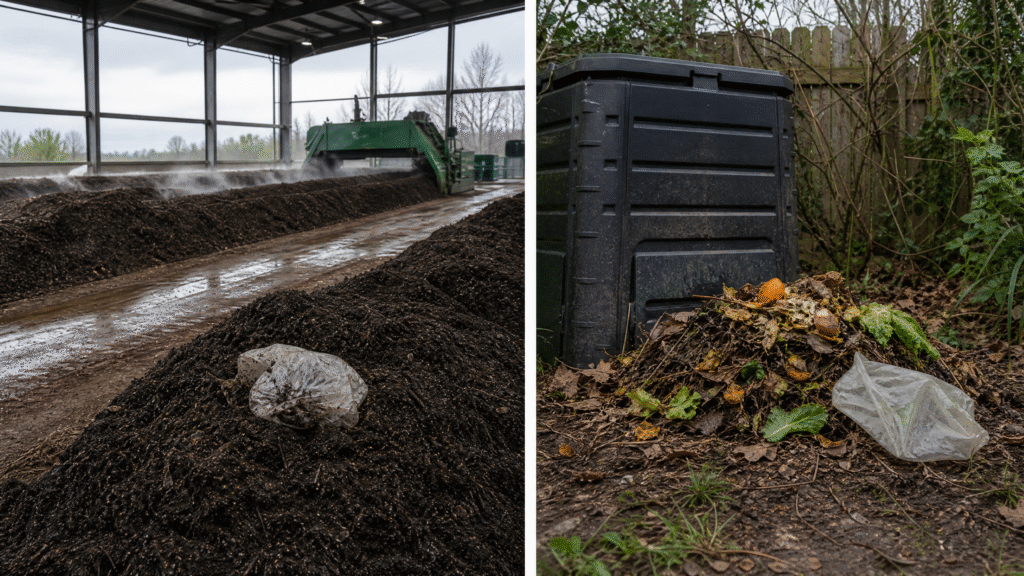
Industrial composting uses controlled conditions, typically including elevated temperatures and managed moisture, oxygen and microbial activity. The OK compost INDUSTRIAL certification evaluates products for controlled industrial composting conditions, including elevated thermophilic temperatures, and should not be assumed to be suitable for home composting .
Home composting occurs under less controlled conditions, so breakdown can take substantially longer and varies with climate, compost conditions, product formulation and thickness. The OK compost HOME certification is specifically designed for products that meet defined compostability requirements under home-composting conditions . To earn this certification, products must prove they can biodegrade in a garden compost heap, a more difficult and slower-paced environment due to lower and less constant temperatures .
Do not assume a bag is home compostable unless the manufacturer provides appropriate home‑compostability certification or substantiation.
How to Choose a Compostable Trash Bag
- Check the certification: Look for EN 13432, ASTM D6400, BPI, or OK Compost logos
- Check the intended disposal route: Industrial vs. home compostable
- Match thickness to the waste: Thicker bags for heavier or wetter waste
- Consider bag size and design: Match to your bin and load
- Check strength and seal performance: Consider tear resistance and seal integrity
- Ask for supplier documentation: Test reports and certificate numbers
- Verify local composting acceptance: Confirm with your local waste hauler
If you’re comparing different products, our guide to the best compostable trash bags covers the main factors to consider when evaluating different bag options.
Red flags to avoid: No certification logo, vague terms like “biodegradable” or “environmentally friendly,” no manufacturer contact info, or refusal to provide test reports .
What Should B2B Buyers Ask a Compostable Bag Supplier?
- What is the material formulation?
- Which compostability standard does the finished bag meet?
- What is the certificate number?
- What product sizes are covered by the certification?
- What is the film thickness?
- What are the tensile / tear properties?
- Is the bag intended for industrial or home composting?
- What test reports are available?
- Does the certification cover the printed version?
- Does the local composting facility accept these bags?
For wholesale or private‑label buyers, don’t stop at the certification logo. Ask for the certificate number, certification scope, material specification, applicable bag dimensions and test documentation.
FAQ
What are compostable trash bags made of?
They are made from biodegradable polymers—typically PBAT (for flexibility), PLA (for stiffness and strength), and starch or biomass blends. The exact formulation varies by manufacturer and application.
What are compostable trash bags made of from plants?
Partially. PLA is produced from fermented plant-based sugars or starches (corn, sugarcane), and some starch blends are plant‑based. PBAT, however, is typically fossil‑derived but is designed to biodegrade.
Is PBAT plastic?
Yes. PBAT is a biodegradable polyester that can be used in certified compostable formulations. It is often fossil‑derived but designed to break down under composting conditions.
Is PLA compostable?
PLA is compostable under industrial composting conditions, but it requires controlled temperature, moisture, and microbial activity. It is not typically suitable for home composting unless specifically certified for that use.
Are starch‑based bags better?
Not necessarily. Starch can help with bio‑based content and breakdown speed, but it can also be moisture‑sensitive. The best formulation depends on the application.
Are compostable trash bags biodegradable?
Yes, but “biodegradable” by itself does not tell buyers how quickly a product will break down, under what conditions, or whether it will completely biodegrade after disposal. Compostable bags are biodegradable under defined composting conditions.
Can compostable trash bags go in home compost?
Only if they carry OK Compost HOME certification. Many certified bags require industrial composting.
How do I know if a compostable trash bag is certified?
Look for third‑party certification logos such as EN 13432, ASTM D6400, BPI, or OK Compost. Ask the supplier for the certificate number, certification scope, material specification, and test reports.
Final Takeaway
A compostable trash bag is not defined by PBAT, PLA, starch, or any other single ingredient. It is the combination of formulation, film structure, manufacturing process, bag design and verified certification that determines the finished product’s performance and compostability.
For buyers, the key question is therefore not simply “What is this bag made of?” but “Does this finished bag meet the performance and compostability requirements for my application and disposal system?”
If you’re comparing products, see our guide to the Best Compostable Trash Bags.