
Quick Answer:
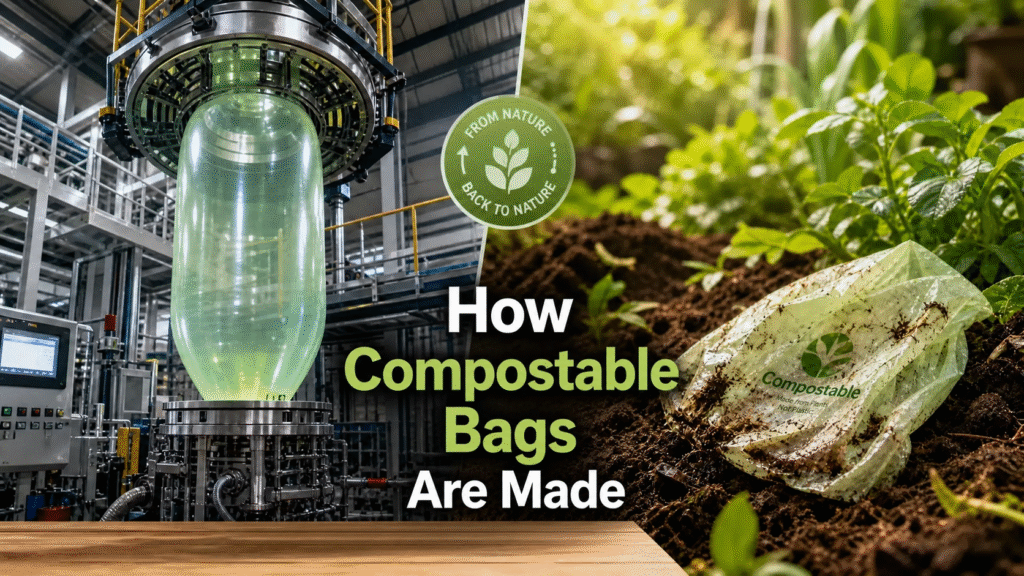
How compostable bags are made starts with selecting the right PLA/PBAT materials and controlling every stage of production, from material inspection and drying to blown film extrusion, printing, bag conversion, and quality testing. The finished bags then undergo strength testing and compostability verification to meet standards such as EN 13432 and ASTM D6400. Based on our experience manufacturing compostable bags for European and North American buyers, process control is the key difference between reliable compostable bags and products that fail in real-world applications.
Key Takeaways:
- Compostable bags are made from plant-based resins (PLA from renewable sources like corn starch and sugarcane, PBAT from biodegradable polyesters) blended with fillers like calcium carbonate or starch
- Calcium carbonate formulations offer better cost-effectiveness and, when properly formulated, can pass home compost certification, while starch-based formulations are preferred for food-grade applications
- The manufacturing process requires tighter temperature control than conventional plastic bags
- Quality control is critical — inconsistent thickness, poor sealing, or weak tear resistance lead to bag failure
- Look for certification standards (ASTM D6400) and EN 13432 to ensure genuine compostability
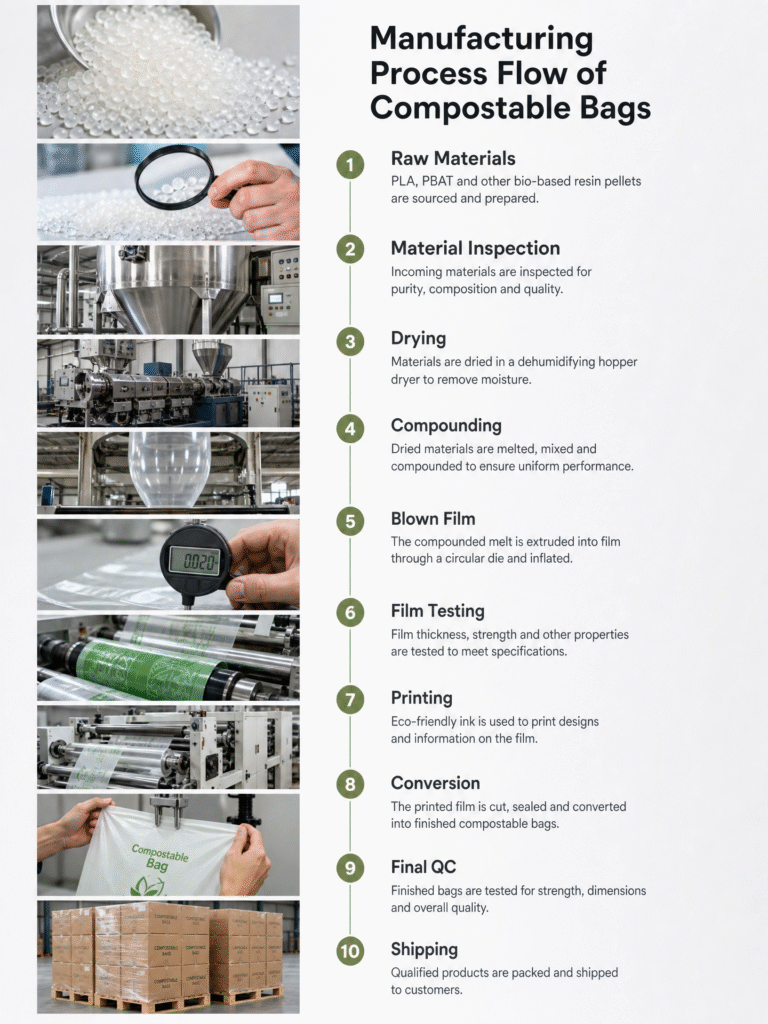
Manufacturing Process Flow
What Are Compostable Bags Made Of?
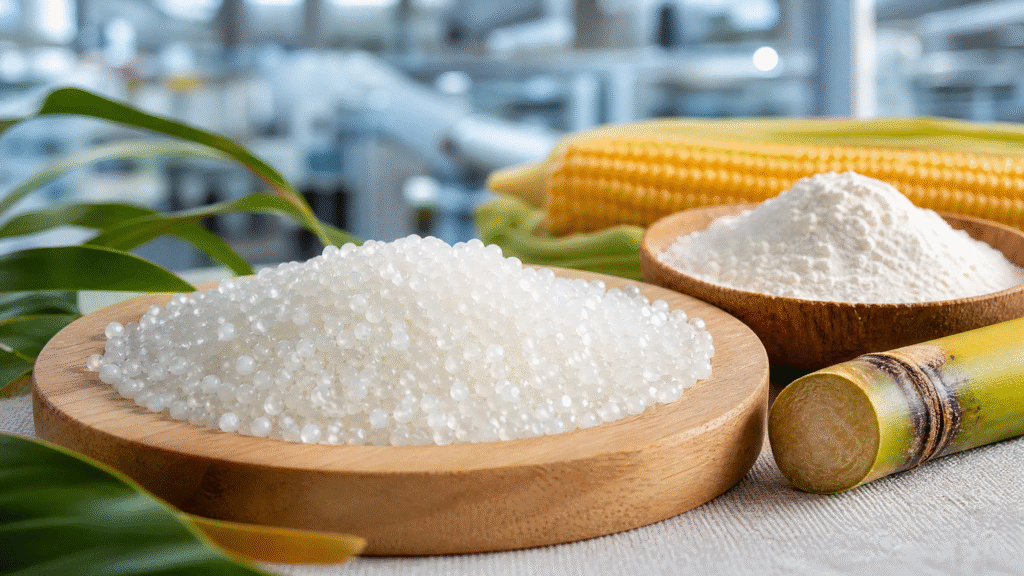
The first step in manufacturing compostable bags is selecting the right raw materials. Unlike conventional plastic bags made from polyethylene (HDPE or LLDPE), compostable bags use biodegradable polymers derived from renewable resources, often blended with mineral or bio-based fillers.
Key Materials for Compostable Bags
| Material | Role in Bag Production | Importance for Buyers |
|---|---|---|
| PLA | Provides rigidity and clarity; commonly produced from renewable sources such as corn starch, sugarcane, or other carbohydrate sources | Key for food contact and rigid packaging; heat sensitive |
| PBAT | A biodegradable polyester commonly used to provide flexibility and toughness in compostable films | Most important for bag strength and tear resistance |
| Starch | Bio-based filler for cost reduction | Good for shopping bags; moisture-sensitive |
| CaCO₃ | Mineral filler for cost-effectiveness | Lower cost; certain calcium carbonate-based formulations can achieve home compost certification when the complete formulation meets certification requirements; NOT for food contact |
HEMCBags Note: Many commercial flexible compostable films use PBAT as the main flexible component with PLA or other biodegradable polymers added for stiffness and performance balance. Exact formulations vary depending on certification, thickness, and application. While PBS and PHA are used in some compostable packaging applications, PLA/PBAT blends remain the most common materials for flexible compostable bags.
Calcium Carbonate vs. Starch
| Aspect | Calcium Carbonate (CaCO₃) | Starch-based |
|---|---|---|
| Cost | Lower cost | Higher cost |
| Home Compost | Certain formulations can pass OK Compost HOME when the complete formulation meets requirements | Can pass OK Compost HOME |
| Food Contact | Not suitable | Preferred |
| Best Use | Trash bags, industrial bags | Produce bags, food packaging |
How Manufacturing Changes by Bag Type
Different compostable bag applications require different manufacturing approaches. Here’s how the process varies:
| Bag Type | Key Manufacturing Requirements | Why It Matters |
|---|---|---|
| Compostable Garbage Bags | Higher tear resistance, thicker film, stronger sealing | Must withstand heavy wet waste without breaking |
| Compostable Shopping Bags | Handle strength, good printability, balanced thickness | Needs to carry weight and look professional |
| Compostable Produce Bags | Breathability, transparency, thinner film | Must allow produce to breathe while being visible |
| Compostable Mailers | Puncture resistance, adhesive performance, tear strength | Must survive shipping and handling |
HEMCBags Insight: A garbage bag and a produce bag may use similar materials, but the thickness, sealing parameters, and quality control requirements are different. A manufacturer who understands these differences can better match the product to the application.
Compostable Bag Manufacturing Timeline
For buyers planning orders, understanding the typical manufacturing timeline is essential for supply chain planning.
| Stage | Typical Time | Notes |
|---|---|---|
| Material preparation & sourcing | 3-7 days | PLA/PBAT resin availability; custom formulations take longer |
| Sample production | 5-10 days | Includes material trial, extrusion, and bag making |
| Certification verification | 2-5 days | EN 13432 / BPI certification review for custom products |
| Mass production | 10-20 days | Depends on order volume and bag complexity |
| Quality testing | 2-5 days | Film thickness, seal strength, tensile testing |
| Packaging & shipping | 1-3 days | Packaging and documentation |
| Total lead time | 4-8 weeks | For custom orders from confirmation to delivery |
HEMCBags Insight: The total lead time for custom compostable bags typically ranges from 4-8 weeks, depending on order volume, customization requirements, and shipping destination. Standard products with no custom printing can ship faster.
How Compostable Bags Are Made in a Factory
Compostable vs Plastic Bag Production
| Process Stage | Conventional Plastic Bags | Compostable Bags | Difference |
|---|---|---|---|
| Raw Materials | Direct HDPE/LLDPE pellets | PLA + PBAT + filler blends | Different materials |
| Compounding | Not required | Required — blending, drying, and filler incorporation | Major difference |
| Film Blowing | Standard machines | Modified/controlled machines | Tighter control |
| Processing Temperature | Wide tolerance | Narrow window (150-190°C) | Critical difference |
| Cooling | Stable | Sensitive control needed | Humidity affects quality |
| Sealing | Wide temperature tolerance | Narrow temperature window | Precise heat control required |
Machinery Used to Manufacture Compostable Bags
| Equipment | Function | Why It Matters |
|---|---|---|
| Resin Dryer | Remove moisture from PLA/PBAT | Prevents hydrolysis and film defects |
| Extruder | Melt and mix resins | Must provide precise temperature control |
| Blown Film Machine | Produce compostable film | Requires modified die design and cooling system |
| Printing Machine | Add graphics and branding | Must use water-based inks for certification |
| Bag Making Machine | Cut and seal bags | Requires precise sealing temperature control |
| Testing Equipment | Quality inspection | Ensures thickness, strength, and certification compliance |
Step 1: Incoming Material Inspection
Before production begins, all raw materials must be inspected and tested. This step is critical because compostable resins from different suppliers can vary significantly in properties.
What is checked:
- Resin grade and purity verification
- Moisture content analysis
- Melt flow index testing
- Batch traceability documentation
HEMCBags Insight: In our experience, material inconsistency is a leading cause of film defects. We test every incoming batch of PLA and PBAT before it enters production. This prevents problems like film bubbles, inconsistent thickness, and sealing failures before they occur.
Step 2: Material Blending & Compounding
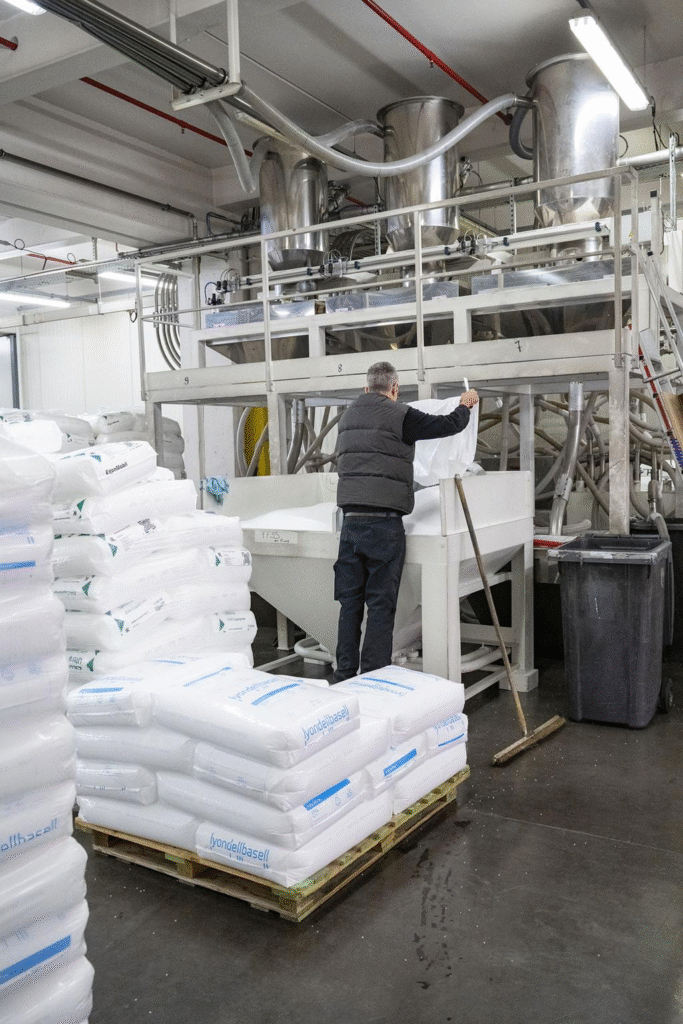
Before manufacturing begins, PLA, PBAT, fillers, and additives must be blended into a uniform compound.
What happens:
- Raw materials are weighed and mixed according to the specific formulation
- The blend is dried (resins are typically dried to very low moisture levels before extrusion)
- The dried blend is fed into an extruder that melts and homogenizes the materials
- The molten compound is cooled and pelletized into compostable resin pellets
Step 3: Blown Film Extrusion
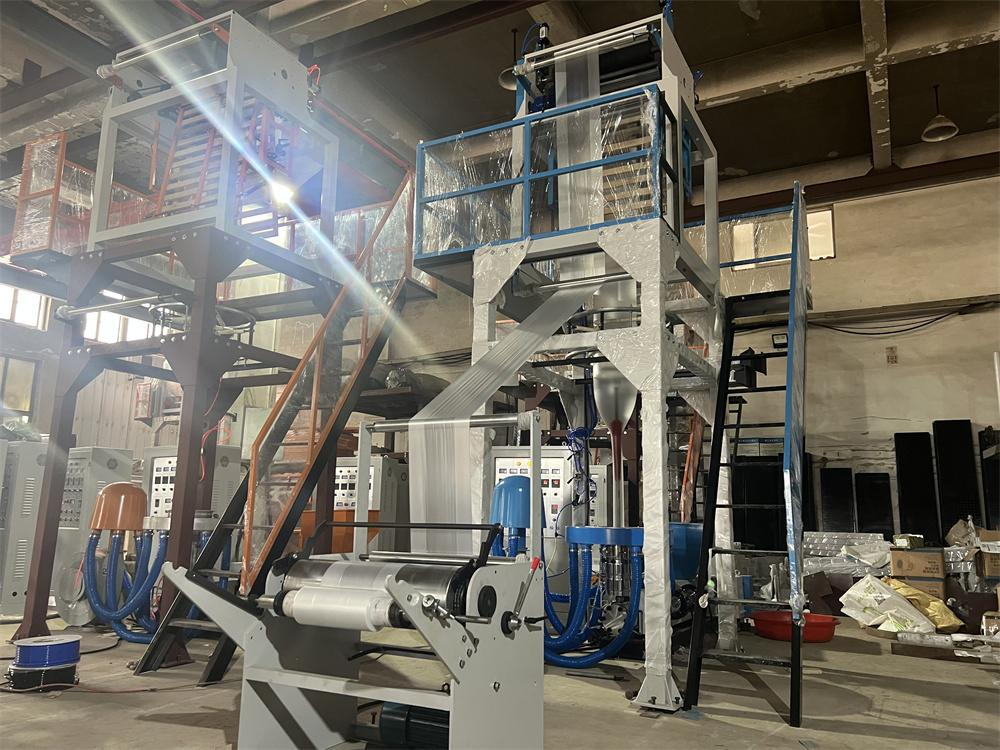
This is the core manufacturing process, where the compostable resin is transformed into thin film. The technique used is called blown film extrusion.
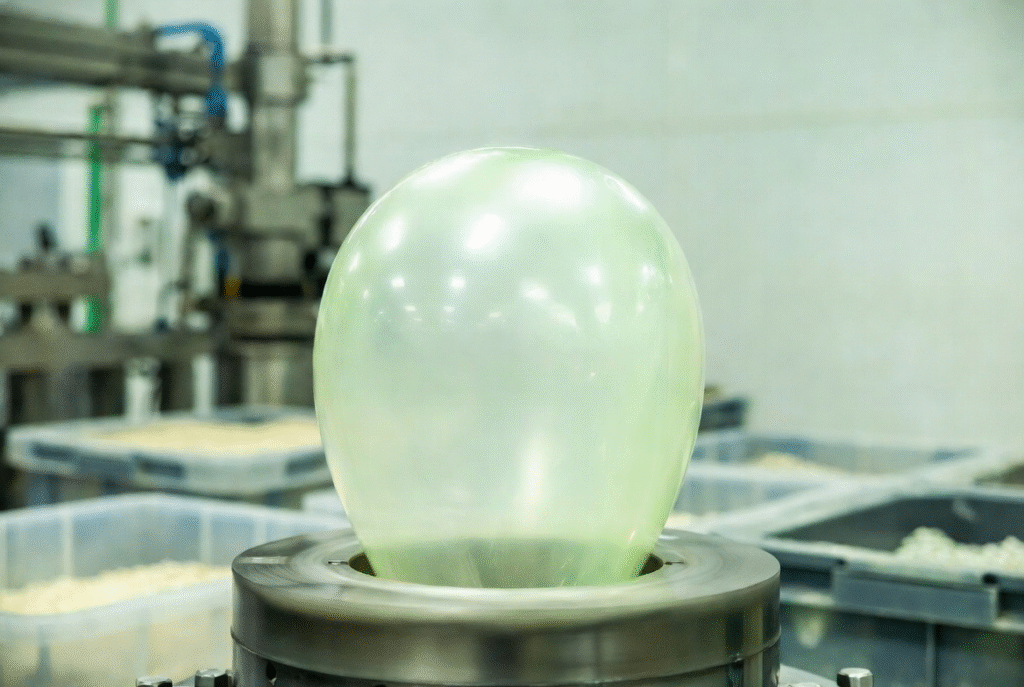
How blown film extrusion works:
- Compostable resin pellets are heated and melted in an extruder
- The molten material is pushed through a circular die
- Air pressure expands the material into a thin bubble
- The bubble is cooled (carefully controlled to prevent shrinkage or crystallization issues)
- The cooled film is flattened into a continuous sheet and wound onto rolls
Temperature ranges for different materials:
| Material | Processing Temperature |
|---|---|
| PLA | 180-210°C |
| PHA | 170-190°C |
| PBAT | 190-220°C |
| PLA/PBAT blends | 150-190°C (tighter window) |
HEMCBags Insight: Compostable film blowing requires much tighter temperature control than traditional plastics. Compostable materials generally require a much narrower processing window than conventional PE films. The die temperature must be adjusted based on the blend ratio and filler content. This is why not every plastic bag manufacturer can successfully switch to compostable bags — the technical skill is different.
Step 4: In-Process Film Testing
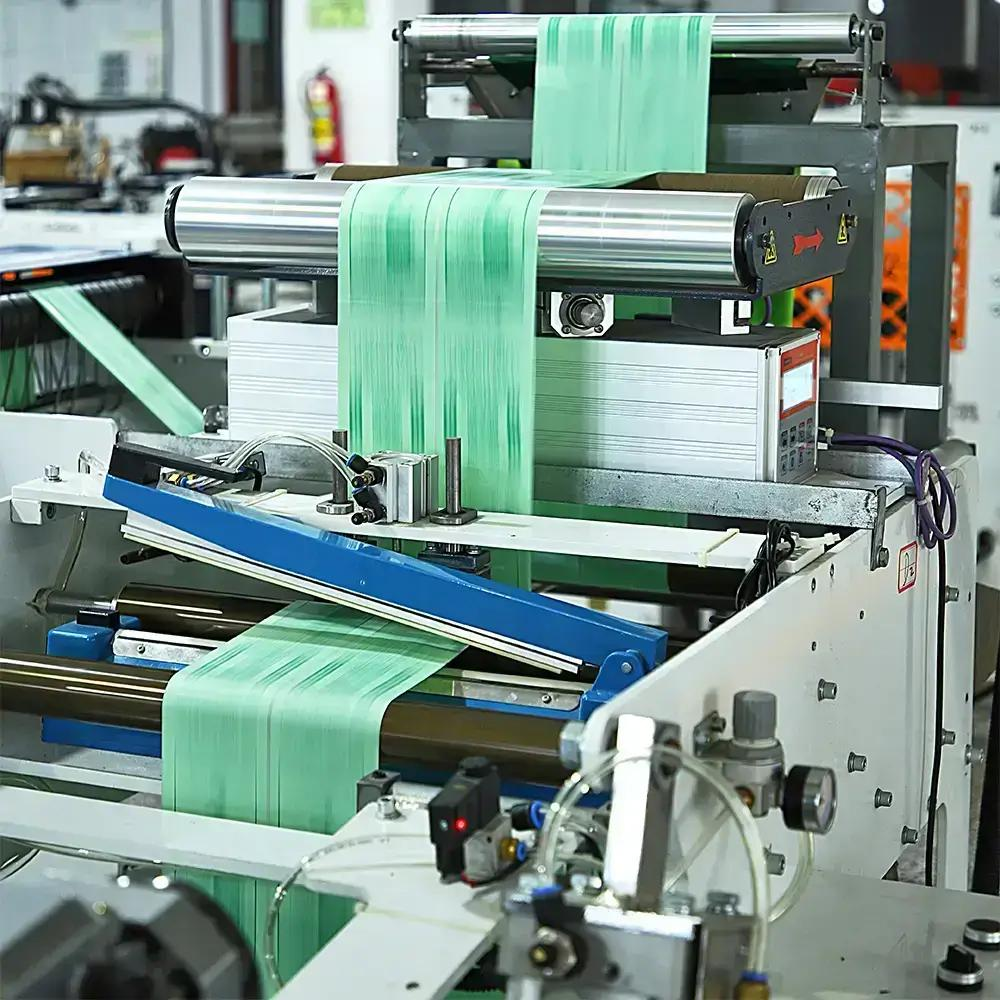
Once film begins production, it is immediately tested to ensure it meets specifications.
Key in-process tests:
| Test | Purpose |
|---|---|
| Film Thickness | Ensure consistency across the roll |
| Tensile Strength | Check mechanical properties |
| Tear Resistance | Verify durability |
This testing is continuous during production runs.
Step 5: Film Printing
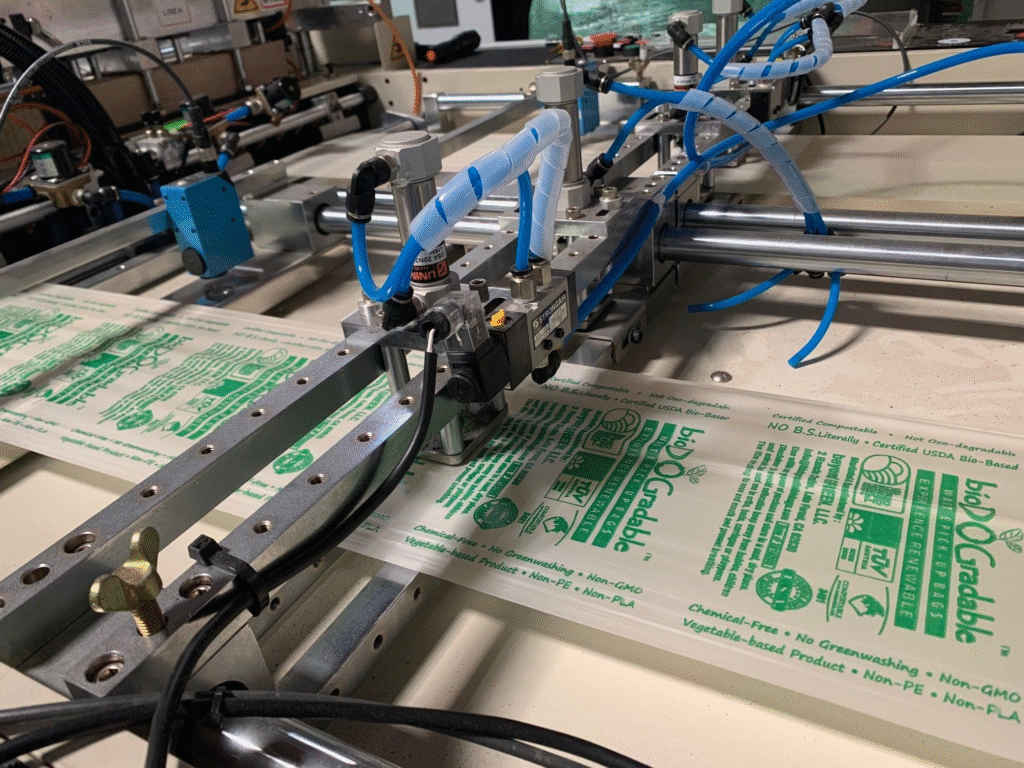
Once the film is produced, it can be printed with branding, logos, or product information.
Printing methods:
- Flexographic printing — the most common method for compostable bags
- Water-based or soy-based inks — required for compostability certification; must be non-toxic and biodegradable
Step 6: Bag Conversion (Cutting and Sealing)
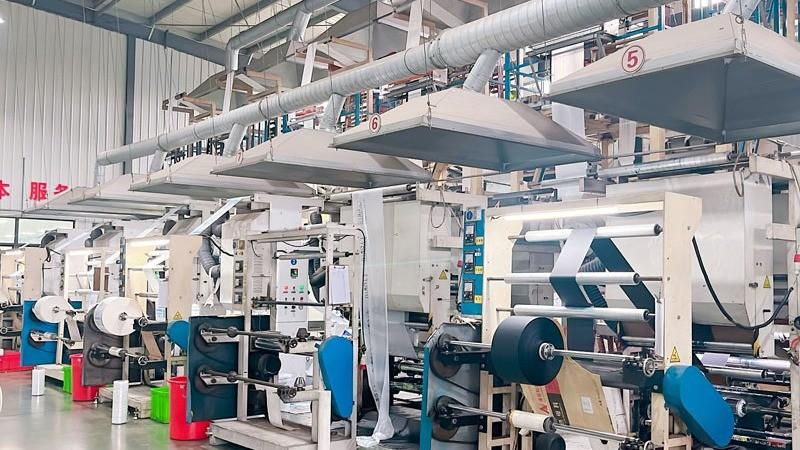
The printed film moves to the bag converting stage, where it is cut, sealed, and shaped into individual bags.
Key challenge: Compostable films are more sensitive to heat sealing conditions than traditional plastics. If the sealing temperature is too low, the seal won’t hold; too high, the film may melt or distort.
Step 7: Final QC Inspection
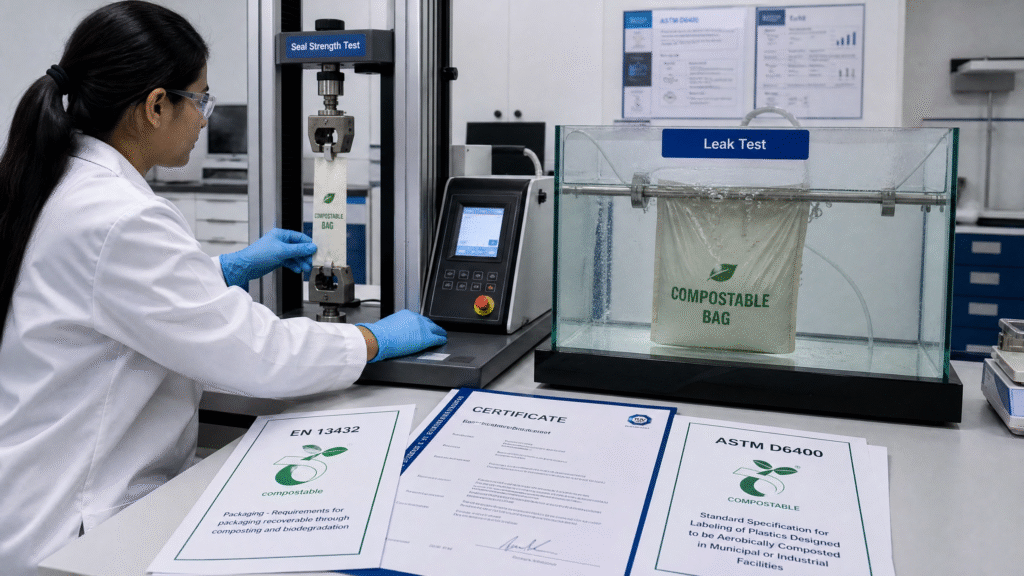
Every production batch undergoes final quality inspection before shipping.
Final QC checks:
- Seal strength testing
- Bag dimensions verification
- Visual inspection for defects
- Batch traceability documentation
- Certification compliance verification
Quality Control During Production
Quality control is an essential part of compostable bag manufacturing because compostable materials are more variable than conventional plastics.
Key Tests Performed
| Test | Purpose | Why It Matters |
|---|---|---|
| Film Thickness | Ensure consistent strength and cost efficiency | Inconsistent thickness leads to weak spots |
| Tensile Strength | Measure force bag can withstand before breaking | Determines load capacity |
| Tear Resistance | Test how easily film tears from a cut | Critical for bag durability |
| Seal Strength | Verify bottom seam holds under pressure | Prevents leaks and failures |
| Dart Impact | Measure impact resistance | Tests puncture resistance |
| Compostability | Confirm breakdown under composting conditions | Certification requirement |
HEMCBags Insight: In our experience, seal strength and film thickness consistency are the two most common quality issues in compostable bags. A bag with perfect materials but poor seals will leak or burst in use. We test seal strength on every production batch and maintain batch-level traceability.
Typical Quality Problems and Causes
| Problem | Possible Cause |
|---|---|
| Bag breaks easily | Incorrect PBAT/PLA ratio or poor material blending |
| Weak sealing / bottom failure | Incorrect sealing temperature or pressure |
| Film bubbles / pinholes | Moisture in resin during extrusion |
| Inconsistent thickness | Unstable extrusion parameters |
| Certification failure | Wrong formulation or process change without recertification |
Certification Testing Requirements
The European standard EN 13432 specifies requirements and procedures to determine the compostability of packaging by addressing four characteristics: biodegradability, disintegration during biological treatment, effect on the biological treatment process, and effect on the quality of the resulting compost. DIN CERTCO is one of the key certification bodies that verifies products meet EN 13432 standards for industrial composting.
The British Plastics Federation’s summary of EN 13432 highlights key requirements:
- Disintegration — After 12 weeks, no more than 10% of material fragments may be larger than 2mm
- Biodegradation — Within 6 months, at least 90% carbon dioxide conversion compared to control
- Heavy metals limits — Upper limits in mg/kg of dry sample: zinc 150, copper 50, nickel 25, cadmium 0.5, lead 50, mercury 0.5, chromium 50, molybdenum 1, selenium 0.75, arsenic 5, fluoride 100
- Eco-toxicity — No adverse effect on compost quality
The BPI Certification Mark confirms that a product meets ASTM D6400 standards and has been tested by accredited labs and reviewed by independent technical experts. Certified compostable products must demonstrate complete disintegration within a specific timeframe, full biodegradation into CO₂, water, and biomass, and no toxic residues or persistent fragments in finished compost.
How Much Does It Cost to Manufacture Compostable Bags?
Cost is one of the most important factors for buyers. Here’s a breakdown of what drives the cost of compostable bag manufacturing:
| Cost Factor | Impact on Price | What Buyers Should Know |
|---|---|---|
| PBAT resin | Highest cost component | Main flexible component; cost fluctuates with market |
| PLA resin | Adds strength and compostability | Stiffness provider; adds to material cost |
| Fillers (CaCO₃, starch) | Reduce material cost | Lower-cost alternatives, but affect performance and certification |
| Certification costs | Adds testing expense | EN 13432 / BPI testing and annual renewal fees |
| Printing | Depends on colors | Each color adds cost; water-based inks required |
| Packaging | Depends on retail requirements | Retail-ready packaging adds cost |
| Manufacturing complexity | Higher than PE | More precise control needed |
| Production speed | Slower than PE | Longer production time per order |
What this means for buyers:
- A compostable bag can cost 2-3x more than a similar PE bag, depending on formulation and certification
- Certified materials (BPI, EN 13432) cost more but provide verification
- Higher volume orders reduce per-unit cost
- Simpler specifications (no printing, standard thickness) lower cost
- Custom formulations add development costs
HEMCBags Insight: The cost premium comes primarily from three areas: raw material cost (PLA/PBAT vs PE), certification requirements, and slower production speeds. Buyers who understand these factors can make better sourcing decisions — for example, using calcium carbonate formulations for non-food applications to reduce cost while maintaining certification.
Why Many Plastic Bag Factories Fail When Producing Compostable Bags
Manufacturing compostable bags is more challenging than conventional plastic bags for several reasons:
Narrow Processing Window
Compostable materials require much tighter temperature control during extrusion. If temperatures drift, the film can become brittle, weak, or inconsistent.
Moisture Sensitivity
PLA and some biodegradable polymer blends are moisture-sensitive and require proper drying before extrusion. Excess moisture causes hydrolysis during extrusion, leading to weak spots and film defects. Raw materials must be dried before processing.
Thickness Control Challenges
Compostable films are harder to keep consistent than plastic films. Variations in thickness can cause weak spots, sealing failure, and inconsistent strength.
Seal Integrity
Heat sealing compostable films requires precise temperature and pressure control. The narrow sealing window means even small temperature fluctuations can lead to weak seals or bag failure.
Compostable Bag Material Variability
Compostable resins from different suppliers can perform differently, even with similar specifications. Manufacturers must adjust process parameters for each new batch of material.
What Buyers Usually Cannot See Inside a Compostable Bag Factory
Many buyers are unaware of the critical factors that separate reliable manufacturers from those producing inconsistent quality. This section reveals what happens behind the scenes — information most suppliers won’t tell you.
Resin Storage Humidity Matters
PLA and some biodegradable polymer blends are hygroscopic — they absorb moisture from the air. If resin pellets are not stored in climate-controlled conditions with humidity below 50%, the absorbed moisture will cause hydrolysis during extrusion, leading to weak spots, bubbles, and reduced film strength. Reliable manufacturers monitor storage humidity continuously.
Different PBAT Suppliers Require Different Settings
Not all PBAT is the same. Different suppliers use different production processes, resulting in variations in melt flow rate, molecular weight distribution, and thermal stability. Successful manufacturers adjust extrusion temperature, drying time, and die head pressure based on the specific PBAT supplier — sometimes requiring significantly different temperature settings depending on resin grade, equipment design, and formulation.
Film Thickness Variation Affects Certification
Certification standards like EN 13432 require testing at specific film thicknesses. If a manufacturer’s film thickness varies significantly from batch to batch, the certification may not apply. The standard also specifies that thinner gauges and lower densities will compost satisfactorily, but this must be verified through testing.
Certification Applies to Finished Products, Not Just Resin
This is one of the most common misconceptions. Raw material certification does NOT guarantee the finished bag is certified. The manufacturing process — including extrusion, sealing, and printing — can affect compostability. Buyers should always verify that the certificate matches the specific finished product they are ordering, not just the resin supplier’s certificate.
Can Traditional Plastic Bag Manufacturers Produce Compostable Bags?
Not every plastic bag factory can successfully manufacture compostable bags. This is one of the most important questions buyers should ask before sourcing.
Although the equipment looks similar, compostable production requires:
- Biopolymer processing knowledge — understanding how PLA and PBAT behave differently from PE
- Moisture-controlled resin handling — drying systems and humidity monitoring
- Customized extrusion parameters — compostable materials generally require a much narrower processing window than conventional PE films
- Precise sealing temperature control — narrower sealing window than conventional plastics
- Compostability certification management — EN 13432, ASTM D6400, BPI, or OK Compost
A factory experienced only in HDPE/LDPE bags may produce bags that look acceptable but fail in strength, sealing, or certification compliance. The technical skill required for compostable bags is fundamentally different from conventional plastic bag manufacturing.
How to Identify a Reliable Compostable Bag Manufacturer
Before sourcing, buyers need to know what separates a reliable manufacturer from an unreliable one. Here are the key indicators:
4 Signs of a Reliable Manufacturer
- They control film production in-house — Manufacturers who produce their own film have full control over quality consistency. Those who outsource film production cannot guarantee batch-to-batch consistency.
- They understand certifications — They can explain the difference between EN 13432, ASTM D6400, and OK Compost HOME. They provide certificates that match the specific finished product, not just raw materials. As BPI explains, certification ensures products are tested by accredited labs and reviewed by independent technical experts.
- They can explain material formulation — They understand why PLA/PBAT ratios matter and can explain the trade-offs between starch and calcium carbonate formulations based on your application.
- They provide production samples — They offer samples that match the exact specifications (material, thickness, size, printing) you would receive in a production order. Samples are not “better than production quality.”
How to Choose a Compostable Bag Manufacturer: 5 Questions Before Sourcing
For buyers sourcing compostable bags, selecting the right manufacturer is critical. Here are the 7 questions you should ask before placing an order:
Do you manufacture compostable film in-house?
Why it matters: Manufacturers who produce their own film have full control over quality. Those who outsource film production introduce variability.
Can you provide EN 13432 or BPI certificates?
Why it matters: Certification verifies that the product meets recognized compostability standards. The BPI online product catalog lists over 50,000 certified items, allowing buyers to independently verify certification status.
Does the certificate match the finished product?
Why it matters: Raw material certification is not enough — the finished bag must be certified.
What resin formulation do you use?
Why it matters: Different formulations suit different applications. Ask about the PLA/PBAT ratio and whether they use calcium carbonate or starch.
Can you provide production samples?
Why it matters: Requesting samples reveals quality issues early.
Custom Compostable Bags Manufacturing Support
For brands and distributors developing compostable bags, choosing the right formulation is often more important than choosing the lowest price supplier. The material selection directly affects bag strength, shelf life, certification compliance, and cost.
What we help buyers with:
| Area | Support Provided |
|---|---|
| Material selection | PBAT/PLA ratio, starch vs CaCO₃, additives |
| Certification matching | EN 13432, ASTM D6400, BPI, OK Compost HOME |
| Custom size/thickness | Based on application requirements |
| Private label packaging | Custom printing and retail-ready packaging |
| Export experience | North America, Europe, and other markets |
Whether you’re a brand launching a new product line or a distributor expanding your sustainable packaging portfolio, the right manufacturing partner makes the difference between a product that works and one that fails in the market.
Manufacturing Insight From HEMCBags
After working with international buyers since 2015, we found that most compostable bag failures do not come from the raw material itself. They usually happen because of incorrect formulation, unstable extrusion conditions, or insufficient quality control during sealing and conversion.
The difference between a reliable compostable bag and one that fails is not the material — it is the manufacturing discipline. Consistent quality requires precise temperature control, proper moisture management, and rigorous testing at every stage of production.
FAQ
Are compostable bags really made from plants?
Yes — primarily from PLA derived from renewable sources such as corn starch or sugarcane, and PBAT which is a biodegradable polyester. Fillers like starch or calcium carbonate are also plant-based or mineral.
Are compostable bags plastic?
Yes. Compostable bags are plastics, but they are biodegradable plastics designed to break down in composting conditions, unlike traditional petroleum-based plastics that persist in the environment.
Are compostable bags biodegradable?
Yes — but not all biodegradable bags are compostable. As TÜV Austria explains, a biodegradable product may be broken down by microorganisms but this does not necessarily imply that it can be converted into good quality compost. Biodegradability and compostability rely heavily on the environment where the product is broken down.
Do compostable bags break down in landfills?
No. Compostable bags require specific conditions — heat, moisture, and oxygen — found in industrial composting facilities. Landfills are compacted and sealed, creating anaerobic conditions where compostable bags won’t break down properly.
Are compostable bags suitable for commercial composting?
Yes — if they are certified to EN 13432 or ASTM D6400 standards. These certifications confirm that the bag will completely break down within 90-180 days in a commercial composting facility. However, not all commercial composting facilities accept compostable bags — buyers should verify with their local facility before switching.
Can compostable bags be manufactured on existing plastic bag machines?
Yes — but with modifications. Existing blown film equipment can often be adapted for compostable materials, but the process control requirements are significantly different. Manufacturers who simply run compostable resins on unmodified PE equipment typically produce inconsistent, low-quality bags.
Can compostable bags be customized?
Yes. Manufacturers can customize size, thickness, printing, packaging, certification requirements, and material formulations depending on application requirements and order volume.
What is the difference between PLA and PBAT in compostable bags?
The difference is expertise. Compostable bag manufacturing requires understanding of biopolymer behavior, moisture management, and certification requirements that conventional plastic bag manufacturers often lack.
How long does it take to manufacture compostable bags?
Total lead time for custom compostable bags typically ranges from 4-8 weeks from order confirmation to delivery, depending on order volume, customization requirements, and shipping destination.
What is MOQ for custom compostable bags?
Typical MOQs range from 5,000 to 50,000 bags, depending on the manufacturer, customization requirements (printing, size, material), and certification needs.
How much do compostable bags cost compared to plastic?
Compostable bags typically cost 2-3x more than PE bags, depending on formulation, certification, and volume. The premium comes from higher raw material costs, certification requirements, and slower production speeds.
How compostable bags are made?
Compostable bags are made by blending PLA, PBAT, and other certified compostable materials, followed by drying, extrusion, printing, bag conversion, and quality testing.
About the Author
Written by Chris
Founder, HEMCBags
Chris is the founder of HEMCBags, a compostable packaging supplier specializing in PBAT/PLA bags, biodegradable packaging solutions, and certified compostable products for global markets.
Since 2015, he has been involved in developing compostable packaging solutions for international buyers across the US, UK, and European markets, with specific experience in compostable garbage bags, shopping bags, mailers, and custom packaging projects. His work includes material formulation selection, certification requirements (EN 13432, ASTM D6400, OK Compost HOME), and custom bag development for brands and distributors.
Unlike general plastic bag manufacturers entering the compostable market, HEMCBags focuses specifically on certified compostable packaging development, with expertise in PBAT/PLA formulations, calcium carbonate and starch-based materials, and certification management.