
Author: HEMCbags Team | Sustainable Packaging Specialists
Quick Answer: Plastic bags are lightweight, flexible containers made mainly from polyethylene (PE). They are widely used for shopping, packaging, food storage, and waste collection. While durable and inexpensive, traditional plastic bags are difficult to recycle through curbside programs and can persist in the environment for hundreds of years. Reusable, recyclable, and certified compostable alternatives can help reduce plastic waste depending on how they are disposed of.
Key Takeaways:
- ✔ Most common material: Polyethylene (LDPE, HDPE) – lightweight, durable, waterproof
- ✔ Types: Grocery bags, trash bags, produce bags, industrial bulk bags
- ✔ Recyclability: Technically recyclable but require specialized drop-off facilities – not accepted in curbside recycling
- ✔ Environmental impact: Take up to 1,000 years to degrade, contribute to marine pollution, fragment into microplastics
- ✔ Alternatives: Reusable bags (cotton, jute), paper bags, recyclable plastic bags, compostable plastic bags
What Is a Plastic Bag?
A plastic bag is a type of container made of thin, flexible plastic film. They are used for containing and transporting goods such as groceries, produce, powders, ice, magazines, chemicals, and waste. Most plastic bags are heat-sealed at the seams, while some are bonded with adhesives or stitched.
Plastic bags are a common form of packaging, valued for their lightweight nature, strength, low cost, and water resistance. However, they are also a significant source of environmental pollution, with an estimated 1 to 5 trillion plastic bags used and discarded globally each year.
A Brief History
According to Wikipedia, the modern lightweight plastic shopping bag was invented by Swedish engineer Sten Gustaf Thulin in the early 1960s. Thulin developed a method of forming a simple one-piece bag by folding, welding, and die-cutting a flat tube of polyethylene for the packaging company Celloplast. His design was patented worldwide in 1965 and became the basis for the familiar “T-shirt” plastic bag design still used today.
From the mid-1980s onwards, plastic bags became common for carrying daily groceries throughout the developed world.
Types of Plastic Bags
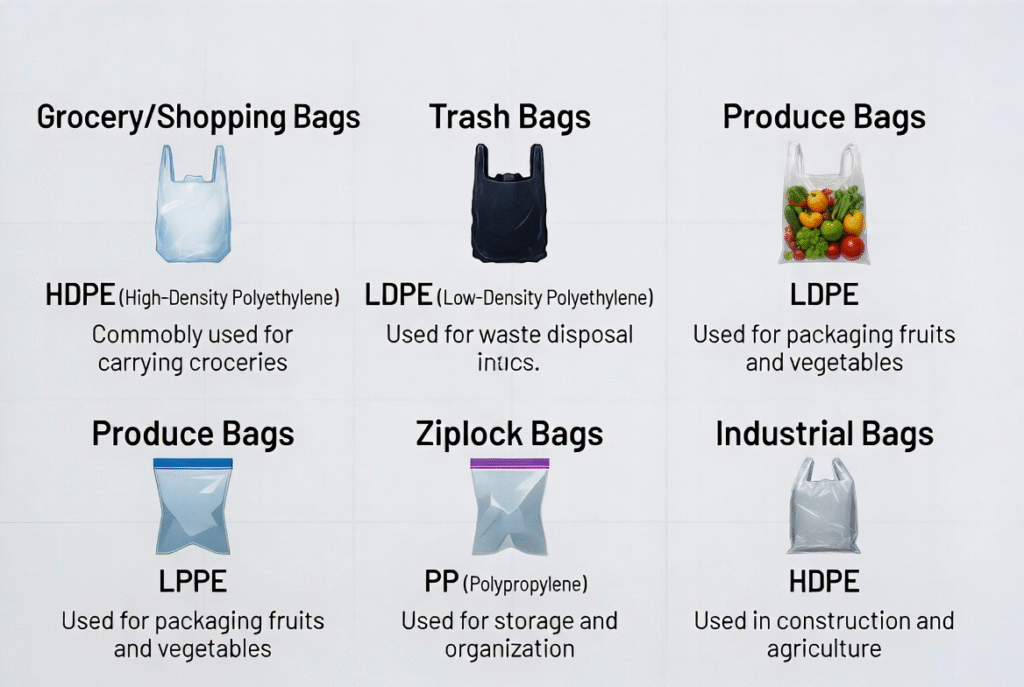
Grocery / Shopping Bags
The most common type – lightweight bags with handles, typically made from HDPE or LDPE. Designed for single-use but often reused as bin liners. Approximately 1 trillion plastic shopping bags are used globally each year.
Trash / Garbage Bags
Thicker, heavier-duty bags for waste disposal. Made from LDPE or LLDPE, available in sizes from 13 to 55 gallons and thicknesses from 0.7 to 1.2 mil.
Produce Bags
Thin, clear bags used in grocery stores for fruits and vegetables. Many are now made from compostable materials like PLA or cornstarch blends.
Industrial Bulk Bags
Large woven plastic bags (Flexible Intermediate Bulk Containers) used for transporting bulk powders, grains, or flowables.
Ziplock / Resealable Bags
Feature press-to-seal closures for food storage and organization. Typically made from LDPE.
Bioplastic Bags
Made from plant-based materials like PLA, PBAT, and PPC blends. Research shows PBAT/PLA/CaCO3 bags have 24-48% reduction across 10 environmental impact categories compared to other biodegradable blends.
Plastic Bag Materials: How Are They Made?
Most plastic bags are made from polyethylene (PE), a polymer derived from fossil fuels. The specific type determines the bag’s properties:
| Plastic Type | Common Applications | Properties |
|---|---|---|
| Low-Density Polyethylene (LDPE) | Grocery bags, cling wrap, garbage bags | Soft, flexible, translucent, softens at 70°C |
| High-Density Polyethylene (HDPE) | Shopping bags, freezer bags, milk bottles | Hard to semi-flexible, moisture resistant, softens at 75°C |
| Polypropylene (PP) | Microwave dishes, packaging tape, straws | Hard, translucent, softens at 140°C |
Some plastic bags are also made from bioplastics – plant-based polymers derived from corn starch, sugarcane, or cellulose. The most common is Polylactic Acid (PLA) , which is biodegradable under industrial composting conditions but does not break down in landfills or home compost systems.
Biodegradable vs Compostable vs Biobased
Understanding these terms is important for making informed choices:
| Term | What It Means | What It Doesn’t Mean |
|---|---|---|
| Biobased | Made from renewable plant sources | Not necessarily biodegradable |
| Biodegradable | Will break down under certain conditions | Doesn’t specify how long or in what environment |
| Compostable | Meets ASTM D6400/EN 13432 – breaks down in 90-180 days in industrial composting | Doesn’t break down in home compost or landfills |
| Oxo-degradable | Fragments faster when exposed to oxygen, heat, and sunlight | Fragments into microplastics – does not fully biodegrade |
Plastic Bag Uses
Plastic bags have a remarkably wide range of applications:
| Application Category | Examples |
|---|---|
| Retail & Grocery | Shopping bags, produce bags, frozen food bags |
| Waste Management | Trash bags, bin liners, yard waste bags |
| Food Packaging | Bread bags, chip bags, cereal box liners |
| Medical | Biohazard bags, IV bags, blood bags, specimen bags |
| Industrial | Bulk bags, pallet covers, irrigation tubing, mulch film |
| Consumer | Ziplock bags, garment bags, freezer bags |
| Construction | Vapor barriers, geotextile bags |
Environmental Impact of Plastic Bags
Pollution and Waste
Plastic bags are a major contributor to global plastic pollution:
- Global usage: Approximately 1 to 5 trillion plastic bags are used and discarded annually
- Lifespan: From point of sale to disposal, a plastic bag has a lifetime of just 12 minutes on average
- Landfill persistence: Plastic bags can take up to 1,000 years to decompose in landfills
- Photodegradation: Plastic bags do not biodegrade but photodegrade – breaking into smaller toxic parts and eventually microplastics
Marine Pollution
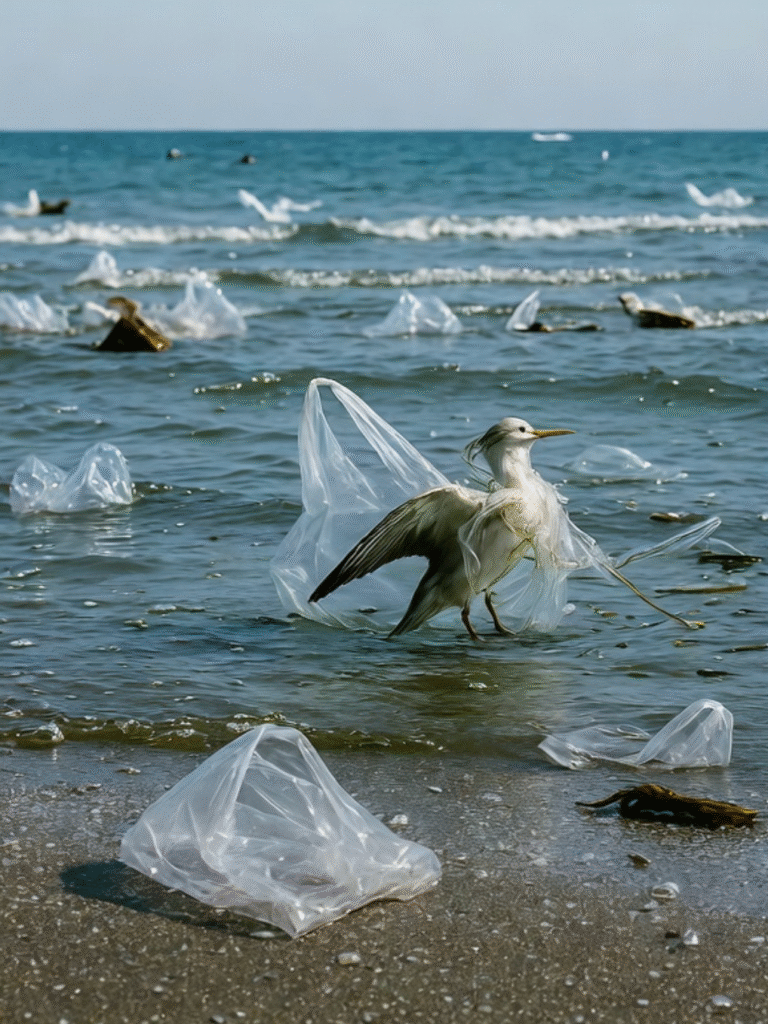
Plastic bags pose a severe threat to marine ecosystems. According to ScienceDirect, floating plastic bags can resemble jellyfish, leading to ingestion by sea turtles, whales, and other marine mammals. The book documents how plastic debris, including bags, bottles, and fishing line, has severe impacts on marine fauna such as seabirds and sea turtles.
Wildlife Impact
Marine animals are not the only victims. The Marine Conservation Society reports that 87% of all litter items recorded on UK beaches are plastic. Marine animals, including sea turtles, cetaceans, and seabirds, often mistake plastic bags for food, leading to internal blockages, starvation, and death.
Plastic Types: Environmental Impact Summary
| Plastic Type | Recyclable? | Environmental Concerns |
|---|---|---|
| PET | Recycled but not reused | Leaches antimony; high energy costs |
| HDPE | Reusable and recyclable | Better option – reusable and widely recycled |
| PVC | Not recyclable or reusable | Contains phthalates; BPA concerns |
| LDPE | Reusable but rarely recycled | Low recycling rates; contributes to litter |
| PP | Reusable but rarely recycled | Better option – heat resistant, reusable |
| PS | Reusable but rarely recycled | Leaks toxic chemicals when heated |
| Other (PLA, PC) | Not recyclable or reusable | May contain BPA; PLA requires industrial composting |
Can Plastic Bags Be Recycled?
Yes, plastic bags are recyclable – but the process requires drop-off locations, not curbside bins.
Why Can’t Plastic Bags Go in Curbside Recycling?
Plastic bags are not accepted in most curbside recycling programs because they:
- Clog and jam recycling machinery designed for rigid plastics
- Get tangled in sorting equipment, causing shutdowns
- Contaminate other recyclable materials
- Are lightweight and easily blown away, creating litter
The Proper Way to Recycle Plastic Bags
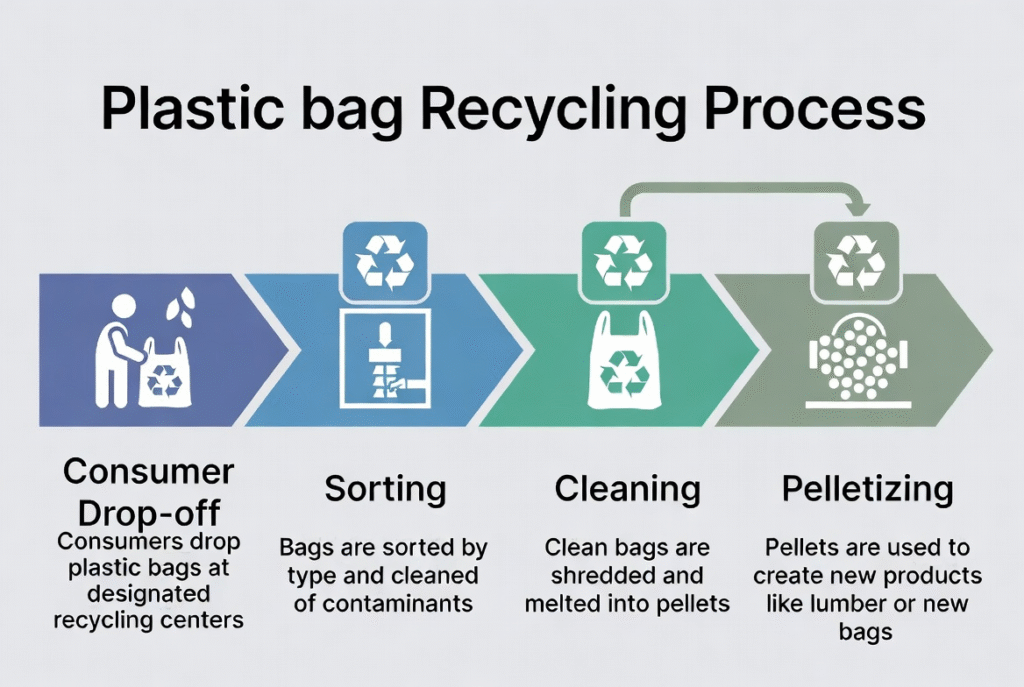
According to Plastic Film Recycling, clean, dry plastic bags are collected at designated drop-off locations, typically at grocery and retail stores. Before dropping off, bags should be clean, dry, and free of labels or receipts.
Plastic Bag Recycling Process:
Consumer ↓ Store Drop-off Location ↓ Sorting (manual/automatic separation) ↓ Cleaning (removing contaminants) ↓ Pelletizing (melting into plastic pellets) ↓ New Products (composite lumber, new bags, bins, fiber)
What Can Be Made from Recycled Bags?
- Composite lumber for decking and outdoor furniture
- New plastic bags (partially or fully recycled content)
- Recycling bins and compost bins
- Fiber for clothing and carpeting
- Construction materials and playground equipment
What Plastic Bags Can Be Recycled?
| Acceptable | Not Acceptable |
|---|---|
| Grocery bags | Heavily soiled bags |
| Bread bags | Bags with food residue |
| Dry cleaning bags | Multi-material bags |
| Produce bags | Biodegradable/compostable bags |
| Bubble wrap | Foam packaging |
| Plastic shipping envelopes | Chip packets (foil-lined) |
The Reality: Low Recycling Rates
According to the U.S. Environmental Protection Agency (EPA), over 380 billion plastic bags and wraps are produced in the U.S. yearly, requiring 12 million barrels of oil to create. The EPA also reports that only 9% of plastics overall are recycled, and plastic accounts for about 19% of materials landfilled.
When one ton of plastic bags is recycled, the energy equivalent of 11 barrels of oil is saved.
Plastic Bags Around the World
Different countries have adopted different approaches to managing plastic bag waste:
| Country/Region | Approach | Details |
|---|---|---|
| EU | Ban/Regulation | Single-use plastic bags banned; member states must reduce consumption to 40 bags per person by 2025 |
| USA | Varies by state | Some states have bans (California, New York, Hawaii); others have taxes or no restrictions |
| UK | Charge | 5p (now 10p) charge on single-use bags introduced in 2015; usage dropped by 95% in major supermarkets |
| Canada | Ban | Single-use plastic bag ban effective December 2022 |
| Australia | Varies by state | Most states have phased out lightweight plastic bags; some have bans |
| China | Ban | Nationwide ban on non-degradable bags in major cities (2021); phased approach ongoing |
Plastic Alternatives
Reusable Shopping Bags
The most effective way to reduce plastic bag use is to use reusable alternatives:
| Material | Pros | Cons |
|---|---|---|
| Cotton | Durable, washable, natural | High water and pesticide footprint |
| Jute | Biodegradable, strong, renewable | Heavier, higher carbon footprint per use |
| Hemp | Renewable, durable, low water needs | Higher upfront cost |
| Recycled PET | Made from recycled plastic | Still plastic-based |
A comprehensive life cycle assessment found that jute bags have a fivefold higher carbon footprint than single-use plastic bags when used once, but become superior after approximately 10 uses.
Paper Bags
Paper bags are biodegradable and widely recycled, but require more energy and water to produce. Studies in Canada found that paper bags had the highest environmental impacts among bag types studied when considering single-use scenarios.
Recyclable Plastic Bags
Some plastic bags are designed to be recycled through store drop-off programs. These are typically made from HDPE or LDPE without additives that contaminate the recycling stream. However, they still require proper disposal at designated drop-off locations.
📖 Learn more: Our Recyclable Plastic Bags Explained guide covers which bags can be recycled, how to recycle them, and common mistakes to avoid.
Compostable Plastic Bags
Made from plant-based polymers like PLA, PBAT, and PPC blends, these bags are designed to break down in industrial composting facilities. Research shows PBAT/PLA/CaCO3 blends have superior environmental performance, reducing human toxicity by 27-48% and ecotoxicity by 35-40% compared to other biodegradable blends.
📖 Learn more: Our Compostable Bags Explained guide covers materials, certifications, and proper disposal methods.
Bio-based Plastics
Bioplastics made from renewable resources like corn starch, sugarcane, and cellulose are emerging alternatives. A new material called “kinari” – a high-concentration cellulose fiber molding composite – has been developed for drink cups and food vessels, achieving up to 90% biomass content when combined with bio-polyethylene.
Biodegradable Bioplastics
Materials like PLA and PBS are suitable for single-use items. However, they require specific industrial composting conditions (55-60°C) for complete degradation and may form microplastics in the environment.
📖 Learn more: Our Biodegradable Explained guide covers what “biodegradable” actually means, why it’s often misleading, and how it compares to compostable alternatives.
Which Alternative Is Best?
| Alternative | Best For | Key Consideration |
|---|---|---|
| Reusable bags (cotton/jute) | Daily shopping | Must be used 10+ times to offset footprint |
| Paper bags | Short-term use | Biodegradable but resource-intensive |
| Recyclable plastic bags | Drop-off recycling programs | Requires proper disposal at store locations |
| Compostable bags | Food waste collection | Requires industrial composting facility |
| Bioplastic bags | Reducing fossil fuel use | May not break down in landfills |
Summary Table: Plastic Types at a Glance
| Plastic Type | Recyclable | Compostable | Common Uses | Environmental Rating |
|---|---|---|---|---|
| LDPE | ✓ (drop-off) | ✗ | Grocery bags, cling wrap | ⚠️ Moderate |
| HDPE | ✓ (drop-off) | ✗ | Shopping bags, milk bottles | ✓ Good |
| PP | ✓ (drop-off) | ✗ | Packaging, straws | ⚠️ Moderate |
| PLA | ✗ | ✓ (industrial) | Compostable bags, cups | ✓ Good |
| PBAT | ✗ | ✓ (industrial) | Compostable bags, films | ✓ Good |
| PET | ✓ (curbside) | ✗ | Bottles, food containers | ⚠️ Moderate |
| PVC | ✗ | ✗ | Packaging, pipes | ✗ Poor |
FAQ
Are plastic bags waterproof?
Yes. Polyethylene, the material used in most plastic bags, is inherently waterproof. This is one of the key reasons they are so widely used – they protect contents from moisture and are suitable for carrying wet items.
Why are plastic bags banned?
Plastic bags are banned in many jurisdictions due to their environmental impact: they take hundreds of years to degrade, contribute to marine pollution, fragment into microplastics, and are difficult to recycle. Bans aim to reduce litter, protect wildlife, and encourage reusable alternatives.
Can plastic bags be recycled at Walmart?
Yes. Many Walmart stores have plastic bag recycling drop-off bins near the entrance. These bins accept clean, dry grocery bags, bread bags, produce bags, and other plastic film packaging. Always check with your local store to confirm availability.
Are plastic bags biodegradable?
Most traditional plastic bags are not biodegradable. They are made from polyethylene and will persist in the environment for hundreds of years. Some bags are marketed as “biodegradable,” but these claims are often misleading – they may only fragment into microplastics rather than fully degrading.
Are plastic bags toxic?
Most polyethylene bags are not highly toxic, but they can leach chemicals under certain conditions. When they degrade, they release additives and can absorb and transport persistent organic pollutants. Additionally, plastic bags degrade into microplastics, which can carry chemicals and enter the food chain.
Why are plastic bags bad?
Plastic bags are problematic because they: take 1,000+ years to degrade, are rarely recycled (only ~1% in the US), cause wildlife entanglement and ingestion, contribute to microplastic pollution, and are often used for just 12 minutes before disposal. They also require fossil fuels for production.
Can plastic bags be composted?
Plastic bags are problematic because they: take 1,000+ years to degrade, are rarely recycled (only ~1% in the US), cause wildlife entanglement and ingestion, contribute to microplastic pollution, and are often used for just 12 minutes before disposal. They also require fossil fuels for production.
How long do plastic bags take to decompose?
Plastic bags can take 500 to 1,000 years to decompose in landfills. They do not biodegrade in the traditional sense but instead photodegrade – breaking down into smaller and smaller pieces over time, eventually becoming microplastics that persist in the environment.
Further Reading
Explore related topics in our sustainable packaging series:
- Compostable Bags Explained – Materials, certifications, and everything you need to know about compostable bags.
- Biodegradable Explained – What “biodegradable” really means, why it’s often misleading, and how it compares to compostable.
- Compostable Certifications Explained – BPI vs TÜV vs ASTM D6400 vs EN 13432 – what each certification means and which you need.
Conclusion
Plastic bags are a ubiquitous part of modern life, valued for their convenience, low cost, and versatility. However, their environmental impact – from fossil fuel consumption to marine pollution and microplastic formation – is significant. While they are technically recyclable, the recycling process is complex and inaccessible for most consumers.
The most effective approach to reducing plastic bag waste is a combination of strategies: choosing reusable alternatives, participating in available recycling programs, and supporting policies that encourage sustainable practices. For applications where a disposable bag is necessary, compostable options can be a better choice – but only if disposed of in the appropriate composting facilities.
Key takeaways:
- Most plastic bags are made from polyethylene (PE) – a fossil fuel-based polymer
- Plastic bags are recyclable but require store drop-off programs – they are not accepted in curbside recycling
- Environmental impact is severe – take up to 1,000 years to degrade, contribute to marine pollution and microplastics
- Reusable alternatives – cotton, jute, and hemp bags become environmentally superior after multiple uses
- Compostable bags – require industrial composting; they do not break down in landfills or home compost systems
Ready to reduce your plastic footprint?
Browse HEMCbags sustainable packaging solutions | Learn more about compostable alternatives