
Quick Answer:
ASTM D6400 is a U.S. technical specification for plastics and plastic products designed to be aerobically composted in municipal or industrial facilities. It establishes requirements for biodegradation, disintegration, and the effects of the material on compost quality. ASTM D6400 covers finished plastic products, including packaging, but it is not a home-composting standard or a certification by itself.
Key Takeaways:
- ASTM D6400 is a technical specification, not a certification itself
- Applies to finished products and packaging, not just raw materials
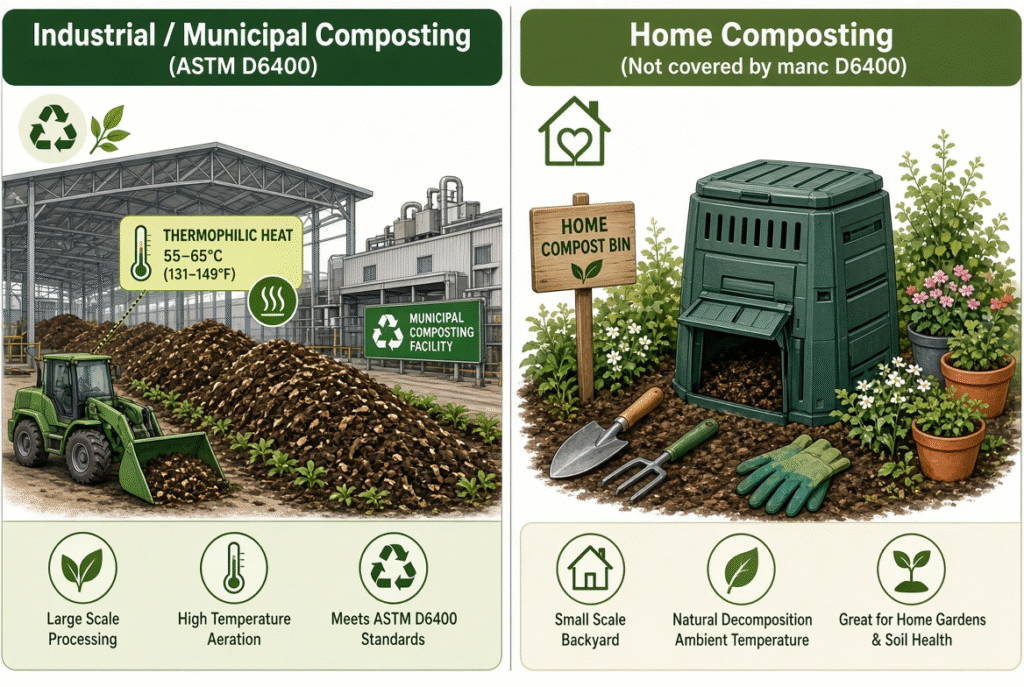
- Designed for industrial/municipal aerobic composting, not home composting
- BPI certification uses ASTM D6400 as its base standard
- Current version: ASTM D6400-26 (active as of June 2026)
What Is ASTM D6400?
ASTM D6400 is the Standard Specification for Labeling of Plastics Designed to be Aerobically Composted in Municipal or Industrial Facilities. It is a U.S. technical standard developed by ASTM International that establishes requirements for plastics and products made from plastics that are designed to be composted in large-scale aerobic composting facilities.
Key points about the standard:
| Aspect | Details |
|---|---|
| Full title | Standard Specification for Labeling of Plastics Designed to be Aerobically Composted in Municipal or Industrial Facilities |
| Current version | ASTM D6400-26 (active, updated June 2026) |
| Replaces | D6400-23 |
| Related international standard | ISO 17088 |
| Scope | Plastics and products made from plastics for aerobic composting in municipal/industrial facilities where thermophilic conditions are achieved |
| Purpose | Establish labeling requirements for materials and products as “compostable in aerobic municipal and industrial composting facilities” |
| Not for | Home composting, landfill, soil, or marine environments |
ASTM D6400 is maintained by ASTM International Subcommittee D20.96 on Environmentally Degradable Plastics and Biobased Products.
ASTM D6400 Compostable Plastics Standard Summary
| Requirement | What ASTM D6400 Evaluates | Why It Matters |
|---|---|---|
| Biodegradation | Aerobic biodegradation under controlled composting conditions | Confirms microbial conversion of the material |
| Disintegration | Physical breakdown during composting | Limits persistent visible plastic fragments |
| Compost quality | Effects of the material and resulting compost | Helps ensure compost quality |
| Regulated substances | Specified substances and limits | Protects the quality of finished compost |
| Finished product | The complete plastic product or packaging | Prevents assuming resin compliance equals product compliance |
In simple terms, ASTM D6400 evaluates whether a finished plastic product can biodegrade, disintegrate, and perform safely in an industrial or municipal composting environment.
ASTM D6400 Compostable Plastics Standard Overview
| Item | ASTM D6400 |
|---|---|
| Country / market | United States |
| Type | ASTM specification |
| Current version | D6400-26 (active) |
| Composting environment | Municipal / industrial aerobic composting |
| Temperature | Thermophilic conditions |
| Products covered | Plastics and plastic products |
| Packaging | Yes—packaging made from plastics is included |
| Home composting | No—not a home-composting standard |
| Finished products | Yes—applies to finished end items, not just raw materials |
| Main purpose | Determine whether products can compost satisfactorily in municipal/industrial facilities |
| Related international standard | ISO 17088 |
What Does ASTM D6400 Require?
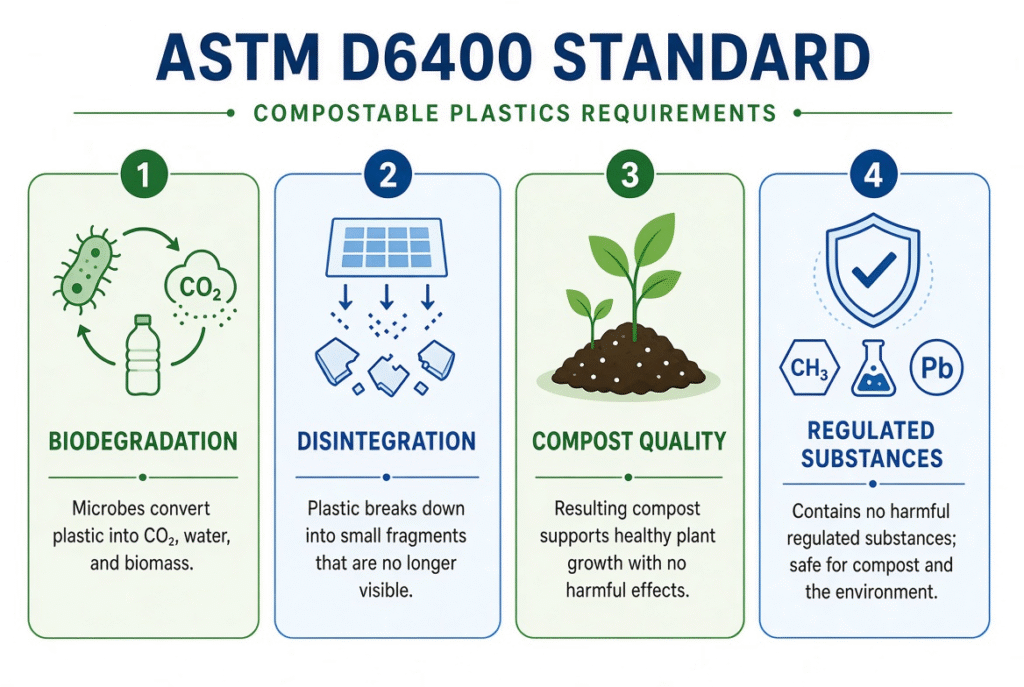
Biodegradation
Biodegradation measures the conversion of organic carbon to CO₂ by microorganisms under composting conditions. This demonstrates that the material is being consumed by microbes rather than simply fragmenting into smaller pieces.
Key point: ASTM D6400 establishes requirements to evaluate whether plastics can biodegrade at a rate comparable to known compostable materials under the specified test conditions.
Disintegration
Disintegration measures the physical breakdown of the material during composting. The standard requires that the material break down into small fragments so that persistent visible plastic pieces do not remain in the finished compost.
Why it matters: A product could biodegrade chemically but still leave visible plastic fragments. Disintegration testing ensures the physical breakdown is complete enough that fragments are not visually apparent in the final compost.
Compost Quality and Plant Growth
Compost quality testing ensures that the resulting compost does not have negative effects on plants or soil. The standard evaluates whether the finished compost supports plant growth without harmful impacts.
Key consideration for B2B buyers: Compostability is not only about breaking down. The resulting compost must remain suitable and safe for agricultural and horticultural use.
Regulated Substances
The standard includes limits on specified substances to protect compost quality. Certification programs such as BPI also apply additional restrictions on fluorinated chemicals (PFAS) as part of their certification requirements.
ASTM D6400, BPI and Compostable Bags: How They Relate
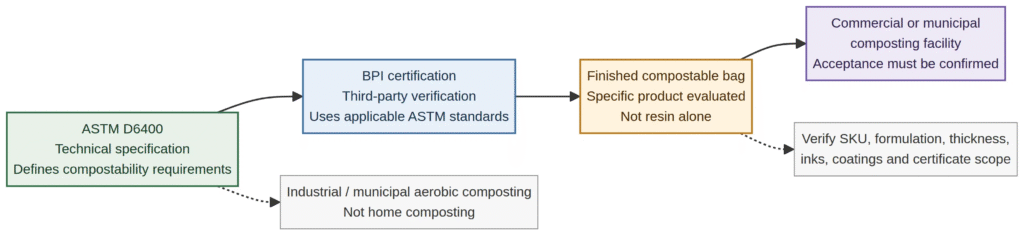
This relationship is important to understand:
- ASTM D6400 defines the technical requirements
- BPI certification provides independent verification that a specific finished product meets those requirements
- The finished bag is what gets certified—not the raw material
- The composting facility is where the product must actually break down
Does ASTM D6400 Apply to Finished Products or Resins?
This is one of the most common misconceptions among buyers.
ASTM D6400 applies to finished products and packaging, not simply to a raw material or resin. The standard explicitly states that it covers “end items (including packaging)”. This means:
- A resin supplier’s claim that their material is “compostable” is not sufficient
- The finished bag—including its formulation, additives, inks, coatings, and any other components—must meet the standard
- Certification applies to the specific finished product, not just the raw material
Why this matters for buyers: A bag made from certified compostable resin is not automatically certified. The finished bag must be tested and certified as a complete product. BPI certification, for example, is issued for specific products and packaging, not for raw materials.
For a deeper look at the materials commonly used in compostable bags, see our guide to what compostable trash bags are made of.
ASTM D6400 Compostable Bags: Requirements, Certification & Buyer Guide
ASTM D6400 compostable bags are plastic bags designed to meet the requirements for aerobic composting in municipal or industrial facilities. However, a bag made from ASTM D6400-compliant or compostable resin is not automatically ASTM D6400 certified. The finished bag must be evaluated as a complete product.
Buyer Question Quick Reference
| Buyer Question | Answer |
|---|---|
| Can compostable bags meet ASTM D6400? | Yes, if the finished product meets the applicable requirements. |
| Is ASTM D6400 certification the same as BPI? | No. ASTM D6400 is a technical specification; BPI is a certification program. |
| Is a compostable resin automatically D6400 certified? | No. The finished product must be evaluated. |
| Does D6400 mean home compostable? | No. ASTM D6400 is for industrial/municipal composting only. |
| Can D6400 bags go into any composting facility? | Not necessarily. Facility acceptance must be checked. |
What to look for when sourcing
When sourcing ASTM D6400 compostable bags, B2B buyers should verify:
- Finished product certification: The bag itself should be certified, not just the raw material
- BPI Certification Mark: Indicates independent testing and verification to applicable ASTM standards
- Certificate number: Can be verified in BPI’s online product database
- Composting facility acceptance: Check whether local composting facilities accept certified compostable bags
Important caveat
The fact that a resin is tested or marketed as compostable does not automatically mean that every finished bag made from that resin is certified. Manufacturing processes, additives, inks, coatings, and bag thickness can all affect compostability. ASTM D6400 compliance should be verified at the finished-product level, not assumed from the raw material alone.
For a closer look at how these products are manufactured, see our guide to how compostable bags are made.
What Does ASTM D6400 Mean for Compostable Bag Buyers?
If you are sourcing compostable bags for the U.S. market, do not evaluate ASTM D6400 compliance based only on the resin name. Ask for documentation covering the finished bag, including:
- Product formulation
- Thickness
- Printing inks and coatings
- Certification scope
If the supplier claims BPI certification, verify the product in the BPI certified product database and make sure the listed product corresponds to the bag you are purchasing. Finally, confirm that the intended composting program accepts certified compostable bags.
For a broader explanation of compostability certifications, see our guide to BPI, TÜV, ASTM D6400 and OK Compost certifications.
ASTM D6400 and BPI Certification: What’s the Difference?
| Aspect | ASTM D6400 | BPI Certification |
|---|---|---|
| What it is | Technical specification | Certification program |
| Function | Defines technical requirements | Verifies eligible products |
| Nature | ASTM standard | Third-party certification |
| Relationship | Base technical standard | Uses applicable ASTM standards as base |
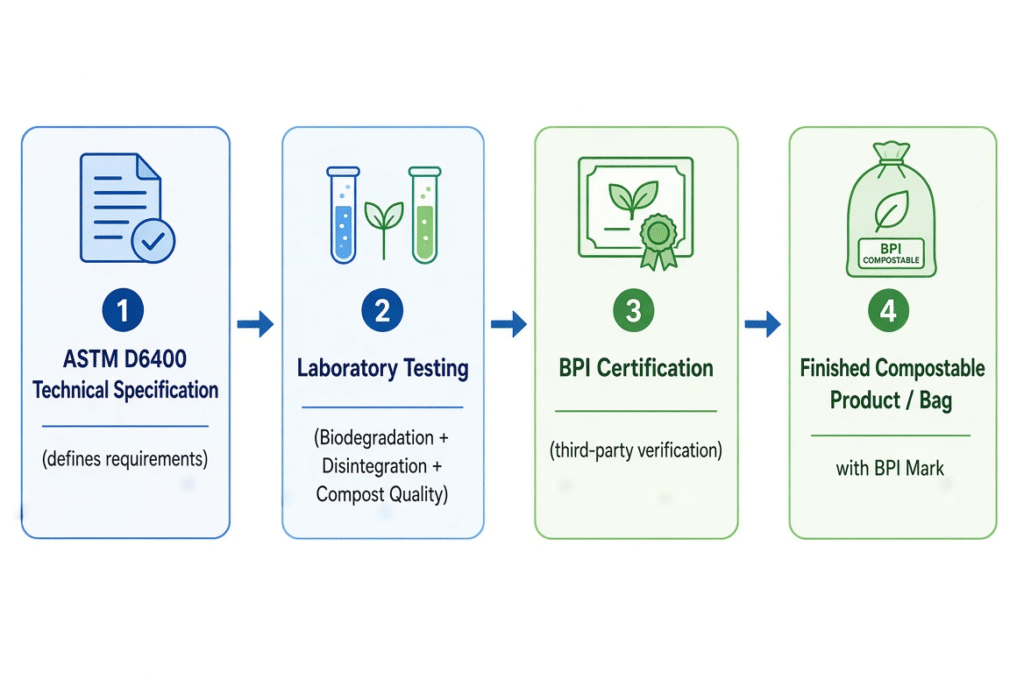
BPI uses ASTM D6400 as the base standard for assessment for items going through the BPI Certification process. Products that carry the BPI Certification Mark have been independently tested and verified to meet applicable ASTM standards, with additional requirements including:
- Laboratory testing to ensure disintegration and complete biodegradation
- Toxicity screening to verify compost safety for soils and plants
- Review and approval by independent technical experts
Key takeaway: ASTM D6400 defines the technical requirements; BPI certification provides third-party verification that a specific product meets those requirements.
ASTM D6400 vs EN 13432
ASTM D6400 and EN 13432 are the two major compostability standards for the US and EU markets. They address similar industrial compostability objectives, but they are different standards with different scopes, test frameworks, and certification systems.
| Aspect | ASTM D6400 (US) | EN 13432 (EU) |
|---|---|---|
| Main market | United States | European Union |
| Composting environment | Municipal / industrial aerobic composting | Industrial composting |
| Product scope | Plastics and plastic products | Packaging |
| Related international standard | ISO 17088 | (Part of European standards framework) |
| Certification examples | BPI (uses applicable ASTM standards as base) | TÜV Austria OK compost |
OK compost INDUSTRIAL certification is based on EN 13432:2000, the harmonized EU standard for packaging recoverable through composting and biodegradation. Products certified only to OK compost INDUSTRIAL are intended for industrial composting facilities at temperatures between 55 to 60°C and should not go into garden compost.
Key takeaway: ASTM D6400 and EN 13432 are both industrial compostability standards, but they serve different markets and are administered through different certification systems. For US market compliance, ASTM D6400 (often verified through BPI certification) is the relevant standard. For EU market compliance, EN 13432 (often verified through TÜV Austria OK compost) is the relevant standard.
ASTM D6400 vs ASTM D6868 and D8410
ASTM has multiple standards related to compostable products. Understanding the differences helps buyers select the right standard for their application.
| Standard | Main Application | Key Distinction |
|---|---|---|
| ASTM D6400 | Plastic products / packaging designed for aerobic composting | Covers plastics and plastic products |
| ASTM D6868 | Compostable coatings or plastic components associated with paper/fiber substrates | Covers plastics used as coatings or binders in paper/fiber products |
| ASTM D8410 | Certain cellulose/fiber-based substrates | Limited to cellulosic-fiber-based substrates; excludes polymer substrates and items where thermoplastic polymer is laminated to cellulosic-fiber-based substrates |
What this means for buyers: If you’re sourcing compostable bags, ASTM D6400 is the relevant standard. If you’re sourcing coated paper products (e.g., compostable plates or cups with a plastic lining), ASTM D6868 may also apply. BPI certification may assess products according to ASTM D6400, D6868, or D8410 depending on the product type and eligibility.
How Is ASTM D6400 Compostability Evaluated?
ASTM D6400 establishes the requirements and test methods used to evaluate qualifying products. Third-party certification programs, such as BPI, use applicable testing and review procedures to verify certified products.
| Step | What Happens | Purpose |
|---|---|---|
| 1. Product formulation review | Manufacturer submits product formulation for assessment | Ensures materials are eligible for certification |
| 2. Laboratory testing | Product is tested under controlled composting conditions | Verifies disintegration, biodegradation, and compost quality |
| 3. Biodegradation assessment | Measures CO₂ conversion under test conditions | Confirms microbial breakdown of the material |
| 4. Disintegration assessment | Evaluates physical breakdown during composting | Prevents persistent visible fragments |
| 5. Compost quality assessment | Tests resulting compost for plant growth and safety | Ensures no harmful residues |
| 6. Certification / verification | If all requirements are met, certification is issued | Provides third-party verification |
Testing and certification timelines depend on the product, test scheme, laboratory, and certification program. Some compostability tests can take several months because biodegradation is evaluated over an extended composting period.
What ASTM D6400 Does Not Mean
| Misconception | Reality |
|---|---|
| “ASTM D6400 means home compostable“ | No—the standard is for industrial/municipal composting facilities, not home composting |
| “ASTM D6400 means biodegradable in landfill” | No—ASTM D6400 is for aerobic composting, not landfill conditions |
| “ASTM D6400 means biodegradable in soil” | No—the standard is for controlled composting facilities, not natural environments |
| “ASTM D6400 means made from bio-based materials” | No—the standard addresses compostability, not feedstock source |
| “ASTM D6400 certification applies to the resin” | No—certification applies to the finished product |
| “ASTM D6400 is a certification” | No—it is a technical specification; certification requires third-party verification |
How to Verify an ASTM D6400 Compostable Bag
Before buying, verify these items:
- Finished product certification — The bag itself should be certified, not just the raw material
- Certificate number — Ask for the certification number for the finished product
- Certification body — Verify the certifying body (e.g., BPI, TÜV Austria)
- Applicable standard — Confirm the standard is ASTM D6400 (not just “compostable”)
- Product name / SKU — Ensure the certificate covers the specific product being purchased
- Certification scope — Verify what product types and applications are covered
- Material formulation — Understand the materials used in the finished product
- Printing inks and coatings — Confirm these are also compostable and within the certification scope
- Bag dimensions and thickness — Verify the bag matches your requirements
- Composting environment — Confirm the bag is designed for industrial/municipal composting
- Certification validity — Verify the certification is current and in good standing
Buyers can verify whether a specific product is listed in the BPI certified product catalog by searching the product name, company, SKU, or keyword.
FAQ
What is ASTM D6400?
ASTM D6400 is a U.S. technical specification for plastics and plastic products designed for aerobic composting in municipal or industrial facilities. It establishes requirements for biodegradation, disintegration, and the effects of the material on compost quality. ASTM D6400 covers finished plastic products, including packaging, but it is not a home-composting standard or a certification by itself.
What is the current version of ASTM D6400?
As of 2026, ASTM D6400-26 is the active version listed by ASTM International, updated June 2026. It replaces D6400-23.
Is ASTM D6400 the same as compostable?
Not exactly. ASTM D6400 is a technical standard that defines the requirements for labeling plastics as compostable in industrial composting facilities. A product that meets ASTM D6400 requirements can be labeled as compostable, but the standard itself is not a certification.
Is ASTM D6400 for home composting?
No. ASTM D6400 is designed for municipal and industrial aerobic composting facilities where thermophilic conditions are achieved. It is not a home-composting standard.
Are compostable bags covered by ASTM D6400?
Yes. Compostable bags made from plastics are within the scope of ASTM D6400, provided they meet the standard’s requirements for biodegradation, disintegration, and compost quality. Certification applies to the finished bag, not just the raw material.
What is the difference between ASTM D6400 and EN 13432?
ASTM D6400 is widely used in the U.S. to define compostability requirements for plastics and plastic products intended for municipal or industrial composting. EN 13432 is the European harmonized standard addressing packaging recoverable through industrial composting and biodegradation. Both address similar objectives but serve different markets and are administered through different certification systems.
Is ASTM D6400 a certification?
No. ASTM D6400 is designed for municipal and industrial aerobic composting facilities where thermophilic conditions are achieved. It is not a home-composting standard.
Does ASTM D6400 apply to finished products?
Yes. The standard specifically covers “end items (including packaging).” ASTM D6400 compliance should be verified at the finished-product level, not assumed from the raw material alone.
Is ASTM D6400 required for compostable bags in the US?
ASTM D6400 is an important U.S. standard used to evaluate the compostability of plastic products. BPI certification is a widely recognized third-party certification program for compostable products in North America. Some U.S. state and local regulations reference ASTM compostability standards or third-party certification, but the specific requirements vary by jurisdiction and product type. Buyers should check the requirements that apply to their product and market.
What is the difference between ASTM D6400 and BPI certification?
ASTM D6400 is a technical standard; BPI certification is a certification program that uses ASTM D6400 as its base standard. The BPI Certification Mark indicates that a product has been independently tested and verified to meet applicable ASTM standards.
Final Takeaway
ASTM D6400 is a technical specification for plastics and plastic products designed for aerobic composting in municipal and industrial facilities. For buyers of compostable bags, the key point is that compostability should be verified at the finished-product level rather than assumed from the raw material alone.
ASTM D6400 is also different from third-party certification programs such as BPI. While ASTM D6400 defines the technical requirements, BPI certification provides independent verification that a specific product meets those requirements.
For B2B buyers: When sourcing compostable bags for the US market, look for BPI Certification Mark (which verifies applicable ASTM standards), verify the certification covers the specific finished product, and confirm that your local composting facilities accept certified compostable bags.