
Quick Answer
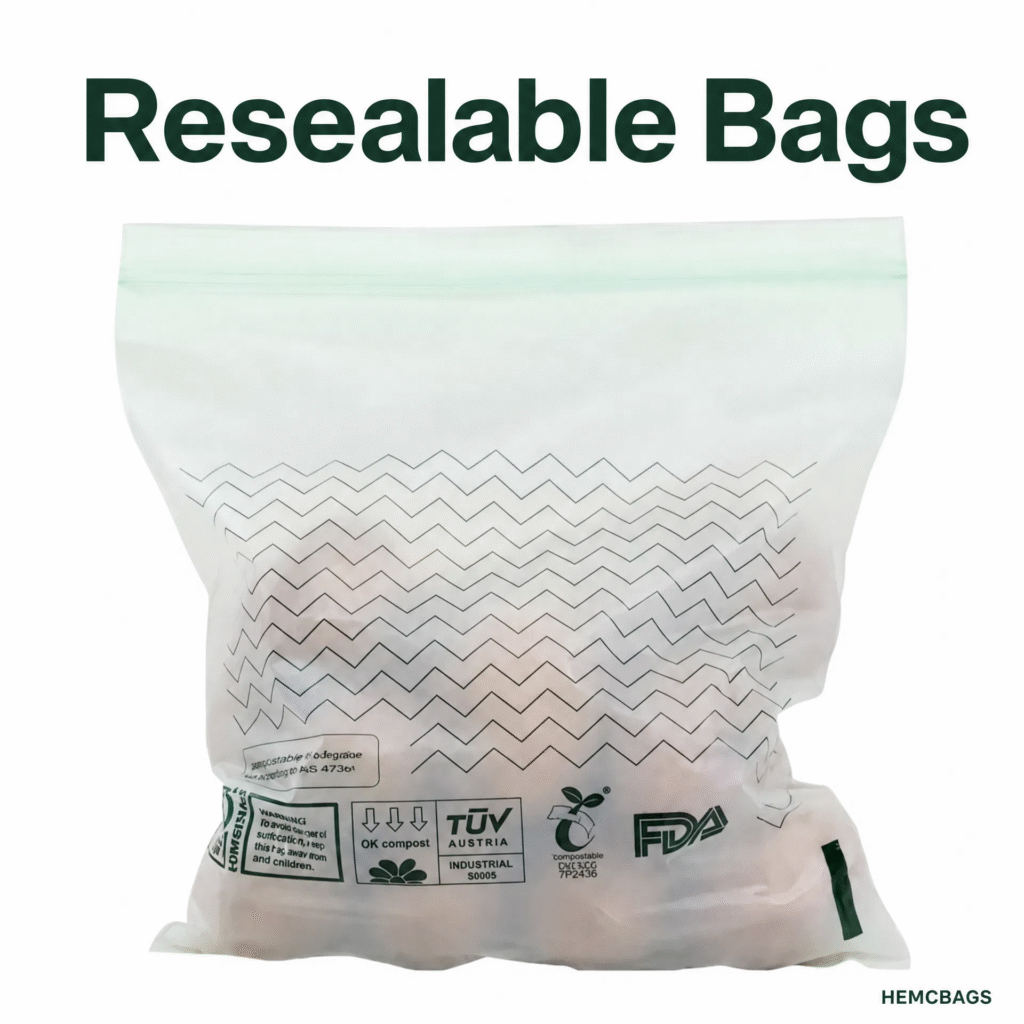
Resealable bags are packaging bags designed with an integrated closure that can be opened and closed multiple times without losing functionality. Common types include grip seal (press-to-close), slider zipper, and lip-and-tape designs. Sizes range from small sample bags (~3″ × 4″) to gallon-sized storage (~11″ × 11″), with custom dimensions available for B2B orders. Thickness varies from lightweight films (~1 mil) to heavy-duty bags (6+ mil), depending on the material and application.
Resealable bags are available in both conventional plastic (LDPE, LLDPE, HDPE, multilayer films) and compostable constructions (compostable polymer blends, e.g., PLA/PBAT). For B2B buyers, the key decision factors are not just size and thickness, but the specific combination of closure type, film material, seal strength, and how the bag will be used in your supply chain.
What Is a Resealable Bag?
A resealable bag is a flexible packaging bag with a closure that allows the package to be opened and closed repeatedly. Common closures include grip seals, zipper tracks, sliders, and adhesive lips. Resealable bags are used for food, apparel, electronics, small parts, cosmetics, and other products requiring repeated access.
Resealable vs. Single-Use Seal Bags

| Feature | Resealable Bags | Single-Use Seal Bags |
|---|---|---|
| Opening | Multiple times | Usually once |
| Closure | Zipper, grip seal, slider, etc. | Adhesive or heat seal |
| Best for | Repeated access | Tamper-evident / permanent sealing |
| Typical applications | Food, apparel, retail, small parts | Mailers, certain medical or sterile-packaging applications, when appropriately validated |
Terminology note: While Ziploc is a registered brand name, the generic terms are “resealable,” “reclosable,” or “zipper bag.” In B2B procurement, specifying the exact closure mechanism (e.g., “grip seal” or “slider zipper”) is more precise.
Resealable Bags vs. Zipper Bags: Terminology Clarified
“Resealable bag” is a broad category, while “zipper bag” generally refers to a bag using a zipper-style closure. A zipper bag can therefore be a type of resealable bag, but not every resealable bag uses a conventional zipper.
| Term | Meaning |
|---|---|
| Resealable bag | Broad category—any bag with a reusable closure |
| Reclosable bag | Common synonym for resealable |
| Grip seal bag | Press-to-close interlocking ridges |
| Zipper bag | Zipper-style closure (press-to-close or slider) |
| Slider bag | Zipper with a sliding tab |
| Ziploc | Brand/trademark (often used generically) |
Resealable Bag Sizes
Important: Consumer zipper-bag dimensions vary by brand. The figures below are common retail references, not standardized industry dimensions.
| Size Category | Approx. Dimensions (W × L) | Common Uses |
|---|---|---|
| Small | 3″ × 4″ – 4″ × 6″ | Jewelry, samples, small parts |
| Snack | ~6.4″ × 3.3″ | Snacks, accessories |
| Sandwich | ~6.7″ × 5.8″ | Food storage, craft items |
| Quart | ~7.8″ × 6.9″ | Larger portions, documents |
| Gallon | ~11″ × 11″ | Bulk storage, large apparel |
| Custom | Any dimensions | B2B/industrial applications |
How to Measure a Resealable Bag
Resealable bag dimensions are normally specified as width × length. For bags with a zipper or grip seal, the stated length may include the closure area, so the usable filling height can be smaller than the overall bag length. For custom orders, always confirm the fillable area with your manufacturer.
Resealable Bag Applications by Industry
| Application | Typical Bag Type | Key Requirement |
|---|---|---|
| Food packaging | Grip seal, slider zipper | Food-contact compliance, reliable closure |
| Apparel & textiles | Grip seal with hang hole | Clear film, retail display |
| Electronics | Anti-static / ESD bag | Electrostatic discharge control |
| Small parts/hardware | Heavy-duty grip seal | Puncture resistance |
| Cosmetics | Custom printed grip seal | Brand presentation |
| Documents/portfolios | Zipper / zip-closure | Premium appearance |
Materials: A Comparison for Buyers

The material determines performance, cost, and environmental profile. Actual performance depends on the specific thickness, formulation, processing conditions, and closure design, not solely on resin type.
| Material | Flexibility | Puncture Resistance | Tear Resistance | Moisture Barrier | Heat-Seal Behavior | Relative Cost | Typical Limitation | Typical Use |
|---|---|---|---|---|---|---|---|---|
| LDPE | High | Moderate | Moderate | Good | Broad window | Low | Lower strength than LLDPE | General purpose, food storage |
| LLDPE | High | Often higher than LDPE at comparable structure and thickness | Often higher than LDPE at comparable structure and thickness | Good | Moderate window | Medium | Higher cost | Heavy-duty, puncture resistance |
| HDPE | Low | Moderate | Low | Typically good, but structure-dependent | Narrow window | Low | Low flexibility, poor tear resistance | Cost-sensitive, lightweight |
| Multilayer Film | Varies | Varies | Varies | Can be high, depending on barrier layer | Varies | High | Higher cost, recycling challenges | Premium packaging, high barrier |
| Compostable (PLA/PBAT) | Moderate | Moderate | Moderate | Moderate | Formulation-dependent, often narrow window | High | Performance depends on formulation; requires certified conditions | Sustainability-focused applications |
Important Note on Performance and Cost Categories: The performance and cost categories above are indicative buying references, not universal specifications. Final selection should be based on supplier samples, agreed testing conditions, and the complete bag construction. All dimensions, thickness ranges, cost categories, and lead times in this guide are indicative references rather than universal industry specifications. Final requirements should be confirmed through supplier documentation and product-specific testing.
On Compostable Materials: Compostable bags are often made from PBAT (a biodegradable polyester) blended with PLA (derived from plant starches). A finished bag’s certification—not the raw material alone—determines if it is genuinely compostable. For a detailed breakdown of these materials, see our guide: PLA vs PBAT vs Cornstarch: Which Compostable Packaging Material Is Best?
Compostable Resealable Bags: What B2B Buyers Should Know
Compostable resealable bags are available, but they require the film, closure system, inks, adhesives, and other components to be evaluated as part of the finished product.
Compostable Resealable Bags vs. Conventional PE Zipper Bags
| Factor | Conventional PE | Compostable |
|---|---|---|
| Flexibility | Usually higher | Formulation-dependent |
| Puncture resistance | Generally strong | Formulation-dependent |
| Moisture barrier | Good | Structure-dependent |
| Repeated opening | Excellent | Closure-dependent |
| Industrial compostability | No | If certified |
| Home compostability | No | Only if specifically certified |
| Cost | Usually lower | Usually higher |
| Best fit | General-purpose storage | Sustainability-led packaging |
What Are Compostable Resealable Bags Made Of?
Compostable resealable bags are typically made from a combination of:
- PBAT: A biodegradable polyester that provides flexibility and toughness.
- PLA: A plant-based polymer (from corn or sugarcane) that adds stiffness and clarity.
- Starch-based components: Often used to increase bio-based content and adjust cost.
- Closure/zipper: May be made from the same or compatible compostable polymer blend.
- Inks and adhesives: Must be compatible with the certification requirements if the finished bag is marketed as compostable.
Are Compostable Resealable Bags as Strong as PE Bags?
Not necessarily. Performance depends on film formulation, thickness, closure design, seal strength, and application. A well-formulated compostable bag can perform well for many applications, but it is not automatically equivalent to LDPE or LLDPE in all respects. Buyers should test samples with their actual product before bulk ordering.
When Do Compostable Bags Make Sense?
| Application | Conventional PE | Compostable | Buyer Considerations |
|---|---|---|---|
| Retail apparel packaging | ✓ | ✓ | Compostable for brands with strong sustainability goals |
| Food contact / organics | ✓ | ✓ | Compostable preferred for food-waste diversion programs |
| Long-term industrial storage | ✓ | Depends | Conventional PE often more durable for extended storage |
| Heavy-duty repeated use | ✓ | Depends | Performance of compostable bags is formulation-dependent |
| Cost-sensitive, high-volume | ✓ | Less common | Conventional PE generally more cost-effective |
Standards, Certifications, and Labels: What’s the Difference?
Understanding the distinction between these concepts is critical for B2B buyers.
Standards
Standards define the technical requirements that a product must meet.
- ASTM D6400-23 is the current U.S. standard specification for labeling plastics designed to be composted in municipal and industrial aerobic composting facilities [1]. The standard covers plastics designed to compost under aerobic conditions where thermophilic conditions are achieved [1].
- EN 13432 is the European standard specifying requirements and procedures to determine packaging compostability by addressing four characteristics: biodegradability, disintegration during biological treatment, effect on the biological treatment process, and effect on the quality of the resulting compost [2].
Certifications
Certifications are third-party verification programs that assess whether a finished product meets these standards.
- BPI (Biodegradable Products Institute) operates a compostability certification program for finished products [3]. Its certification scheme evaluates requirements including disintegration, biodegradation, and ecotoxicity, together with other applicable certification criteria [3]. BPI also maintains a searchable directory of certified commercially compostable products [3].
- TÜV Austria (OK compost) provides certification programs that assess finished products against applicable compostability requirements [4a]. OK compost INDUSTRIAL is a certification scheme for products intended to biodegrade in industrial composting facilities; the applicable requirements and standards should be verified for the specific certified product and market [4b]. OK compost HOME certifies compostability at lower temperatures suitable for garden compost heaps [4a].
Labels
Labels are the claims made on packaging or marketing materials. Even with certification, labels must accurately reflect what is certified. For example, a BPI Commercial certification should not be labeled as “home compostable.”
Critical distinction: Industrial compostability certification (ASTM D6400 / EN 13432) does not mean the product will break down in a home compost bin, soil, or marine environment [1] [2] [4a] [4b]. Industrial composting requires sustained thermophilic conditions (55–60°C) that backyard systems cannot maintain [4b]. For a finished product claim, the certification or conformity assessment should cover the complete product as marketed, including relevant components such as the film, closure, inks, and adhesives, where applicable.
How to Choose the Right Resealable Bag
Choosing correctly means moving beyond “what size” to understanding your product and process.
- Define the product & load: Weight, sharpness, moisture sensitivity.
- Select the closure: For frequent consumer access, slider zipper; for cost-effective general use, grip seal; for flat items, lip & tape.
- Match material to performance & sustainability: LDPE/LLDPE for durability; compostable blends for certified sustainability.
- Specify thickness accurately: Use thickness ranges as references, not specifications. Always test with your actual product.
- Verify certifications: Food-contact, compostability, or ESD as required.
- Evaluate MOQ, setup costs & lead time: Custom resealable bags may require minimum order quantities depending on film structure, zipper type, printing method, and bag dimensions.
Resealable Bag Selection Matrix
| Use Case | Recommended Structure | Primary Reason | Must-Verify Criteria |
|---|---|---|---|
| Lightweight apparel | LDPE grip-seal bag | Flexible, transparent, cost-effective | Clarity, seal strength, display performance |
| Sharp small parts | LLDPE heavy-duty bag | Puncture and tear resistance | Drop test, puncture resistance, tensile strength |
| Frequent-open food packaging | Slider zipper structure | Convenience for repeated access | Closure reliability, food-contact compliance |
| Sustainable brand packaging | Certified compostable structure | Meets specific sustainability claims | Finished product certification, disposal conditions, strength |
| ESD-sensitive electronics | Anti-static / ESD bag | Controls electrostatic risk | Surface resistance, shielding properties, ESD documentation |
Anti-static, Static-Dissipative, and Shielding Bags: Not all ESD bags are the same. Buyers should verify which type is appropriate for their application:
| ESD Bag Type | Property to Verify |
|---|---|
| Anti-static bag | Surface resistance, triboelectric charging characteristics |
| Static-dissipative bag | Static dissipation performance, surface resistance range |
| Shielding bag | Shielding attenuation, surface resistance, grounding and closure method |
What Thickness Resealable Bag Do I Need?
Thickness (in mils) is a common question. However, these are general reference ranges, not performance guarantees. The right thickness depends on material, seal strength, and load.
| Thickness Range | Common Reference Use |
|---|---|
| 1–2 mil | Lightweight, short-term items |
| 2–4 mil | Standard retail, office, apparel |
| 4–6 mil | Heavy-duty, sharp parts |
| 6+ mil | Maximum puncture resistance |
For B2B buyers: Define your load, request samples of different thicknesses, and test them filled—not empty—under your actual packing and handling conditions.
How Are Resealable Bags Manufactured?
Understanding production quality points helps you evaluate suppliers. This is what a custom manufacturer focuses on:
| Stage | Key QC Check |
|---|---|
| Film extrusion | Uniform thickness |
| Corona treatment | Surface tension (dyne level) for print adhesion |
| Printing | Accurate color registration and ink adhesion |
| Zipper/closure insertion | Correct zipper alignment and seal strength |
| Heat sealing / bag forming | Seal strength and precise dimensions |
| Cutting | Cut accuracy |
| Dimensional inspection | Finished size consistency |
| Closure/seal testing | Opening/closing force, seal integrity |
| Packing | Correct count and packaging integrity |
A bag that passes an empty-bag inspection may still fail when filled with the customer’s actual product. Therefore, filled-bag testing is a critical step before bulk approval.
Supplier Sample Evaluation Checklist
Use this checklist to evaluate supplier samples before bulk approval. The test conditions and acceptance criteria should be agreed by the buyer and supplier before sampling, because requirements vary by product weight, drop height, transport mode, and storage environment.
| Test Item | Recommended Approach |
|---|---|
| Closure durability | Open and close the bag at the intended usage frequency. Document the force profile and any deterioration in sealing performance |
| Filled drop test | Drop bags filled with the actual product from a buyer-supplier agreed height. For illustration only, a project may use 24–48 inches depending on the handling and transport environment; this range is not a universal industry requirement |
| Leak test | Check closure and heat-seal edges for leakage. For liquid or powder applications, use an agreed test method (e.g., water immersion or dye penetration) |
| Puncture test | Test with the actual sharp or abrasive product to be packed. Document whether penetration occurs |
| Seal strength | Request the supplier’s test method and acceptance criteria. For heat-sealed bags, ASTM F88/F88M is a recognized reference [5] |
| Dimensional inspection | Verify finished dimensions, opening size, and usable fill height against the agreed specification |
| Print adhesion | Test under friction, tape, or actual transport conditions. For flexible packaging, ASTM F2252/F2252M is a recognized reference [6] |
Common Resealable Bag Problems: Supplier Perspective
Here are common issues and their root causes from a manufacturing viewpoint:
| Problem | Likely Cause in Production |
|---|---|
| Bag doesn’t stay closed | Zipper profile damaged, contamination in track, or improper sealing pressure during manufacture |
| Tears near the zipper | Film too thin for the load, poor seal strength between film and zipper, or stress concentration at the zipper’s end |
| Zipper difficult to open | Excessive closure force from tight dimensions, stiff film material, or zipper profile design |
| Bag leaks | Zipper not fully engaged, contamination in closure, poor zipper-to-film seal, unsuitable closure design, or excessive internal pressure |
For B2B Buyers: If you encounter these problems, communicate the specific issue to your supplier. An experienced manufacturer should diagnose the root cause and suggest a material or design adjustment.
What Specifications Should You Send to a Manufacturer?

To get an accurate quote, use this checklist:
| Specification | Example |
|---|---|
| Bag type | Grip seal / Slider zipper / Zipper |
| Finished size (W × L) | 200 × 300 mm |
| Material | LDPE / Compostable blend |
| Thickness | 50 microns / 2 mil |
| Closure | Press-to-close / Slider track |
| Closure position | Top / Side / Custom |
| Printing | 2 colors, 1 side |
| Seal type | Heat seal / Zipper seal / Bottom seal |
| Packaging | 100 pcs/bag, 10 bags/carton |
| Certification required | EN 13432 / FDA food-grade |
| Special performance requirements | Food contact / ESD / Moisture resistance / Puncture resistance |
| Target market | EU / US |
| Estimated quantity | 50,000 pcs |
Printing Note: In many flexible-packaging projects, flexographic printing is considered for simpler artwork and gravure printing for higher-volume work requiring fine detail; the appropriate process depends on artwork, run length, film structure, and supplier capability.
Custom Resealable Bags for Businesses
HEMCbags offers custom resealable bags in selected sizes, film structures, closure types, thicknesses, and printing options. Sample availability, MOQ, and production timing depend on the final specification and should be confirmed during quotation.
Sampling & Lead Times (Typical Estimates, Subject to Confirmation):
- Samples: ~7 days, depending on specification and current production schedule
- Bulk production: 15–20 days after sample approval, depending on order quantity and material availability
- MOQ: Varies by specification; trial orders may be available
FAQ
What is the difference between a zipper bag and a resealable bag?
“Resealable bag” is the broader category. A “zipper bag” uses a zipper-style closure and is one type of resealable bag. Other types include grip seal, slider, and lip-and-tape closures.
What are resealable bags called?
Resealable bags are also called reclosable bags, zipper bags, grip seal bags, or slider bags, depending on the closure mechanism. “Resealable bag” is the broader term, while zipper bag usually refers to a bag with a zipper-style closure.
What is the best alternative to Ziploc bags?
The best alternative depends on the application. Grip-seal bags are a cost-effective option for general storage, slider bags are convenient for frequent opening, and certified compostable resealable bags may be suitable for brands seeking an alternative to conventional polyethylene packaging.
Where can businesses buy custom resealable bags?
Businesses can purchase custom resealable bags directly from packaging manufacturers or specialist flexible-packaging suppliers. Buyers should provide the required dimensions, material, thickness, closure type, printing requirements, application, and estimated quantity when requesting a quotation.
Can compostable resealable bags replace plastic zipper bags?
In some applications, yes. However, performance depends on the specific bag construction. Compostable bags may not match LDPE/LLDPE in all performance aspects (e.g., puncture resistance, moisture barrier, shelf life). Testing with the actual product is recommended.
How do I test resealable bag quality before placing a bulk order?
Request samples and test them under your actual packing and handling conditions—filled, not empty. Use the Supplier Sample Evaluation Checklist above for closure durability, filled drop tests, leak tests, puncture tests, and seal strength. The test conditions and acceptance criteria should be agreed with the supplier before testing.
Are compostable resealable bags really compostable?
Only if the finished product meets the applicable standard and is supported by a valid certification or conformity assessment for the marketed configuration, such as ASTM D6400-23 or EN 13432 together with a relevant certification scheme such as BPI, OK compost INDUSTRIAL, or OK compost HOME. Industrial certification does not guarantee home compostability [4a] [4b]. Certification must cover the complete bag, including closures, inks, and adhesives, not just the raw material.
Are resealable bags suitable for food packaging?
Yes, when manufactured from food-contact compliant materials and with appropriate closures. For food-contact applications, buyers should request a declaration of compliance and supporting migration or compliance documentation applicable to the intended food type, contact time, and temperature. FDA 21 CFR and EU Regulation (EC) No 1935/2004 may be relevant [7] [8], but the applicable requirements depend on the complete packaging construction and market.
Can resealable bags be airtight?
They can provide good sealing, but they are not automatically airtight. The level of air/gas barrier depends on the film material, seal design, and closure construction. For oxygen-sensitive products, consider oxygen transmission rate (OTR), moisture vapor transmission rate (WVTR), leak rate, and actual shelf-life testing.
What thickness resealable bag do I need?
Thickness depends on the load, material, and application. Lightweight items (1–2 mil); standard retail (2–4 mil); heavy-duty (4–6+ mil). Always test with your actual product.
Request a Custom Resealable Bag Quote
Send us your target size, material, thickness, closure type, printing requirements, application, and estimated quantity. We can review the specification and recommend a suitable bag structure for sampling.
Send us your requirements to discuss a custom resealable bag for your application.
References
[3] BPI Compostability Certification: Commercial and Home Certification Programs
[4a] TÜV Austria OK compost HOME Certification
[4b] TÜV Austria OK compost INDUSTRIAL Certification
[5] ASTM F88/F88M-23: Standard Test Method for Seal Strength of Flexible Barrier Materials
[8] Regulation (EC) No 1935/2004 on Materials and Articles Intended to Come into Contact with Food
Written by: HEMCbags Packaging Materials Team
Technical Review: Packaging Compliance Team