
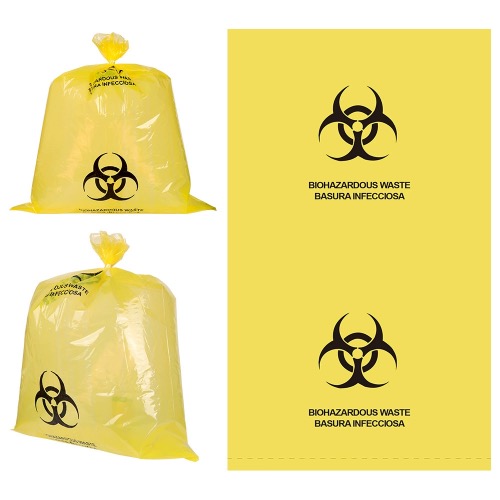
Quick Summary (TL;DR): As global healthcare pivots toward sustainability, I explore how custom biohazard waste bags are bridging the gap between clinical safety and 2026 carbon-neutral mandates. This guide covers international color-coding, sterilization compatibility (EO/Gamma), and how to verify BPI/TÜV certifications for your facility.
I have spent years observing the waste streams of modern hospitals. In the high-pressure environment of a surgical ward or a diagnostic lab, a custom biohazard waste bag is more than just a yellow or red plastic film. It is a critical safety barrier. But as I look at the mountain of persistent plastic we generate every day, I realized that the traditional “incinerate and forget” model is failing our environment.
The real challenge I faced wasn’t just finding a compostable medical waste bag that breaks down; it was engineering a containment system that stands up to clinical rigor while leaving no trace in the soil.
The Sterilization Paradox: Where I See Most Biodegradable Biohazard Bags Fail
One of the most frequent questions I get asked is about sterilization. It’s a paradox: how can a material designed to be “fragile” enough for a compost pile be “tough” enough for a medical autoclave?
In my experience, this is where most standard biodegradable biohazard bags fail. If a bag warps during Ethylene Oxide (EO) processing or becomes brittle after Gamma Radiation, it is a liability. I’ve focused on developing formulations that maintain their molecular integrity through these harsh processes. The goal I strive for is simple: Stability in the ward, fragility in the soil.
6 Color-Coded Standards for Custom Biohazard Waste Bags Safety
I’ve always believed that segregation is our first line of defense. In a clinical setting, a bag’s color must be a guarantee. When I design custom biohazard bags, I adhere to the strict international color-coding that I know procurement managers rely on to manage biomedical waste safely and hygienically.
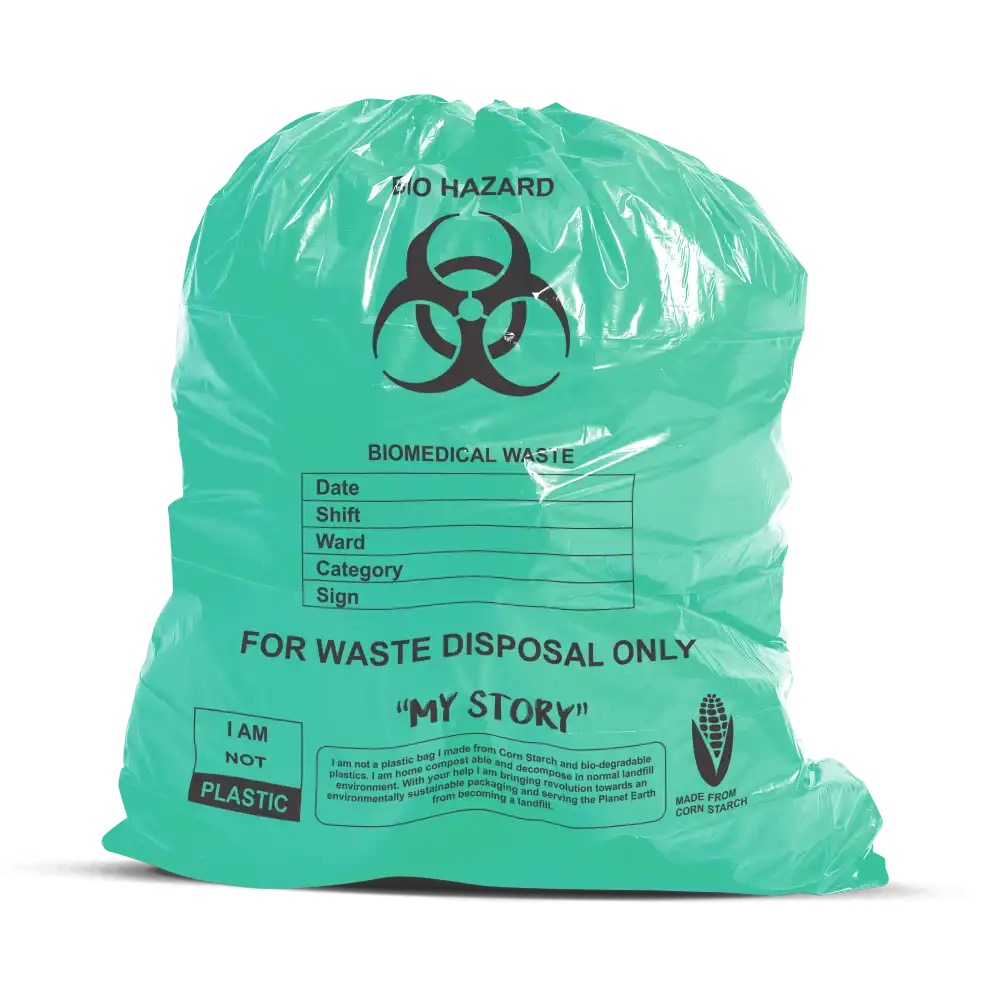
To streamline waste management and reduce infection risks, I follow this comprehensive color-coding system:
| Bag Color | Waste Category | Common Items for Disposal |
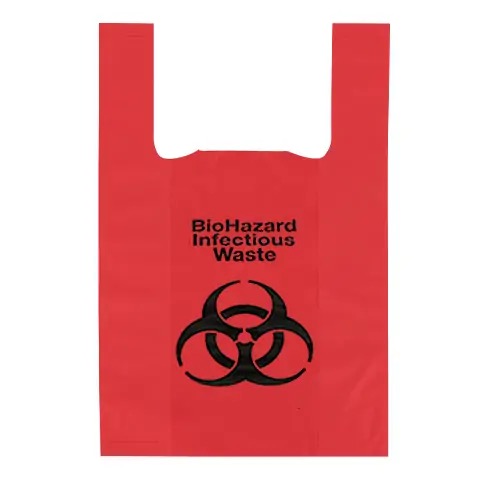
| Yellow Bags | Contaminated Non-Sharps | Body fluid-contaminated paper/cloth, cotton waste, face masks, caps, infectious dressings, and bedding. |
| Red Bags | Infectious Waste | Syringes (without needles), urine bags, catheters, dialysis kits, gloves, and goggles. |
| Black Bags | Hazardous & Chemical | Expired medicine, radioactive waste, anatomical waste, discarded medications, and chemotherapy waste. |
| Blue Bags | Sharps & Glass | Glass bottles, lab slides, scissors, infectious vials, and metallic body implants. |
| White Bags | Sharp Instruments | Needles, lancets, scalpel blades, and broken glass slides. |
| Green Bags | General Waste | Tissue paper, disposable paper cups, office stationery, disposed mail, and water bottles. |
By following these guidelines, healthcare facilities can effectively manage their biomedical waste, minimize environmental impact, and ensure 100% compliance with safety protocols.
Tailored Solutions for Your Specific Needs
I understand that “one size fits all” doesn’t work in a medical setting. That’s why I focus on providing tailored solutions to match your unique requirements. Whether you are managing a large-scale hospital network or a specialized laboratory, you can customize your compostable medical waste bags to optimize your specific waste management process:

•Versatile Options: Choose from various bag types (flat-top, wave-top, vest handle, or drawstring closure), sizes, and thicknesses to ensure the perfect fit for your containers.
•Branding & Professionalism: I can print your logo and brand identifiers on every bag using eco-friendly inks. This not only enhances your brand image but also communicates your facility’s commitment to sustainability to every staff member and patient.
•Precision Manufacturing: From 15 to 100+ microns, I ensure each bag has the puncture resistance and leak-proof performance required for high-risk clinical waste.
The Transparency of a License Number
I am often skeptical of vague “eco-friendly” claims. In this industry, I’ve learned that a logo on a bag is just a promise, but a License Number is a fact.
Whether it’s the disintegration windows of TÜV Austria or the biodegradation standards of BPI (ASTM D6400), I always tell my partners to look for the verifiable data. If I can’t trace a bag back to its certified resin source, I won’t use it. For me, transparency is the ultimate risk-mitigation strategy.
As global regulations like the EU’s Packaging and Packaging Waste Regulation (PPWR) and California’s SB 54 take full effect, having a partner who understands certified compostable standards is more critical than ever.
Frequently Asked Questions (FAQ)
1. Are compostable biohazard bags as strong as traditional plastic?
Yes. I use high-performance PLA and PBAT blends that offer superior tensile strength and puncture resistance. Our bags are specifically engineered to handle wet clinical waste without leaking or tearing during transport.
2. Can these bags be sterilized in an autoclave?
While compostable materials are designed to break down, I offer specialized formulations that are compatible with Ethylene Oxide (EO) and Gamma Radiation sterilization. For steam autoclaving, I recommend testing specific thicknesses to ensure integrity.
3. How do I verify if a biohazard bag is truly compostable?
Always look for a valid License Number from BPI or TÜV Austria printed on the bag. You can verify these numbers on their respective official databases to ensure the product meets ASTM D6400 or EN 13432 standards.
My Vision for Circular Healthcare
The transition to compostable biohazard containment is more than a material swap. It’s a shift in how we view the lifecycle of medical supplies. I view every medical bag as a technical instrument—one that must be leak-proof, puncture-resistant, and compatible with existing hospital workflows, while offering a clear, certified path to carbon-neutral disposal.
I don’t just want to help save lives today; I want to ensure the environment we leave behind is healthy enough to sustain life tomorrow.
Technical Specifications (My Capabilities)
•Material: High-integrity PLA/PBAT/Starch blends.
•Compliance: Certified to EN 13432, ASTM D6400, and AS 4736.
•Wholesale Availability: I offer biohazard waste bags wholesale with flexible MOQ and global shipping capabilities.
I invite you to explore the technical data or request a clinical-grade sample kit directly from me.