
Introduction
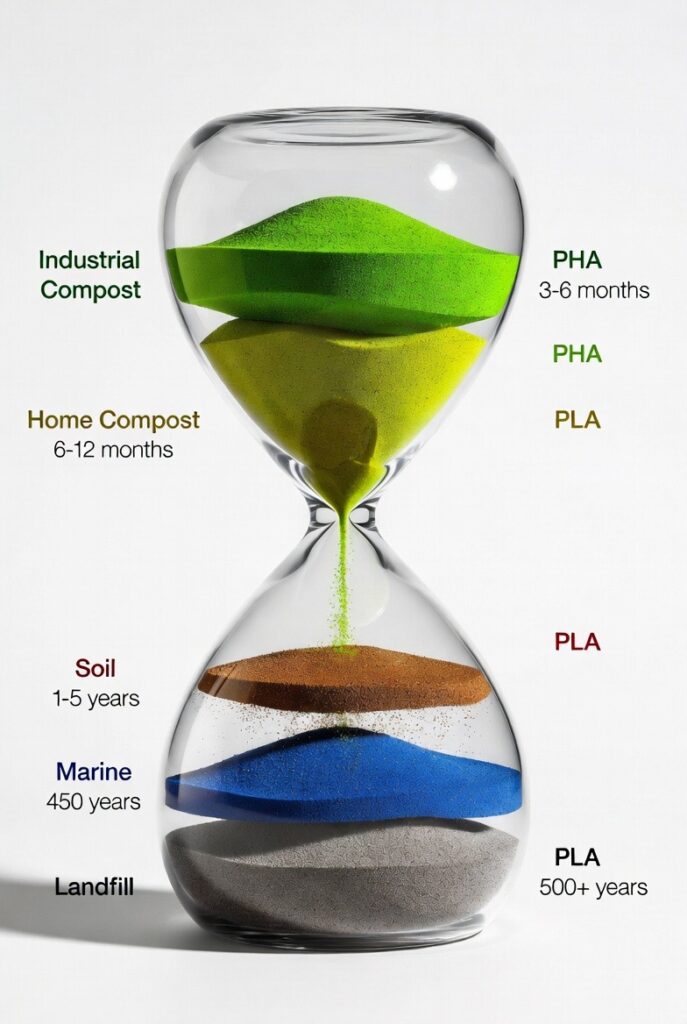
How long does biodegradable plastic take to decompose? This question sits at the heart of the global shift toward sustainable materials, yet the answer is far more complex than most consumers realize. By 2026, the global market for biodegradable plastics had expanded significantly, driven by tightening regulations and growing environmental awareness. But a fundamental gap persists between marketing promises and scientific reality: a material labeled “biodegradable” can break down in 90 days under one set of conditions, yet persist for years—or even decades—in another.
The decomposition timeline for biodegradable plastics is not a fixed number printed on a package. It depends almost entirely on where the material ends up and what conditions prevail there. Industrial composting facilities, home compost piles, garden soil, ocean water, and landfills each represent radically different environments, and a material that performs admirably in one may fail completely in another.
Short Answer: Biodegradable plastic decomposition time ranges from 90 days in industrial compost to over 100 years in marine environments or landfills, depending entirely on material type (PHA, PLA, or starch-based) and disposal conditions.
🎬 Is Biodegradable Plastic Actually Possible?
PBS explores the chemistry behind biodegradable plastics — and whether they truly break down.
Watch on PBS →This article provides a comprehensive, evidence-based analysis of biodegradable plastic decomposition time across five distinct environments. We examine the scientific mechanisms driving breakdown, the critical role of temperature and microbial communities, the specific PLA degradation timeline compared to other materials, and the often-overlooked biodegradable plastic problems that arise when disposal infrastructure fails to match material design. Whether you are a consumer seeking the best compostable bags for your kitchen, a business evaluating packaging options, or simply someone who wants to understand what “biodegradable” actually means, this guide will equip you with the knowledge to make informed decisions.
Understanding Key Terms: Biodegradable vs. Compostable
Before exploring specific timelines, clarifying the terminology is essential. Much of the confusion surrounding biodegradable plastic decomposition time stems from the loose, often interchangeable use of terms that have distinct scientific and regulatory meanings.
Biodegradable: A Conditional Promise
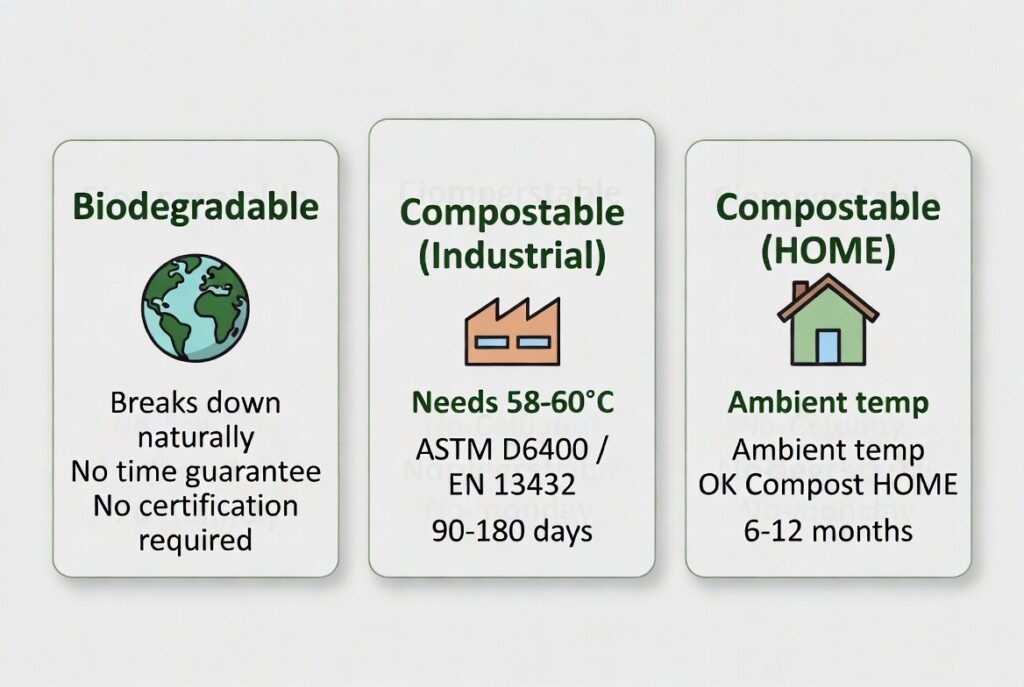
In scientific terms, a material is biodegradable if microorganisms—bacteria, fungi, and actinomycetes—can metabolize it into water, carbon dioxide (or methane under anaerobic conditions), and biomass. This definition contains a crucial nuance that is often omitted from marketing claims: biodegradation requires specific environmental conditions. Temperature, moisture, oxygen availability, and the presence of specialized microbial communities all determine whether—and how quickly—the process occurs.
Think of an apple core left on a grassy lawn. Given time, warmth, and moisture, it will appear to disappear completely, digested by microorganisms. That same apple core, if frozen in a glacier or buried deep in an arid landfill devoid of microbial activity, could remain recognizable for years. The same principle applies to biodegradable plastics, but the range of suitable conditions is far narrower. This gap between expectation and reality is one of the most significant biodegradable plastic problems facing consumers and policymakers alike.
Compostable: Certified and Regulated
Composting is essentially biodegradation accelerated and controlled by human intervention. What distinguishes “compostable” from merely “biodegradable” is certification—independent, third-party verification that a material meets specific, measurable performance standards under defined conditions.
The two most widely recognized standards globally are:
- EN 13432 (European Union): A material must biodegrade by at least 90% within 180 days under aerobic conditions, and disintegrate into fragments smaller than 2 mm within 12 weeks when in contact with organic waste.
- ASTM D6400 (North America): Applies to plastics designed for aerobic composting in municipal or industrial facilities, with requirements functionally equivalent to EN 13432.
These certification timeframes provide the first concrete answer to the decomposition question: certified industrially compostable plastics are engineered to break down within 90 to 180 days under controlled industrial composting conditions. However, as we will see, these numbers apply only in one specific environment.
Home Compostable: A Different Standard
Recognizing that most households lack access to industrial composting facilities, certification programs like TÜV Austria’s OK Compost HOME establish separate standards. Certified home compostable bioplastics are designed to disintegrate within 12 weeks and fully biodegrade within 6 to 12 months under the lower, more variable temperatures characteristic of backyard compost piles.
Critically, materials certified for industrial composting are not guaranteed to break down in a home compost bin. This distinction is vital for anyone searching for the best compostable bags for household use—a certification that works for municipal collection may fail entirely in a backyard pile. What Are the Certification Standards for Home Compostable Bioplastics?
How Long Does Biodegradable Plastic Take to Decompose by Environment?
The single most important variable determining how long biodegradable plastic takes to decompose is the environment in which it is disposed. The following analysis examines five distinct scenarios, with performance varying by orders of magnitude between them.
At a Glance: Decomposition Time by Environment
- Industrial Composting Facilities: 3–6 months for certified materials
- Home Compost Piles: 6–12 months for optimized materials; PLA may not fully degrade
- Soil Environments: PHA 3–18 months; PLA 1–5 years
- Marine Environments: PHA 3–24 months; PLA decades to >100 years
- Landfills: Decades to centuries; produces methane when degradation occurs
Industrial Composting Facilities: The Gold Standard
Industrial composting represents the optimal environment for most biodegradable plastics. These facilities maintain sustained high temperatures (58–60°C), elevated humidity, controlled oxygen flow, and a carefully balanced carbon-to-nitrogen ratio that supports dense, active microbial communities.
Under these conditions, decomposition occurs rapidly across all major material types:
- PHA (Polyhydroxyalkanoates) : 1–6 months. PHA is particularly responsive to thermophilic conditions, achieving over 90% mineralization within 90 days for many formulations.
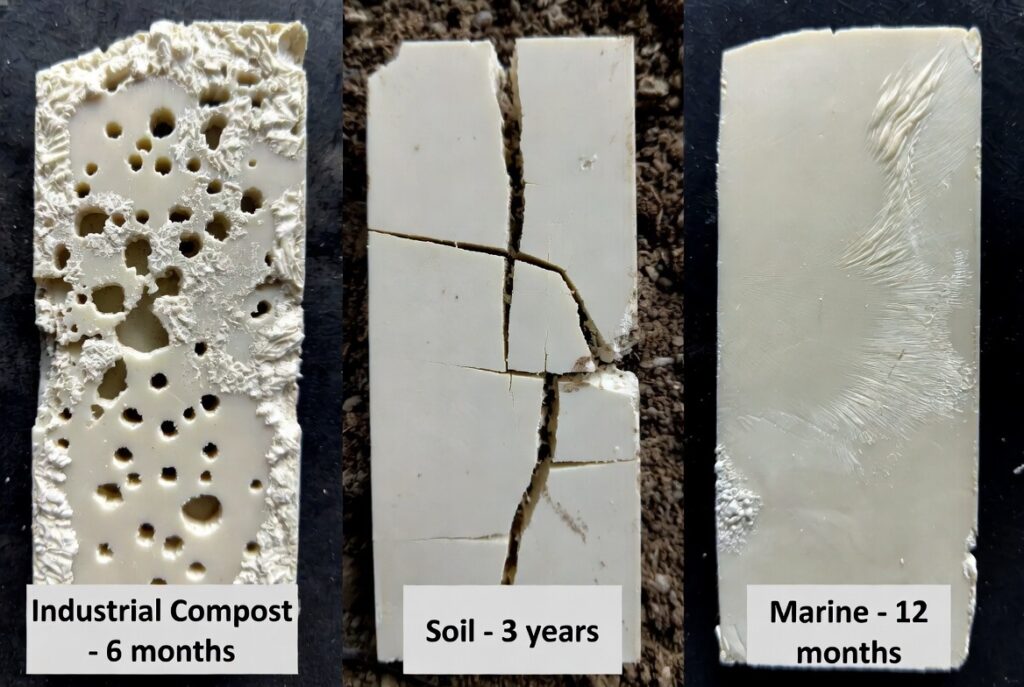
- PLA (Polylactic Acid) : 3–12 months. The PLA degradation timeline in industrial composting is well-documented: at 58–60°C, it achieves over 90% mineralization within 90 days, meeting ASTM D6400 standards.
- Starch-based plastics: 1–6 months. These materials, often blended with other biopolymers, degrade efficiently under thermophilic conditions.
A 2024 study investigating decomposition of biodegradable plastic bags at an industrial composting plant within a practically realistic timeframe of 6 weeks found that properly certified materials can achieve significant disintegration even within these shorter operational windows, though full biodegradation typically requires the full 12-week period specified by standards.
Key takeaway: In industrial composting, certified compostable plastics reliably decompose within 3–6 months.
Home Compost Piles: Slower and Less Reliable
Home compost piles operate at ambient temperatures, typically 20–30°C, with fluctuating moisture levels and less controlled microbial populations. These conditions significantly extend biodegradable plastic decomposition time and, for some materials, prevent complete breakdown altogether.
PHA: Performs well in home composting, degrading in 3–12 months due to its susceptibility to enzymatic attack by a wide range of naturally occurring bacteria and fungi.
Starch-based plastics: Many formulations degrade in 3–12 months in home compost settings, though performance depends heavily on specific blend composition.
PLA: Degrades slowly or incompletely in home compost conditions. The PLA degradation timeline in ambient home compost extends well beyond one year, and many products show minimal visible change after 12 months. PLA’s crystalline structure requires sustained elevated temperatures to initiate the hydrolysis process that precedes microbial digestion; without this thermal trigger, PLA can persist for well over a year.
Certified home compostable products: Materials bearing OK Compost HOME certification are specifically engineered for these conditions, targeting disintegration within 12 weeks and full biodegradation within 6–12 months.
Key takeaway: Home composting extends decomposition times to 6–12 months for optimized materials, and may fail entirely for industrial-only certified products.
Soil Environments: The PHA Advantage
Soil presents a more challenging environment than managed compost, with lower temperatures, less consistent moisture, and sparser—though still significant—microbial populations. Performance diverges sharply by material type.
PHA: Demonstrates superior soil degradation, with 90% breakdown often occurring within 200 days (approximately 6–7 months). Full degradation typically ranges from 3–18 months depending on soil temperature, moisture, and microbial density. PHA’s molecular structure resembles natural polyesters like plant cutin, enabling broad microbial recognition across diverse soil ecosystems.
Starch-based plastics: Degrade in 6–24 months in soil environments, with pure starch components breaking down quickly but blended polymers extending the overall timeline.
PLA: Degrades very slowly in ambient soil. The PLA degradation timeline in uncontrolled soil conditions typically requires 1–5 years, as PLA’s crystalline structure limits microbial access without sufficient thermal energy. Mass loss after 180 days at typical soil temperatures is approximately only 16%. Chinese researchers have demonstrated that incorporating cultured diatom shells can accelerate PLA soil degradation from 24 months to as little as 3 months, but this requires material modification rather than standard PLA formulations.
Key takeaway: In soil, PHA degrades in under a year; PLA may persist for multiple years; starch-based materials fall in between.
Marine Environments: Where the Gap Widens Dramatically
Marine settings—oceans, seas, and coastal waters—represent the most challenging environment for biodegradable plastics. Cold temperatures (typically well below 20°C in most ocean waters), high salinity, and sparse microbial communities combine to dramatically slow biodegradable plastic decomposition time. This is where many of the most serious biodegradable plastic problems emerge, as materials designed for terrestrial composting enter aquatic ecosystems with vastly different characteristics.
PHA: The strongest performer in marine environments, with degradation times of 3–24 months. PHA degrades at measured rates of 0.04–0.09 mg per day per square centimeter in marine settings, allowing a standard bottle to mineralize fully in 1.5–3.5 years. Certain formulations achieve 80–90% breakdown within weeks under optimal marine conditions. Recent field research confirmed that PHBV (a common PHA copolymer) fully degraded at all test sites within a 51-week timeframe.
PBAT (Polybutylene Adipate Terephthalate) : Marine degradation rates for PBAT have been measured at approximately 89 μm per month, placing it in an intermediate performance category—faster than PLA but slower than PCL in coastal environments.
Starch-based plastics: Moderate marine performance, with degradation ranging from 6–36 months depending on blend composition and water temperature.
PLA: Demonstrates minimal to no degradation in marine environments. A Greek study found that after 12 months in seawater, PLA lost only 0.23% of its mass—essentially no meaningful degradation. Other research confirms that PLA shows non-significant degradation even after 365 days in seawater at 25°C. Under typical ocean conditions, the PLA degradation timeline may extend for decades or even centuries, effectively behaving like conventional plastic in marine settings.
Key takeaway: Marine environments expose the limits of “biodegradable” claims. PHA degrades within months to a few years; PLA may last longer than a human lifetime.
Landfills: The Worst-Case Scenario
Despite marketing claims that suggest otherwise, landfills are among the worst possible environments for biodegradable plastics. Modern sanitary landfills are designed to minimize decomposition of all materials—a deliberate engineering choice to prevent groundwater contamination, control methane emissions, and maintain structural stability. Evaluation of bioplastics biodegradation under simulated landfill conditions.
Key factors inhibiting biodegradation in landfills include:
- Anaerobic conditions: Oxygen is severely limited, forcing any biodegradation that does occur into anaerobic pathways that are far slower and produce methane rather than CO₂.
- Low microbial activity: The dense compaction and limited moisture of landfills suppress the microbial communities necessary for polymer breakdown.
- Temperature limitations: Landfills lack the elevated temperatures that drive rapid biodegradation in composting systems.
Under anaerobic landfill conditions, PLA shows minimal biodegradation—approximately 11%—with correspondingly low methane yields. Cellulose-based bioplastics perform better anaerobically, achieving higher methane yields and near-complete degradation, but this still occurs far more slowly than aerobic composting.
Crucially: Even when biodegradable plastics do break down in landfills, the primary end product under anaerobic conditions is methane—a greenhouse gas with approximately 25 times the global warming potential of carbon dioxide over a 100-year period. Unless landfill gas capture systems are in place and functioning, this methane escapes directly to the atmosphere. This is one of the most overlooked biodegradable plastic problems: a material marketed as environmentally friendly may contribute to climate change when disposed of improperly.
Key takeaway: Biodegradable plastics in landfills may persist for decades to centuries, and when they do degrade, they produce methane rather than benign CO₂.
Material-Specific Performance Summary
The following table synthesizes decomposition timeframes across the three most common biodegradable plastic types and five environmental scenarios, based on peer-reviewed research and certification standards.
Table: Biodegradable Plastic Decomposition Time by Environment and Material Type
| Material | Industrial Compost | Home Compost | Soil | Marine | Landfill |
|---|---|---|---|---|---|
| PHA | 1–6 months | 3–12 months | 3–18 months | 3–24 months | Years to decades |
| PLA | 3–12 months | Incomplete / >1 year | 1–5 years | Decades / >100 years | Decades to centuries |
| Starch-based | 1–6 months | 3–12 months | 6–24 months | 6–36 months | Years to decades |
Timelines are approximate and vary based on specific formulations, additive packages, material thickness, and precise environmental conditions.
Material Selection Implications
The dramatic performance differences across environments have practical implications for anyone seeking the best compostable bags or other biodegradable products:
- PHA provides the broadest degradation across environments, making it suitable for applications where the disposal pathway is uncertain—agricultural films, marine gear, products likely to be littered.
- PLA performs effectively in controlled industrial composting systems but offers limited advantages over conventional plastic in uncontrolled natural settings. It is best suited for applications with guaranteed access to industrial composting infrastructure, such as food service ware in municipalities with organics collection programs.
- Starch-based plastics balance cost and performance, with outcomes heavily dependent on blend composition. Many commercial products combine starch with PBAT or PLA to achieve specific mechanical and degradation profiles.
The Plymouth Study: A Landmark Reality Check
Perhaps the most influential real-world study on biodegradable plastic decomposition time was published by researchers at the University of Plymouth. Over a three-year period, scientists tested five types of plastic bags—including conventional polyethylene, oxo-biodegradable formulations, bags labeled “biodegradable,” and a bag certified compostable to EN 13432—exposed to air, soil, and marine environments.
The findings were sobering and exposed significant biodegradable plastic problems:
- Open air exposure: After nine months, all materials had disintegrated into fragments due to UV radiation and weathering. This fragmentation, however, produces microplastics rather than true biological assimilation.
- Soil burial: The biodegradable, oxo-biodegradable, and conventional plastic bags remained functional as carrier bags after more than three years in soil—they could still hold shopping. A photograph from the study showed a bag submerged in soil for three years still capable of carrying groceries.
- Marine environment: The compostable bag completely disappeared from the experimental test rig in the marine environment within three months. However, it was still present in soil after 27 months, showing only some signs of deterioration.
Lead researcher Imogen Napper expressed surprise that a bag labeled biodegradable could remain functional after three years in soil: “When you see something labelled in that way, I think you automatically assume it will degrade more quickly than conventional bags. But after three years at least, our research shows that might not be the case.”
The study sparked significant debate. European Bioplastics argued that only the compostable bag was actually certified biodegradable, and only under industrial composting conditions for which it was not tested. This rebuttal underscores a critical point: the study did not test materials in the environments for which they were designed. Nevertheless, it revealed the dangerous gap between consumer expectations—that “biodegradable” means “will disappear quickly if littered”—and the scientific reality.
Factors That Govern Decomposition Speed
Why does the same material decompose in 90 days in one setting yet persist for years in another? Understanding these factors is essential for predicting biodegradable plastic decomposition time in real-world scenarios.
Temperature: The Primary Accelerator
Temperature is arguably the single most important variable governing biodegradation rate. Higher temperatures accelerate microbial metabolic rates and enzymatic activity, dramatically speeding decomposition. The optimal temperature range for most degrading microorganisms is 20–35°C, but industrial composting pushes conditions to 55–60°C—temperatures that thermophilic bacteria thrive in but which never occur naturally in soil or marine settings.
This explains the PLA degradation timeline disparity: 3–12 months in industrial compost versus 1–5 years in soil and effectively never in cold ocean water. PLA’s hydrolysis mechanism simply cannot initiate efficiently without sustained elevated heat.
Moisture: The Essential Medium
Water is essential for microbial metabolism and for the hydrolysis reactions that initiate degradation in materials like PLA. Adequate moisture—typically 40–60% relative humidity or higher in composting contexts—supports the movement of enzymes, the dissolution of nutrients, and the proliferation of microbial colonies.
In arid soil or the deep ocean, where moisture is either too scarce or present in a form that limits microbial access (high salinity), biodegradation rates plummet accordingly.
Microbial Communities: The Invisible Workforce
The density, diversity, and specialization of microbial populations vary enormously across environments. Soil typically has a much higher concentration and diversity of microorganisms capable of degrading plastics compared to aquatic environments.
At the heart of bioplastic breakdown lies the activity of specialized enzymes produced by bacteria and fungi. These enzymes act as molecular scissors, cleaving long polymer chains into smaller, digestible fragments. Different materials require different enzymatic toolkits: PHA’s structure is recognized by a wide range of naturally occurring microbes, enabling degradation across diverse settings; PLA requires more specialized microbial consortia that are abundant primarily in thermophilic compost.
Oxygen Availability: Aerobic vs. Anaerobic
Oxygen availability fundamentally changes both the speed and the end products of biodegradation. Aerobic decomposition (with oxygen) proceeds faster and produces primarily carbon dioxide and water. Anaerobic decomposition (without oxygen) is slower and produces methane, a potent greenhouse gas.
This distinction is critical for understanding landfill performance—one of the key biodegradable plastic problems that undermines the environmental benefits of these materials when disposal infrastructure fails.
pH and Nutrient Balance
Most degrading microorganisms exhibit optimal activity in neutral to weakly alkaline environments (pH 7–8). Strongly acidic or highly alkaline conditions suppress microbial metabolism and slow degradation. Additionally, the balance of carbon to nitrogen in the surrounding environment influences microbial growth; too little nitrogen starves the decomposer community, while excess nitrogen can lead to ammonia toxicity.
The Microplastic Concern
An often-overlooked dimension of the biodegradable plastic decomposition time is what happens during the degradation process. When a material takes years to fully mineralize, what is its physical state in the interim?
The answer, particularly for slower-degrading materials like PLA in marine or soil environments, is concerning. PLA often fragments into microplastic particles before achieving complete mineralization. These particles—typically smaller than 5 mm—can persist in the environment, enter food chains, and cause ecological harm in the same ways that conventional microplastics do.
In contrast, PHA mineralizes without such persistent residues, aligning with natural degradation patterns and reducing harm to ecosystems. This distinction is critical: a material that takes 5 years to disappear but remains as intact macroplastic for most of that period poses different risks than a material that fragments into microscopic particles within months.
This issue highlights one of the most significant biodegradable plastic problems: when these materials enter environments for which they were not designed—particularly oceans—the risk of microplastic generation becomes a significant, underappreciated concern.
Greenwashing: When Marketing Outpaces Science
The gap between consumer expectations and material performance has created fertile ground for misleading marketing. Common phrases that should raise skepticism include:
- “Eco-friendly” : Vague, unregulated, with no legal definition.
- “Breaks down naturally” : Implies soil or backyard compost conditions, but most bags require industrial heat and aeration.
- “Plant-based” : Does not guarantee biodegradability. PLA is plant-based but only degrades under high-heat composting.
- “Oxo-biodegradable” or “degradable” : Indicates additive-triggered fragmentation into microplastics, not true biological assimilation. The European Union banned oxo-degradable plastics for precisely this reason.
- “Biodegrades in landfill” : Scientifically implausible under typical landfill conditions; modern landfills are designed specifically to prevent decomposition.
The most reliable indicator of genuine biodegradability is third-party certification. Look for logos from organizations such as BPI (Biodegradable Products Institute), TÜV Austria (OK Compost INDUSTRIAL or HOME), or DIN CERTCO, accompanied by the relevant standard number (ASTM D6400 or EN 13432).
Practical Guidance for Consumers and Businesses
Understanding how long biodegradable plastic takes to decompose enables better decisions about material selection and disposal. Consider the following framework:
Match Material to Disposal Infrastructure
Before selecting a biodegradable plastic product, ask one critical question: Where will this actually end up?
- If you have access to municipal organics collection that accepts compostable plastics, products certified to ASTM D6400 or EN 13432 (typically PLA-based) are appropriate.
- If you maintain an active home compost pile, look specifically for OK Compost HOME certification.
- If the product is likely to enter the broader environment—agricultural films, fishing gear, consumer items prone to littering—PHA-based materials offer the best chance of meaningful biodegradation outside controlled facilities.
- If you lack access to any composting infrastructure, biodegradable plastics offer limited environmental advantage over conventional materials and may simply shift pollution to microplastic or methane pathways.
Finding the Best Compostable Bags for Your Needs
When searching for the best compostable bags, whether for kitchen use or commercial applications, consider these criteria:
- Certification: Look for BPI, TÜV Austria, or DIN CERTCO logos with clear standard numbers.
- Thickness: For biodegradable bags for kitchen food waste, a thickness of at least 18–22 microns provides adequate leak resistance for daily use. For wetter waste or longer storage, 22–25 microns or reinforced seams offer better performance.
- Intended use: Bags specifically labeled for “kitchen waste” or “food scrap collection” are engineered with greater attention to moisture resistance than general-purpose compostable bags.
- Storage conditions: Store bags in cool, dry environments away from direct sunlight to prevent premature degradation before use.
Explore our collection of certified compostable shopping bags and kitchen liners designed to meet ASTM D6400 and EN 13432 standards.
Accelerate Degradation Where Possible
When composting at home, several strategies can meaningfully reduce biodegradable plastic decomposition time:
- Increase surface area: Cutting bioplastic items into smaller pieces increases the surface area available for microbial colonization and enzymatic attack.
- Optimize compost conditions: Maintaining adequate moisture (like a wrung-out sponge), turning the pile regularly for aeration, and ensuring a balanced mix of “greens” (nitrogen-rich materials) and “browns” (carbon-rich materials) supports the microbial activity necessary for bioplastic breakdown.
- Monitor temperature: Position your compost pile in a sunny location and insulate during colder months to maintain temperatures as high as possible, which accelerates degradation for all materials.
Verify Before You Buy
Given the prevalence of unsubstantiated environmental claims, verification is essential. Check packaging for:
- A clear certification logo from a recognized body (BPI, TÜV Austria, DIN CERTCO).
- The specific standard the product meets (ASTM D6400, EN 13432, or OK Compost HOME).
- A certification number that can be verified on the certifying body’s public database.
Avoid products that rely solely on vague language like “eco-friendly,” “green,” or “earth-safe” without accompanying third-party verification.
Conclusion
The question “How long does biodegradable plastic take to decompose?” has no single answer. The same material can biodegrade in 90 days or persist for a century, depending entirely on where it ends up.
In industrial composting facilities, certified materials reliably break down within 3–6 months. In home compost piles, the timeline extends to 6–12 months for optimized formulations. In soil, PHA degrades in under a year while the PLA degradation timeline may stretch to half a decade. In marine environments, the performance gap widens dramatically: PHA degrades within months to a few years; PLA may effectively never degrade. And in landfills—where most waste actually ends up—all biodegradable plastics face conditions designed specifically to prevent decomposition, often persisting for decades while generating methane when any breakdown does occur.
The University of Plymouth’s three-year study crystallized these realities: a bag labeled “biodegradable” still functioned as a carrier bag after three years in soil, while a compostable bag that vanished from seawater within three months remained present in soil 27 months later. The environment dictates everything.
For consumers seeking the best compostable bags or biodegradable bags for kitchen food waste, the path forward lies not in simplistic labels but in understanding the relationship between material, environment, and time. Choose materials matched to available disposal infrastructure. Verify certification claims through recognized third-party programs. And recognize that “biodegradable” is not a guarantee of rapid decomposition—it is a conditional promise that only certain environments can fulfill.
The ultimate solution to plastic pollution is not a magical material that disappears regardless of where it’s discarded. It is a combination of thoughtful material selection, robust composting infrastructure, and consumer education that closes the gap between what “biodegradable” implies and what it actually delivers. By understanding the true biodegradable plastic decomposition time across environments and acknowledging the real biodegradable plastic problems that arise from mismatched disposal, we can make choices that genuinely benefit the planet rather than simply shifting pollution from one form to another.
FAQ
Q: How long does biodegradable plastic take to decompose in a landfill?
A: In modern sanitary landfills—which are designed to minimize decomposition—biodegradable plastics may persist for decades to centuries. The anaerobic conditions, low microbial activity, and lack of sustained high temperatures all inhibit breakdown. When degradation does occur, it produces methane, a potent greenhouse gas, rather than the benign CO₂ produced in aerobic composting.
Q: What is the PLA degradation timeline in home compost?
A: PLA degrades very slowly in home compost conditions, often showing minimal visible change after 12 months. Full degradation typically requires more than one year and may not complete at all without sustained elevated temperatures. For home composting, look for products specifically certified to OK Compost HOME rather than industrial-only certifications.
Q: Are biodegradable bags suitable for kitchen food waste?
A: Yes, biodegradable bags for kitchen food waste can perform well when matched to appropriate disposal infrastructure. For daily kitchen use with municipal organics collection, choose bags certified to ASTM D6400 or EN 13432 with thicknesses of at least 18–22 microns. For home composting, select bags with OK Compost HOME certification. Placing a paper towel at the bottom of the bag can help absorb excess moisture and extend usable life.
Q: What are the main biodegradable plastic problems consumers should know?
A: Key biodegradable plastic problems include: (1) many products labeled “biodegradable” only break down in industrial composting facilities, not in home compost or soil; (2) PLA persists for decades in marine environments and may fragment into microplastics; (3) in landfills, these materials produce methane rather than benign CO₂; (4) consumer confusion about disposal pathways leads to contamination of recycling streams and improper disposal.
Q: How can I find the best compostable bags for my needs?
A: The best compostable bags depend on your specific disposal pathway. For municipal organics collection, look for ASTM D6400 or EN 13432 certification. For home composting, seek OK Compost HOME certification. For kitchen use, prioritize bags with thicknesses of 18–25 microns and reinforced seams to prevent leakage with wet food waste. Always verify certification logos rather than relying on vague “eco-friendly” claims.
Q: Does PHA degrade faster than PLA?
A: Yes, across virtually all environments, PHA degrades significantly faster than PLA. In soil, PHA achieves 90% breakdown within approximately 200 days, while PLA requires 1–5 years. In marine environments, PHA degrades within 3–24 months, whereas PLA shows negligible degradation even after a year. PHA’s molecular structure is recognized by a broader range of naturally occurring microbes, enabling more rapid biodegradation across diverse settings.