
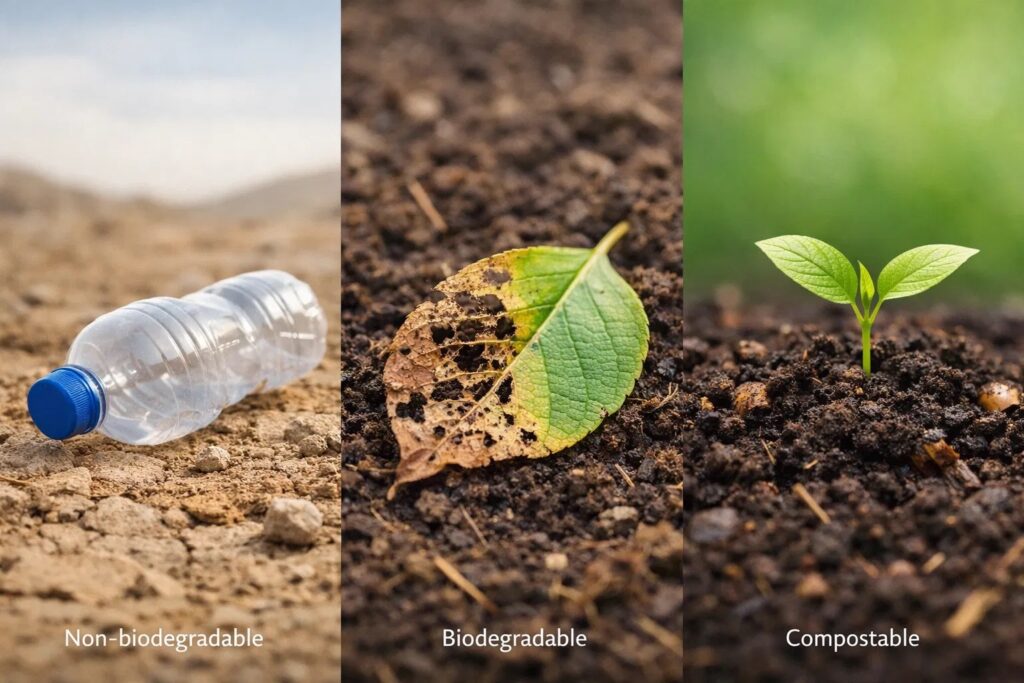
Understanding the difference between Non-biodegradable VS Biodegradable VS Compostable is essential for anyone looking to live a more sustainable lifestyle. Navigating the world of eco-friendly products can be confusing. Terms like “degradable,” “biodegradable,” and “compostable” are everywhere, but what do they really mean for our planet? This ultimate guide on Non-biodegradable VS Biodegradable VS Compostable materials cuts through the jargon to help you understand the crucial differences, make informed choices, and avoid common pitfalls.
What is the Non-biodegradable?
Non-biodegradable materials are substances that cannot be broken down naturally by microorganisms (like bacteria and fungi) into harmless components within a reasonable timeframe. These materials, primarily traditional plastics such as polyethylene (PE), polypropylene (PP), and polyvinyl chloride (PVC), are synthetically produced and possess stable structures that resist natural decomposition .
When discarded, non-biodegradable items persist in the environment for hundreds, even thousands, of years. A single plastic bottle, for instance, can take up to 450 years to “break down” in a landfill . However, this breakdown is merely fragmentation into tiny pieces known as microplastics, which never truly disappear. These microplastics contaminate soil and water, enter the food chain, and pose long-term threats to ecosystems and human health .
Key Characteristics:
•No Microbial Breakdown: Lacks the chemical structure for microorganisms to process.
•Persistent in Environment: Contributes to long-term pollution and accumulation.
•Forms Microplastics: Poses ecological and health risks without true disappearance.
What is the Biodegradable?
When we talk about products being biodegradable biodegradable, we refer to the natural process of decomposition by microorganisms.
Biodegradable materials are those capable of decomposing through the action of microorganisms into natural elements like carbon dioxide, water, methane, and biomass under specific conditions . While this sounds promising, the “specific conditions” are critical to understanding their actual environmental benefit.
Many products labeled “biodegradable” require particular environmental factors—such as specific temperatures, moisture levels, oxygen availability, and light exposure—to decompose effectively. For example, some biodegradable plastics might break down quickly in an industrial composting facility but will degrade very slowly, or even produce harmful methane gas, in a typical landfill (which lacks oxygen and sunlight) or marine environment . Furthermore, the timeframe for biodegradation is often unspecified, and some materials may leave microscopic residues .
Key Characteristics:
•Microbial Decomposition: Can be broken down by living organisms.
•Natural End Products: Converts into basic elements like CO2 and water.
•Condition-Dependent: Decomposition rate and effectiveness heavily rely on specific environmental factors.
•No Universal Standard: Lack of a precise timeframe or environment can lead to misleading claims.
Beware of “Degradable” and “Oxo-degradable” Labels
The term “degradable” is broad; technically, everything degrades over time. More concerning is “oxo-degradable” plastic, which contains additives that cause it to fragment into smaller plastic pieces when exposed to oxygen and UV light . These fragments are still plastic and do not fully biodegrade, potentially accelerating microplastic pollution rather than solving it. Always be cautious when encountering these labels without further certification.
Ok, so what about compostable?
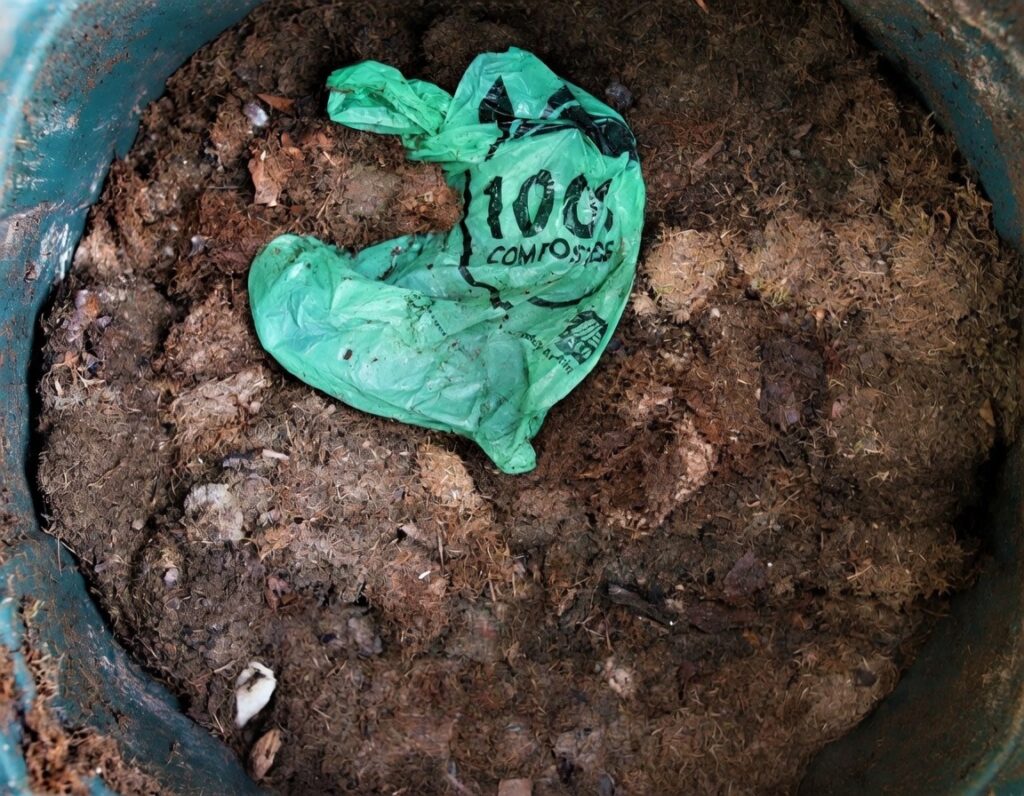
Compostable represents a stricter subset of biodegradable materials, offering clearer environmental benefits. A compostable material not only biodegrades but must do so under specific composting conditions (typically in industrial composting facilities) within a defined timeframe (e.g., 90 days). It must completely break down into carbon dioxide, water, inorganic compounds, and nutrient-rich humus, leaving no toxic residues .
Compostable products are often made from plant-based materials like polylactic acid (PLA) derived from corn starch or sugarcane. The resulting humus enriches the soil, embodying a true “cradle-to-cradle” cycle. However, it’s vital to note that not all compostable products are suitable for home composting; many require specialized industrial facilities for proper degradation . The presence of authoritative certifications like ASTM D6400 (North America) or EN 13432 (Europe) is crucial for verifying compostability.
The final and most eco-friendly category in the Non-biodegradable VS Biodegradable VS Compostable hierarchy is compostable materials.
Key Characteristics:
•Strict Biodegradation: A more rigorous form of biodegradation.
•Specific Composting Conditions: Requires controlled environments, often industrial facilities.
•Beneficial End Product: Decomposes into CO2, water, and nutrient-rich humus, with no toxic residue.
•Certified Standards: Backed by clear international standards (e.g., ASTM D6400, EN 13432).
The Ultimate Comparison: Non-biodegradable VS Biodegradable VS Compostable
To provide a clear overview, here’s a detailed comparison of these three critical terms:
| Feature | Non-biodegradable | Biodegradable | Compostable |
| Decomposition Method | No microbial breakdown | Microbial breakdown | Microbial breakdown |
| Decomposition Conditions | None; only physical fragmentation | Requires specific environmental conditions (temp, moisture, oxygen, light); conditions often vague | Requires specific, controlled composting conditions (e.g., industrial facility); conditions strict and certified |
| End Products | Microplastics, persists indefinitely | CO2, water, methane, biomass; may leave residues | CO2, water, nutrient-rich humus; no toxic residues |
| Decomposition Speed | Extremely slow (hundreds to thousands of years) | Varies greatly depending on conditions and material; timeframe often undefined | Fast (typically 90-180 days under ideal conditions) |
| Environmental Impact | Long-term pollution, microplastic harm, ecosystem and health threats | Variable; can be beneficial but may produce methane or leave residues if improperly disposed | Beneficial for soil, non-toxic, supports circular economy |
| Certification | None | No universal certification; prone to greenwashing | Strict international standards (e.g., ASTM D6400, EN 13432) |
| Examples | Traditional plastics (PE, PP, PVC), glass, metals | Some bioplastics, uncoated paper products | PLA products, food scraps, certified compostable packaging |
What should I be doing to decompose my waste in an eco-friendly way?
•Check the label to see what the product is made from and how to dispose of it. For instance, if you’re looking for sustainable alternatives, you can explore our range of eco-friendly products that meet these standards.
•Don’t put compostable items in your black bin as they need warmth, air and moisture to properly compost.
•If something is labeled as biodegradable but it cannot be recycled or composted, try to find an alternative as it will be sent to landfill, unable to break down.
•Choose home compostable products where possible, rather than industrially compostable products.
•Don’t mix recyclable products with non-recyclable products in the bin as it could render the whole lot as unusable.
How products break down is just as important as how products are actually made when it comes to sustainable living. A huge problem is how we treat plastic as a single-use item. A plastic bag only gets used once for roughly 12 minutes before it is tossed away. Most of it ends up deep in landfill, destined to live there forever. Therefore, reducing our plastic waste altogether is the most eco-friendly option.
FAQ
Q1: What is the fundamental difference between “biodegradable” and “compostable”?
A1: The core difference lies in standards and environmental requirements. “Compostable” is a stricter subset of “biodegradable.” All compostable products are biodegradable, but not all biodegradable products are compostable . Compostable items must fully break down into beneficial humus within a specific timeframe under controlled composting conditions, leaving no toxic residues. Biodegradable products have less stringent requirements for decomposition time and environment, often leading to incomplete breakdown in real-world scenarios.
Q2: Can I put biodegradable plastic in my home compost or garden?
A2: Generally, no. Most biodegradable plastics require the higher temperatures and specific microbial activity found in industrial composting facilities to break down properly. Placing them in a home compost bin or garden may result in very slow decomposition, incomplete breakdown, or contamination of your compost . Always check for a “home compostable” certification if you intend to compost at home.
Q3: Is PLA plastic truly compostable?
A3: Yes, but usually in industrial facilities. Polylactic Acid (PLA) is a common bioplastic derived from renewable resources like corn starch. While it is biodegradable and compostable, most PLA products require the controlled heat and moisture of an industrial composting facility to break down effectively according to standards like ASTM D6400 . Home composting of PLA is generally not recommended unless the product is specifically certified as “home compostable.”
Q4: What is the difference between Non-biodegradable Biodegradable and compostable materials?
A4: The main difference is the Non-biodegradable Biodegradable and compostable spectrum is how they impact our environment. Non-biodegradable waste stays in nature forever as microplastics, while biodegradable items can break down under the right conditions. Compostable products are the best choice as they turn into nutrient-rich soil within a specific timeframe, completing a true circular economy.
Conclusion
Understanding the nuances between non-biodegradable, biodegradable, and compostable is crucial for making truly sustainable choices. By prioritizing certified compostable options for single-use items, supporting proper waste management, and always remembering the hierarchy of reduce, reuse, recycle, we can collectively contribute to a healthier planet.
This guide on Non-biodegradable VS Biodegradable VS Compostable materials aims to empower you with the knowledge to navigate eco-labels confidently.