
Learning how to choose compostable bags suppliers is critical for any business transitioning away from single-use plastics. The global shift has made compostable bags a hot commodity, but not all suppliers are honest, and not all “compostable” bags actually compost. If you’re sourcing for a retail chain, waste management company, or eco‑brand, choosing the wrong supplier can lead to product failures, greenwashing accusations, and financial losses.
Demand Real Certifications – No Logo, No Deal
The compostable bag market is flooded with “oxo‑degradable” or “bio‑based” claims that mean nothing. Always look for third‑party industrial composting certifications.
| Market | Required Certification |
|---|---|
| North America | BPI (Biodegradable Products Institute) |
| Europe | OK compost INDUSTRIAL (TÜV Austria) or DIN CERTCO |
| Home composting | OK compost HOME (stricter standard) |
| International | EN 13432 or ASTM D6400 |
Pro tip: Ask for the original certificate and verify its validity on the certifier’s website. For example, check BPI certifications directly on the BPI website. Expired or photoshopped certificates are common red flags. For the North American market, BPI certified compostable bags are the gold standard. Always cross-check the supplier’s certificate number on the BPI website, as some may present expired or fraudulent documents.
Also request ASTM D6866 (bio‑based content) and REACH or RoHS compliance reports to rule out heavy metals and PFAS. In Europe, look for OK compost INDUSTRIAL or HOME certification from TÜV Austria.
In addition to BPI and OK compost, European buyers may also encounter certifications from DIN CERTCO, another widely recognized certifier for compostable products under EN 13432.
When sourcing, you should always verify that suppliers provide proper certification documents. For example, our compostable bags product includes complete BPI certificates and third‑party test reports – you can check it out as a real‑world reference.
Whether you are looking for certified compostable bags wholesale or just evaluating a few samples, the following criteria apply to all suppliers.
Know the Difference: Compostable vs. Biodegradable – Don’t Get Greenwashed
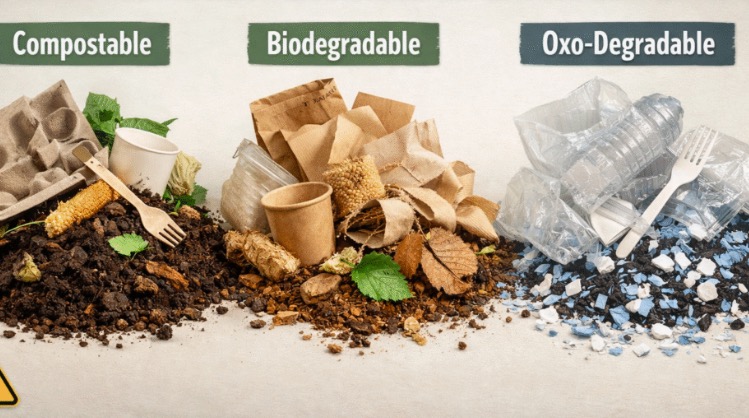
Many suppliers confuse these terms on purpose. A “biodegradable” bag may simply break into microplastics. A compostable bag must turn into CO₂, water, and biomass within a set time without harming soil.
| Feature | True Compostable Bag | Fake (Oxo‑degradable) Bag |
|---|---|---|
| Raw material | PLA, PBAT, starch | LDPE/LLDPE + additives |
| End product | CO₂ + water + biomass | Microplastics |
| Standard | ISO 14855 / ASTM D5338 | None |
| Soil impact | Passes OECD 208 (no toxicity) | Leaves persistent plastic fragments |
What to ask: “Can you provide an ISO 14855 test report showing ≥90% biodegradation within 90 days?” – A reliable supplier will say yes. The report should reference recognized standards like ASTM D6400.
This distinction is exactly why knowing how to choose compostable bags suppliers starts with demanding ISO 14855 reports, not vague claims.
Match the Bag to Your Real‑World Use Case
One formulation does not fit all. The best suppliers offer customized blends for different applications.
- Light‑duty (10–15 microns) – For grocery produce or dry waste liners. Requires high tear strength (handles won’t snap).
- Heavy‑duty (25–35 microns) – For kitchen food waste or yard trimmings. Critical metric: wet puncture resistance (no leakage after 30 minutes of wet waste).
- Hot & humid environments – Tropical regions or hot kitchens need heat‑stabilized PLA to prevent premature softening.
Ask the supplier: “How many hours can your bag hold 50°C food waste at 90% humidity without leaking?”
A professional supplier will give you a data‑backed answer, not a vague promise.
Hidden Red Flags: Production Capacity & Quality Control
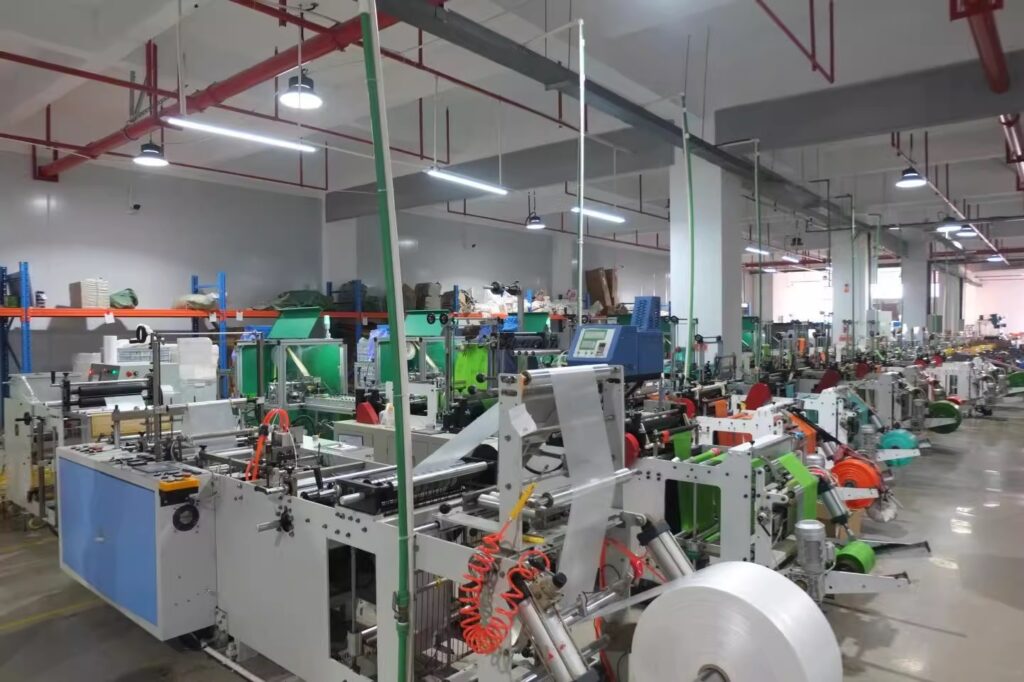
Compostable resins (PLA/PBAT) are sensitive to moisture and temperature. Poor storage or unstable extrusion lines cause pinholes, brittleness, or uneven thickness.
What to check before placing a large order:
- Raw material storage – Ask for a video or photo of their warehouse. PLA/PBAT must be kept at ≤25°C and <50% humidity. If they store resins in an open yard, walk away.
- Online inspection – Do they use pinhole detectors and automatic thickness control? These are non‑negotiable for consistent quality.
- Batch traceability – Every roll should have a printed batch number linking to raw material lots and production machines.
Warning sign: If the supplier avoids these questions and says “we have many years of experience” – proceed with extreme caution.
Shelf Life & Storage – The Hidden Cost You’ll Pay
Unlike conventional plastic bags, compostable bags have a shelf life – typically 9–12 months under ideal conditions (cool, dark, sealed). After that, mechanical properties drop sharply.
What to request:
- Accelerated aging test data (e.g., strength retention after 4 weeks at 40°C / 75% RH)
- Recommended storage guidelines (temperature, humidity, max stacking height)
- Batch manufacturing date clearly printed on every carton
One often-overlooked factor is compostable bag shelf life. Unlike conventional plastics, these bags begin to degrade after 9–12 months even under ideal storage conditions (cool, dark, sealed).
Total cost of ownership tip: Don’t just compare price per ton. A thin, unreliable bag may require double‑bagging or cause messy spills. Ask for “load capacity per gram of bag” – how many kilograms of wet waste can 1 kg of your bags safely hold?
Practical Supplier Screening Process (Step by Step)
Now let’s put how to choose compostable bags suppliers into a repeatable 4‑step process you can use with any candidate.
Step 1 – Document screening
Request: Certificates (BPI/OK compost), ISO 14855 report, raw material source declaration
Step 2 – Sample testing
Order 1,000+ bags from the same batch. Test them in your actual environment:
- Fill with wet food waste, lift, and leave for 24 hours – check for leaks.
- After 4 weeks in a compost bin – observe fragmentation.
Step 3 – Remote or on‑site audit
Video call to check: raw material warehouse conditions, extrusion line cleanliness, and online inspection equipment.
Step 4 – Contract protection
Include a clause: “If any batch fails third‑party compostability testing, supplier covers full refund + recall costs.” Also specify random batch testing rights.
What Does the Best Compostable Bag Supplier Look Like?
Holds valid BPI / OK compost INDUSTRIAL certification
Provides ISO 14855 full test report (not just a statement)
Stores resins in climate‑controlled warehouse
Uses online thickness control & pinhole detection
Customizes formulation for your waste type & climate
Clearly states shelf life & storage conditions (never says “lasts 2 years”)
You now have a complete framework to evaluate suppliers. To save you time, you can also check out our curated list of top biodegradable bag wholesalers in China.
Final Thought
Ready to source certified compostable bags wholesale? Start by applying this checklist to your potential partners. We recommend requesting samples and verifying their certifications before placing a large order.