
Quick Answer
Compostable yard waste bags for municipal and commercial collection must match three things: the collection program’s accepted certification, the load requirements (dry leaves vs. wet grass vs. heavy branches), and the facility’s end-market constraints. Many U.S. municipalities require certified compostable bags for curbside yard waste collection, but the rules are not consistent. Some programs accept BPI-certified plastic film bags. Others accept only paper. A few reject all plastic film, even certified products. There is no universal standard. Verify the local program’s current requirements before placing a bulk order.
Scope note: The municipal examples in this guide are curbside collection rules for specific jurisdictions. They are not universal standards for commercial composting facilities, which may have separate contracts, acceptance criteria, and end-market requirements.
Why Bag Choice Matters
Yard waste collection programs exist to divert organic material from landfills. When leaves, grass, and branches decompose anaerobically in a landfill, they generate methane — a greenhouse gas far more potent than carbon dioxide over the short term.
But the bag you use determines whether your yard waste actually gets composted. Conventional plastic bags do not break down. They must be manually removed, screened out, or they contaminate the finished compost. This is why many municipalities have restricted or banned plastic bags from yard waste collection entirely.
The stakes go beyond convenience. Contamination with synthetic material can affect a composting facility’s ability to sell its product into certain end markets. Recent USDA organic-program discussions have raised questions about synthetic compostable materials in compost used for organic production, but these discussions are specific to the USDA Organic regulatory process and do not create a universal rule for every municipal yard-waste program or commercial composting facility. Buyers should check both local collection requirements and the intended end market for the finished compost.
Paper Bags vs. Certified Compostable Plastic Bags
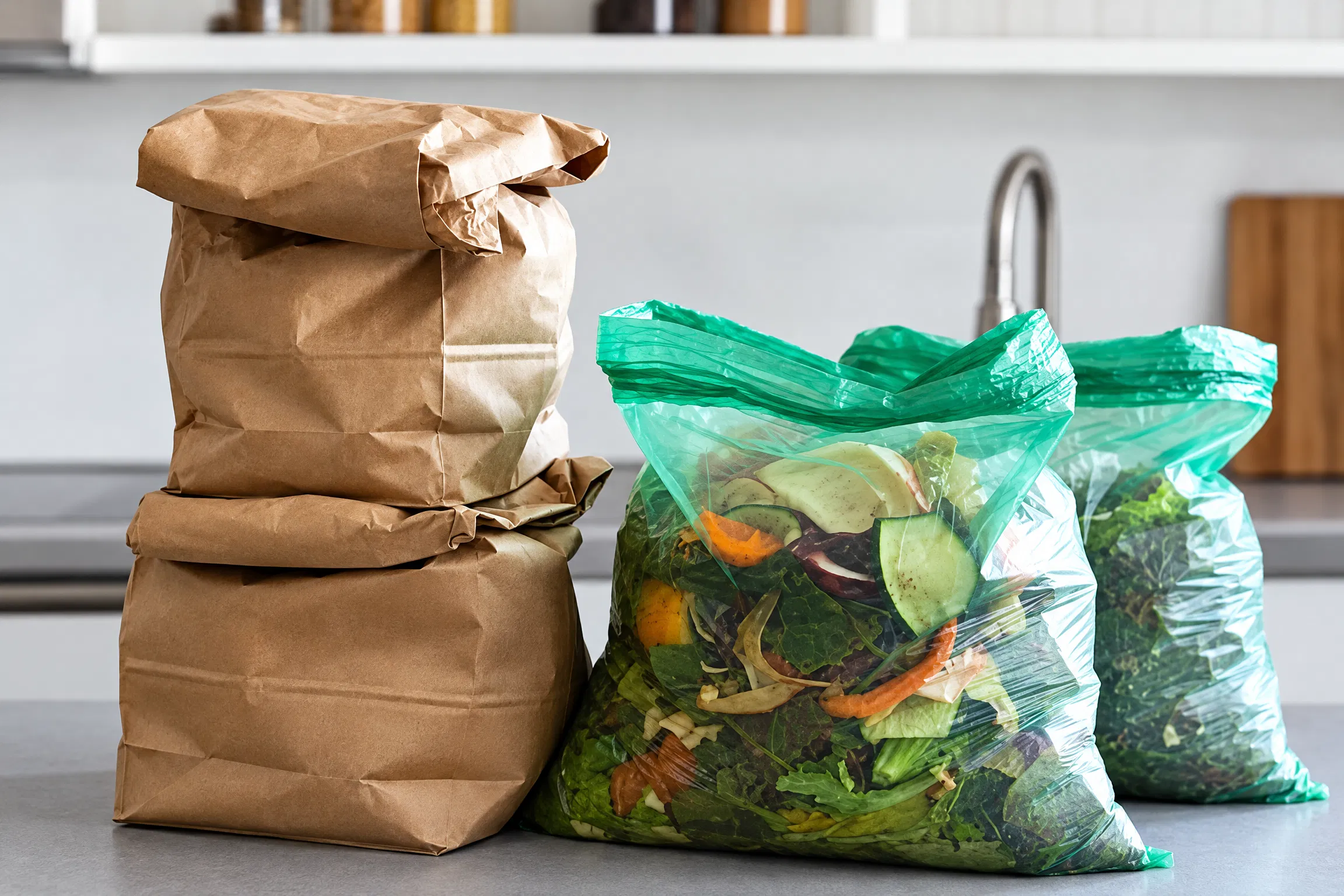
There are two main categories of compostable yard waste bags. Each has trade-offs that matter depending on the load and the program.
| Factor | Kraft Paper Bags | Certified Compostable Plastic Bags |
|---|---|---|
| Compostability | Breaks down readily in most systems | Requires certified conditions; BPI logo required in many programs |
| Wet load handling | Weakens when wet; bottom can fall out | More water-resistant; holds wet grass better |
| Home composting | Generally suitable | Depends on certification (BPI Home Compostable or OK Compost HOME) |
| Municipal acceptance | Widely accepted | Accepted only if BPI-certified in many programs |
| Cost | Often comparable when compacted | Generally higher per bag |
| Fragmentation risk | Low | Some risk if not fully degraded |
| Availability | Hardware stores, grocery stores, big-box stores | Varies; check program requirements |
Paper bags are the traditional option. They work well for dry leaves and are widely accepted. However, they weaken when wet, and wet debris at the bottom can cause the bag to fail before pickup.
Certified compostable plastic bags offer better wet-load performance. They resist tearing and hold moisture without disintegrating before collection. But they must carry recognized certification — usually the BPI Certification Mark in North America — to be accepted by municipal programs. If they lack certification, they will be treated as plastic contamination.
A practical compromise many programs use: paper bags for dry leaves and yard debris, certified compostable film bags for wet or heavy loads where paper would fail.
Need help matching bag specifications to your target market? Send us your required bag size, thickness, certification, packaging, and estimated order volume. HEMCbags can recommend suitable compostable yard-waste bag options for your market.
What Municipal Programs Actually Require (Verified Curbside Examples)
Rules for compostable yard waste bags vary significantly by city and state. The following examples come from official municipal sources and illustrate the range of requirements for curbside collection in specific jurisdictions. Rules can change — buyers should confirm current requirements on the city’s official page before purchasing. Commercial composting facilities may have separate acceptance criteria.
| City / Program | Requirement | Official Source | Last Checked |
|---|---|---|---|
| Minneapolis, MN | Compostable plastic bags must have the BPI logo. State law prohibits traditional plastic bags for yard waste. Weight limit: 40 lbs. | City of Minneapolis | October 2026 |
| Moorhead, MN | Accepts BPI-Certified and ASTM D6400 compliant compostable lawn bags, or paper bags. Weight limit: 30 lbs, 32 gallons. | City of Moorhead | October 2026 |
| Raleigh, NC | Only biodegradable paper bags accepted. “Biodegradable or compostable plastic bags do not break down in the composting process.” | RaleighNC.gov | October 2026 |
| Manatee County, FL | No plastic bags of any kind — “Compostable plastic bags are NOT able to be accepted – only compostable paper bags.” | Manatee County | October 2026 |
| Sonoma County, CA | No compostable or biodegradable plastic bags in green bins. “Even if the bag or item is certified, compostable plastic items are considered ‘synthetic materials’.” | Zero Waste Sonoma | October 2026 |
| Lake Barrington, IL | Yard waste requires biodegradable paper bags or containers. BPI-certified bags may be used only for lining kitchen compost bins, not for yard waste collection. | Village of Lake Barrington | October 2026 |
The pattern is clear and inconsistent: Some programs accept BPI-certified compostable plastic bags (Minneapolis, Moorhead). Some accept only paper (Raleigh, Manatee County). Some reject all plastic film, even certified (Sonoma County). Lake Barrington allows certified bags for kitchen collection but not for yard waste.
This inconsistency is not an accident. Composting facilities have different processing capabilities, end markets, and certification requirements. A facility that sells compost for use in organic production may apply stricter restrictions on synthetic materials because of organic-program requirements and end-market expectations. A facility that processes yard waste separately may accept certified film because it has the screening equipment to handle it — but even then, the facility may choose to screen it out rather than risk contamination.
How to Read Certification Labels (and What They Actually Prove)
For compostable plastic yard waste bags, look for a recognized third-party certification that matches the intended composting environment. In North America, BPI certification is widely recognized, but certification alone does not guarantee acceptance by a specific collection program or composting facility.
BPI is one of the most widely recognized compostability certification programs in North America. Its Certification Mark identifies products that have been evaluated against applicable compostability requirements — ASTM D6400 for plastics, or ASTM D6868 for coatings on paper and fiber. The mark is reserved for products that have passed independent laboratory testing for disintegration, biodegradation, and ecotoxicity.
What BPI certification actually requires:
- Disintegration: Physical breakdown within 12 weeks under industrial composting conditions
- Biodegradation: Microbial conversion into CO₂, water, and biomass
- Ecotoxicity: No harmful residues or heavy metal contamination in the finished compost
These are testable criteria, not marketing claims. A product bearing the BPI mark has been verified against all three.
What does NOT qualify:
- “Biodegradable” without certification — BPI’s guiding principles explicitly recommend prohibiting the term on products because it is misleading without defined conditions and timeframes
- “Eco-friendly” or “made from plants” without a cert logo
- Conventional plastic bags (even if labeled “degradable”)
Important nuance: BPI’s commercial compostability certification is based on ASTM D6400 and related standards. Its home compostability certification is a separate program based on NF T 51-800, with testing adapted for the lower, more variable temperatures of backyard systems. Only products with a “Yes” in the home-compostable column of BPI’s product registry are certified for home use. A product certified for commercial composting is not automatically suitable for home composting.
How to verify: BPI maintains a searchable product directory. Because certification status and product counts can change, buyers should verify the specific product before placing an order. BPI certification requires periodic re-qualification.
Critical distinction: BPI certification demonstrates that a product meets a compostability certification program’s requirements. It does not guarantee acceptance by every municipality or composting facility.
Thickness, Load, and Durability
Yard waste bags face heavier loads than kitchen liners. Branches, wet grass, and compacted leaves require puncture resistance and lifting strength.
Typical thickness ranges:
| Application | Typical Thickness |
|---|---|
| Standard yard waste | 0.8–1.0 mil |
| Heavy-duty / commercial | 1.0–1.2 mil |
| Kitchen liners (for comparison) | 0.5–0.9 mil |
Many commercial yard-waste film bags are offered in approximately 0.8–1.2 mil ranges, although the appropriate thickness depends on bag dimensions, resin formulation, load type, and required performance. Thicker film may improve puncture resistance, but thickness alone does not guarantee load capacity, puncture resistance, or compostability. Branches in particular can pierce film regardless of thickness.
Load requirements to verify with a supplier:
- Recommended maximum load weight
- Tensile and puncture-resistance test data
- Bag bottom construction (star seal vs. flat seal)
- Performance with wet vs. dry loads
Choose the thinnest certified bag that meets the required load and durability specifications.
Weight limits: Many municipal programs set maximum weights per bag — commonly 30 to 40 pounds (Moorhead: 30 lbs; Minneapolis: 40 lbs). Bags that exceed the limit may not be collected.
Shelf life: Compostable bags degrade over time when exposed to heat and moisture. Store in a cool, dry place and rotate stock.
Home Composting vs. Municipal Collection

Where the bag will be disposed of determines which certification matters.
For municipal or commercial collection: Look for BPI commercial compostability certification (or the local program’s specified certification). Industrial composting facilities are designed to provide the elevated temperatures, moisture, and aeration needed for certified compostable films to break down. Actual performance depends on the product, facility, and processing cycle.
For home composting: Paper bags are the safest choice. Certified compostable plastic bags may not fully degrade in cooler backyard piles. BPI’s own guidance notes that home composting relies primarily on mesophilic microbes and ambient heat, rather than the sustained thermophilic conditions of industrial systems — which means only select materials engineered for faster hydrolysis can be certified for home composting.
If a plastic-like liner is needed for home composting, look specifically for BPI Home Compostable certification (or OK Compost HOME).
The distinction that matters for B2B buyers: A bag certified for one disposal environment may not work in the other. Matching certification to the actual end-of-life pathway is the difference between a product that delivers its environmental claim and one that ends up as contamination.
B2B Procurement Decision Flow
For distributors, importers, and private-label brands sourcing yard-waste bags, follow this sequence:
Step 1 — Confirm local acceptance requirements. Contact the target municipality or composting facility. Ask which certification they accept, whether they accept plastic film bags at all, and what weight/size limits apply.
Step 2 — Define bag type and load. Decide paper vs. certified compostable film based on the program’s requirements and the load type (dry leaves, wet grass, branches).
Step 3 — Verify finished-product certification. Confirm the specific product — not just the manufacturer — carries active certification. Request the registration number and check the certifying body’s public directory.
Step 4 — Request samples and test reports. Evaluate puncture resistance, seal integrity, and load performance with the actual waste stream the bag will hold.
Step 5 — Confirm packaging, MOQ, and lead time. Align production and delivery with the program’s collection season.
B2B Specification Checklist — request the following from suppliers:
- Finished-product certification number
- Bag dimensions and usable capacity (30 gallon, 33 gallon, 39 gallon, etc.)
- Film thickness and tolerance
- Maximum recommended load
- Tensile and puncture-resistance data
- Certification scope for printed bags (inks and adhesives may affect compliance)
- Shelf life and storage conditions
- MOQ and lead time
- Private-label packaging options
- Sample and test-report availability
- Destination-market acceptance requirements
FAQs
Can I use regular plastic bags for yard waste?
Most municipalities prohibit it. Plastic bags do not break down in composting systems and must be removed manually, adding cost and contamination risk. Some programs will refuse to collect yard waste in plastic bags entirely.
Are compostable plastic bags accepted everywhere?
No. Some programs accept only paper bags (Raleigh, Manatee County, Sonoma County). Others accept BPI-certified compostable plastic bags (Minneapolis, Moorhead). Always check the local program’s requirements before purchasing.
What does the BPI logo mean?
The BPI Certification Mark indicates that a product has been independently tested and certified to meet ASTM D6400 or D6868 standards for compostability. It is recognized by many North American municipal composting programs.
Can I compost yard waste bags at home?
Paper bags are generally suitable for home composting. Certified compostable plastic bags may not fully degrade in cooler home piles unless they carry BPI Home Compostable certification (or OK Compost HOME). For backyard composting, paper is the more reliable choice.
How thick should a yard waste bag be?
Many commercial yard-waste film bags range from 0.8 to 1.2 mil. The appropriate thickness depends on bag dimensions, resin formulation, load type, and required performance. Choose the thinnest bag that handles the load without tearing — and verify load and puncture data with the supplier.
Conclusion
Choosing the right compostable yard waste bags for municipal or commercial collection is not about picking the “greenest” label. It is about matching the bag to the local program’s requirements, the load type, and the disposal pathway.
The decision framework:
| Your situation | Recommended choice | What to verify |
|---|---|---|
| Municipal curbside collection (BPI accepted) | BPI-certified compostable plastic bag | Local program accepts BPI; weight limit |
| Program requires paper only | Kraft paper yard waste bag | Weight limits; wet-load handling |
| Home composting | Kraft paper bag | Avoid plastic film unless BPI Home Compostable certified |
| Heavy wet grass / branches | Thicker certified compostable bag (1.0–1.2 mil) | Puncture resistance; load data; weight limits |
| Dry leaves | Kraft paper bag | Cost per bag; compaction capacity |
The inconsistency in municipal rules means B2B buyers cannot assume a single product will work across all markets. A bag accepted in Minneapolis may be rejected in Sonoma County. Verify certification requirements market by market before committing to bulk orders — and verify the specific product in BPI’s registry, not just the supplier’s claim.
Looking for a certified compostable yard-waste bag supplier? HEMCbags supports distributors, importers, and private-label brands with compostable bag sourcing, product specifications, packaging customization, and certification documentation. MOQ is flexible — volume pricing applies. Production lead time is typically 15–20 days depending on order size; sampling takes about 3–7 days. Contact us to request samples and a quotation.
Important Note
Municipal collection rules, certification requirements, and accepted bag types can change. The examples in this guide are provided for general information only. Always confirm the current requirements with the local collection program, composting facility, or purchasing authority before placing an order.
Sources and Further Reading
- BPI — The Science Behind Certified Compostable Products (certification benchmarks; home vs. commercial conditions)
- BPI — Find Certified Products (public product directory; verify certification status)
- BPI — Commercial Compostability Certification (certification requirements; ASTM D6400 basis; PFAS limits)
- BPI — Guiding Principles for Labeling (certification mark usage; “biodegradable” term restrictions)
- City of Minneapolis — Yard Waste (BPI logo required; 40-lb limit)
- City of Moorhead — Yard Waste (BPI-certified bags accepted; weight/size limits)
- RaleighNC.gov — Yard Waste Collection FAQ (paper bags only; compostable plastic not accepted)
- Manatee County — Yard Waste Rules (compostable plastic bags not accepted; paper only)
- Zero Waste Sonoma — Green Bin FAQ (certified compostable plastic prohibited)
- Village of Lake Barrington — Yard Waste Collection (paper bags for yard waste; BPI bags for kitchen bins only)
- Local waste-management program requirements — check the municipality or regional authority.
About this guide: Written by the HEMCbags Product Team. Reviewed for certification and municipal acceptance requirements. HEMCbags is a supplier of compostable bags and custom packaging solutions.