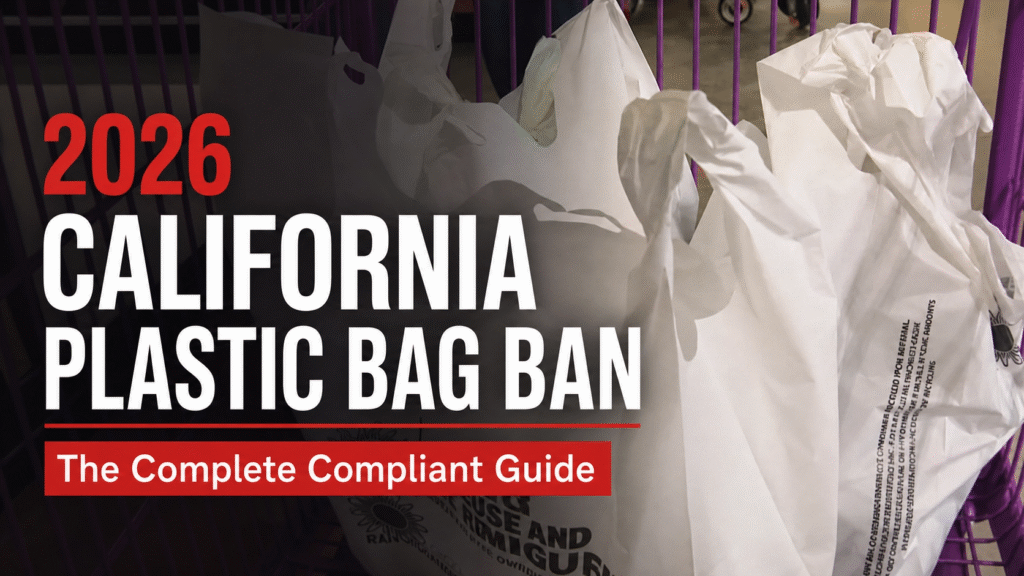
The 2026 Plastic Bag Ban California (SB 1053) is a state law effective January 1, 2026, that prohibits all plastic carryout bags at checkout, including thicker reusable bags.
If you run a supermarket, convenience store, liquor shop, or pharmacy, the plastic checkout bags you relied on are now prohibited. The only legal alternative is a recycled paper bag, sold for at least 10 cents. This guide explains every California bag law requirement clearly and concludes with how to identify a properly certified recycled paper bag supplier when you’re ready to switch.
What Is the 2026 Plastic Bag Ban California?
The California Plastic Bag Ban (SB 1053) is a state law effective January 1, 2026, that prohibits all plastic film carryout bags at checkout, including the thicker “reusable” bags previously allowed. Under the new rules, covered retailers can only provide recycled paper bags for a minimum fee of $0.10.
Under the original ban (SB 270), plastic bags thicker than 2.25 mils were allowed. In practice, consumers treated them as single‑use and rarely recycled them. According to state environmental reports, California’s discarded plastic bag tonnage rose 47 % between 2014 and 2022 — from 157,385 tons to 231,072 tons. SB 1053 eliminates the thicker‑bag exception entirely.
Who Must Comply?
Which businesses are affected by SB 1053? The following “covered stores” in California must comply with the 2026 plastic bag ban California:
- Supermarkets and grocery stores with ≥$2 million in gross annual sales
- Convenience stores and food marts
- Liquor stores
- Retail stores with an in‑store pharmacy and ≥10,000 sq ft of retail space
Compliance is required at every point of sale: checkout lanes, self‑checkout kiosks, in‑store pickup, curbside delivery, and home delivery. If your business appears on the list above, every transaction point must follow the rules.
What’s Shopping Bags Banned?
All plastic shopping bags — regardless of thickness — are prohibited. This covers thin single‑use bags, the thicker bags once marketed as “reusable,” and any bag made wholly or partly from plastic film.
Pre‑checkout bags (produce, bakery, meat) have their own set of requirements, detailed below.
Paper Bag Requirements: 40 % Recycled Content and More
A recycled paper bag is now the only carryout bag a covered store can provide at checkout. The law sets these conditions:
| Requirement | Current (2026) | Effective January 1, 2028 |
|---|---|---|
| Post‑consumer recycled content | At least 40 % | At least 50 % |
| Mandatory bag labelling | Manufacturer name, country of origin, recycled content % printed on every bag | Same |
| Curbside recyclability | Must be accepted in a majority of California programs | Same |
| Minimum customer charge | $0.10 per bag, itemized on receipt, cannot be waived | $0.10 per bag |
The 10‑cent charge must appear as a separate line. Stores absorb it, waive it with loyalty programs, or bundle it into product prices — none are permitted. The store keeps all bag revenue.
How to Identify a Compliant Bag Supplier
Before ordering, verify three things:
- Written proof of post‑consumer recycled content (40 % now, 50 % by 2028).
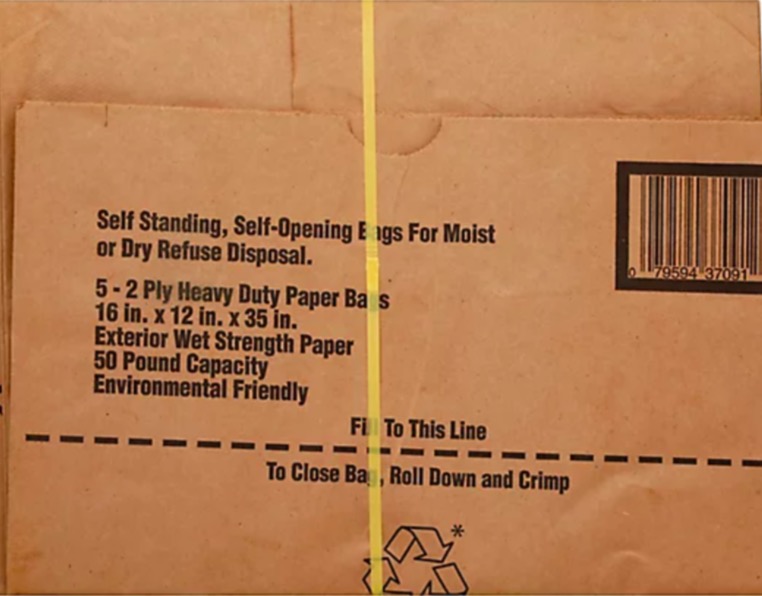
- Printed bag labels showing manufacturer name, country of origin, and recycled percentage — missing labels mean non‑compliance.
- Curbside recyclability confirmation that the bag is accepted in most California programs.
Where to Buy Recycled Paper Bags Online?
If you are looking to buy SB 1053-compliant recycled paper bags online in bulk and at wholesale prices, look no further than HemcBags. We sell recycled paper bags at wholesale prices. Despite custom paper bags, we also supply wholesale compostable bags, and other compostable plastic packaging products.
Compostable Pre‑Checkout Bags: What’s Legal
Pre‑checkout bags for unwrapped produce, bulk bakery items, or raw meat have been regulated since January 1, 2025. They must be:
- Recycled paper bags, OR
- Compostable plastic bags with active BPI (Biodegradable Products Institute) certification and the word “Compostable” printed on the bag.
Non‑compostable plastic pre‑checkout bags are prohibited. Checking for the BPI logo and the printed word “Compostable” is the fastest way to confirm compliance during an inspection.
Are There Any Exceptions?
Only narrow ones exist, and none can be expanded:
- WIC and CalFresh (EBT) customers — stores must provide recycled paper bags at no charge. POS systems should auto‑waive the 10‑cent fee for these payment types.
- Prescription medication bags dispensed by a pharmacy are not classified as carryout bags.
- Non‑handled garment bags remain allowed for laundromats and dry cleaners.
- Non‑handled protective bags are permitted only inside a compliant paper carryout bag to prevent damage or contamination. Using one as a standalone checkout bag is a violation.
Penalties for Non‑Compliance
Enforcement is handled by cities, counties, and the California Attorney General. While CalRecycle provides regulatory guidance, they do not directly enforce SB 1053 penalties.
| Violation | Maximum Penalty |
|---|---|
| First violation | $1,000 per day |
| Second violation | $2,000 per day |
Between 2025 and 2026, seven plastic bag manufacturers paid over $5.1 million in penalties and legal fees for marketing non‑recyclable bags in California. Retail enforcement is the agencies’ stated next priority.
Compliance Checklist for Retailers
- Remove all plastic checkout bags — cover registers, self‑checkout, pickup, and delivery.
- Source compliant recycled paper bags — minimum 40 % post‑consumer content with full printed labelling.
- Switch pre‑checkout bags to recycled paper or BPI‑certified compostable plastic.
- Configure your POS to charge $0.10 per paper bag, itemize it, and waive automatically for WIC/EBT.
- Check your local ordinance — cities may impose higher charges (e.g., San Francisco charges $0.25).
- Train staff on what’s prohibited and what’s allowed at every checkout point.
Frequently Asked Questions
Are thicker reusable plastic bags still legal in California?
No. As of January 1, 2026, SB 1053 permanently bans all plastic film carryout bags, regardless of thickness. The “reusable” plastic bags (over 2.25 mils) previously allowed under SB 270 are now prohibited at all covered retail checkout points.
Are grocery stores getting rid of produce bags?
No, but the material has changed. Produce, bakery, and meat bags must now be either recycled paper or BPI‑certified compostable plastic. Non‑compostable plastic produce bags are not permitted.
Can I take my own bags to Walmart or other stores?
Yes. The law restricts what stores provide, not what customers bring. You can carry your own reusable bags into any California retailer.
Do I have to charge 10 cents on delivery orders?
Yes. The 10‑cent minimum applies to all distribution methods — in‑store, curbside pickup, and home delivery.
What are the paper bag requirements in California for 2026?
Under SB 1053, retailers must provide recycled paper bags containing at least 40% post-consumer content (increasing to 50% in 2028). These bags must be sold for at least $0.10 and carry specific labels showing the manufacturer and recycled content percentage.
Ready to Switch to Compliant Bags?
The 2026 plastic bag ban California is fully active, and enforcement is underway. Compliance comes down to two practical steps: provide recycled paper checkout bags with proper labelling, and use recycled paper or BPI‑certified compostable pre‑checkout bags.
The blog shares information about California bag law to help you understand every requirement of the SB 1053. You can get in touch with HemcBags to buy various types of recycled paper bags and compostable bags.