
Abstract
In the rapidly evolving world of sustainable packaging, understanding the nuances of Compostable vs Biodegradable vs Oxo-Degradable is no longer just for environmentalists—it’s a critical business requirement for 2026. However, the terminology surrounding these materials—compostable, biodegradable, and oxo-degradable—is often misunderstood, leading to confusion, mislabeling, and the risk of “greenwashing” fines.
This 2026 buyer’s guide aims to demystify these terms, providing a clear, authoritative resource for procurement managers, brand owners, and FBA sellers. We will delve into the scientific definitions, regulatory distinctions, and certification standards (such as ASTM D6400, EN 13432, and BPI), empowering you to make informed purchasing decisions, ensure compliance, and genuinely enhance your brand’s environmental integrity.
By understanding these crucial differences, you can avoid costly penalties and confidently choose truly sustainable packaging solutions.
Introduction: Navigating the Green Packaging Maze in 2026
The global push for sustainability has transformed the packaging industry. Consumers are demanding greener products, and governments worldwide are enacting stricter regulations to curb plastic pollution. For businesses, this presents both an opportunity to enhance brand image and a challenge to navigate a complex web of terminology and compliance requirements.
The terms “compostable,” “biodegradable,” and “oxo-degradable” are frequently used interchangeably, yet their meanings, environmental impacts, and regulatory statuses are vastly different. Misinterpreting these terms can lead to significant financial penalties, reputational damage, and, most importantly, a failure to achieve genuine environmental benefits.
This 2026 Buyer’s Guide to Avoiding “Greenwashing” Fines will serve as your essential compass, helping you distinguish between truly sustainable options and misleading claims, ensuring your packaging choices are both environmentally responsible and legally compliant.
Part One: Defining the Core Concepts: Compostable vs Biodegradable vs Oxo-Degradable
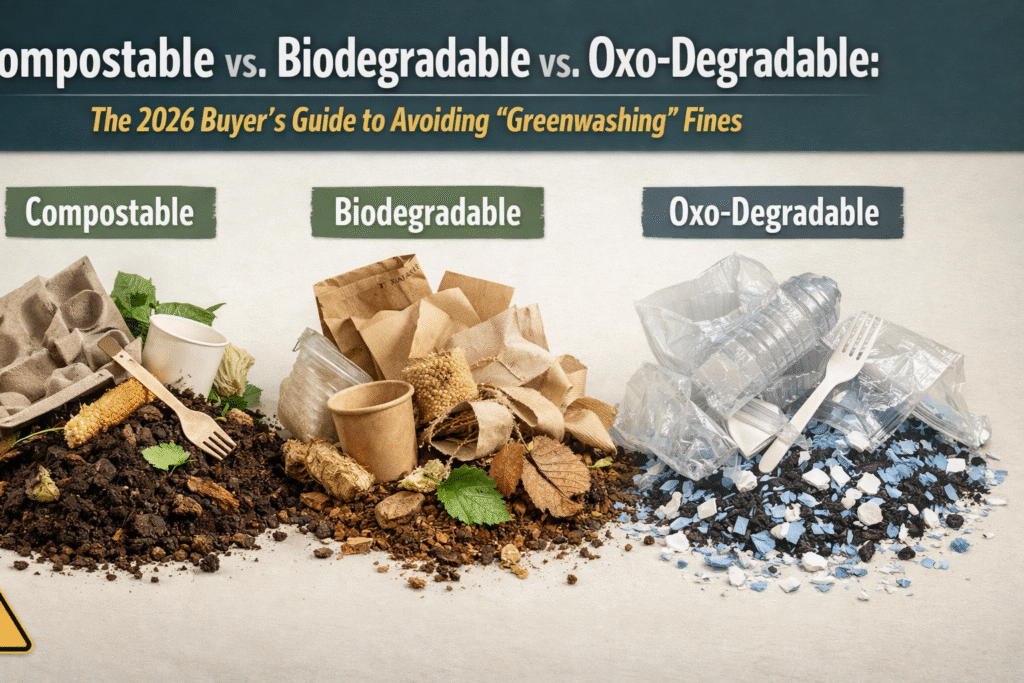
When we compare Compostable vs Biodegradable vs Oxo-Degradable materials, we are looking at three fundamentally different environmental pathways. Understanding the precise definitions of compostable, biodegradable, and oxo-degradable is the first critical step in making informed packaging decisions. These terms are not synonyms; they describe distinct processes and outcomes for material degradation.
1.1 What is “Compostable” Packaging?
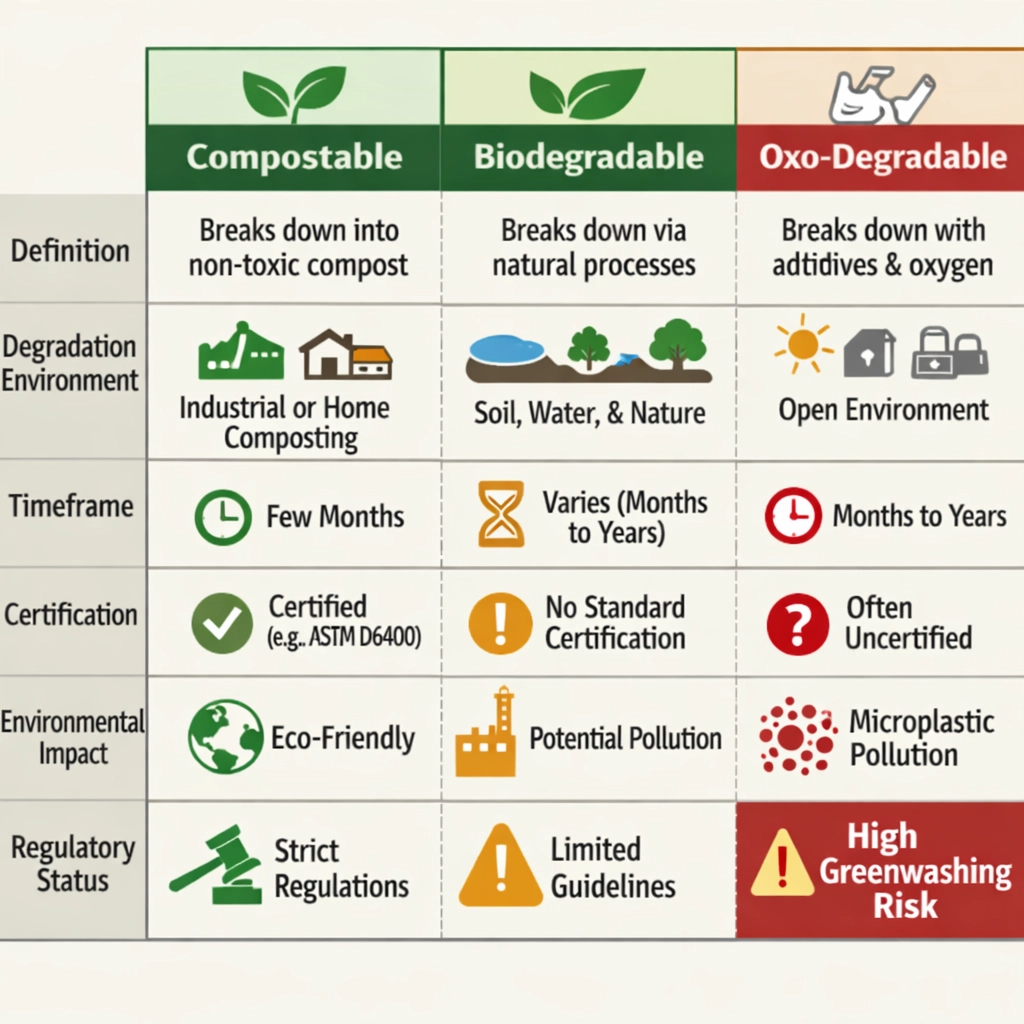
Compostable packaging refers to materials that are capable of breaking down into natural elements (carbon dioxide, water, inorganic compounds, and biomass) in a specific composting environment, leaving no visible, distinguishable, or toxic residue. The key here is the “specific composting environment” and the “timeframe.”
•Industrial Composting: Most compostable packaging requires industrial composting facilities, which maintain high temperatures (typically 55-60°C), specific moisture levels, and a balanced mix of microorganisms. Under these conditions, the material breaks down within 90 to 180 days.
•Home Composting: A smaller subset of compostable materials is certified for home composting, which occurs at lower, less controlled temperatures. These materials are designed to break down in a typical backyard compost pile, though this process can take longer.
Crucial Point: Compostable materials are designed to return nutrients to the soil, contributing to a circular economy. They are not meant for landfills, where they may still produce methane (a potent greenhouse gas) due to anaerobic conditions.
1.2 What is “Biodegradable” Packaging?
Biodegradable packaging is a broader term that simply means a material can be broken down by microorganisms into natural substances. However, unlike compostable, the term “biodegradable” often lacks specific requirements for the timeframe or the environment in which degradation occurs.
•Lack of Specificity: A product labeled “biodegradable” might take hundreds of years to break down in a landfill or ocean, or it might require very specific conditions that are rarely met in natural environments. For example, wood is biodegradable, but a wooden log in a landfill will take decades to decompose.
•Regulatory Loopholes: Due to this lack of specificity, the term “biodegradable” has often been misused, leading to consumer confusion and regulatory scrutiny. Many jurisdictions now prohibit or restrict the use of the term “biodegradable” on packaging unless it meets specific, verifiable standards for degradation within a defined timeframe and environment.
Crucial Point: Without specific certifications (like compostable standards), “biodegradable” claims are often vague and can be misleading. A product might be technically biodegradable, but if it takes 500 years in a landfill, it offers little environmental benefit.
1.3 What is “Oxo-Degradable” Packaging?
Oxo-degradable packaging refers to conventional plastics (like polyethylene or polypropylene) that have been mixed with additives (often metal salts) designed to accelerate their fragmentation into smaller plastic pieces when exposed to oxygen and UV light. This process is often marketed as “biodegradable.”
•Fragmentation, Not Degradation: The critical issue with oxo-degradable plastics is that they do not truly biodegrade. Instead, they merely break down into microplastics, which persist in the environment, accumulate in ecosystems, and can enter the food chain. These microplastics are often invisible to the naked eye but are still plastic.
•Regulatory Bans: Due to the severe environmental concerns associated with microplastic pollution, oxo-degradable plastics are increasingly being banned worldwide. The European Union, for instance, has explicitly prohibited oxo-degradable plastics under its Single-Use Plastics Directive [3]. California’s SB 54 also addresses misleading claims related to degradable plastics [4].
Crucial Point: Oxo-degradable plastics are considered a form of “greenwashing” by environmental groups and regulators. They do not offer a genuine solution to plastic pollution and pose a significant risk of fines and reputational damage for businesses that use them.
Part Two: The Regulatory Landscape and Certification Standards (2026 Update)
Understanding the legal standards for Compostable vs Biodegradable vs Oxo-Degradable packaging is essential for global trade compliance in 2026. As of 2026, the regulatory environment for sustainable packaging is becoming increasingly stringent. Understanding and adhering to recognized certification standards is paramount for avoiding “greenwashing” fines and ensuring your packaging claims are credible.
2.1 Key International Compostable Standards
True compostable packaging is verified by rigorous third-party certifications that ensure materials break down under specific conditions within a defined timeframe. The most widely recognized standards include:
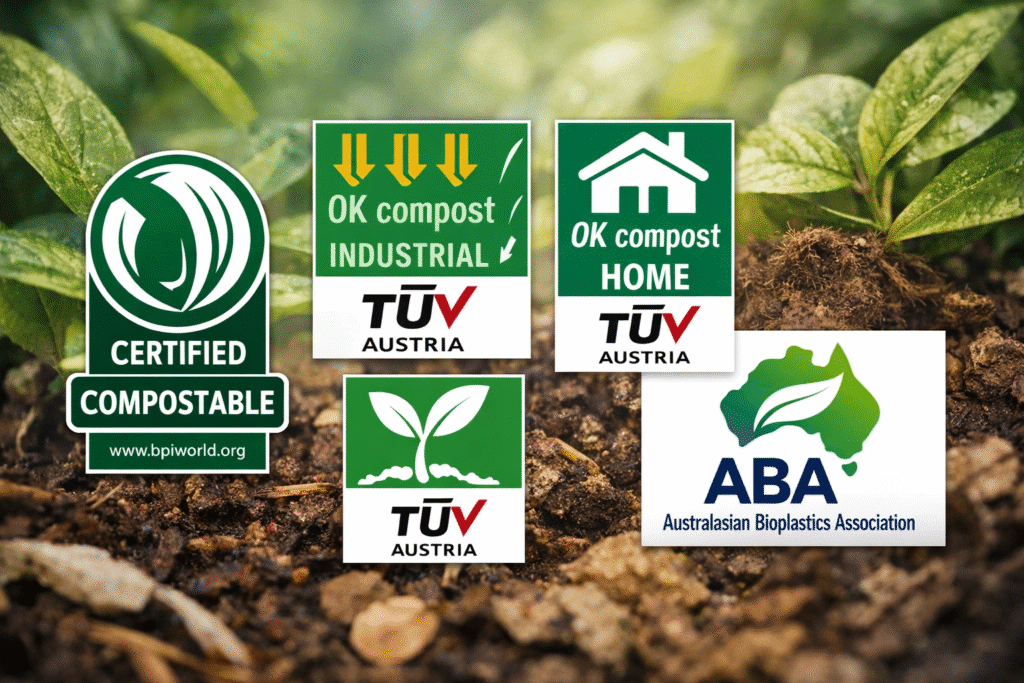
•ASTM D6400 (North America): This standard, developed by ASTM International, specifies the requirements for plastics designed to be composted in municipal or industrial aerobic composting facilities. It covers disintegration, biodegradation, and ecotoxicity. Products certified to ASTM D6400 are typically labeled with the BPI (Biodegradable Products Institute) certification mark [5].
•EN 13432 (Europe): This European standard outlines the requirements for packaging recoverable through composting and biodegradation. Similar to ASTM D6400, it specifies criteria for disintegration, biodegradation, chemical composition, and ecotoxicity. Products meeting this standard often carry the “OK Compost INDUSTRIAL” or “Seedling” logo from TÜV AUSTRIA [6].
•AS 4736 / AS 5810 (Australia): These Australian standards are equivalent to EN 13432 for industrial composting (AS 4736) and home composting (AS 5810), respectively. Products are often certified by the Australasian Bioplastics Association (ABA) [7].
Crucial Point: Always look for these specific certification marks on packaging. A simple claim of “compostable” without a corresponding certification logo is a red flag.
2.2 The Rise of Home Composting Certifications
While industrial composting is more common, the demand for home compostable packaging is growing. Specific certifications exist for this:
•OK Compost HOME (Europe): Also from TÜV AUSTRIA, this certification ensures materials can break down in a typical backyard compost pile at lower, less consistent temperatures [6].
•AS 5810 (Australia): As mentioned, this standard specifically addresses home composting [7].
Crucial Point: Home compostable claims are even more stringent. If a product is only industrial compostable, it should not be marketed as home compostable.
2.3 Why “Biodegradable” Claims are Risky Without Certification
As discussed, “biodegradable” is a vague term. Regulatory bodies worldwide are cracking down on unsubstantiated biodegradable claims. For example:
•Federal Trade Commission (FTC) Green Guides (USA): The FTC provides guidance to marketers to avoid deceiving consumers with environmental claims. It states that unqualified “biodegradable” claims are deceptive if the item won’t completely break down within a reasonably short period of time after customary disposal [8].
•European Union Directives: The EU has been particularly active in this area, with directives aimed at preventing misleading environmental claims.
Crucial Point: To avoid “greenwashing” fines and build consumer trust, businesses should only use “biodegradable” in conjunction with specific, verifiable certifications that define the environment and timeframe for degradation. Otherwise, it’s best to avoid the term altogether.
Part Three: The “Greenwashing” Trap and How to Avoid It
When evaluating Compostable vs Biodegradable vs Oxo-Degradable options, procurement managers must look beyond marketing claims and focus on third-party certifications. “Greenwashing” is the practice of making unsubstantiated or misleading claims about the environmental benefits of a product, service, or company.
In the packaging industry, it’s a pervasive issue that can severely damage a brand’s reputation and lead to significant legal and financial repercussions. This 2026 Buyer’s Guide to Avoiding “Greenwashing” Fines emphasizes vigilance.
3.1 Common Greenwashing Tactics in Packaging
•Vague Claims: Using terms like “eco-friendly,” “natural,” or “green” without specific evidence or context.
•Misleading Certifications: Displaying self-made or unrecognized “eco-labels” that resemble legitimate certifications.
•Focusing on Irrelevant Attributes: Highlighting a minor environmental benefit while ignoring more significant environmental harms (e.g., a “recyclable” product that is rarely recycled in practice).
•Oxo-Degradable Misrepresentation: Marketing oxo-degradable plastics as “biodegradable” or “compostable.”
•False Promises: Claiming a product is “100% biodegradable” without specifying the conditions or timeframe.
3.2 The Cost of Greenwashing: Fines and Reputational Damage
Regulators are increasingly imposing hefty fines for greenwashing. For example:
•California’s SB 54: This act specifically targets misleading claims about plastic products, including those related to recyclability and compostability, with significant penalties for non-compliance [4].
•FTC Enforcement Actions: The FTC has taken action against companies making deceptive biodegradable claims, resulting in substantial monetary penalties [8].
•Consumer Backlash: Beyond legal fines, greenwashing can lead to severe consumer backlash, boycotts, and a permanent loss of trust, which is often more damaging than financial penalties.
Crucial Point: Transparency and verifiable claims are your best defense against greenwashing accusations. Always back up your environmental claims with credible third-party certifications and clear, accurate information.
Part Four: Making the Right Choice: A Procurement Manager’s Checklist
This checklist helps you decide between Compostable vs Biodegradable vs Oxo-Degradable options based on your specific business needs. For procurement managers and brand owners, navigating the complexities of sustainable packaging requires a systematic approach. This checklist, informed by the 2026 Buyer’s Guide to Avoiding “Greenwashing” Fines, will help you make responsible and compliant choices.
4.1 Understand Your Product’s End-of-Life
•Composting Infrastructure: Does your target market have access to industrial composting facilities? If not, industrial compostable packaging might end up in landfills, negating its benefits.
•Consumer Behavior: Will your end-users realistically compost the packaging, or will they dispose of it in regular waste?
4.2 Prioritize Certified Compostable Packaging
•Look for Logos: Always demand products with clear, verifiable certification logos (BPI, OK Compost INDUSTRIAL/HOME, Seedling, ABA).
•Request Certificates: Ask your supplier for copies of their current certification certificates. Verify these certificates directly with the issuing body (e.g., BPIworld.org, TUV-at.be).
4.3 Scrutinize “Biodegradable” Claims
•Demand Specificity: If a supplier claims “biodegradable,” ask: “Under what conditions? In what timeframe? With what certification?” If they cannot provide clear answers and third-party verification, proceed with extreme caution.
•Avoid Oxo-Degradable: Steer clear of any packaging marketed as “oxo-biodegradable” or “degradable with additives.” These are generally considered harmful and are increasingly banned.
4.4 Partner with a Knowledgeable Supplier
Recommended Resources for Your Industry:
- If you are an Amazon FBA seller, ensure your packaging meets strict platform compliance by following our specialized sourcing guide.
- For fashion brands looking to enhance their sustainable image, we offer customizable compostable mailers tailored to your brand identity.
- Pet industry wholesalers and retailers can explore our high-quality options for bulk compostable dog poop bags to meet growing eco-conscious demand.
•Expertise: Choose a supplier that demonstrates deep knowledge of compostable materials, international regulations, and certification processes. They should be able to guide you through the complexities.
•Transparency: A reputable supplier will be transparent about their materials, manufacturing processes, and certifications. They should not shy away from your questions.
•HemcBags Advantage: With over 20 years of expertise in compostable resin modification and a robust portfolio of BPI and TÜV certified products, HemcBags is your trusted partner in navigating the sustainable packaging landscape. We provide full traceability and compliance assurance, helping you avoid “greenwashing” pitfalls and build a truly eco-responsible brand. Contact Us Today for a Compliance Consultation!
Conclusion: Your Path to Genuine Sustainable Packaging
In summary, the choice of Compostable vs Biodegradable vs Oxo-Degradable will define your brand’s sustainability legacy.
In the dynamic world of 2026, making informed packaging choices is no longer just about environmental responsibility; it’s about business resilience and avoiding significant legal and reputational risks. By understanding the critical distinctions between compostable, biodegradable, and oxo-degradable materials, and by prioritizing third-party certified solutions, you can confidently navigate the green packaging maze.
This 2026 Buyer’s Guide to Avoiding “Greenwashing” Fines empowers you to protect your brand, comply with evolving regulations, and genuinely contribute to a healthier planet. Choose wisely, choose certified, choose HemcBags.
References
•[1] European Commission. Packaging and Packaging Waste Regulation (PPWR). Available at: https://environment.ec.europa.eu/topics/waste-and-recycling/packaging-and-packaging-waste_en
•[2] California Legislative Information. Senate Bill No. 54. Available at: https://leginfo.legislature.ca.gov/faces/billTextClient.xhtml?bill_id=202120220SB54
•[3] European Commission. Single-Use Plastics Directive. Available at: https://environment.ec.europa.eu/topics/waste-and-recycling/single-use-plastics_en
•[4] BPI (Biodegradable Products Institute). Certified Compostable Products. Available at: https://bpiworld.org/
•[5] TÜV AUSTRIA. OK Compost Certification. Available at: https://www.tuv-at.be/green-marks/certifications/ok-compost/
•[6] Australasian Bioplastics Association (ABA). Certification Program. Available at: https://bioplastics.org.au/
•[7] Federal Trade Commission (FTC). Environmental Marketing Claims: Green Guides. Available at: https://www.ftc.gov/tips-advice/business-center/guidance/environmental-marketing-claims-green-guides
Frequently Asked Questions (FAQs)
Q1: What is the main takeaway in the Compostable vs Biodegradable vs Oxo-Degradable debate for 2026?
A1: The main takeaway is that compostable packaging, backed by third-party certifications like BPI or TÜV AUSTRIA, offers a verifiable and genuinely sustainable end-of-life solution in industrial or home composting environments. Biodegradable is a vague term that often lacks specific conditions or timeframes, making it risky for greenwashing. Oxo-degradable plastics are actively harmful, breaking into microplastics and are increasingly banned globally. For 2026, always prioritize certified compostable options to avoid fines and ensure true environmental benefit.
Q2: Why is “biodegradable” often considered a misleading term?
A2: The term “biodegradable” is misleading because it simply means a material can break down by microorganisms, but it doesn’t specify how long it takes or under what conditions. A product could be technically biodegradable but take hundreds of years to degrade in a landfill, offering little environmental advantage. Without specific certifications, it’s a vague claim that can easily lead to greenwashing.
Q3: What are the risks of using oxo-degradable packaging?
A3: The primary risk of oxo-degradable packaging is that it doesn’t truly biodegrade. Instead, it fragments into microplastics, which pollute ecosystems, harm wildlife, and can enter the human food chain. Many regions, including the European Union, have banned oxo-degradable plastics due to these severe environmental concerns. Businesses using them face significant greenwashing fines and reputational damage.
Q4: How can businesses avoid greenwashing fines when choosing packaging?
A4: To avoid greenwashing fines, businesses should prioritize packaging with clear, verifiable third-party certifications (e.g., BPI, EN 13432, ASTM D6400, TÜV AUSTRIA). Always request and verify supplier certificates. Be wary of vague “biodegradable” claims without specific conditions or certifications, and completely avoid oxo-degradable plastics. Partnering with knowledgeable suppliers like HemcBags, who offer full traceability and compliance assurance, is also crucial.
Q5: Where can I find more information on certified compostable packaging?
A5: For more information on certified compostable packaging, you can refer to the websites of leading certification bodies such as the Biodegradable Products Institute (BPIworld.org), TÜV AUSTRIA (tuv-at.be), and the Australasian Bioplastics Association (bioplastics.org.au). These organizations provide lists of certified products and detailed information on their standards. HemcBags also offers expert consultation to guide you through the selection process.