
Abstract
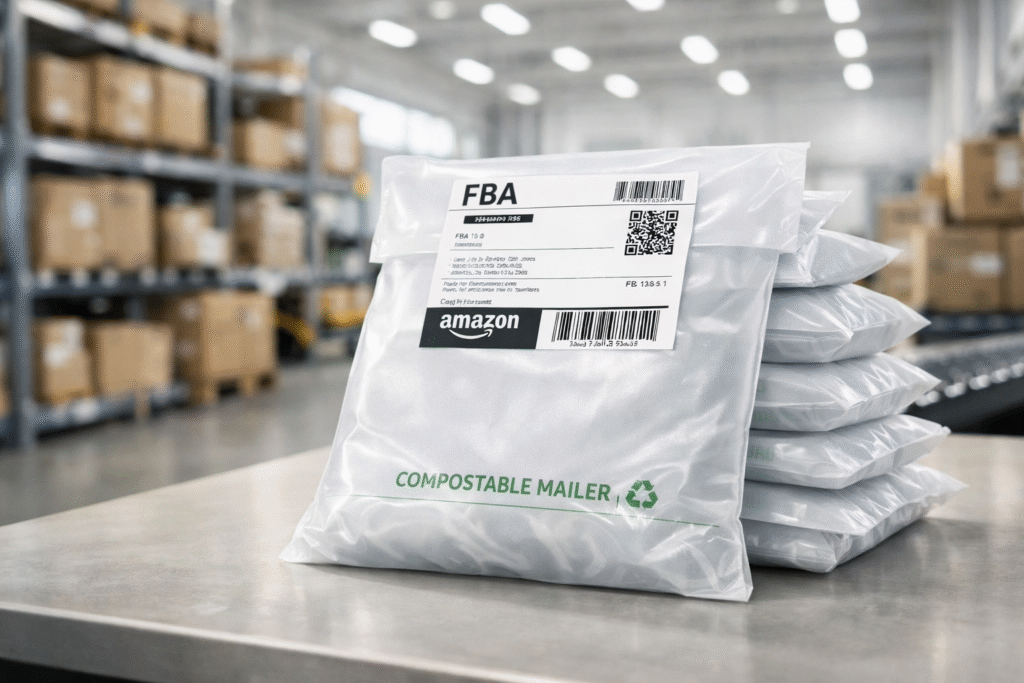
With growing global consumer environmental awareness and stringent government restrictions on plastic pollution, Amazon FBA sellers are facing unprecedented pressure to transition their packaging. This Amazon FBA Compostable Packaging Guide provides sellers with a comprehensive compostable packaging sourcing strategy to ensure your products not only comply with Amazon FBA packaging requirements and increasingly strict environmental regulations (especially new rules for 2026) but also enhance brand sustainability and optimize operational costs. We will delve into FBA’s specific regulations for compostable bags, the characteristics of various compostable materials, key considerations when sourcing, and how to avoid common pitfalls, helping you seize eco-opportunities in the highly competitive e-commerce market.
Introduction: The Unignorable Eco-Packaging Trend for FBA Sellers
Amazon FBA (Fulfillment by Amazon), as a leading global e-commerce logistics service, profoundly impacts millions of sellers with its vast scale and strict operational standards. In recent years, with the implementation of environmental regulations such as the EU PPWR (Packaging and Packaging Waste Regulation) [1] and California SB 54 Act [2], coupled with consumers’ growing preference for sustainable products, eco-friendly packaging is no longer a mere “added bonus” but a mandatory requirement for FBA sellers.
Compostable packaging, as an ideal alternative to traditional plastic packaging, is rapidly becoming a focal point for FBA sellers. However, choosing truly compliant, efficient, and economical compostable packaging, and avoiding product rejections, delistings, or even fines due to misunderstanding FBA’s detailed requirements or making false environmental claims, presents a significant challenge for every FBA seller. This guide will cut through the confusion, providing a clear and practical FBA compostable packaging sourcing roadmap to ensure your business thrives amidst the wave of sustainable development.
Part One: In-Depth Understanding of Amazon FBA Compliance Requirements for Compostable Packaging
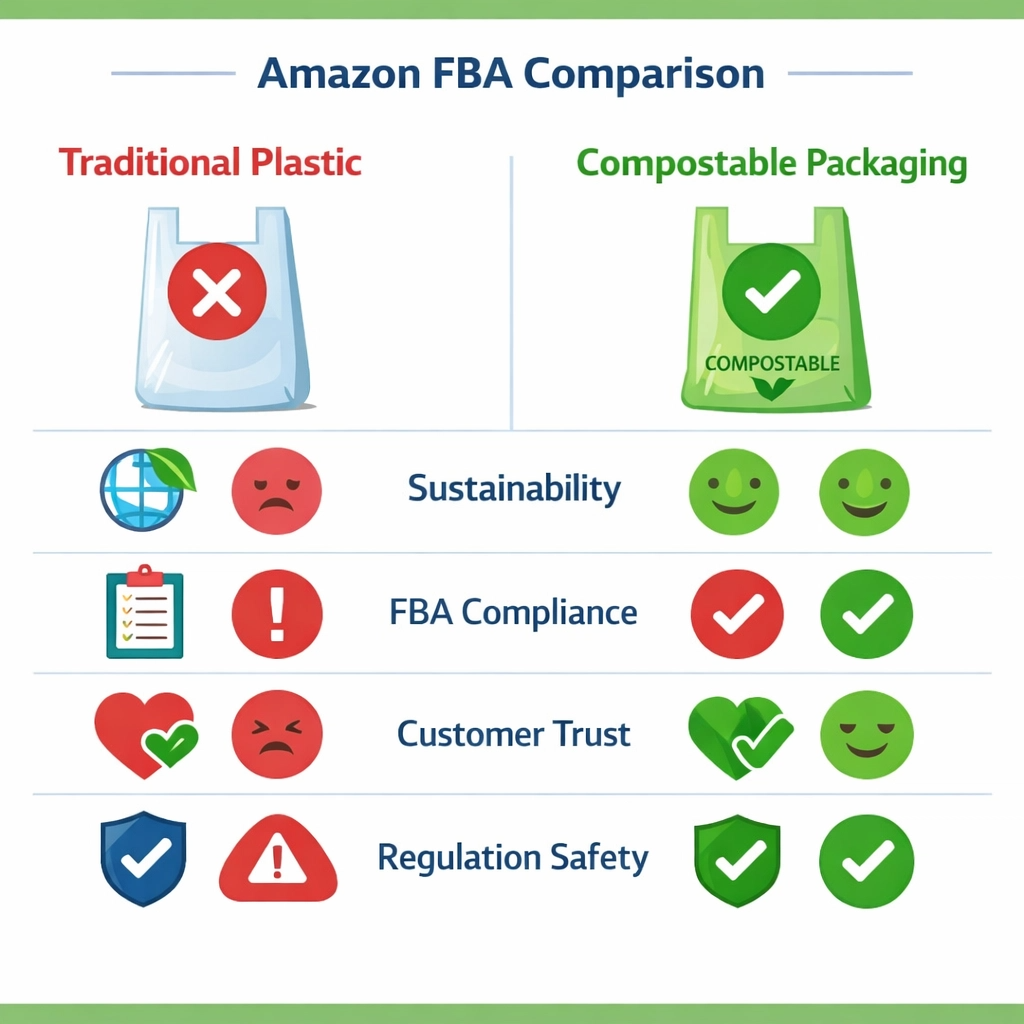
In this Amazon FBA Compostable Packaging Guide, understanding compliance requirements is the fundamental first step for successful product inbound and sales. For compostable packaging, FBA not only has general regulations but also a strict review mechanism for “eco-claims” to combat “greenwashing.”
1.1 General FBA Packaging Requirements: Compostable Bags Must Comply
in this Amazon FBA Compostable Packaging Guide, we emphasize that all products shipped to Amazon fulfillment centers, regardless of their packaging material, must comply with general FBA requirements.:
- Transparency: If compostable bags are used to package individual items, they typically need to be transparent to allow Amazon staff to scan barcodes or identify products. Opaque bags may require additional labeling or window designs.
- Thickness: Amazon requires plastic bags to be at least 1.5 mil thick (approximately 38 microns) to ensure they are not easily damaged during shipping and storage. Although compostable bags are made from different materials than traditional plastics, they must still meet similar strength requirements to prevent product damage and FBA rejections.
- Size: Packaging bags should be appropriately sized for the product, avoiding excessive size that incurs additional shipping costs or being too small, which could lead to product damage.
- Scannable Barcodes: The FNSKU or UPC barcode on the product must be clearly visible and not obscured or distorted by the packaging bag. Compostable bags should ensure the barcode area is flat.
- Suffocation Warning Label: Any plastic bag (including compostable bags) with an opening greater than 5 inches (approximately 12.7 cm) must have a suffocation warning label printed or affixed. The label content and font size must comply with Amazon’s regulations, typically requiring multiple languages.
1.2 Amazon’s Strict Scrutiny of “Eco-Claims”: Beware of Greenwashing Risks
As detailed in our Amazon FBA Compostable Packaging Guide, Amazon’s Environmental Marketing Guidelines explicitly state that sellers making any environmental claims must provide clear, verifiable evidence.
Key Takeaways:
- Distinguish “Biodegradable” from “Compostable”: This is the most common confusion. Not all “biodegradable” materials fully degrade in a composting environment, and some may even produce microplastics during degradation. Amazon requires sellers to provide clear third-party certifications to support their “compostable” claims.
- Avoid Vague Language: Refrain from using ambiguous terms like “eco-friendly,” “green,” or “natural” unless specific, quantifiable evidence can be provided.
- Certification is Crucial: Amazon explicitly recognizes “compostable” products verified by third-party certification bodies. This means merely claiming “compostable” is insufficient; you must provide authoritative certification.
1.3 Key Third-Party Certification Standards: FBA’s “Passports”
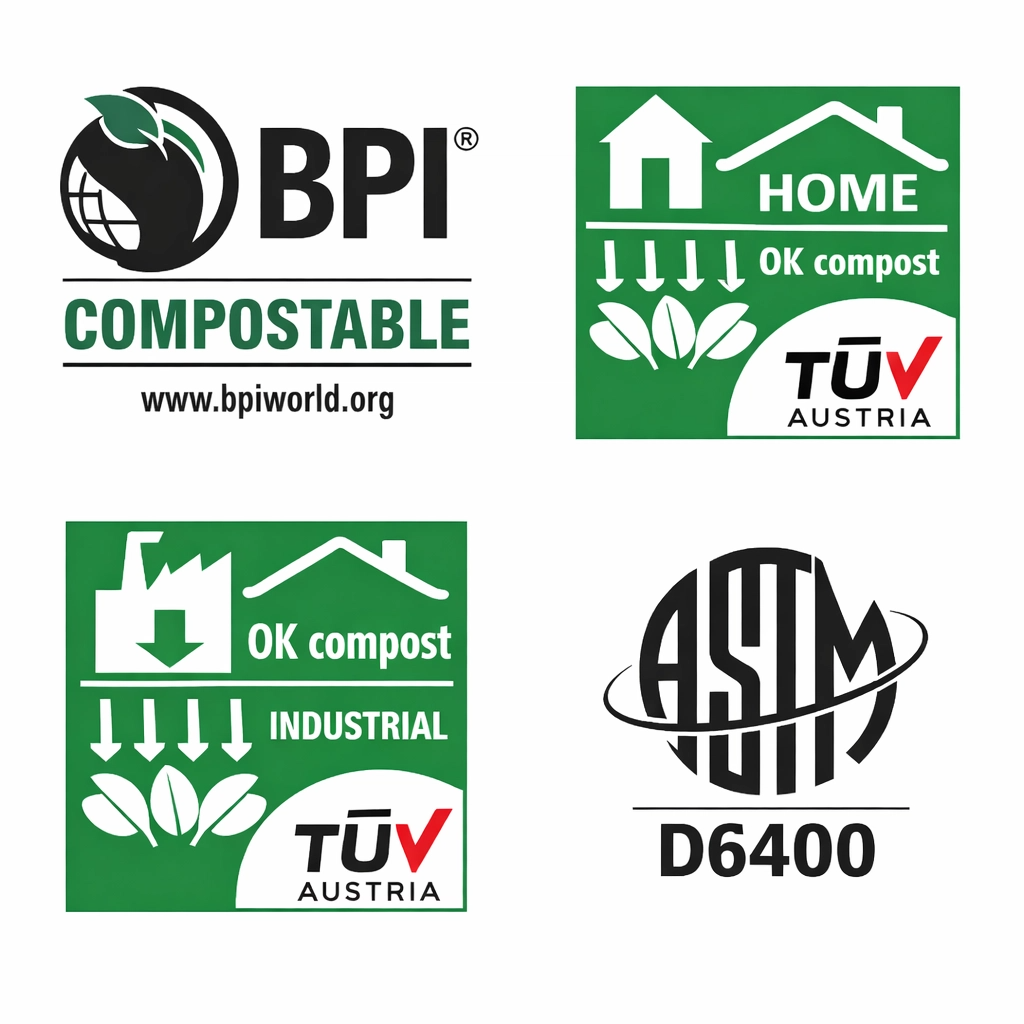
To ensure your compostable packaging complies with FBA and global environmental regulations, understanding and selecting products with authoritative third-party certifications is vital. Here are some of the most recognized compostable certification standards internationally:
| Certification Standard | Applicable Region | Certifying Body | Core Requirements | Notes |
|---|---|---|---|---|
| ASTM D6400 | USA | BPI (Biodegradable Products Institute) | Degradation in industrial composting conditions, >90% biodegradation within 90 days, no heavy metals, no negative impact on compost quality. | Most common industrial composting certification in the US market. |
| EN 13432 | European Union | TÜV Austria (OK Compost Industrial), DIN CERTCO | Degradation in industrial composting conditions, >90% disintegration within 12 weeks, >90% biodegradation within 6 months, no heavy metals, no negative impact on compost quality. | Most common industrial composting certification in the EU market. |
| AS 4736 | Australia | ABA (Australasian Bioplastics Association) | Degradation in industrial composting conditions, similar to EN 13432. | Australian industrial composting standard. |
| AS 5810 | Australia | ABA | Degradation in home composting conditions, >90% biodegradation within 12 months under home composting conditions. | Australian home composting standard, higher requirements. |
| OK Compost HOME | Global | TÜV Austria | Degradation in home composting conditions, effective degradation at lower and less stable home composting temperatures. | More stringent than industrial composting, more challenging. |
Important Note: FBA sellers must request the latest, valid third-party certification certificates from suppliers and verify that the product information on the certificate matches the products you are sourcing. These certificates are crucial evidence for proving product compliance to Amazon.
1.4 FBA Policy Updates Outlook for 2026: Plan Ahead, Mitigate Risks
With the accelerating tightening of global environmental regulations, Amazon FBA is expected to further strengthen its requirements for packaging sustainability in 2026 and beyond. For example:
- Stricter Material Restrictions: There may be restrictions on certain “biodegradable” materials that do not perform well in actual degradation.
- Mandatory Recycling/Composting Labels: Requiring clear recycling or composting instructions on packaging to guide consumers on proper disposal.
- Extended Producer Responsibility (EPR): In more countries and regions, FBA sellers may be required to bear the costs of packaging waste collection and treatment.
Plan Ahead: Monitoring official Amazon announcements and choosing suppliers that offer packaging aligned with future regulatory trends is crucial for FBA sellers to mitigate risks and maintain competitiveness.
Part Two: Selecting the Right Materials for Your Amazon FBA Compostable Packaging Guide
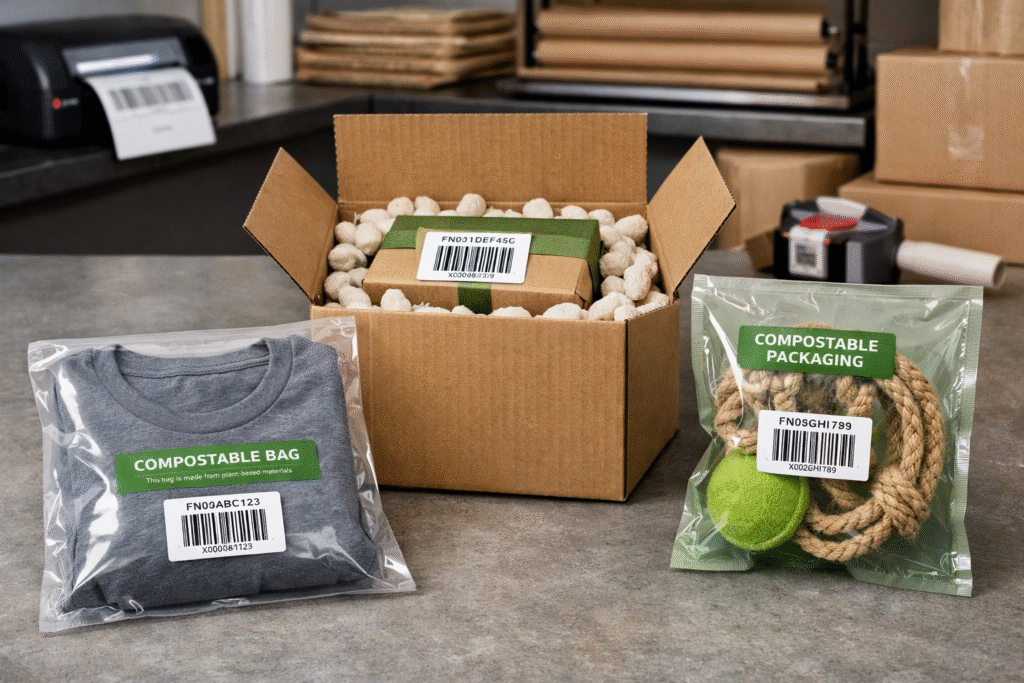
As detailed in this Amazon FBA Compostable Packaging Guide, selecting the right material—whether PLA or PBAT—is crucial for different product types. Understanding the characteristics of these materials and their applicability to different FBA products is key to making informed sourcing decisions.
Looking for FBA-Compliant Packaging? Don’t let packaging hold back your Amazon business. At HemcBags, we specialize in high-performance Compostable Mailer Bags and Eco-friendly Shipping Supplies that meet all 2026 FBA requirements. Our bags are tear-resistant, waterproof, and 100% certified. Browse Our Full Catalog & Request Free Samples Today →
2.1 Analysis of Common Compostable Materials
A core part of the Amazon FBA Compostable Packaging Guide is understanding that the main compostable packaging materials currently on the market include PLA, PBAT, and corn starch-based resins:
- PLA (Polylactic Acid):
- Characteristics: Made from renewable plant resources such as corn starch, cassava roots, and sugarcane through fermentation. It has good transparency, gloss, and printability, feeling similar to traditional plastics. It fully degrades under industrial composting conditions.
- Pros and Cons: Advantages include high transparency, good rigidity, and strong plasticity; disadvantages include relatively poor heat resistance (typically below 60°C), potential for accelerated degradation in humid environments, and unsuitability for long-term storage. Pure PLA usually requires industrial composting environments.
- FBA Applicability: Often used for transparent packaging bags, blister packs, and disposable tableware. For FBA products that need to display their appearance, PLA is a good choice, but its heat resistance and storage conditions need to be considered.
- PBAT (Polybutylene Adipate Terephthalate):
- Characteristics: A petroleum-based or bio-based aliphatic/aromatic copolyester with good flexibility, ductility, and biodegradability. When mixed with PLA, it can improve PLA’s toughness.
- Pros and Cons: Advantages include softness, good toughness, easy film blowing processing, and full degradation under industrial composting conditions; disadvantages include less transparency than PLA and relatively higher cost.
- FBA Applicability: Often used for courier bags, garbage bags, and shopping bags. Its excellent flexibility and strength make it very suitable for FBA product shipping packaging, especially in scenarios requiring tear resistance and leak prevention.
- Corn Starch Based Materials:
- Characteristics: Uses corn starch as the main raw material, processed through modification and plasticization. It is usually mixed with PLA, PBAT, etc., to improve performance.
- Pros and Cons: Advantages include high renewable resource content, fast degradation rate, and relatively lower cost; disadvantages include poorer strength and water resistance for pure starch-based materials, usually requiring blending with other polymers to achieve practical performance.
- FBA Applicability: Often used for disposable tableware, shopping bags, and garbage bags. It offers a cost advantage for FBA products with less demanding strength and water resistance requirements, or as part of a composite material.
2.2 Selection Strategy for the Amazon FBA Compostable Packaging Guide: Product-Specific Recommendations
Choosing the right compostable packaging bags for different FBA product categories is crucial. This not only concerns compliance but also affects user experience and brand image.
| FBA Product Type | Recommended Compostable Packaging Type | Key Considerations | HemcBags Solution Examples |
|---|---|---|---|
| Apparel/Textiles | Compostable Mailer Bags | Durability (tear resistance), water resistance (moisture proof), sealability, lightweight (reduces shipping costs), printability (brand logo). | High-strength PBAT/PLA blend courier bags, featuring eight-fold sealing technology, customizable logo and size. |
| Food/Perishables | Food Grade Compostable Bags, e.g., produce bags, food waste bags | Food contact safety certification, breathability (for some produce), moisture resistance, strength (prevents breakage). | BPI/EN 13432 certified PLA/corn starch-based food bags, compliant with FDA food contact standards. |
| Pet Supplies | Compostable Dog Poop Bags | Leak-proof, odor control, strength (prevents breakage), easy tear-off. | Thickened PBAT/PLA pet waste bags, with tear-off design, effectively locking in odors, compliant with ASTM D6400 standard. |
| Home/Daily Goods | Compostable Flat Bags, Zipper Bags, Garbage Bags | Load-bearing capacity, leak-proof (for garbage bags), variety of sizes, cost-effectiveness. | Multi-size, high-toughness compostable garbage bags, suitable for kitchen, office, etc., customizable thickness. |
Customization Options:
- Brand Printing: Printing your brand logo, product information, and composting instructions on compostable packaging not only enhances brand professionalism but also educates consumers on proper disposal, reinforcing your brand’s eco-friendly image.
- Custom Size and Thickness: Custom size and thickness based on your product characteristics and the Amazon FBA Compostable Packaging Guide requirements, avoiding unnecessary waste and increased costs.
For fashion sellers looking to elevate their brand identity, we also offer a specialized Custom Compostable Mailers Guide for Clothing Brands focusing on premium branding and high-definition printing.
Part Three: Sourcing Strategy and Supplier Evaluation for the Amazon FBA Compostable Packaging Guide
A key part of any Amazon FBA Compostable Packaging Guide is the sourcing strategy and supplier evaluation process to ensure long-term supply chain stability. Choosing a reliable compostable packaging supplier is crucial for the success of FBA sellers. An excellent supplier can provide not only compliant products but also support in technical assistance, supply chain stability, and cost control.
Why Leading FBA Sellers Trust HemcBags With over 20 years of expertise in compostable resin modification, HemcBags provides more than just bags—we provide compliance security. Whether you need Custom Printed Compostable Bags with your logo or bulk Compostable Dog Poop Bags for your pet brand, our team ensures every batch is ASTM D6400 and EN 13432 certified. Get a Quick Quote for Your FBA Brand →
3.1 Channels for Finding Qualified Suppliers
- B2B Online Platforms: This Amazon FBA Compostable Packaging Guide recommends using platforms like Alibaba and Made-in-China as common channels for finding qualified suppliers.
- Industry Exhibitions and Trade Shows: Attending packaging industry or sustainability-themed exhibitions allows direct communication with suppliers, learning about the latest products and technologies, and building initial trust.
- Industry Recommendations and Word-of-Mouth: Seek out suppliers with good reputations and extensive FBA collaboration experience through industry associations, peer recommendations, or professional forums.
3.2 Supplier Evaluation Checklist: Ensuring Foolproof Sourcing
When selecting an FBA compostable packaging supplier, a comprehensive and meticulous evaluation is essential. Here is a detailed evaluation checklist:
- Certification (Certification):
- Core Requirement: Can the supplier provide the latest, valid third-party certification certificates such as ASTM D6400, EN 13432, BPI, TÜV Austria (OK Compost)? Does the product information on the certificate exactly match the products you are sourcing?
- Verification Method: Request the supplier to provide the certificate number and verify it on the official website of the certification body.
- Production Capacity and Quality Control (Production & QC):
- Factory Scale and Equipment: Understand the supplier’s production lines, capacity, and technical level to ensure they can meet your order demands.
- Quality Management System: Do they have ISO 9001 or other quality management system certifications? Do they have comprehensive incoming material inspection, in-process control, and finished product inspection procedures?
- Customization Capability and Flexibility (Customization & Flexibility):
- Design Services: Can they provide packaging design, logo printing, and custom size and thickness services?
- Minimum Order Quantity (MOQ): Does the MOQ align with your procurement budget and inventory management strategy?
- Lead Time and Logistics (Lead Time & Logistics):
- Production Cycle: Understand the average production cycle from order placement to shipment.
- Logistics Support: Can they provide FBA first-leg logistics support? Do they have extensive international logistics experience to ensure safe and timely delivery to Amazon warehouses?
- Pricing and Cost-effectiveness (Pricing & Cost-effectiveness):
- Quote Transparency: Does the quote include all costs (material fees, printing fees, mold fees, shipping fees, etc.)?
- Overall Cost: In addition to the purchase price, consider the hidden costs such as FBA fines, returns, and brand damage due to non-compliant packaging.
3.3 Sample Testing and Verification: Ensuring FBA Compatibility
Before making bulk purchases, this Amazon FBA Compostable Packaging Guide emphasizes that strict sample testing and verification are essential to avoid future FBA rejections. This is a critical step to avoid future FBA rejections or product damage.
- Physical Performance Testing:
- Strength and Toughness: Simulate the squeezing and dropping during FBA warehouse operations and transportation to test the packaging bag’s tear resistance, puncture resistance, and load-bearing capacity.
- Sealability: Check if the seal is firm, especially for liquid or powder products, where leak-proof performance is crucial.
- Transparency and Barcode Scanning: Ensure transparent bags clearly display products and barcodes can be accurately scanned by FBA scanning equipment.
- FBA Simulation Testing:
- Use sample packaging bags for actual FBA products and conduct small-batch shipment tests to observe Amazon’s receiving status and customer feedback.
- Ensure suffocation warning labels, barcodes, etc., comply with the latest FBA requirements.
Part Four: Avoiding Common Pitfalls in FBA Compostable Packaging Sourcing
Even experienced sellers following this Amazon FBA Compostable Packaging Guide can encounter various pitfalls during the sourcing process. Understanding these common mistakes is crucial. Understanding these common mistakes can help you mitigate risks and ensure smooth procurement.
4.1 Misunderstanding “Biodegradable” vs. “Compostable”: The Most Common Greenwashing Trap
This is the most common misconception that can lead FBA sellers into trouble. Many suppliers promote their products as “biodegradable,” but in reality, this is fundamentally different from “compostable.”
- Biodegradable: Refers to materials that decompose into natural substances under the action of microorganisms. However, this process can take decades or even centuries, and the decomposition products may still be microplastics, causing secondary pollution to the environment.
- Compostable: Refers to materials that, under specific composting conditions (e.g., industrial or home composting), fully decompose within a specified time (usually 90-180 days) into carbon dioxide, water, and biomass, leaving no toxic residues and not negatively impacting compost quality. Compostable materials are always biodegradable, but biodegradable materials are not necessarily compostable.
Risk: If your product packaging claims to be “compostable” but only meets “biodegradable” standards, Amazon may consider it false advertising, leading to product delisting, fines, or even affecting your seller account health.
4.2 Ignoring Latest Regulatory Changes: Compliance is the Bottom Line
As highlighted in our Amazon FBA Compostable Packaging Guide, global environmental regulations are constantly evolving, and sellers must monitor the latest policies.
- California SB 54 Act: Since 2022, California has imposed strict restrictions on single-use plastic packaging, requiring all single-use packaging to be recyclable or compostable by 2032 [2].
- EU PPWR (Packaging and Packaging Waste Regulation): The EU is developing stricter packaging regulations, with more mandatory requirements expected in 2026, including packaging design, recyclability, compostability, and recycling targets [1].
Risk: Failure to adapt packaging in time to comply with the latest regulations may result in products being unable to enter specific markets or facing substantial fines.
4.3 Over-reliance on Supplier Oral Promises: Written Evidence is Your Guarantee
Some irresponsible suppliers may verbally promise their products are “completely eco-friendly” or “absolutely degradable” but fail to provide valid third-party certifications.
Risk: If Amazon requests proof of compliance, you will be unable to provide valid documentation, leading to all the aforementioned risks. Always request and verify all certification certificates, ensuring their authenticity and validity.
4.4 Insufficient Packaging Strength Leading to Damage: A Common Cause of FBA Rejection
Compostable materials may differ from traditional plastics in terms of strength and toughness. As highlighted in this Amazon FBA Compostable Packaging Guide, choosing packaging bags with insufficient strength can easily lead to damage in FBA’s demanding warehousing environment.
Risk: Product damage not only affects customer experience, leading to negative reviews and returns, but also may result in FBA rejections, incurring additional handling fees and inventory backlog.
Ready to Future-Proof Your Amazon Business?
Following the steps in this Amazon FBA Compostable Packaging Guide will help you future-proof your business and lead the way in sustainable e-commerce. The 2026 environmental regulations are coming fast. Transitioning to compostable packaging is the smartest move you can make to protect your FBA account and attract eco-conscious customers. We also offer Bulk Compostable Dog Poop Bags for pet industry sellers.
Take the next step with HemcBags:
- Custom Solutions: Tailored sizes and thickness to fit your specific FBA products.
- Compliance Guaranteed: Full access to our BPI and TUV certification documents for your Amazon appeals.
- Global Logistics: We support direct shipping to Amazon Fulfillment Centers worldwide.
Contact Our FBA Packaging Experts Now to discuss your project, or Download our FBA Compostable Compliance Checklist to ensure your current packaging isn’t putting your account at risk.
Contact Us | View All Products | Request Samples
References
- [1] European Commission. Packaging and Packaging Waste Regulation (PPWR). Available at: https://environment.ec.europa.eu/topics/waste-and-recycling/packaging-and-packaging-waste_en
- [2] California Legislative Information. Senate Bill No. 54. Available at: https://leginfo.legislature.ca.gov/faces/billTextClient.xhtml?bill_id=202120220SB54
- [3] Amazon Seller Central. FBA Product Packaging and Prep Requirements. Available at: https://sellercentral.amazon.com/gp/help/200141500
- [4] Amazon Seller Central. Environmental Marketing Guidelines. Available at: https://sellercentral.amazon.com/gp/help/external/201893650
- [5] NCSL (National Conference of State Legislatures). State Plastic Bag Legislation. Available at: https://www.ncsl.org/environment-and-natural-resources/state-plastic-bag-legislation
- [6] BPI (Biodegradable Products Institute). Certified Compostable Products. Available at: https://bpiworld.org/
- [7] TÜV AUSTRIA. OK Compost Certification. Available at: https://www.tuv-at.be/green-marks/certifications/ok-compost/
- [8] ASTM International. Standards for Compostable Products. Available at: https://www.astm.org/